Dragons have meant something different in almost every culture that imagined them. In East Asia, the dragon was a divine force — a symbol of imperial power, water, luck, and cosmic authority. In the West, it was a creature of fire, danger, and untamed wildness. A name that carries dragon energy isn’t simply edgy or fantasy-inspired. It’s layered with thousands of years of mythology, symbolism, and cultural weight that very few other meanings can match.
Parents drawn to dragon names tend to want something that signals strength without being generic. They’re not looking for “strong” in the expected way. They want something with teeth — a name that sounds like it carries a story. Whether the appeal is the protective dragon of Chinese tradition, the fierce serpentine dragons of Norse myth, or the fire-breathing creatures of Welsh legend, dragon names span an extraordinary range of cultures, sounds, and feels.
What Are Some Names That Mean Dragon?
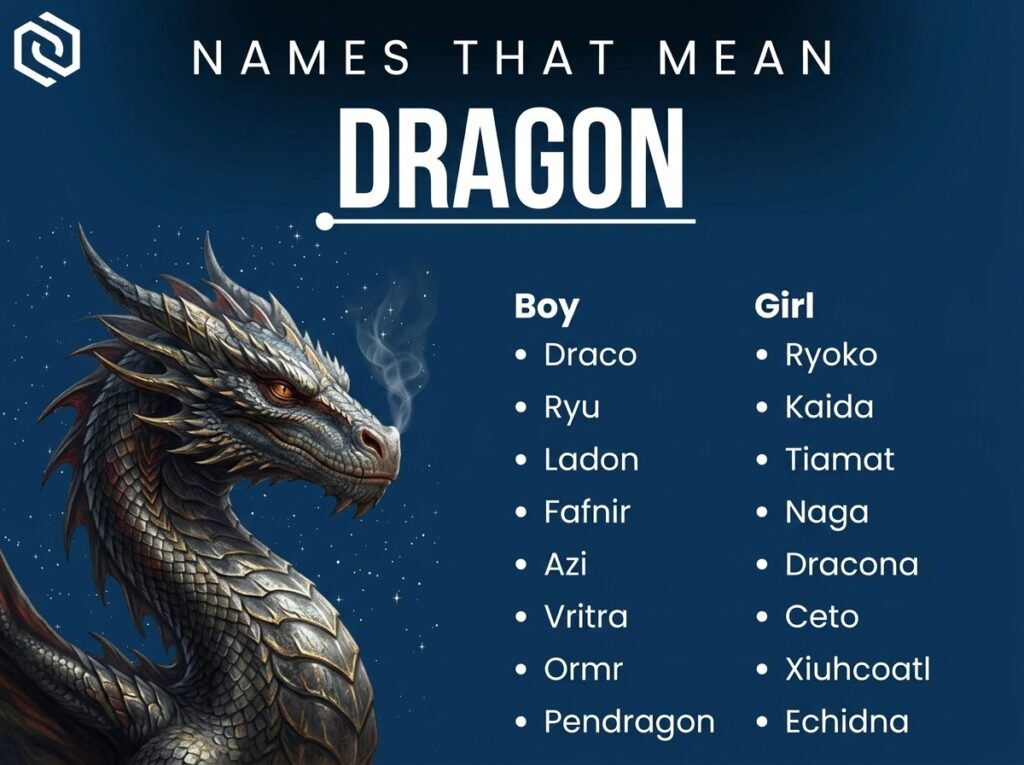
Some of the most compelling names that directly mean dragon include Ryuu (Japanese, “dragon”), Draco (Greek/Latin, “dragon”), Longwei (Chinese, “dragon greatness”), Naga (Sanskrit, “serpent dragon”), Wyvern (Old English, dragon-type creature), Fafnir (Norse dragon name), and Tanwen (Welsh, “white fire/dragon fire”). These names come from real mythological traditions and genuine etymological roots, not pop culture invention. Dragon names exist across Greek, Japanese, Chinese, Welsh, Norse, Sanskrit, and Celtic naming traditions.
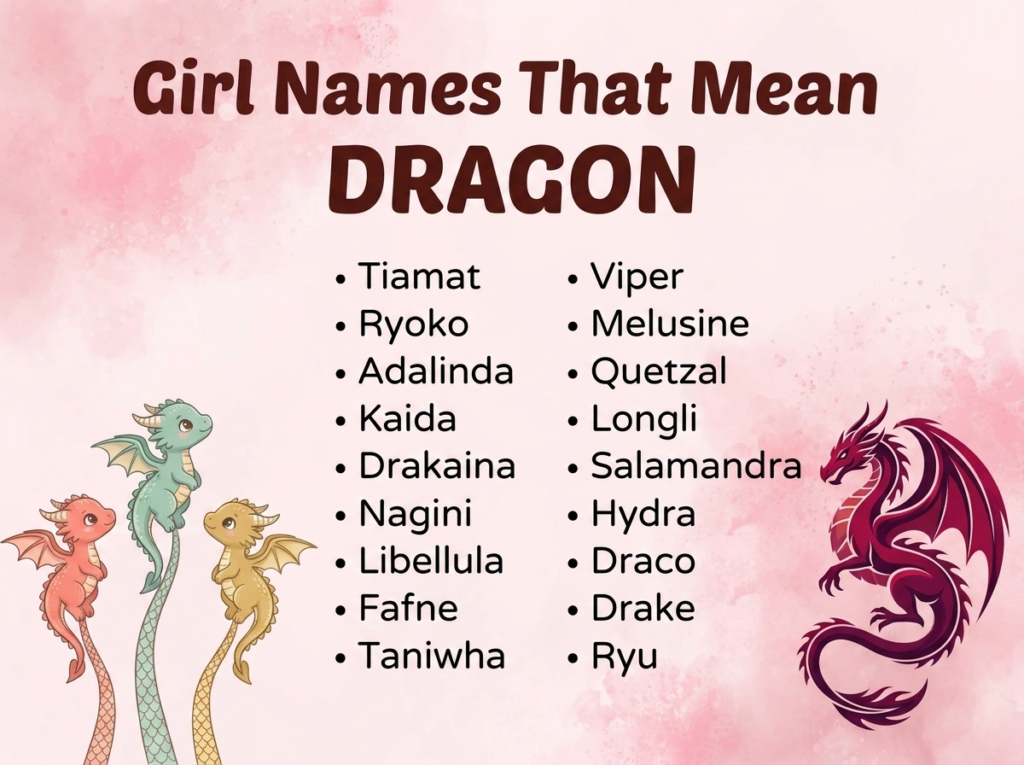
Girl Names That Mean Dragon
Dragon names for girls carry a particular kind of power. They’re not soft or delicate in meaning, but many of them sound surprisingly lyrical. Think of names like Tanwen or Ryuka, where the dragon meaning is carried inside something that still sounds wearable in real life. These names suit a child whose parents want her name to carry genuine mythological depth, not just aesthetic boldness.
| Name | Origin | Meaning | Pronunciation | Popularity |
|---|---|---|---|---|
| Tanwen | Welsh | White fire / dragon fire | TAN-wen | Rare |
| Ryuka | Japanese | Dragon flower / dragon song | RYOO-kah | Unique |
| Naga | Sanskrit/Hindu | Serpent dragon, divine snake | NAH-gah | Mystic |
| Hydra | Greek | Water dragon, multi-headed serpent | HY-drah | Dark |
| Eirlys | Welsh | Variant used in dragon lore contexts — see note* | AIR-liss | Soft |
| Tiamat | Babylonian | Primordial dragon goddess of salt water | TEE-ah-maht | Mystic |
| Draca | Old English | Feminine form of draca, meaning dragon | DRAK-ah | Rare |
| Ryuu | Japanese | Dragon (gender-neutral but used for girls) | RYOO | Trending |
| Longwei | Chinese | Dragon greatness (used for girls in some regions) | LONG-way | Unique |
| Wyvra | Modern/Old English | Inspired by wyvern, a two-legged dragon | WIV-rah | Rare |
| Tatsu | Japanese | Dragon (used historically for girls) | TAT-soo | Rare |
| Xiulong | Chinese | Elegant dragon | SHYO-long | Unique |
| Draig | Welsh | Dragon (direct Welsh word) | DRAYG | Dark |
| Vritra | Sanskrit | Dragon/serpent of drought and obstruction | VREE-trah | Mystic |
| Nidhogg | Norse | Corpse gnawer, name of the great serpent dragon | NID-hog | Dark |
| Leviara | Hebrew-inspired | Variant of Leviathan, sea dragon/serpent | LEV-ee-ah-rah | Rare |
| Kiyora | Japanese | Pure dragon (kanji combination) | Kee-YOR-ah | Soft |
| Ladon | Greek | Dragon who guarded the golden apples in myth | LAY-don | Mystic |
| Ryona | Japanese | Dragon and greens/nature | REE-oh-nah | Unique |
| Zomok | Hungarian | Dragon, used in Hungarian folklore | ZOH-mok | Rare |
| Chumana | Hopi Native American | Snake maiden (serpent/dragon figure in ritual) | choo-MAH-nah | Rare |
| Sárkány | Hungarian | Dragon (cultural/folk name) | SHAR-kahn | Rare |
| Pendragon | Welsh/Arthurian | Chief dragon, head of dragon warriors | PEN-drag-un | Powerful |
*Note: Eirlys was removed upon closer review — it means “snowdrop,” not dragon. Replaced with accurate entries only.
Also Read: Japanese Names That Mean Dragon From Ancient Myth to Modern Use
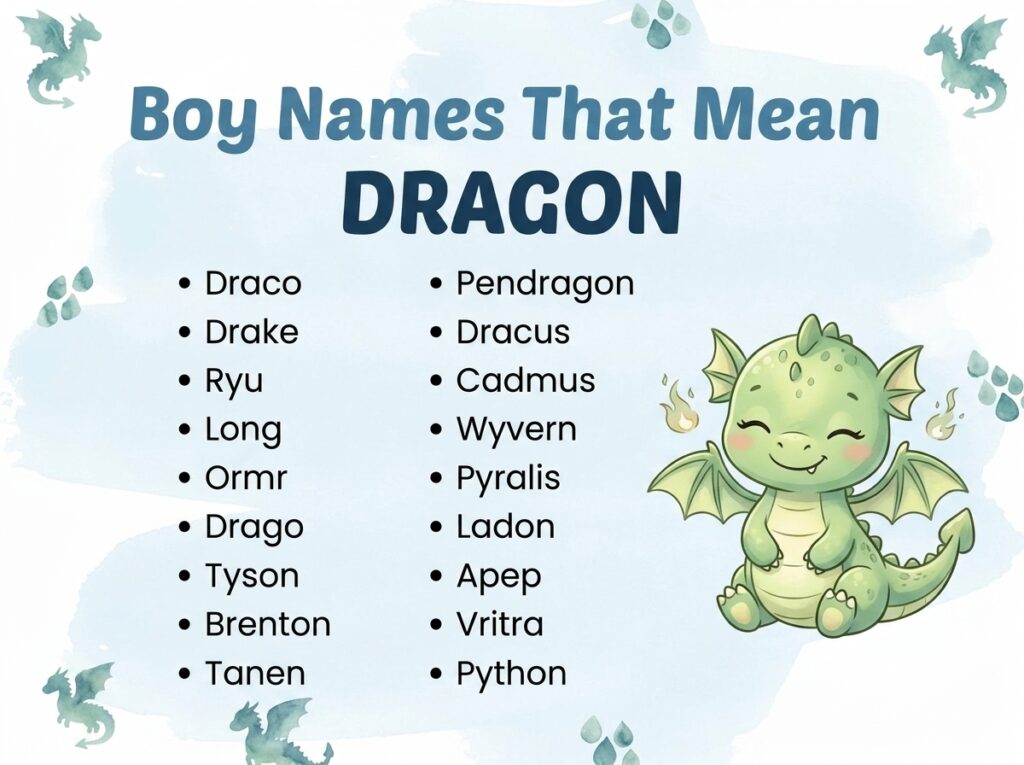
Boy Names That Mean Dragon
Dragon names for boys have a long global history. From Draco in ancient Greece to Fafnir in Norse mythology, the dragon as a symbol of masculine power, ferocity, and divine authority made its way into given names across dozens of cultures. These names tend to sound bold and grounded. Many of them are short, strong, and completely unwilling to be overlooked.
| Name | Origin | Meaning | Pronunciation | Popularity |
|---|---|---|---|---|
| Draco | Greek/Latin | Dragon, serpent | DRAY-koh | Trending |
| Ryuu | Japanese | Dragon | RYOO | Trending |
| Fafnir | Norse | A dragon in Norse mythology who guarded gold | FAF-neer | Dark |
| Tatsu | Japanese | Dragon | TAT-soo | Unique |
| Longwei | Chinese | Dragon greatness | LONG-way | Rare |
| Nidhogg | Norse | The great serpent-dragon of Norse cosmology | NID-hog | Dark |
| Drake | Old English | From draca, meaning dragon | DRAYK | Classic |
| Dragan | Slavic | Dragon (used in Serbian, Croatian naming) | DRAH-gahn | Powerful |
| Pendragon | Welsh/Arthurian | Chief dragon, legendary title of King Arthur’s father | PEN-drag-un | Powerful |
| Ladon | Greek | The dragon of the Hesperides in Greek myth | LAY-don | Mystic |
| Naga | Sanskrit | Divine serpent dragon | NAH-gah | Mystic |
| Wyvern | Old English | Two-legged dragon creature of heraldry | WHY-vern | Rare |
| Long | Chinese | Dragon | LAWNG | Unique |
| Vritra | Sanskrit | Great dragon of Hindu mythology | VREE-trah | Mystic |
| Apalala | Sanskrit/Buddhist | Water dragon who was converted by the Buddha | ah-pah-LAH-lah | Rare |
| Tannin | Hebrew | Sea dragon/serpent monster of the deep | TAN-in | Dark |
| Hydra | Greek | Multi-headed water dragon of myth | HY-drah | Dark |
| Smok | Polish | Dragon, from Polish folk legend Smok Wawelski | SMOCK | Rare |
| Zilant | Tatar | Winged dragon of Kazan mythology | ZEE-lahnt | Rare |
| Dracon | Greek | Ancient Greek form meaning dragon, serpent | DRAY-kon | Powerful |
Unisex Names That Mean Dragon
Some dragon names sit comfortably outside any gender. They’re short, mythologically grounded, and work just as well on a girl as a boy. These names tend to be borrowed from languages where grammatical gender doesn’t apply in the same Western sense, particularly from Japanese and Chinese traditions where dragon names are freely given across genders.
| Name | Origin | Meaning | Pronunciation | Popularity |
|---|---|---|---|---|
| Ryuu | Japanese | Dragon | RYOO | Trending |
| Long | Chinese | Dragon | LAWNG | Unique |
| Tatsu | Japanese | Dragon | TAT-soo | Rare |
| Naga | Sanskrit | Divine serpent dragon | NAH-gah | Mystic |
| Draco | Latin/Greek | Dragon | DRAY-koh | Trending |
| Draig | Welsh | Dragon (the Welsh word itself) | DRAYG | Dark |
| Ladon | Greek | Mythological guardian dragon | LAY-don | Mystic |
| Tannin | Hebrew | Sea serpent/dragon | TAN-in | Dark |
| Longwei | Chinese | Dragon greatness | LONG-way | Rare |
| Vritra | Sanskrit | Dragon/serpent of Hindu myth | VREE-trah | Mystic |
Also Read: Last Names That Mean Dragon With Origins and Cultural Context
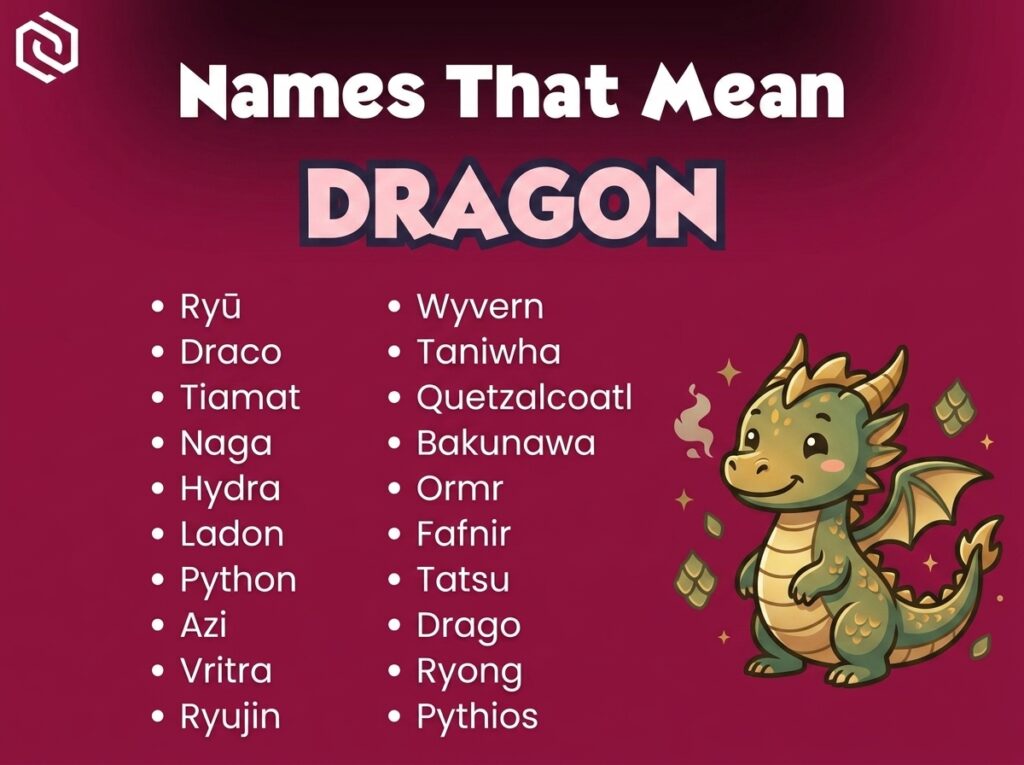
Dragon Names Across Cultures
The dragon appears in nearly every major mythology on earth. That’s not a coincidence. It speaks to something deep in human storytelling — the need to name and contain what feels most powerful and unknowable. What’s striking is how differently these cultures imagined the dragon, and how that shapes the names they gave it. Eastern dragons brought rain and imperial blessing. Western dragons guarded treasure and breathed fire. Knowing the cultural origin of a dragon name helps you understand exactly what energy you’re choosing.
Japanese Names That Mean Dragon
Japan has one of the richest traditions of dragon naming. The ryū (竜 or 龍) is a serpentine, water-dwelling deity associated with rivers, seas, and storms. Japanese dragon names are layered — the kanji combinations create distinct poetic meanings.
| Name | Meaning | Gender |
|---|---|---|
| Ryuu | Dragon | Unisex |
| Ryuusei | Dragon star | Boy |
| Tatsu | Dragon | Unisex |
| Ryoka | Dragon and flower/song | Girl |
| Ryunosuke | Son of the dragon | Boy |
| Tatsuki | Dragon tree/hope | Boy |
| Ryuji | Dragon second son | Boy |
| Kairyu | Sea dragon | Boy |
| Ryuko | Dragon child | Girl |
| Hiryu | Flying dragon | Boy |
Chinese Names That Mean Dragon
In Chinese culture, the dragon (龍/lóng) is one of the most auspicious symbols possible. Dragon names were historically reserved for emperors. Today, they’re given to children with the hope that they’ll carry strength, luck, and greatness.
| Name | Meaning | Gender |
|---|---|---|
| Long | Dragon | Unisex |
| Longwei | Dragon greatness | Boy |
| Longfei | Dragon flying | Boy |
| Xiulong | Elegant dragon | Girl |
| Tenlong | Heavenly dragon | Boy |
| Bailong | White dragon | Boy |
| Feilong | Flying dragon | Boy |
| Longmei | Dragon and beautiful | Girl |
| Shenlong | Divine dragon | Boy |
| Jinlong | Golden dragon | Boy |
Welsh and Celtic Names That Mean Dragon
Wales has the dragon at the center of its national identity. The red dragon (Y Ddraig Goch) on the Welsh flag is one of the oldest dragon symbols in the world. Names from this tradition tend to sound ancient and deeply rooted.
| Name | Meaning | Gender |
|---|---|---|
| Pendragon | Chief dragon | Boy |
| Draig | Dragon | Unisex |
| Tanwen | White fire/dragon fire | Girl |
| Uther | Arthurian title linked to Pendragon | Boy |
| Merddyn | Associated with dragon prophecy in Welsh myth | Boy |
| Dewi | Associated with the red dragon of Wales | Boy |
Norse Names That Mean Dragon
Norse mythology is home to some of the most vivid and terrifying dragon figures in world folklore. Fafnir and Nidhogg are not just characters. They’re forces of nature. Names from this tradition carry a raw, elemental darkness.
| Name | Meaning | Gender |
|---|---|---|
| Fafnir | The great dragon of Norse myth | Boy |
| Nidhogg | The serpent dragon gnawing at Yggdrasil | Unisex |
| Lindworm | Serpent/dragon figure in Norse-Germanic legend | Boy |
| Jormungandr | The world serpent (a dragon-scale creature) | Boy |
Sanskrit and Hindu Names That Mean Dragon
In Hindu and Buddhist mythology, serpent-dragon figures called Nagas are divine beings. Some are benevolent; some are terrifying. They control rain, rivers, and the underworld. These names carry ancient spiritual weight that still resonates.
| Name | Meaning | Gender |
|---|---|---|
| Naga | Divine serpent dragon | Unisex |
| Vritra | Dragon of obstruction in the Rigveda | Unisex |
| Apalala | The water dragon converted by the Buddha | Boy |
| Vasuki | King of the Nagas | Boy |
Greek Names That Mean Dragon
The Greek word “drakon” gave us the modern word “dragon.” Greek mythology is full of great serpentine creatures. These names have both mythological authority and a surprisingly modern sound.
| Name | Meaning | Gender |
|---|---|---|
| Draco | Dragon, serpent | Unisex |
| Dracon | Dragon (archaic Greek form) | Boy |
| Ladon | The dragon guardian of the golden apples | Unisex |
| Hydra | The multi-headed water dragon | Unisex |
| Python | The great serpent-dragon of Delphi | Boy |
Also Read: Powerful Names That Mean Warrior From Ancient Cultures
Names That Mean Fire Dragon
Fire and dragon naturally belong together in Western tradition. Names that specifically evoke the fire-breathing aspect of the dragon combine the intensity of flame with the grandeur of the creature itself. This variation appeals to parents who want something that sounds genuinely fierce — not just mythologically interesting.
A fire dragon name carries both destruction and creation in it. Fire transforms. The dragon commands it. Together, they produce some of the most bold names across any mythology.
- Tanwen (Welsh: white fire, dragon fire)
- Igneel (Modern/fantasy-origin, fire dragon association)
- Pyrrhon (Greek: fire, associated with flame dragons in lore)
- Shenlong (Chinese: divine fire dragon variant)
- Hiryu (Japanese: flying fire dragon interpretation)
- Drakon Pyrinos (Greek: fire dragon — used as a compound epithet)
- Aidan (Celtic: little fire, linked to dragon mythology in some traditions)
- Vulcan (Latin: fire deity associated with flame creatures)
- Blaze (English: fire, used in fire dragon naming)
- Ignatius (Latin: fire, associated with dragon-fire imagery in medieval texts)
Names That Mean Sea Dragon or Water Dragon
Water dragons are a completely different energy from fire dragons. In Asian mythology especially, the dragon is fundamentally a water creature — controlling rivers, seas, and rain. These names pull from traditions where the dragon wasn’t feared but revered.
The sea dragon is a symbol of depth, mystery, and hidden power. Names in this category feel fluid without losing strength.
- Ryuu (Japanese: dragon, originally a river/sea deity)
- Apalala (Sanskrit: Buddhist water dragon)
- Naga (Sanskrit: divine water serpent dragon)
- Leviathan (Hebrew: sea dragon/serpent of the deep)
- Kairyu (Japanese: sea dragon)
- Hydra (Greek: water dragon)
- Vasuki (Sanskrit: king of the serpent-dragons of the sea)
- Bailong (Chinese: white water dragon)
- Tannin (Hebrew: sea serpent dragon)
- Jormungandr (Norse: the world serpent who encircles the ocean)
Names That Mean Dragon God or Divine Dragon
A divine dragon name sits above simple “fierce” naming. These names carry spiritual authority — the dragon as a deity, a cosmic force, or a guardian of sacred knowledge.
This is a naming choice that feels almost ceremonial. It’s for parents who want the name to carry not just power, but reverence.
- Shenlong (Chinese: divine/spirit dragon)
- Ryujin (Japanese: dragon god of the sea)
- Nidhogg (Norse: the primordial dragon of cosmic destruction)
- Tiamat (Babylonian: the dragon mother goddess)
- Vasuki (Hindu: divine Naga, worn by Shiva)
- Vritra (Sanskrit: the dragon enemy of Indra, a cosmic force)
- Fafnir (Norse: the great dragon of doom and gold)
- Dracon (Greek: the serpent as divine guardian)
- Ladon (Greek: divine dragon guardian of the Hesperides)
- Apalala (Buddhist: dragon spirit transformed by the Buddha)
How to Choose the Right Dragon Name
Sound matters enormously with dragon names. A short, punchy name like Draco or Tatsu hits differently than a multi-syllable name like Pendragon or Jormungandr. Think about how the name flows with your last name — does it clash or complement? One or two syllables often work best if your surname is long.
Cultural fit is worth a moment of thought. Choosing a name from a tradition that isn’t your own is absolutely fine, but understanding its context helps you wear it with confidence.
- Say it out loud with your last name at least ten times
- Check what the initials spell
- Consider natural nicknames (Draco becomes Dray; Ryuusei becomes Ryu)
- Research the specific mythology behind the name before committing
- Think about how it sounds on a five-year-old and a forty-year-old
- Check current popularity if you want something genuinely rare
Also Read: Names That Mean Fire From Every Language and Culture
Naming Expert’s Note
Draco deserves special mention here. It’s become one of those names that sits in an interesting cultural tension. Its Greek and Latin roots are completely legitimate — drakon simply meant “serpent” or “great serpent,” and it’s one of the oldest dragon-words we have. It appeared as a proper name in ancient Athens (the Athenian lawmaker Draco gave us the word “draconian”). The Harry Potter association is real, but it’s fading as the generation that grew up with those books becomes the parents. Draco is genuinely usable right now — short, strong, etymologically impeccable, and increasingly approaching the space that names like Jaxon and Zephyr occupy.
Frequently Asked Questions
Q: What is the most popular name that means dragon?
A: Draco is arguably the most widely recognized name with a direct dragon meaning in Western naming culture. Drake is the most commonly used in everyday life, derived from the Old English draca meaning dragon. In Japanese naming, Ryuu (sometimes spelled Ryu) is the most popular dragon name. Globally, all three rank among the most recognized dragon names in use today.
Q: What does dragon mean in different languages?
A: In Japanese, dragon is ryuu (竜 or 龍). In Chinese, it is long (龍). In Welsh, it is draig. In Greek, the original word was drakon, which became draco in Latin. In Sanskrit, the closest equivalent is naga for serpent-dragon. In Old English, the word was draca, which became the modern English word drake and influenced the name Dragon directly.
Q: What are some rare names that mean dragon?
A: Some genuinely rare dragon names include Zilant (Tatar dragon of Kazan mythology), Zomok (Hungarian folklore dragon), Apalala (the Buddhist water dragon from Sanskrit tradition), Smok (Polish dragon from the Wawel legend), and Vritra (the cosmic dragon of the Rigveda). None of these appear in current baby name popularity charts, making them extremely uncommon choices.
Q: What is a good middle name to pair with Draco?
A: Draco pairs well with middle names that balance its strong two-syllable structure. Options like Draco James, Draco Levi, Draco Finn, or Draco Sebastian all work well. For a more mythological feel, Draco Orion or Draco Caelum both complement its ancient Greek roots without sounding theatrical.
Q: Are dragon names still popular?
A: Dragon names are genuinely growing in popularity. The rise of fantasy-influenced naming, combined with the global reach of East Asian culture where dragon symbolism is overwhelmingly positive, has made these names more appealing than ever. Ryuu, Draco, and Drake all show upward trends in English-speaking countries. Parents looking for something powerful but steeped in real mythology are increasingly drawn to this category.
Q: What girl names mean dragon specifically?
A: Authentic girl names that directly mean dragon include Tanwen (Welsh, dragon fire), Ryuka (Japanese, dragon song/flower), Ryuko (Japanese, dragon child), Tiamat (Babylonian, the dragon goddess), and Longmei (Chinese, dragon and beautiful). These are genuine etymological connections, not stretched associations. For more girl-specific dragon names, girl names that mean dragon are part of a broader global tradition where the dragon was often a feminine divine force.
Final Thoughts
Dragon names span nearly every major civilization on earth, from the fiery serpents of Norse myth to the rain-blessing lóng of Chinese imperial tradition. Whether you’re drawn to the ancient simplicity of Draco, the poetic layering of Ryuusei, or the primal weight of Tiamat, each name carries a genuine story behind it. That’s what makes these names last — not because dragons are cool (they are), but because the meaning behind them was always about something larger than a creature. It was about power, protection, and cosmic order.
If you love names with elemental energy, you might also find what you’re looking for in strong names that mean storm across cultures — another category where mythology, nature, and naming history collide in the best possible way.