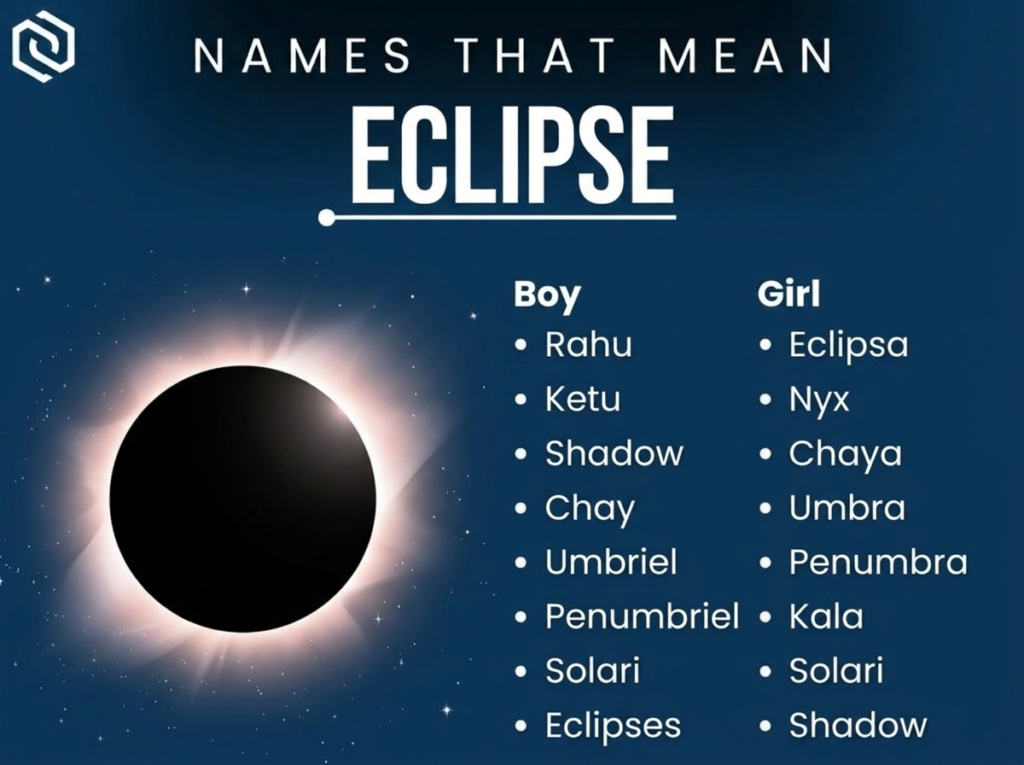
An eclipse is one of the most dramatic events the sky can produce. For a few breathtaking minutes, light is swallowed by shadow, the world goes quiet, and something ancient stirs. Ancient cultures didn’t just observe eclipses — they named their gods, demons, and mythological creatures after them. The word eclipse itself comes from the Greek ekleipsis, meaning “abandonment” or “a failing to appear.” That weight, that sense of something immense happening in the space between light and dark, is exactly what makes eclipse-inspired names so compelling.
Parents drawn to these names usually aren’t chasing trends. They want something with real depth behind it — names tied to mythology, to celestial events, to the kind of meaning that holds up across a lifetime. Names connected to eclipses often carry undertones of mystery, transformation, and the rare. They sit at the edge of light and darkness without fully belonging to either.
What are some names that mean eclipse?
Some of the strongest names meaning eclipse or directly tied to eclipse mythology include Rahuketu (Vedic demon who causes eclipses), Ketu (the shadow-body in Hindu astronomy that causes lunar eclipses), Rahu (the eclipse-causing demon of Vedic tradition), Apep (the Egyptian serpent who tried to swallow the sun), Tsukuyomi (Japanese moon god), Chandra (Sanskrit for moon, linked to lunar eclipse lore), Ekleipsis (Greek word-name meaning eclipse itself), and Nibiru (Babylonian planet associated with celestial crossing). These names span Vedic, Egyptian, Greek, Japanese, and Babylonian traditions.
Girl Names That Mean Eclipse
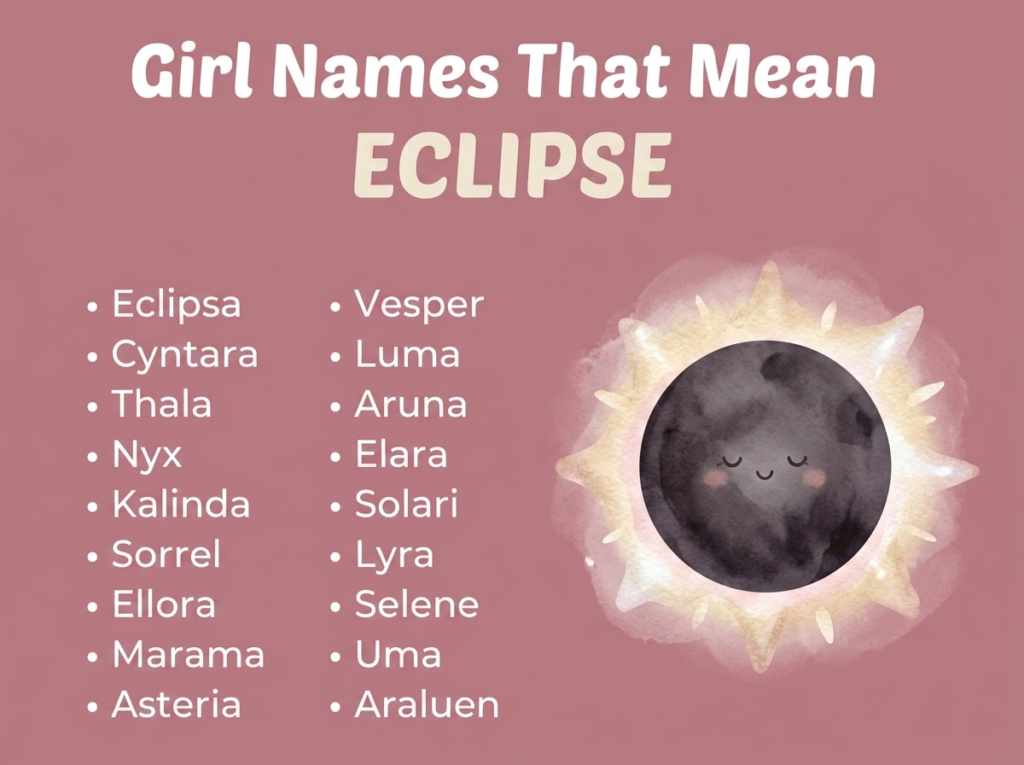
Eclipse-tied names for girls tend to carry a rare, otherworldly quality. They feel dramatic without being heavy-handed — names that would belong equally on a quiet scholar or a mythological figure painted on a cave wall. Many come from traditions where the eclipse was feminine and fearsome, a goddess swallowing the sun or a celestial force demanding respect.
| Name | Origin | Meaning | Pronunciation | Popularity |
|---|---|---|---|---|
| Ekleipsis | Greek | Eclipse; literally “a failing to appear” | ek-LIP-sis | Unique |
| Surya | Sanskrit | The sun, central to solar eclipse lore | SOOR-yah | Mystic |
| Rahu | Vedic/Sanskrit | The demon who causes solar eclipses by swallowing the sun | RAH-hoo | Dark |
| Chandra | Sanskrit | Moon; directly tied to lunar eclipse mythology | CHAHN-dra | Classic |
| Apep | Egyptian | The serpent who attempted to devour the sun, causing eclipses | AH-pep | Rare |
| Skadi | Norse | Goddess of darkness and shadow, associated with solar dimming | SKAH-dee | Unique |
| Nyx | Greek | Goddess of night whose passage was linked to solar blackout events | NIKS | Trending |
| Morrighan | Celtic/Irish | Dark goddess associated with shadow and battle; her presence dimmed the sky | MOR-ree-an | Mystic |
| Kali | Sanskrit | Goddess whose dark form devours light; linked to eclipse ritual | KAH-lee | Classic |
| Nephthys | Egyptian | Goddess of darkness and the transition between light and shadow | NEF-thees | Rare |
| Selene | Greek | Titan goddess of the moon, who moves to cause lunar eclipses | seh-LEE-nee | Trending |
| Erebus | Greek | Primordial deity of deep darkness; feminine form Ereba | EH-reh-bah | Dark |
| Umbra | Latin | The total shadow zone of a solar eclipse | UM-brah | Unique |
| Penumbra | Latin | The partial shadow region during an eclipse | peh-NUM-brah | Rare |
| Hecate | Greek | Goddess of liminal spaces, including the twilight of eclipses | HEK-ah-tee | Mystic |
| Laima | Baltic | Goddess of fate and fortune, linked to celestial omens including eclipses | LAY-mah | Rare |
| Ratri | Sanskrit | Goddess of night, invoked during eclipse rituals in Vedic texts | RAH-tree | Rare |
| Tamasa | Sanskrit | Darkness; the absence of light, as in an eclipse | tah-MAH-sah | Mystic |
| Chhaya | Sanskrit | Shadow; in Hindu myth, a figure who replaces Surya (the sun) | CHAH-yah | Soft |
| Aine | Irish/Celtic | Sun goddess whose light was said to vanish during eclipses | AW-nyeh | Rare |
Also Read: Names That Mean Shadow for Girls, Boys, and Every Culture
Boy Names That Mean Eclipse
Eclipse names for boys carry something unyielding. Many of the world’s mythological eclipse figures were male — the serpent that swallows the sun, the demon who disrupts celestial order, the god who stands at the threshold of light and dark. These names feel weighty and serious, the kind that a child grows into rather than out of.
| Name | Origin | Meaning | Pronunciation | Popularity |
|---|---|---|---|---|
| Rahu | Vedic/Sanskrit | Severed demon head that causes solar eclipses by swallowing the sun | RAH-hoo | Dark |
| Ketu | Vedic/Sanskrit | The shadow-body (tail of Rahu) that causes lunar eclipses in Hindu astronomy | KAY-too | Mystic |
| Apep | Egyptian | Serpent of chaos who tried to swallow Ra (the sun) during his nightly journey | AH-pep | Dark |
| Rangi | Māori | Sky god whose separation from earth was associated with darkness and eclipse | RAHN-gee | Unique |
| Nergal | Babylonian/Sumerian | God of the underworld and plague, invoked during solar eclipses | NER-gal | Rare |
| Tsukuyomi | Japanese | Moon god whose conflict with Amaterasu (the sun) caused day and night — and eclipses | tsoo-KOO-yoh-mee | Mystic |
| Nibiru | Babylonian | Celestial body of “crossing,” tied to planetary eclipse events | nee-BEE-roo | Rare |
| Mawu | West African (Fon) | Moon deity associated with cyclical darkness; Mawu-Lisa controls sun and moon | MAH-woo | Unique |
| Helios | Greek | Titan sun god whose absence during an eclipse the Greeks mourned | HEE-lee-os | Classic |
| Surya | Sanskrit | The solar deity around whom eclipse mythology is built in Hindu tradition | SOOR-yah | Mystic |
| Erebus | Greek | Primordial god of deep darkness; the shadow that precedes total eclipse | EH-reh-bus | Dark |
| Camazotz | Mayan | Bat deity associated with night, death, and the eclipse of the sun | kah-mah-SOTZ | Rare |
| Balor | Celtic/Irish | Cyclops-like figure whose one terrible eye could darken the world | BAH-lor | Dark |
| Fenrir | Norse | The wolf who swallows the sun at Ragnarök — the ultimate solar eclipse | FEN-reer | Powerful |
| Skoll | Norse | The wolf who chases the sun across the sky; catching it means total eclipse | SKOHL | Dark |
Unisex Names That Mean Eclipse
These names sit comfortably between genders. Some are abstract enough that they carry the concept of eclipse without being tied to one mythological figure. Others come from traditions that don’t assign rigid gender to celestial forces. They feel poetic and slightly unconventional — ideal if you want a name that truly stands apart.
| Name | Origin | Meaning | Pronunciation | Popularity |
|---|---|---|---|---|
| Umbra | Latin | The darkest part of a shadow, specifically the total shadow zone during a solar eclipse | UM-brah | Unique |
| Chandra | Sanskrit | Moon; lunar eclipse mythology runs through nearly every Hindu scripture | CHAHN-dra | Classic |
| Tamasa | Sanskrit | Darkness; the shadow that obliterates light | tah-MAH-sah | Mystic |
| Eclipse | English/Greek | Directly derived from Greek ekleipsis; usable as a given name | ee-KLIPS | Rare |
| Nyx | Greek | Goddess of night; her children include Darkness, Shadow, and Sleep | NIKS | Trending |
| Chhaya | Sanskrit | Shadow; the mythological “shadow woman” in Hindu texts linked to solar events | CHAH-yah | Soft |
| Aphelion | Greek/Astronomical | The point farthest from the sun in a celestial orbit; used as a modern name concept | af-HEE-lee-on | Rare |
| Morrigan | Celtic/Irish | Dark deity whose presence was said to blot out light | MOR-ree-gan | Mystic |
| Ratri | Sanskrit | Night; invoked in Vedic eclipse prayers | RAH-tree | Rare |
| Skadi | Norse | A deity of shadow and winter darkness who dims the world | SKAH-dee | Unique |
Also Read: Names That Mean Night for Girls, Boys, and Unisex
Eclipse Names Across Cultures
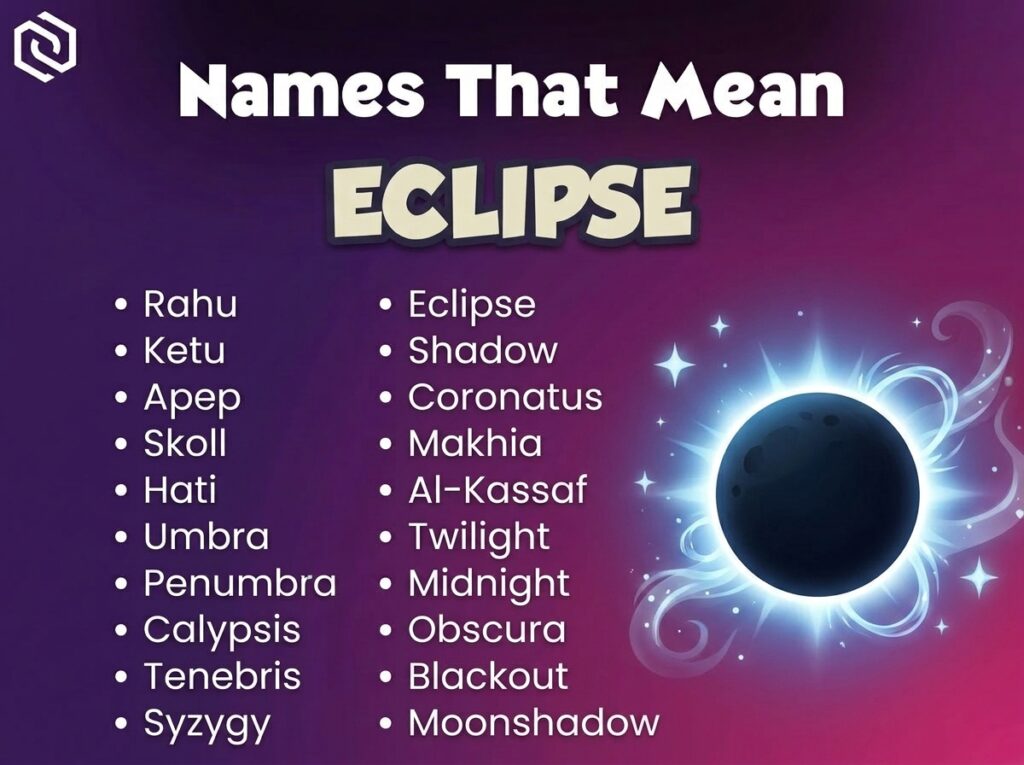
One of the most telling things about eclipses is how universally humanity feared and revered them. Almost every ancient culture developed a story to explain the moment the sun disappears. A dragon eating the sky. A demon swallowing the sun. Two lovers in conflict. The names born from those stories stretch across Sanskrit, Greek, Norse, Japanese, Mayan, and Egyptian traditions.
Sanskrit and Vedic Names Connected to Eclipses
In Vedic astronomy, the eclipse has two agents: Rahu and Ketu. These aren’t casual folk stories — they are embedded in Jyotisha (Vedic astrology) and remain culturally significant in South Asia today. The eclipse is the moment these shadow-bodies align with the sun or moon.
| Name | Meaning | Gender |
|---|---|---|
| Rahu | Seizing demon who swallows the sun | Boy |
| Ketu | Shadow-body causing lunar eclipses | Boy |
| Chandra | Moon; central to lunar eclipse events | Unisex |
| Tamasa | Primordial darkness | Unisex |
| Chhaya | Shadow; the duplicate form | Unisex |
| Ratri | Night goddess | Girl |
| Surya | The sun around which eclipses occur | Unisex |
| Kali | The dark goddess who swallows light | Girl |
Greek Names Rooted in Eclipse Mythology
The Greeks gave us the actual word eclipse, from ekleipsis (“abandonment”). Greek eclipse mythology is rich — from the wolf-like creatures said to chase the moon, to the gods of darkness whose shadow swept across the earth.
| Name | Meaning | Gender |
|---|---|---|
| Ekleipsis | Eclipse; abandonment of light | Girl |
| Nyx | Goddess of night | Unisex |
| Erebus | Primordial darkness | Boy |
| Selene | Moon goddess whose crossing causes eclipses | Girl |
| Hecate | Goddess of thresholds and liminal dark | Girl |
| Helios | Sun god whose absence IS the eclipse | Boy |
| Aphelion | The far point from the sun | Unisex |
Norse Names Associated with Solar Eclipse Events
In Norse mythology, eclipses weren’t caused by shadow-bodies — they were caused by wolves. Skoll chases the sun, and Hati chases the moon. The great fear was that one day, they would catch them. That day is Ragnarök. These names carry that wild, end-of-world energy.
| Name | Meaning | Gender |
|---|---|---|
| Skoll | The wolf that chases the sun | Boy |
| Hati | The wolf that chases the moon | Boy |
| Fenrir | The world-wolf who swallows the sun | Boy |
| Skadi | Goddess of shadow and winter | Unisex |
| Surtr | Fire giant who dims the sun at Ragnarök | Boy |
Japanese Names Tied to Eclipse Mythology
In Japanese Shinto tradition, the solar eclipse was explained through the conflict between Amaterasu (sun goddess) and Tsukuyomi (moon god). After Tsukuyomi killed the food goddess Ukemochi, Amaterasu declared she would never face him again — and so day and night were born. Their eternal separation created the cycle that makes eclipses possible.
| Name | Meaning | Gender |
|---|---|---|
| Tsukuyomi | Moon-reader; the moon god | Boy |
| Amaterasu | Heaven-illuminating; the sun goddess | Girl |
| Kageri | Shadowing, dimming of light | Girl |
| Kuroki | Black, dark | Boy |
| Yami | Darkness | Unisex |
Egyptian Names Rooted in Solar Eclipse Lore
In ancient Egypt, the serpent Apep (also called Apophis) lived in the underworld and attacked Ra’s solar barge every night. When Apep succeeded — even briefly — it caused an eclipse. Egyptian priests performed rituals daily to repel him. These names carry that ancient, ritualistic heaviness.
| Name | Meaning | Gender |
|---|---|---|
| Apep | The chaos serpent who swallows the sun | Boy/Unisex |
| Nephthys | Goddess of shadow and transition | Girl |
| Kuk | God of primordial darkness | Boy |
| Naunet | Goddess of the primordial void and deep dark | Girl |
Names That Mean Void, Shadow, and Illusion
Names That Mean Void
The void is what an eclipse briefly reveals — that total absence, that moment when even the sun can disappear. Void names feel profound rather than dark. They suggest depth, potential, the space before creation rather than the end of it. For parents who want a name that holds genuine philosophical weight, void names are worth considering.
- Khaos (Greek) — the primordial void from which all things came
- Nihil (Latin) — nothingness; the root of “nihilism”
- Abyss (Greek/English) — bottomless void; the formless deep
- Keku (Egyptian) — god of darkness and the primordial void
- Achlys (Greek) — goddess of the death-mist and the eternal void
- Inanity (Latin root) — emptiness, void; more of a concept name
- Erebus (Greek) — the void of deep darkness between the living world and the underworld
- Tiamat (Babylonian) — primordial chaos-goddess of the void before creation
- Kaos (Greek variant) — modernized form of Khaos
- Void (English) — rarely used but gaining traction in maximalist naming circles
Also Read: Names That Mean Void From Ancient Traditions
Names That Mean Illusion
An eclipse is one of nature’s great illusions — the sun doesn’t vanish, but it appears to. Illusion names feel otherworldly and slippery, names for children with imaginative, liminal personalities. Many come from Sanskrit and Japanese, two naming traditions that have long honored the philosophical concept of false appearance.
- Maya (Sanskrit) — illusion; the cosmic illusion of material reality in Hindu philosophy
- Māyā (Sanskrit) — specifically the divine illusion that veils true reality
- Mara (Sanskrit/Buddhist) — the demon of illusion and temptation in Buddhist tradition
- Phantasm (Greek root) — a ghost or illusory figure
- Indrajal (Sanskrit) — literally “Indra’s net”; a term for illusion and magic
- Moha (Sanskrit) — delusion, a form of illusion
- Phantom (Greek/French) — one who appears but is not fully real
- Eidolon (Greek) — a phantom image; an illusory double
- Genmu (Japanese) — phantom dream; illusion
- Genjitsu (Japanese) — contrasted with illusion; but Genmu is the illusion itself
Also Read: Names That Mean Illusion, Phantom, and False Light
Names That Mean Shadow
Shadow and eclipse are inseparable — a solar eclipse is, technically, the moon’s shadow falling on the earth. Shadow names have been rising steadily in naming culture because they carry depth without tipping into explicitly dark territory. They feel grounded and atmospheric.
- Chhaya (Sanskrit) — shadow; the mythological shadow-woman
- Umbra (Latin) — the total shadow cone of an eclipse
- Penumbra (Latin) — the partial shadow zone
- Sciath (Irish) — shadow, protection
- Erebus (Greek) — primordial shadow-darkness
- Skia (Greek) — shadow
- Kage (Japanese) — shadow
- Zill (Arabic) — shade, shadow
- Tamasis (Celtic river name, possibly shadow-rooted)
- Schattenreich (German) — realm of shadow (compound, unusual as a name but used in fiction)
How to Choose the Right Eclipse Name
Sound matters first. A name like Umbra feels spare and precise. A name like Ekleipsis feels ancient and weighty. Think about what you want the name to feel like when spoken aloud — quiet, dramatic, poetic, fierce. Try it with your last name. A short powerful name like Nyx pairs well with longer surnames. A longer name like Tsukuyomi may need a shorter surname to balance.
Cultural origin is worth thinking through carefully. Some of these names come from living religious traditions — Rahu and Ketu are still used in active Vedic astrology practice. If you’re outside those traditions, it’s worth doing extra research before using them for a child.
- Say the full name out loud, including the middle name
- Check what the initials spell
- Think about what nickname forms naturally from the name
- Research whether the name is still sacred in its culture of origin
- Consider whether the name works on a toddler and a 40-year-old equally
- Look up current popularity if you want something genuinely rare
Also Read: Names That Mean Mystery, Secrecy, and the Unknown
Naming Expert’s Note
Umbra is the most underused gem on this entire list. It’s a real Latin word — specifically the technical term for the total shadow cone during a solar eclipse. It’s clean, two syllables, and works beautifully on both a girl and a boy. It carries astronomical precision without feeling cold. And because most people only vaguely know the word, it lands as unusual without being unpronounceable. If you want a genuine eclipse name that doesn’t read as “trying too hard,” Umbra is the one to watch.
Frequently Asked Questions
Q: What is the most popular name that means eclipse?
A: Among names directly connected to eclipse mythology, Selene and Nyx are currently the most popular in Western naming circles. Selene (Greek moon goddess) has been rising steadily on baby name charts, and Nyx has crossed into mainstream use in the past decade. Rahu and Ketu remain culturally significant in South Asian communities.
Q: What does eclipse mean in different languages?
A: In Greek, eclipse comes from ekleipsis meaning “abandonment” or “a failing to appear.” In Sanskrit, a solar eclipse is Surya Grahan and a lunar eclipse is Chandra Grahan — both from the word grahan, meaning “to seize.” In Arabic, eclipse is kusuf (solar) or khusuf (lunar). In Japanese, a solar eclipse is nichi-shoku and a lunar eclipse is gek-shoku.
Q: What are some rare names that mean eclipse?
A: Some of the rarest genuine eclipse names include Ekleipsis (Greek), Nibiru (Babylonian), Camazotz (Mayan), Penumbra (Latin), and Naunet (Egyptian). These names have authentic etymological or mythological connections to eclipses but are almost never used as given names, which makes them genuinely distinctive.
Q: What is a good middle name to pair with Umbra?
A: Umbra pairs well with names that offer some warmth or softness to balance its austere quality. Umbra Celeste, Umbra Elowen, Umbra Serene, or Umbra Faye all work nicely. For a boy, Umbra Cael or Umbra Ryn keeps the atmospheric feel without becoming too heavy.
Q: Are eclipse names still popular in 2024 and 2025?
A: Eclipse-adjacent names are genuinely gaining ground. The 2024 total solar eclipse across North America sparked renewed interest in celestial naming. Nyx, Selene, and Umbra have all seen increased search traffic in naming communities. Rahu and Ketu remain culturally specific to South Asian communities but are seeing broader curiosity from parents interested in Sanskrit names.
Q: Is Eclipse itself usable as a baby name?
A: Eclipse is occasionally used as a given name and is arguably more usable today than it might have been a decade ago, given the trend toward bold, nature-concept names. It has no unpleasant associations, it’s easy to pronounce, and it carries obvious meaning. The main hesitation most naming experts raise is that it’s more of a word-name than a traditional given name — but for parents who want something unmistakably original, it works.
Conclusion
Eclipse names span an extraordinary range. From the Sanskrit shadow-bodies Rahu and Ketu to the Latin precision of Umbra, from the Norse wolves chasing the sun to the Egyptian chaos-serpent Apep — every culture that watched the sky created names for the moment light disappeared. That’s not coincidence. It says something about how deeply humans feel that particular event. Names rooted in eclipse mythology carry that ancient weight and that sense of standing at the edge of something immense. They’re names that last.
If you’re drawn to celestial darkness in naming, you might also love these rare and powerful names that mean shadow across world cultures or these haunting and beautiful names that mean night.