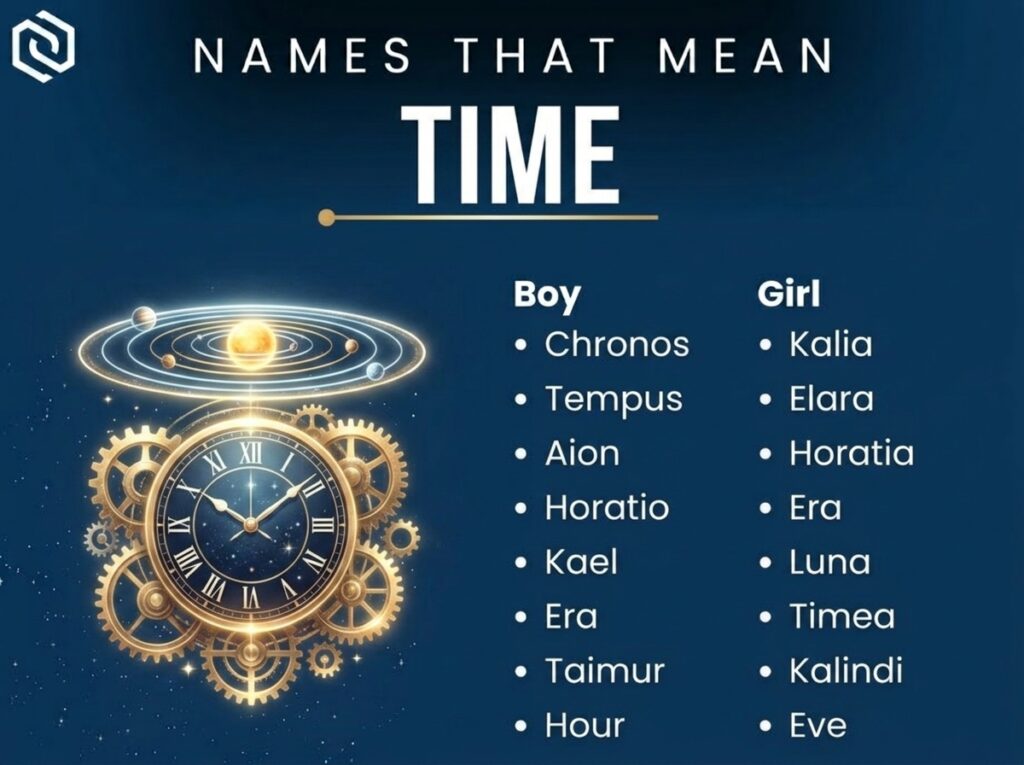
Time is one of the few concepts every human culture has tried to name, worship, and personify. Ancient Greeks gave time two distinct divine forms. Sanskrit scholars built an entire philosophical framework around its cycles. Norse, Japanese, and Arabic traditions all have their own ways of honoring the passage of hours, seasons, and ages. When you name a child after time, you’re connecting them to something genuinely universal, a thread that runs through every civilization that has ever existed.
Parents drawn to these names tend to be thinkers. They’re often drawn to depth over trend, and they want a name that carries real meaning rather than just a pleasing sound. Names that mean time carry a quiet authority. They feel grounded and weighty without being heavy. Whether you’re drawn to the mythological gravity of Kronos, the lyrical softness of Kalinda, or the rare beauty of Aiôn, there’s something here for every kind of family.
What Are Some Names That Mean Time?
Some of the strongest names that mean time come from mythology and ancient language roots. Kronos (Greek, god of time), Tempus (Latin, “time”), Kala (Sanskrit, “time” and “fate”), Aiôn (Greek, “eternity/age”), Zaman (Arabic, “time/era”), Saa (Swahili, “hour/time”), Kalinda (Sanskrit-rooted, linked to time and the sun’s path), and Era (Latin, “period of time”) are among the most direct options. These names don’t just gesture toward time — they genuinely embody it across languages and traditions.
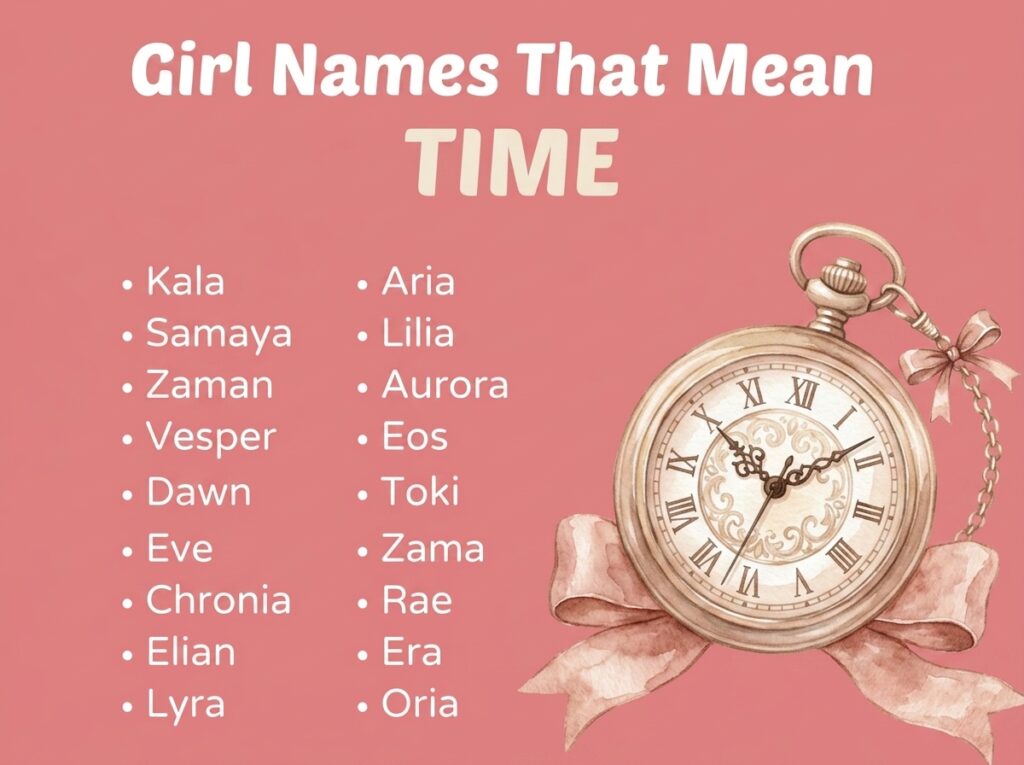
Girl Names That Mean Time
Feminine names connected to time are quietly rare, and that’s part of their appeal. They don’t appear on every trending list. They carry a layered, almost literary quality. Many of them come from Sanskrit, Greek, and Latin roots, where time was understood not just as a measurement, but as a sacred, cyclical force.
| Name | Origin | Meaning | Pronunciation | Popularity |
|---|---|---|---|---|
| Kala | Sanskrit | Time, fate, the right moment | KAH-lah | Classic |
| Kalinda | Sanskrit/Hindi | Related to time and the sun’s ordered path | kah-LIN-dah | Soft |
| Era | Latin | A period or age in time | EE-rah | Trending |
| Aion | Greek | Age, eternity, a span of time | AY-on | Mystic |
| Kalani | Hawaiian | The time of heaven (temporal heavenly cycle) | kah-LAH-nee | Trending |
| Temporina | Latin | Derived from “tempus” meaning time | tem-poh-REE-nah | Rare |
| Kalika | Sanskrit | Bud, related to Kali, goddess of time | kah-LEE-kah | Unique |
| Zamana | Arabic/Urdu | Era, period, the time of an age | zah-MAH-nah | Rare |
| Hora | Greek | Hour, season, the right time | HOR-ah | Soft |
| Horae | Greek | Goddesses of the seasons and time’s order | HOR-ay | Mystic |
| Saa | Swahili | Hour, unit of time | SAH | Unique |
| Kali | Sanskrit | She who is time; goddess of time and change | KAH-lee | Powerful |
| Devi Kala | Sanskrit | Divine time, feminine form of time’s force | DEH-vee KAH-lah | Rare |
| Templa | Latin | Derived from time’s sacred measurement | TEM-plah | Rare |
| Yuga | Sanskrit | An age or cycle of time (cosmic era) | YOO-gah | Mystic |
| Aiône | Greek (variant) | Eternal time, a long age | ay-OH-neh | Rare |
| Kairos | Greek | The opportune moment, the right time | KY-ros | Unique |
| Mahina | Hawaiian | Moon; used in the context of time-keeping cycles | mah-HEE-nah | Soft |
| Sezona | Slavic | Season, a division of time | seh-ZOH-nah | Rare |
| Waqta | Arabic (feminine variant) | Time, moment in time | WAHK-tah | Rare |
| Chronista | Greek-derived | Keeper of time, one who records time | kroh-NEES-tah | Unique |
| Vela | Latin | A time of watch, guard duty at a set hour | VEH-lah | Soft |
Naming Expert’s Note: Kali is one of the most misunderstood names on this list. In the West it often reads as a soft, friendly sound close to Callie. But in Sanskrit tradition, Kali is the goddess of time, destruction, and transformation — one of Hinduism’s most complex and powerful figures. If you love the name, it’s worth understanding that weight before you use it. It’s a name with genuine spiritual gravity, not just an aesthetic choice.
Also Read: Names That Mean Eternity — Timeless Picks With Ancient Roots
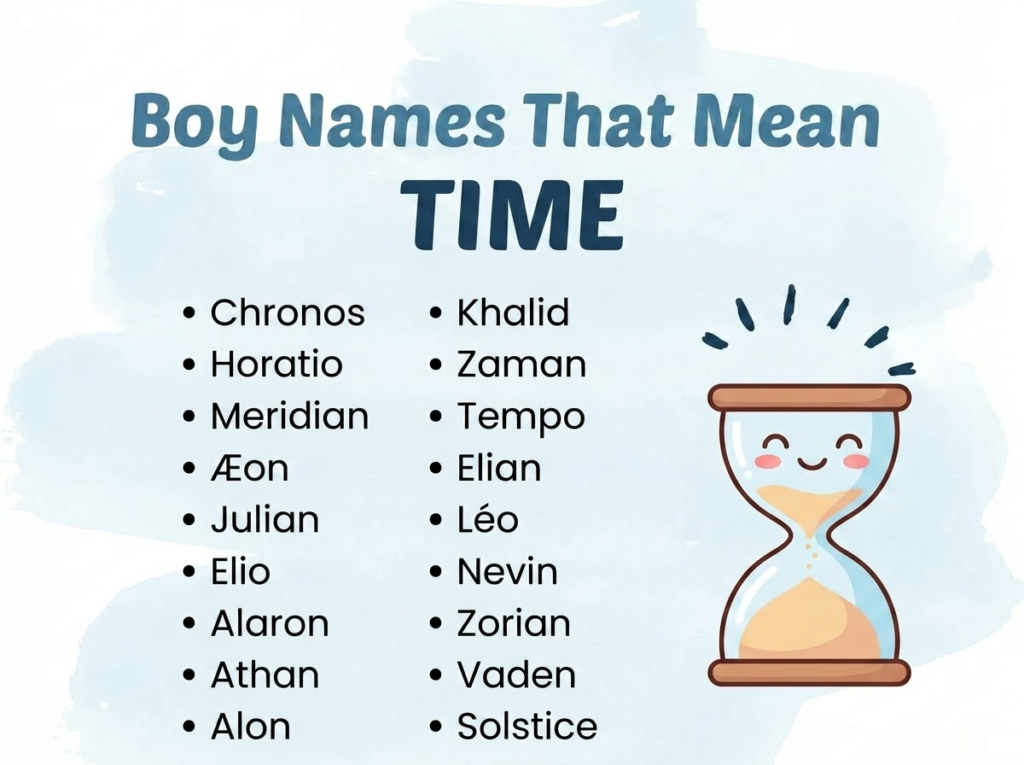
Boy Names That Mean Time
Names connected to time tend to sit especially well on boys. They carry a philosophical weight that feels natural alongside strong consonants and mythological heritage. Many of these come directly from ancient deity names or scholarly traditions where measuring and mastering time was considered a mark of wisdom.
| Name | Origin | Meaning | Pronunciation | Popularity |
|---|---|---|---|---|
| Kronos | Greek | God of time; father of Zeus | KROH-nos | Powerful |
| Tempus | Latin | Time itself; the Roman word for time | TEM-pus | Mystic |
| Kala | Sanskrit | Time, fate (also used for boys in Indian tradition) | KAH-lah | Classic |
| Zaman | Arabic | Time, era, an age or period | zah-MAHN | Classic |
| Aiôn | Greek | Eternal time, an age or eon | AY-on | Mystic |
| Kairos | Greek | The right moment, opportune time | KY-ros | Unique |
| Chronos | Greek | Personification of time; the primordial time deity | KROH-nos | Powerful |
| Waqt | Arabic | Time, a moment, a defined period | WAHKT | Rare |
| Yugas | Sanskrit | Great cosmic age or cycle of time | YOO-gahs | Mystic |
| Tempo | Italian/Latin | Time, the measure of time in music and language | TEM-poh | Unique |
| Kalan | Sanskrit-derived | Related to time and seasons | KAY-lan | Soft |
| Saat | Turkish | Hour, clock, a unit of time | SAHT | Rare |
| Aevum | Latin | An age, a lifetime, a span of time | EE-vum | Rare |
| Saeculum | Latin | An age, a generation, a long period of time | SAY-kyoo-lum | Rare |
| Hrōþ | Old Norse | Glory of the age; time-linked fame concept | HROTH | Dark |
| Calpa | Sanskrit | A cosmic time cycle (kalpa) | KAL-pah | Mystic |
| Zamani | Swahili | Time, the past era, a period | zah-MAH-nee | Unique |
| Aeternos | Latin | Eternal, everlasting, beyond time | ay-TER-nos | Rare |
| Hora | Greek | Hour, appointed time (used in ancient masculine context) | HOR-ah | Soft |
| Dahr | Arabic | A long stretch of time, the ages | DAHR | Dark |
Also Read: Names That Mean Destiny — Powerful Picks With Fate-Driven Meanings
Unisex Names That Mean Time
These names sit comfortably across genders. Some are short and modern-feeling. Others carry an ancient, almost ceremonial weight. What unites them is that their meaning genuinely points to time, not just to celestial beauty or seasonal imagery.
| Name | Origin | Meaning | Pronunciation | Popularity |
|---|---|---|---|---|
| Kairos | Greek | The perfect, opportune moment in time | KY-ros | Unique |
| Era | Latin | A defined period of time or age | EE-rah | Trending |
| Zaman | Arabic | Time, era, a period in history | zah-MAHN | Classic |
| Kala | Sanskrit | Time, fate, the passing of moments | KAH-lah | Classic |
| Aion | Greek | An age or eon; eternal time personified | AY-on | Mystic |
| Saa | Swahili | Hour, a unit of measured time | SAH | Rare |
| Tempo | Latin/Italian | Time as measure; pace of time | TEM-poh | Unique |
| Saat | Turkish | Hour, clock, measured time | SAHT | Rare |
| Hora | Greek | Hour, season, the appointed time | HOR-ah | Soft |
| Yuga | Sanskrit | A cosmic age or cycle of time | YOO-gah | Mystic |
Time Names Across Cultures
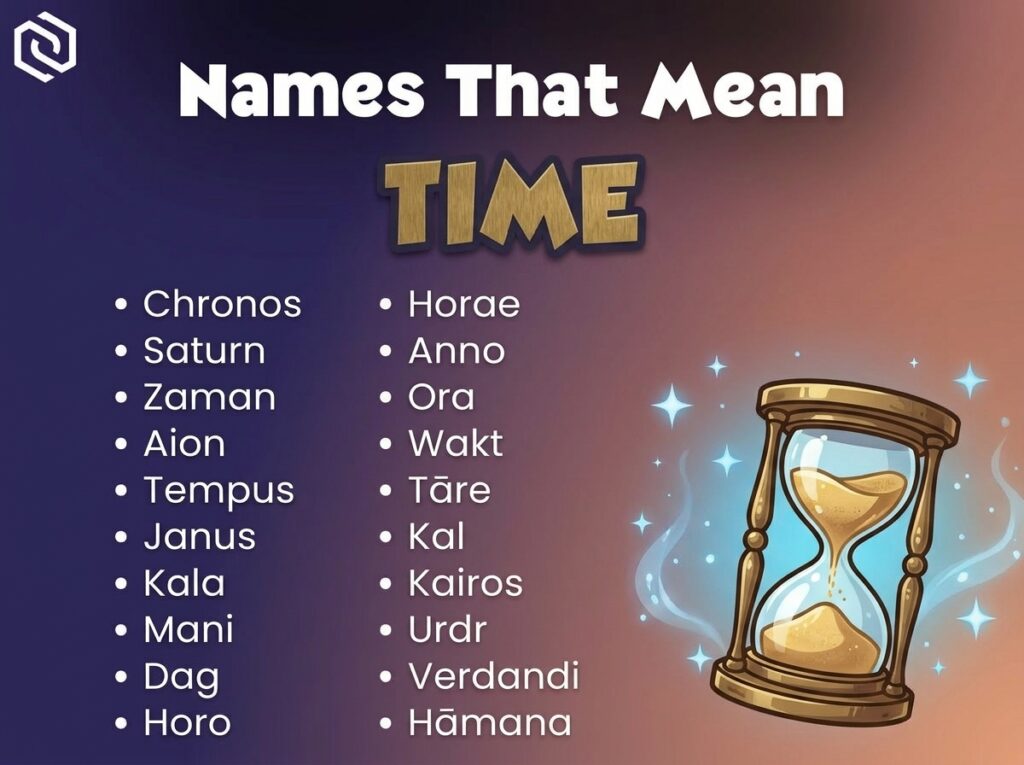
Time isn’t just a scientific measurement. It’s one of the oldest philosophical preoccupations of human civilization. Cultures across every continent have developed words, gods, and rituals around time’s passage. That’s why so many genuine names meaning time exist across languages that have no common ancestry.
Greek Names That Mean Time
Greek mythology gave time two completely separate divine identities: Chronos, the raw primordial force of time, and Kairos, the god of the perfect moment. These weren’t redundant figures. They represented two completely different relationships humans have with time.
| Name | Meaning | Gender |
|---|---|---|
| Chronos | Personification of time itself | Boy |
| Kronos | Titan ruler associated with time | Boy |
| Kairos | The opportune moment, right time | Unisex |
| Aiôn | Eternal time, an endless age | Unisex |
| Hora | Hour, the appointed season | Girl |
| Horae | Goddesses of seasons and time | Girl |
Sanskrit and Hindu Names That Mean Time
In Hindu philosophy, time isn’t linear. It’s cyclical, sacred, and deeply connected to divine forces. The Sanskrit word kala means both time and fate, showing how inseparable these two concepts were in ancient Indian thought. Kali, one of Hinduism’s most powerful goddesses, literally means “she who is time.”
| Name | Meaning | Gender |
|---|---|---|
| Kala | Time, fate, the right moment | Unisex |
| Kali | Goddess of time and transformation | Girl |
| Kalika | Bud; related to Kali, time’s goddess | Girl |
| Yuga | A cosmic age or cycle | Unisex |
| Calpa/Kalpa | A vast cosmic time cycle | Boy |
| Kalinda | Related to time and sun cycles | Girl |
Arabic Names That Mean Time
Arabic has a rich vocabulary for time. Words like zaman (era/time), waqt (a moment or set time), and dahr (the ages, a long stretch of time) all appear in classical Arabic literature and have been used as names across the Arab world and beyond.
| Name | Meaning | Gender |
|---|---|---|
| Zaman | Time, era, a historical period | Unisex |
| Zamana | An era or age in time | Girl |
| Waqt | A moment, defined time | Boy |
| Zamani | Time, the era (Swahili-Arabic root) | Boy |
| Dahr | The ages, a long span of time | Boy |
| Waqta | A moment in time (feminine variant) | Girl |
Latin Names That Mean Time
Latin gave the modern world its clearest vocabulary for time. Tempus (time), aevum (an age), and saeculum (a generation or era) were the building blocks of how Western civilization conceptualized chronological existence. These are rare as given names but historically significant and genuinely usable as distinctive choices.
| Name | Meaning | Gender |
|---|---|---|
| Tempus | Time itself | Boy |
| Aevum | An age, a lifetime | Boy |
| Era | A period or age | Girl/Unisex |
| Vela | A watch period, a set hour | Girl |
| Aeternos | Eternal, beyond time | Boy |
| Temporina | Derived from time | Girl |
Swahili and African Names That Mean Time
Swahili has direct, clear words for time that have crossed into naming tradition. Saa means hour, and Zamani refers to the past or an era, drawing from the Arabic root zaman.
| Name | Meaning | Gender |
|---|---|---|
| Saa | Hour, unit of time | Unisex |
| Zamani | Time, the past era | Boy |
| Wakati | Time (Swahili) | Unisex |
Also Read: Names That Mean Immortal — Ancient and Rare Picks That Defy Time
Names That Mean Timekeeper
Some names go a step beyond meaning time itself. They carry the specific sense of measuring, guarding, or keeping track of time. These are rare but genuinely well-sourced, coming from cultures where certain roles or deities were assigned the function of timekeeping.
What makes a timekeeper name different from a time name is agency. A timekeeper isn’t just time personified. A timekeeper is someone who watches, marks, and holds time accountable.
- Chronista (Greek-derived, feminine) — one who records time’s passage
- Hora (Greek) — the Horae were goddesses who marked the hours and kept the seasons in order
- Saat (Turkish) — directly means clock or the hour-keeper
- Horologios (Greek) — root meaning “one who tells the hour,” origin of the word horology (the study of timekeeping)
- Vela (Latin) — a watch or set period of guard; implies keeping time through the night hours
- Kairos (Greek) — the one who knows the right moment; a kind of intuitive timekeeper
- Kalpa (Sanskrit) — one who operates within and understands cosmic time cycles
- Templar (Latin-derived) — historically linked to time-marking through sacred ritual schedules
- Zamani (Swahili) — one who holds the memory of an era
- Chronos (Greek) — the original timekeeper of myth; the force that moves all things forward
Names That Mean Eternity or Endless Time
Eternity is time’s most extreme expression. These names don’t just mean time as a passing hour. They point to time without limit, time that transcends ordinary human experience. That’s a different feeling entirely, one that lends these names a mythological, almost sacred quality.
If you’re drawn to the concept of endlessness rather than just time’s passage, these names carry that weight more specifically.
- Aiôn (Greek) — literally the eternal age, time without end
- Aeternos (Latin) — eternal, everlasting, beyond time’s limits
- Aeon (English/Greek) — an immeasurably long period, used in science and philosophy
- Amaranth (Greek) — the unfading, the one that time cannot wither (figuratively linked to eternity)
- Ananta (Sanskrit) — infinite, endless, without temporal limit
- Nirvana (Sanskrit) — the state beyond cyclical time (samsara)
- Kalpa (Sanskrit) — one full cosmic age; nearly incomprehensible in length
- Sempiterna (Latin) — everlasting, perpetual
- Olam (Hebrew) — eternity, the world beyond time
- Viecny (Slavic) — eternal, the one who lasts through all ages
Also Read: Names That Mean Eternity — Ancient Picks With Timeless Meanings
Names That Mean Season or Time of Year
Seasons are the most human-scaled measurement of time. Every culture in the world has named its seasons and, in many traditions, those seasonal names became personal names too. These carry a warmer, more grounded feeling than mythological time names.
A name that means a specific season is still genuinely a time name. It just grounds that meaning in something tangible rather than philosophical.
- Haru (Japanese) — spring; a specific time of year with strong cultural resonance in Japan
- Natsu (Japanese) — summer; one of the most direct seasonal names in any language
- Fuyu (Japanese) — winter; sparse and striking as a name
- Vernal (Latin) — of or belonging to spring; the vernal equinox
- Sezona (Slavic) — season, a division of time
- Kharif (Arabic) — the autumn harvest season; used as a name in South Asian tradition
- Rabi (Arabic) — spring; used widely in Arabic and Urdu-speaking communities as a male name
- Hora (Greek) — the Horae personified the seasons as divine beings
- Primavera (Spanish/Italian) — springtime; used as a given name in Latin cultures
- Haruki (Japanese) — spring child; radiant spring
How to Choose the Right Time Name
Sound and length matter more than many parents expect. A long mythological name like Temporina or Chronista is striking on paper, but it has to work in everyday life, called across a playground, signed on a legal document, paired with a middle and last name. Shorter options like Era, Kala, or Saa carry the same meaning with far less friction.
Cultural fit is equally worth thinking through. Names like Kali, Kairos, or Zaman come from living traditions with real cultural significance. If the name doesn’t connect to your heritage, that’s not necessarily a barrier, but it’s worth understanding the cultural context before you commit.
- Say the name out loud with your last name at least ten times
- Check what the initials spell
- Think about natural nicknames — does Chronista become Chron? Is that what you want?
- Research the cultural and mythological origin; some names carry religious significance
- Consider how the name sounds on a child and also on a 40-year-old professional
- Check current popularity if rarity matters to you — most time names are genuinely uncommon
Frequently Asked Questions
Q: What is the most popular name that means time?
A: Kala (Sanskrit) and Zaman (Arabic) are the most widely used names that genuinely mean time. Kairos has gained noticeable traction in English-speaking countries recently, particularly among parents drawn to meaningful Greek mythology names. Era is also rising as a minimalist but meaningful choice in Europe and North America.
Q: What does “time” mean in different languages used as names?
A: In Greek, Chronos and Kairos are the key words. In Sanskrit, Kala means time and fate together. In Arabic, Zaman means era and Waqt means a defined moment. In Latin, Tempus means time itself. In Swahili, Saa means hour and Zamani means a past era. Each language reflects a slightly different cultural relationship with time’s meaning.
Q: What are some rare names that mean time?
A: Some of the rarest genuine time names include Aevum (Latin, “an age”), Temporina (Latin-derived, “of time”), Dahr (Arabic, “the ages”), Saat (Turkish, “hour/clock”), and Vela (Latin, “a watch period”). These are extremely uncommon as given names in English-speaking countries, which makes them distinctive choices for parents who want something truly rare.
Q: What is a good middle name to pair with Kairos?
A: Kairos pairs well with grounded, one or two-syllable middle names that balance its strong Greek sound. Options like Kairos James, Kairos Eliot, Kairos Lune, or Kairos Sage work well. For girls using Kairos, Kairos Mae or Kairos Wren feel balanced without competing with the first name’s weight.
Q: Are names that mean time still popular in 2024?
A: Most names that directly mean time remain genuinely rare in English-speaking countries, which is actually part of their appeal right now. Kairos has seen a measurable uptick as parents search for mythology-based names. Era is rising in Scandinavian countries. Kala and Zaman remain more common in communities connected to South Asian and Arabic-speaking traditions respectively.
Q: Is Chronos an acceptable given name today?
A: Chronos is unusual as a given name in modern Western contexts but not unheard of. It was primarily used in ancient Greek religious and philosophical writing rather than as a personal name for individuals. Today it works best for parents who want a bold, mythological choice. Kronos (the Titan spelling) carries the same etymology but even heavier mythological weight. Both are legitimate but carry significant associations that parents should consider carefully.
Conclusion
Names that mean time span some of the oldest languages on earth. From Greek mythology’s twin time deities to the Sanskrit concept of kala, from Arabic zaman to the quiet simplicity of Swahili saa, this is a category with genuine depth and remarkable variety across cultures. These names work because time is universal. Every parent understands what it means to feel like a name should last, that it should carry weight across a lifetime and still feel relevant decades from now.
If you’re exploring names with this kind of philosophical depth, you might also enjoy exploring names that mean destiny and fate from across world cultures, which share a similar ancient, elemental quality.