Fate is one of those concepts that humans have been wrestling with forever. Every culture has a word for it, a goddess for it, and a name that captures it. The idea that a life path is somehow woven before birth? That’s not just philosophy. It’s something parents feel when they hold their newborn for the first time.
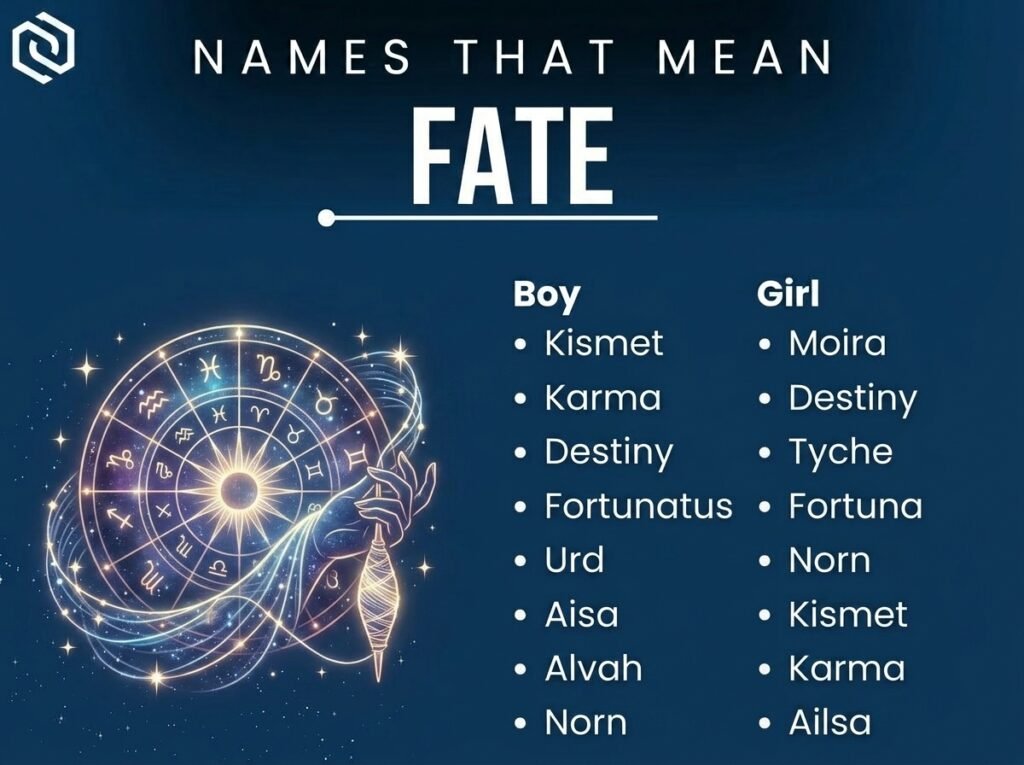
Names that mean fate carry genuine weight. They come from Greek mythology, Norse legend, Latin roots, Arabic poetry, and Japanese tradition. Whether you’re drawn to the mystical side of destiny or simply love how these names sound, you’re choosing something that means something real.
What Are Some Names That Mean Fate?
Some of the strongest names that mean fate include Moira (Greek, “fate” or “destiny”), Fatima (Arabic, rooted in the concept of fate and providence), Verdandi (Norse, one of the three Norns who weave fate), Atropos (Greek Fate goddess), Parca (Latin fate deity), Kismet (Turkish/Arabic, “fate” or “lot”), and Urdr (Old Norse, fate). These names come from living mythological traditions and accepted etymologies, making them genuinely meaningful choices for a baby born into a story already beginning to unfold.
Also Read: Names That Mean Destiny: Powerful Choices Across Cultures
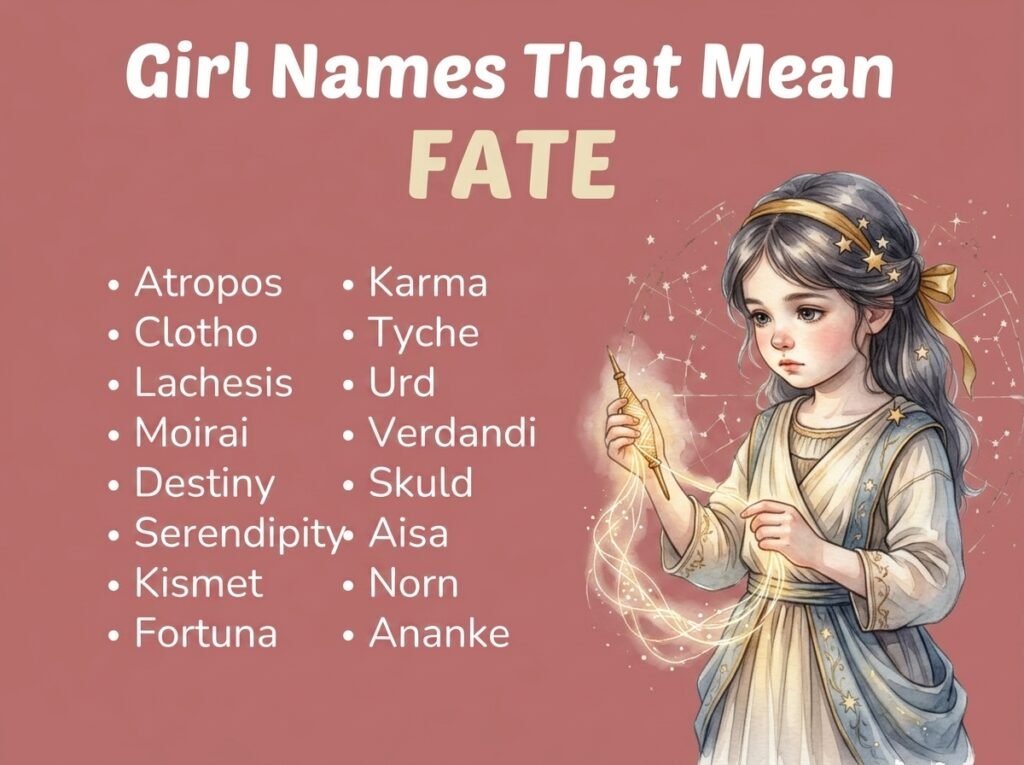
Girl Names That Mean Fate
Fate names for girls tend to carry a particular kind of gravitas. They feel ancient without being stuffy, mythological without being unpronounceable. Many of these names come directly from goddesses of fate in Greek, Norse, and Roman traditions, which gives them a depth that purely trend-driven names simply can’t match. If you want a name that feels chosen rather than picked, this list is a good place to start.
| Name | Origin | Meaning | Pronunciation | Popularity |
|---|---|---|---|---|
| Moira | Greek | “Fate,” “destiny,” or “share” | MOY-rah | Classic |
| Fatima | Arabic | One who abstains; associated with fate and divine providence | FAH-tee-mah | Trending |
| Verdandi | Norse | “That which is becoming”; one of the three Norns who weave fate | ver-DAHN-dee | Mystic |
| Atropos | Greek | “She who cannot be turned”; the Fate who cuts the thread of life | AH-troh-pos | Rare |
| Parca | Latin/Roman | Roman goddess of fate who measured the thread of life | PAR-kah | Rare |
| Decima | Latin/Roman | “The tenth”; Roman Fate who measured the thread of life | DEH-see-mah | Rare |
| Nona | Latin/Roman | Roman Fate who spun the thread of life | NOH-nah | Soft |
| Morta | Latin/Roman | Roman Fate who cut the thread; “death” and fate intertwined | MOR-tah | Dark |
| Clotho | Greek | “Spinner”; the Fate who spins the thread of life | KLOH-thoh | Mystic |
| Lachesis | Greek | “Allotter”; the Fate who measures the thread of life | LAK-eh-sis | Mystic |
| Urd | Norse | “Fate” or “what has become”; eldest of the three Norns | OORD | Powerful |
| Skuld | Norse | “What shall be”; youngest Norn goddess of fate | SKOOLD | Dark |
| Wyrd | Old English | “Fate” or “destiny” in Anglo-Saxon tradition | WEERD | Mystic |
| Kismet | Turkish/Arabic | “Fate,” “lot,” or “portion”; borrowed from Arabic qisma | KIZ-met | Trending |
| Tyche | Greek | Goddess of fortune and fate; “chance” or “luck” | TY-kee | Rare |
| Parcae | Latin | Collective name of the three Roman Fates | PAR-kay | Rare |
| Aisa | Greek | “Fate” or “destiny”; alternate name for Moira in early texts | AY-sah | Unique |
| Heimarmene | Greek | Philosophical term for fate as natural law; used as a name | hee-MAR-meh-nee | Rare |
| Adrasteia | Greek | “Inescapable fate”; a deity of divine retribution and fate | ah-dras-TAY-ah | Mystic |
| Porscia | Latin | Variant connected to Roman fate goddess tradition | POR-shee-ah | Rare |
| Destinée | French | Directly means “destiny” or “fate”; feminine French form | des-tee-NAY | Soft |
| Fatum | Latin | The root word for fate itself; used as a feminine given name in rare tradition | FAH-toom | Rare |
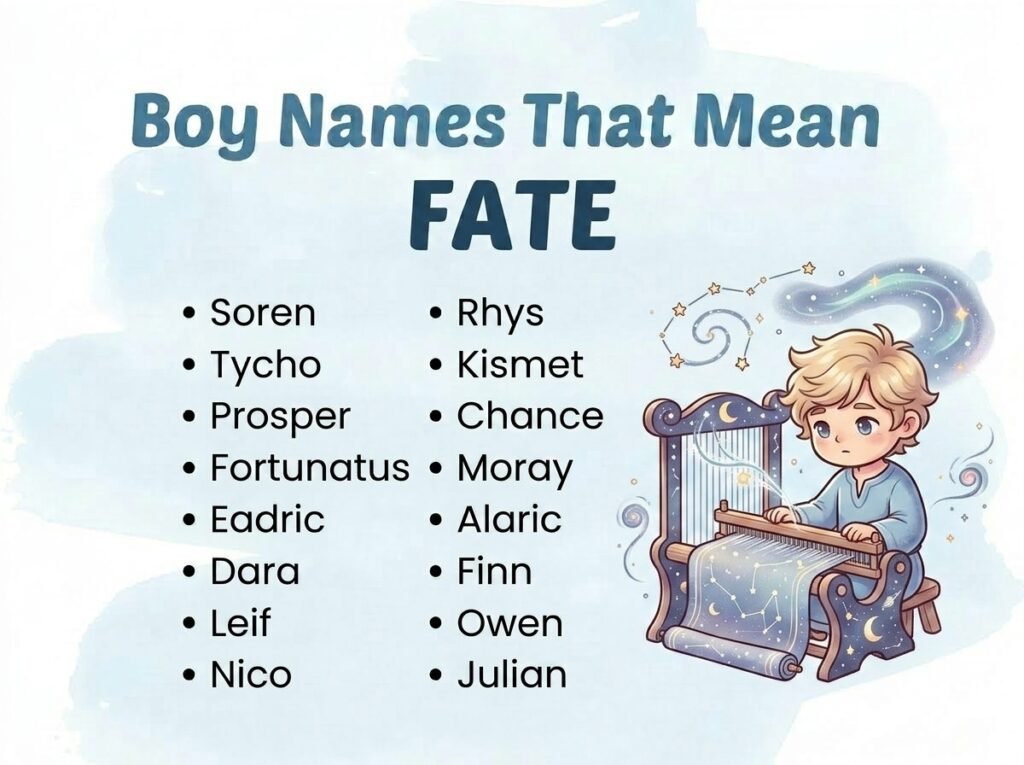
Boy Names That Mean Fate
Fate names for boys tend to feel bold and philosophical at the same time. They’re not soft names. They carry the weight of mythology, of ancient cultures that believed strongly in predestination and cosmic order. Many of these come from Norse, Greek, and Latin traditions where fate was never something to fear but something to be worthy of.
| Name | Origin | Meaning | Pronunciation | Popularity |
|---|---|---|---|---|
| Moros | Greek | “Doom” or “fate”; son of Nyx in Greek mythology | MOR-os | Dark |
| Terminus | Latin | Roman god of boundaries and fate of endings | TER-mih-nus | Rare |
| Fato | Latin/Italian | “Fate”; variant of the Latin fatum used in Italian tradition | FAH-toh | Unique |
| Ananke | Greek | Personification of necessity and fate (sometimes used for boys) | ah-NAHN-kee | Mystic |
| Wyrd | Old English | “Fate” in the Anglo-Saxon worldview; used for both genders | WEERD | Dark |
| Moiro | Greek | Masculine variant form connected to Moira, meaning fate | MOY-roh | Rare |
| Parcus | Latin | Masculine form connected to the Parcae; one who allots fate | PAR-kus | Rare |
| Norn | Norse | Referring to the Norns, the weavers of fate in Norse legend | NORN | Mystic |
| Kismet | Turkish/Arabic | “Fate” or “destiny”; used as a masculine name in Turkish tradition | KIZ-met | Trending |
| Fortis | Latin | “Strong fate” or “strong destiny”; connected to Fortuna tradition | FOR-tis | Powerful |
| Qismat | Arabic | “Fate” or “portion allotted by God”; used across South Asia and the Middle East | KIS-mat | Unique |
| Nasib | Arabic | “Fate,” “lot,” or “destiny”; widely used as a masculine name | nah-SEEB | Classic |
| Destino | Spanish/Italian | “Fate” or “destiny”; poetic masculine form | des-TEE-noh | Soft |
| Urðr | Old Norse | The eldest Norn whose name means “fate”; used historically for both genders | OOR-dur | Rare |
Unisex Names That Mean Fate
These names sit comfortably in the middle ground. They feel strong without being gendered, mythological without being inaccessible. Some come from languages where grammatical gender doesn’t map onto English naming conventions, making them genuinely neutral in modern use.
| Name | Origin | Meaning | Pronunciation | Popularity |
|---|---|---|---|---|
| Kismet | Turkish/Arabic | “Fate,” “lot,” or “portion”; widely used across genders | KIZ-met | Trending |
| Wyrd | Old English | Anglo-Saxon concept and word for fate | WEERD | Mystic |
| Nasib | Arabic | “Fate” or “destiny”; used for boys and girls in different regions | nah-SEEB | Unique |
| Destiny | English | Directly means “fate” or “one’s destined path” | DES-tih-nee | Classic |
| Qismat | Arabic/Urdu | “Fate” or “allotted share”; used across South Asia | KIS-mat | Rare |
| Fatum | Latin | The root word for fate; occasionally used as a name | FAH-toom | Rare |
| Tyche | Greek | Fortune and fate; increasingly used as a gender-neutral name in modern contexts | TY-kee | Mystic |
| Atë | Greek | Goddess of ruin and fate; short and sharp | AH-tay | Dark |
| Moirai | Greek | Collective name for the three Fates; used poetically | MOY-rye | Mystic |
| Anank | Greek | Short form of Ananke, the force of fate and necessity | AH-nank | Rare |
Also Read: Names That Mean Fortune: Lucky and Destiny-Filled Choices
The Cultural Roots of Fate Names
The concept of fate is so universal it appears in virtually every major naming tradition on earth. What’s fascinating is that cultures arrived at it independently, with their own imagery and their own deities. In Greece it was three women with thread. In Norse tradition, also three women. In Rome, also three. In Arabic, it came through the concept of divine portion. That parallel across cultures tells you something important: this meaning is ancient and deeply human.
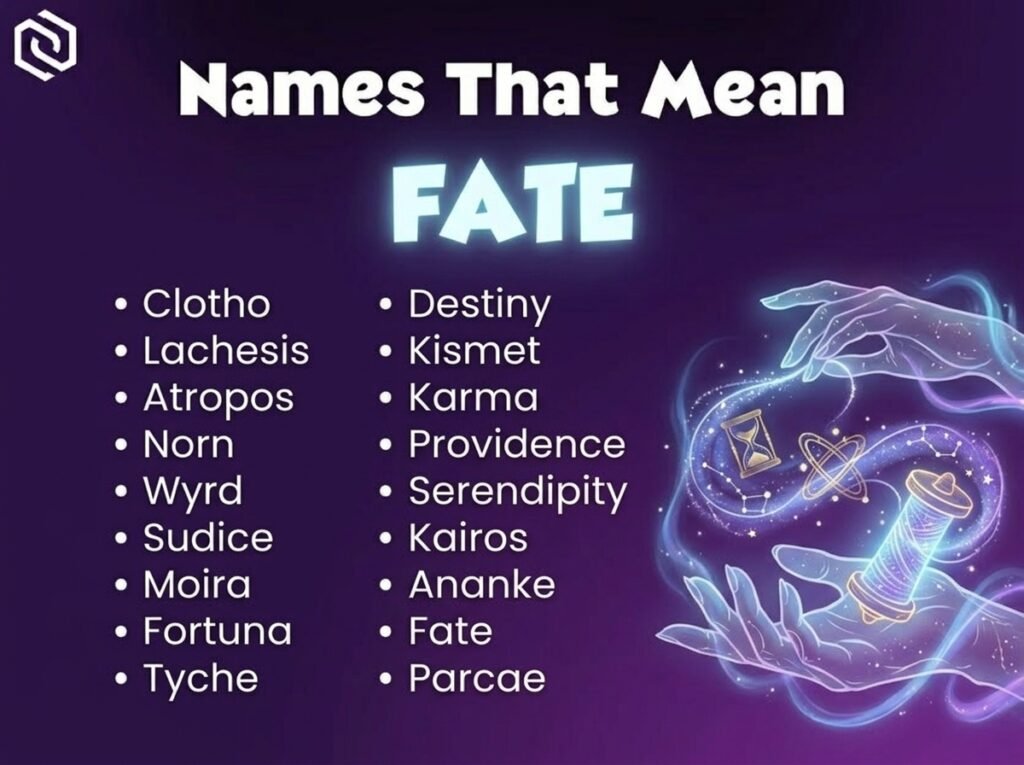
Greek Names That Mean Fate
Greek mythology gave us the Moirai, three goddesses who controlled the thread of every human life. Their names are among the most etymologically authentic fate names in existence.
| Name | Meaning | Gender |
|---|---|---|
| Moira | Fate, destiny, share | Girl |
| Clotho | Spinner of the life thread | Girl |
| Lachesis | Allotter of fate | Girl |
| Atropos | She who cannot be turned | Girl |
| Moros | Doom, fate | Boy |
| Tyche | Fortune and fate | Unisex |
| Aisa | Fate, destiny | Girl |
| Adrasteia | Inescapable fate | Girl |
| Ananke | Necessity, fate as cosmic force | Unisex |
| Atë | Goddess of ruin and fate | Girl |
Norse Names That Mean Fate
In Norse mythology, the Norns sat at the roots of Yggdrasil weaving the destinies of gods and mortals alike. Their names are among the oldest fate-names in any European tradition.
| Name | Meaning | Gender |
|---|---|---|
| Urd | What has become; fate | Girl |
| Verdandi | What is becoming | Girl |
| Skuld | What shall be; fate | Girl |
| Wyrd | Fate (Old English/Germanic root) | Unisex |
| Norn | Referring to the fate-weavers | Unisex |
| Urðr | Old Norse form of Urd; fate | Girl |
Latin and Roman Names That Mean Fate
Rome had its own trio of fate goddesses, the Parcae, and their names survive as some of the most historically grounded fate names in the Latin tradition.
| Name | Meaning | Gender |
|---|---|---|
| Nona | Roman Fate who spun life’s thread | Girl |
| Decima | Roman Fate who measured the thread | Girl |
| Morta | Roman Fate who cut the thread | Girl |
| Parca | Roman fate goddess | Girl |
| Fatum | Fate itself; the Latin root word | Unisex |
| Fortis | Strong fate; connected to the destiny tradition | Boy |
| Terminus | Fate of endings and boundaries | Boy |
Arabic Names That Mean Fate
In Arabic and Islamic tradition, fate is expressed through the concept of qisma or nasib, meaning the portion God has allotted to each person. These names are widely used across the Arab world, South Asia, and beyond.
| Name | Meaning | Gender |
|---|---|---|
| Nasib | Fate, destiny, one’s lot | Boy |
| Qismat | Fate, allotted share | Unisex |
| Kismet | Fate, lot (from Arabic qisma) | Unisex |
| Fatima | Associated with fate and divine providence | Girl |
| Naseeb | Fate, fortune allotted by God | Boy |
Turkish Names That Mean Fate
Turkish naming tradition absorbed the Arabic concept of kısmet directly, and it became one of the most emotionally resonant words for fate in any language.
| Name | Meaning | Gender |
|---|---|---|
| Kısmet | Fate, destiny, lot | Unisex |
| Nasip | Fate, divine portion (from Arabic via Turkish) | Boy |
| Alın yazısı | “Written on the forehead”; poetic phrase for fate, occasionally used as name element | Unisex |
Spanish and Italian Names That Mean Fate
Romance languages borrowed heavily from Latin, and the concept of fate survived through words like destino and fato.
| Name | Meaning | Gender |
|---|---|---|
| Destino | Fate, destiny | Boy |
| Destinée | Fate, destiny (French feminine) | Girl |
| Fato | Fate (Italian masculine form) | Boy |
Also Read: Names That Mean Lucky: Fortune-Filled Baby Names From Every Culture
Names That Mean Destiny, Fortune, and Doom
Names That Mean Destiny
Destiny is fate’s closest synonym in the English naming world. While “fate” tends to feel more cosmic and fixed, “destiny” carries a slightly more hopeful charge, the sense that something great is meant to happen. Both are rooted in the same idea, but the nuance matters to many parents.
- Destiny (English, “one’s destined path”)
- Destinée (French, “destiny”)
- Destino (Spanish/Italian, “destiny”)
- Nasib (Arabic, “destiny, lot”)
- Kismet (Turkish/Arabic, “destiny, fate”)
- Aisa (Greek, “destiny, fate”)
- Moira (Greek, “fate, destiny, share”)
- Tyche (Greek, “fortune, destiny”)
- Naseeb (Arabic, “destiny allotted by God”)
- Fatum (Latin, “fate, that which has been spoken”)
Names That Mean Fortune
Fortune sits at the intersection of fate and luck. These names carry the sense that one’s path is tied to something fortunate rather than merely predetermined.
- Tyche (Greek goddess of fortune and fate)
- Fortuna (Latin, Roman goddess of fortune)
- Fortis (Latin, “strong fortune”)
- Felicitas (Latin, “luck, fortune, fate”)
- Nasib (Arabic, “fortune allotted by God”)
Names That Mean Doom or Inevitable Fate
For parents drawn to the darker, more mythological side of fate, these names carry genuine weight. They’re not horror-movie names. They come from serious mythological traditions.
- Moros (Greek, “doom, fate”)
- Atropos (Greek, “the one who cannot be turned”)
- Morta (Roman, the Fate who cuts the thread)
- Skuld (Norse, fate of what shall be)
- Atë (Greek goddess of ruin and fate)
- Wyrd (Old English, the inescapable force of fate)
- Ananke (Greek, necessity and fate as cosmic law)
- Heimarmene (Greek philosophical fate)
- Adrasteia (Greek, inescapable fate)
- Fatum (Latin, fate as a force that has already spoken)
Naming Expert’s Note
Moira deserves special attention here. It’s etymologically airtight as a fate name, ranking among the most authentic on this entire list. But what makes it genuinely usable in modern life is the sound. Two syllables. Easy to spell. Comfortable in every English-speaking country and familiar in Irish naming tradition as well. It peaked mid-century in the English-speaking world, which means it’s now in that golden window where it feels vintage but not dated. If you want a fate name that works on a school roll call just as well as it works in mythology, Moira is the one.
How to Choose the Right Fate Name
Sound matters first. A beautiful meaning doesn’t help much if the name trips up every person you introduce your child to. Consider the length of your last name and whether a short or longer first name creates better flow. Moira paired with a long surname can feel rushed. Verdandi with a short surname feels balanced.
Cultural origin matters too, especially for names pulled from living traditions. Fatima is a deeply significant name in Islamic culture, and Nasib carries real meaning in Arabic-speaking communities.
- Say it out loud with your last name at least twenty times
- Check what the initials spell
- Think about the nickname that naturally shortens from it
- Research the mythological figure behind the name before committing
- Consider whether it sounds professional on an adult, not just sweet on a baby
- Check current popularity data if you prefer something less commonly heard
Frequently Asked Questions
Q: What is the most popular name that means fate?
A: Moira is consistently the most recognized and widely used name with a direct meaning of fate. It comes from the Greek moira, meaning “fate,” “share,” or “destiny,” and is familiar across Irish, Greek, and English-speaking naming cultures. Kismet has been growing in popularity as a more modern-feeling alternative.
Q: What does “fate” mean in different languages?
A: The concept of fate appears across languages with distinct words: Greek uses moira, Latin uses fatum, Arabic uses qisma or nasib, Old Norse uses urðr or wyrd, Turkish uses kısmet, and Spanish and Italian use destino and fato. Many of these have become actual given names across cultures.
Q: What are some rare names that mean fate?
A: Some genuinely rare fate names include Atropos (Greek), Heimarmene (Greek philosophical fate), Adrasteia (Greek inescapable fate), Verdandi (Norse), Skuld (Norse), and Decima (Roman). These are historically authentic but rarely used as given names today, which makes them distinctive choices.
Q: What is a good middle name to pair with Moira?
A: Moira pairs well with longer, flowing middle names that give it room to breathe. Options like Moira Celestine, Moira Eleanore, or Moira Isolde work beautifully. If you prefer something shorter, Moira Jane or Moira Claire keep it clean and classic.
Q: Are names that mean fate still popular today?
A: Yes, though their popularity varies by form. Destiny and Kismet are genuinely trending in English-speaking countries right now. Moira is seeing a quiet revival. The more mythological forms like Clotho, Atropos, or Verdandi remain rare, which is exactly why parents drawn to distinctive names are starting to notice them.
Q: Is Kismet a real name or just a word?
A: Kismet is both. It’s a real word meaning “fate” or “lot” in Turkish and Arabic, derived from the Arabic qisma. It has been used as an actual given name in Turkish culture for generations and has become increasingly used as a first name in English-speaking countries over the past decade. It reads as a genuine name, not an invented one.
Conclusion
Fate names reach across cultures and centuries without losing their meaning. Whether you’re drawn to the classical precision of Moira, the Norse weight of Verdandi, or the modern ease of Kismet, each of these names carries something real behind it. They’re not trend names. They’re names with roots. The reason fate names endure is simple: every parent who has ever looked at their newborn has felt, even briefly, that something bigger than chance brought this child to them.
If you love names with this kind of depth, you might also appreciate names that mean mystery across mythology and every language or names that mean time with ancient and modern roots.