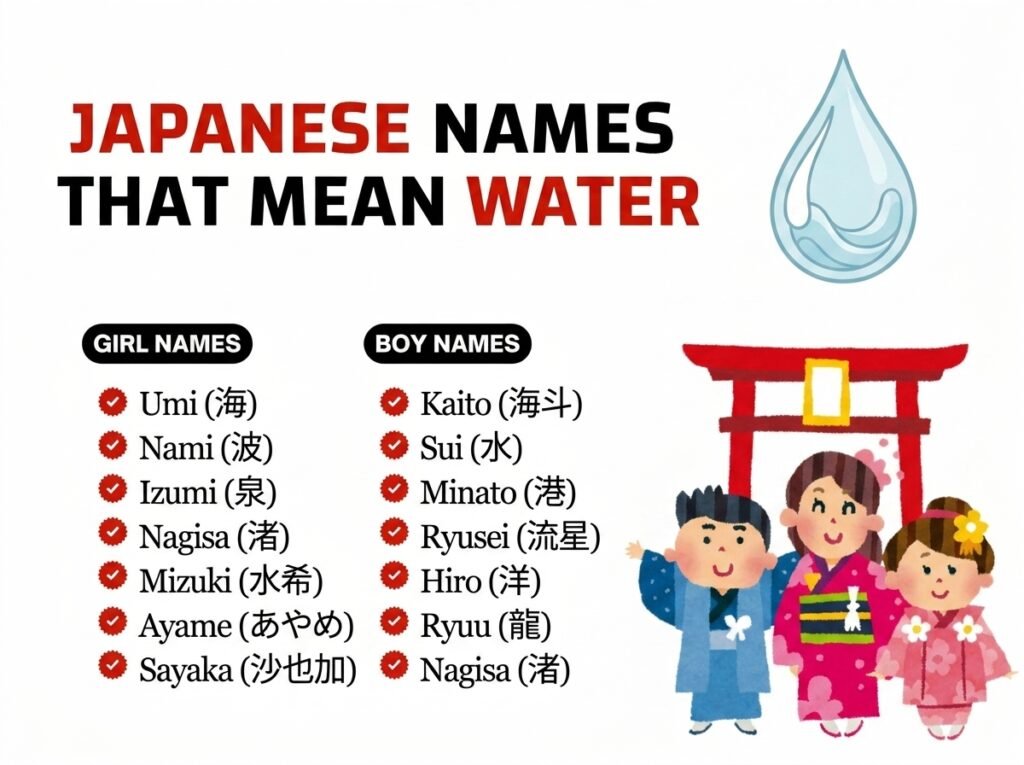
Water runs through Japanese culture in a way few other elements do. The islands are shaped by ocean currents, mountain springs, and seasonal rainfall, and the language carries that connection in its very structure. The kanji 水 (mizu) appears in hundreds of given names, each one shifting in meaning depending on the characters it pairs with.
Japanese parents often choose water names to express wishes for adaptability, quiet strength, or clarity. A name built around 海 (sea) feels open and bold. One rooted in 泉 (spring) suggests gentle renewal. The meaning changes with every kanji combination, which is what makes this naming tradition so deeply personal.
What are some Japanese names that mean water?
Some of the most popular Japanese names that mean water include Mio (waterway), Kai (sea), Izumi (spring), Nami (wave), and Minato (harbor). These names draw from kanji like 水 (mizu), 海 (umi), and 泉 (izumi), each capturing a different quality of water from quiet streams to the open ocean.
Japanese Girl Names That Mean Water
Japanese girl names connected to water often carry a sense of grace and movement. Many use kanji for waves, tides, and shorelines, giving them a rhythmic quality that sounds natural in both Japanese and English. These names range from short and modern to traditional and poetic, so there is something here for every naming style.
| Name | Origin | Meaning | Pronunciation | Popularity |
|---|---|---|---|---|
| Mio | Japanese | Waterway, channel | MEE-oh | Trending |
| Nami | Japanese | Wave | NAH-mee | Classic |
| Izumi | Japanese | Spring, fountain | ee-ZOO-mee | Classic |
| Umi | Japanese | Sea, ocean | OO-mee | Trending |
| Shizuku | Japanese | Water drop | shee-ZOO-koo | Rare |
| Nagisa | Japanese | Water’s edge, shore | nah-GEE-sah | Soft |
| Shio | Japanese | Evening tide | SHEE-oh | Unique |
| Taki | Japanese | Waterfall | TAH-kee | Rare |
| Sawa | Japanese | Mountain stream, marsh | SAH-wah | Rare |
| Sumi | Japanese | Clear, limpid water | SOO-mee | Classic |
| Mizuki | Japanese | Water and hope | mee-ZOO-kee | Trending |
| Umiko | Japanese | Child of the sea | oo-MEE-koh | Rare |
| Namiko | Japanese | Child of the wave | nah-MEE-koh | Classic |
| Sazanami | Japanese | Ripple, small waves | sah-ZAH-nah-mee | Mystic |
| Mizore | Japanese | Sleet, freezing rain | mee-ZOH-reh | Unique |
Naming Expert’s Note: Mio (澪) has become one of the most popular girl names in Japan over the last decade, and for good reason. It is short, easy to pronounce in almost any language, and the waterway meaning gives it a sense of direction and flow. If you want a Japanese water name that travels well outside Japan, Mio is a strong choice.
Japanese Boy Names That Mean Water
Water names for boys in Japanese tend to feel strong and expansive. Kanji like 海 (sea), 浩 (vast water), and 大河 (great river) give these names a bold, open quality that suits a child growing into adulthood. Many have been used for generations, while others like Kaito and Nagi have surged in popularity over the last decade.
| Name | Origin | Meaning | Pronunciation | Popularity |
|---|---|---|---|---|
| Kai | Japanese | Sea, ocean | KY | Trending |
| Hiro | Japanese | Vast water, expansive | HEE-roh | Classic |
| Wataru | Japanese | To ford, cross a river | wah-TAH-roo | Classic |
| Jun | Japanese | Pure, clear water | JOON | Classic |
| Minato | Japanese | Harbor, port | mee-NAH-toh | Trending |
| Ryū | Japanese | Flow, current | REE-yoo | Powerful |
| Kaito | Japanese | Sea and constellation | KY-toh | Trending |
| Taiga | Japanese | Great river | TY-gah | Powerful |
| Kiyoshi | Japanese | Clear, pure water | kee-YOH-shee | Classic |
| Yō | Japanese | Ocean, western sea | YOH | Rare |
| Sui | Japanese | Water | SOO-ee | Unique |
| Junpei | Japanese | Moisture and peace | joon-PAY | Soft |
| Nagi | Japanese | Calm sea, lull | NAH-gee | Trending |
| Hiroto | Japanese | Vast water and person | hee-ROH-toh | Classic |
| Kaiji | Japanese | Sea and governance | KY-jee | Rare |
Also Read: Beautiful Names That Mean Ocean From Every Culture
Unisex Japanese Names That Mean Water
Gender-neutral water names are growing in popularity across Japan, and many of the most natural choices come from single-kanji words tied to the sea, tides, and flowing water. These names read cleanly in Japanese and translate easily into English, making them practical for families living between cultures. Their meanings feel universal rather than gendered, which is part of their lasting appeal.
| Name | Origin | Meaning | Pronunciation | Popularity |
|---|---|---|---|---|
| Izumi | Japanese | Spring, fountain | ee-ZOO-mee | Classic |
| Nagi | Japanese | Calm sea, lull | NAH-gee | Soft |
| Ren | Japanese | Ripple on water | REN | Trending |
| Minato | Japanese | Harbor, port | mee-NAH-toh | Trending |
| Taki | Japanese | Waterfall | TAH-kee | Unique |
| Jun | Japanese | Moisture, pure water | JOON | Classic |
| Shio | Japanese | Tide | SHEE-oh | Unique |
| Sui | Japanese | Water | SOO-ee | Rare |
| Kai | Japanese | Sea, ocean | KY | Powerful |
| Mio | Japanese | Waterway, channel | MEE-oh | Soft |
The Cultural Roots of Japanese Water Names
Water holds a sacred place in Japanese spiritual life that goes far beyond the physical landscape. Shinto shrines are built near rivers and waterfalls, and purification rituals called misogi center on standing under flowing water to cleanse the spirit. This deep cultural bond explains why water kanji appear so frequently in Japanese given names across every region and historical era.
Names Rooted in 水 (Mizu) and Freshwater Kanji
The kanji 水 is the most direct water character in Japanese, and it combines with other characters to create names that reference springs, droplets, and clear streams. These names tend to feel gentle and introspective.
| Name | Meaning | Gender |
|---|---|---|
| Mizuki | Water and hope | Girl |
| Shizuku | Water drop | Girl |
| Sui | Water | Unisex |
| Sumi | Clear, limpid water | Girl |
Names Drawn from 海 (Umi) and the Sea
Ocean kanji produce some of the boldest Japanese water names. The character 海 appears in names that feel wide-open and adventurous, and it has become especially popular for boys born in coastal prefectures like Kanagawa and Shizuoka.
| Name | Meaning | Gender |
|---|---|---|
| Umi | Sea | Girl |
| Kai | Sea | Boy/Unisex |
| Kaito | Sea and constellation | Boy |
| Umiko | Child of the sea | Girl |
Water Names in Broader East Asian Tradition
Japanese water naming shares roots with Chinese and Korean traditions, where the same characters often carry similar meanings. The kanji 泉 (spring) and 海 (sea) are read differently in Mandarin and Korean but retain their water associations, which is why water names from other cultures often feel familiar to families with mixed East Asian heritage.
| Name | Meaning | Gender |
|---|---|---|
| Quán (Chinese) | Spring, fountain | Unisex |
| Hǎi (Chinese) | Sea, ocean | Boy |
| Su (Korean) | Water, excellence | Unisex |
| Bada (Korean) | Ocean, sea | Unisex |
Japanese Names That Mean Ocean, Rain, and River
Names That Mean Ocean
Ocean names in Japanese carry a sense of vastness and freedom that sets them apart from gentler freshwater names. The kanji 海 (umi) and 洋 (yō) are the most common ocean characters, and they produce names that feel bold and modern. These work especially well for families with a connection to the coast or the sea.
- Umi (sea)
- Kai (sea)
- Kaito (sea and constellation)
- Yō (ocean)
- Kaiji (sea and governance)
- Umiko (child of the sea)
- Hiro (vast water)
- Hiroto (vast water and person)
- Kaiyo (ocean expanse)
- Minato (harbor)
Names That Mean Rain
Rain names in Japanese are quieter and more atmospheric than ocean or river names. The kanji 雨 (ame) appears in names that feel poetic and seasonal, often referencing specific types of rainfall like spring showers or autumn drizzle. These are rarer as given names, which gives them a distinctive quality. You can also explore names that mean rain from other naming traditions if you want more options.
- Ame (rain)
- Ameko (rain child)
- Shigure (autumn shower)
- Hisame (cold rain)
- Harusame (spring rain)
- Samidare (early summer rain)
- Kosame (light rain)
- Amayo (rainy night)
- U (rain, literary)
- Amemi (rain beauty)
Names That Mean River
River names in Japanese draw from the kanji 川 (kawa) and 河 (ga/kawa), both meaning river or stream. These names tend to feel grounded and steady, evoking the image of water that moves forward with quiet persistence. They are more common in traditional naming but are seeing a revival among parents who want nature-connected names with substance.
- Taiga (great river)
- Ryū (flow, current)
- Kōta (river and strength)
- Kōhei (river and peace)
- Kōsuke (river and help)
- Kōki (river and hope)
- Kōji (river and governance)
- Kōichi (river and first)
- Kawanami (river wave)
- Sen (stream, current)
How to Choose the Right Japanese Water Name
Sound and flow matter more than most parents expect. A short name like Kai or Mio pairs easily with longer surnames, while a multi-syllable name like Shizuku or Sazanami needs a shorter last name to avoid feeling heavy. Say the full name out loud several times before deciding.
Cultural fit is equally important, especially if your family has Japanese heritage or you plan to use the name in a Japanese-speaking context. The kanji you choose will shape how the name is perceived in Japan, so research the specific characters before committing.
- Say the full name out loud with your last name
- Check the initials to avoid unintended combinations
- Think about natural nicknames your child might use
- Research the kanji and cultural origin before committing
- Consider how the name sounds on both a child and an adult
- Check current popularity if you want something less common
Frequently Asked Questions
Q: What is the most popular Japanese name that means water?
A: Kai (海), meaning “sea,” is currently one of the most popular Japanese names that mean water, especially for boys. For girls, Mio (澪), meaning “waterway,” has climbed the charts steadily over the past decade and is now a top choice in Japan.
Q: What does water mean in Japanese naming tradition?
A: In Japanese naming, water kanji like 水 (mizu), 海 (umi), and 泉 (izumi) symbolize purity, adaptability, and life force. Water is central to Shinto purification practices, so these names carry spiritual weight beyond their literal meanings.
Q: What are some rare Japanese water names?
A: Shizuku (water drop), Sazanami (ripple), and Mizore (sleet) are all rare Japanese water names that you will not hear often outside Japan. For boys, Sui (water) and Yō (ocean) are uncommon but carry strong, direct meanings.
Q: What is a good middle name to pair with Kai?
A: Kai pairs well with middle names that have two or three syllables to balance its short, punchy sound. Options like Kai Haruki, Kai Sōta, or Kai Ren flow naturally in both Japanese and English contexts.
Q: Are Japanese water names still popular?
A: Yes. Water names remain consistently popular in Japan because of their connection to nature and Shinto tradition. Names like Minato, Kaito, and Nagi have actually increased in popularity over the last five years, according to Japanese birth registry data.
Q: Can Japanese water names be used outside Japan?
A: Many Japanese water names work well internationally. Mio, Kai, Ren, and Nami are easy to pronounce in English, Spanish, and many other languages. Names with more complex sounds like Shizuku or Sazanami may require more explanation but are still usable.
Conclusion
Japanese water names span a wide range of sounds and meanings, from the single-syllable strength of Kai to the quiet poetry of Shizuku. Whether you are drawn to ocean kanji, river imagery, or the simplicity of 水 itself, these names carry centuries of cultural meaning that still feels fresh and relevant. Water names endure because they speak to something universal: the need for flow, clarity, and renewal. If you are exploring other elemental naming traditions, Japanese names that mean fire offer a striking contrast worth considering.


2 thoughts on “95+ Japanese Names Meaning Water (With Meanings)”