The concept of an angel arrived in Japan through Christian missionaries and Western literature, which means traditional Japanese naming culture doesn’t have ancient roots in this specific word. But that hasn’t stopped modern parents from creating beautiful names using kanji for heaven (天), messenger (使), and wing (翼). These combinations produce names that feel both distinctly Japanese and universally spiritual. If you want a name that carries the gentle, protective energy of an angel while honoring Japanese linguistic tradition, the options are smaller than you might expect but genuinely striking when you find them.
What are some Japanese names that mean angel?
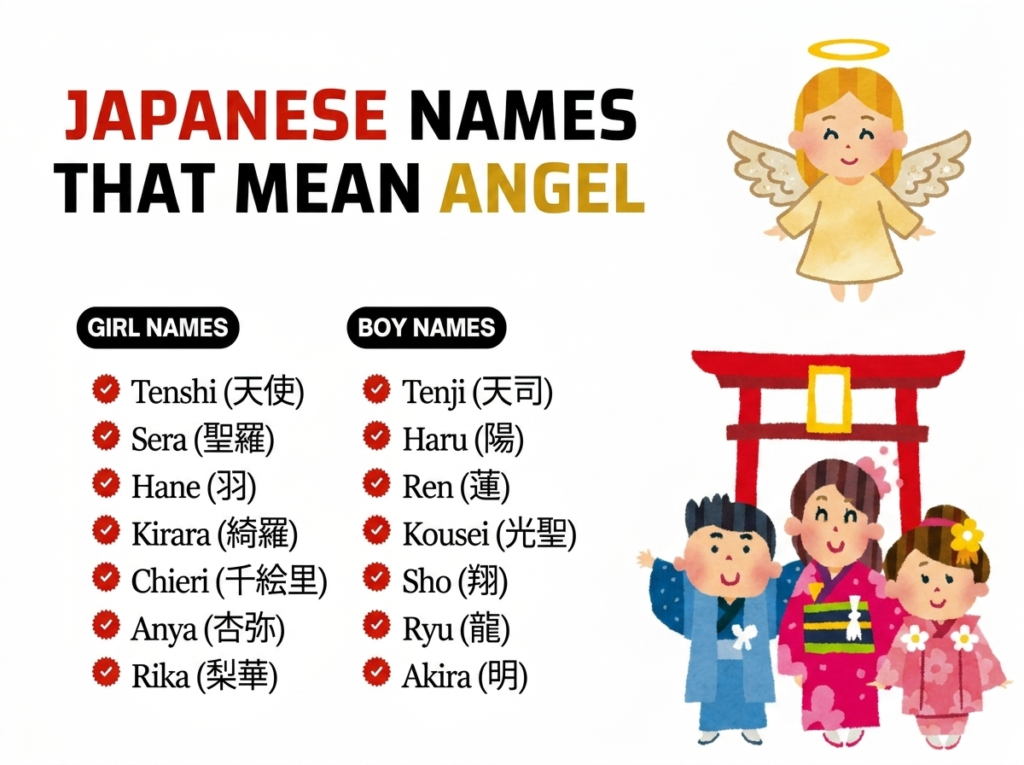
The most direct Japanese name meaning angel is Tenshi (天使), built from the kanji for heaven and messenger. Other authentic choices include Amaha (heavenly feather), Amane (heavenly sound), Tsubasa (wing), Amatsuki (heavenly messenger), and Tenyu (divine blessing). Most of these names draw from kanji related to heaven, wings, and divine messengers rather than a single word for angel.
Japanese Girl Names That Mean Angel
Japanese girl names connected to angels lean heavily into softness and light. The kanji combinations favor heavenly imagery over direct translation, giving these names a poetic quality that feels natural in Japanese. Many pair 天 (heaven) with characters for beauty, sound, fragrance, or radiance to evoke the feeling of a celestial being watching over your child.
| Name | Origin | Meaning | Pronunciation | Popularity |
|---|---|---|---|---|
| Tenshi | Japanese | Angel (heaven + messenger) | TEN-shee | Rare |
| Amaha | Japanese | Heavenly feather | ah-MAH-hah | Rare |
| Amane | Japanese | Heavenly sound | ah-MAH-neh | Soft |
| Amaka | Japanese | Heavenly fragrance | ah-MAH-kah | Soft |
| Amateru | Japanese | Heavenly radiance | ah-mah-TEH-roo | Mystic |
| Tenmi | Japanese | Heavenly beauty | TEN-mee | Soft |
| Amaki | Japanese | Heavenly hope | ah-MAH-kee | Soft |
| Tenko | Japanese | Heavenly light | TEN-koh | Mystic |
| Hane | Japanese | Feather, wing | HAH-neh | Rare |
| Hagoromo | Japanese | Feather robe (angelic garment) | hah-GOH-roh-moh | Mystic |
| Seira | Japanese | Holy and good | SAY-rah | Soft |
| Tensha | Japanese | Angel (creative reading of 天使) | TEN-shah | Unique |
| Tensei | Japanese | Angel (creative reading of 天使) | TEN-say | Unique |
| Tenka | Japanese | Angel (creative reading of 天使) | TEN-kah | Unique |
| Amatsuki | Japanese | Heavenly messenger | ah-mah-TSOO-kee | Rare |
Japanese Boy Names That Mean Angel
Boy names with angelic meanings in Japanese often emphasize strength and divine purpose rather than gentleness. You will see kanji for heavenly flight, divine blessing, and radiant light paired with the heaven character. These names carry a quiet authority that works well across cultures and age beautifully from childhood into adulthood.
| Name | Origin | Meaning | Pronunciation | Popularity |
|---|---|---|---|---|
| Tenshi | Japanese | Angel (heaven + messenger) | TEN-shee | Rare |
| Tsubasa | Japanese | Wing | tsoo-BAH-sah | Trending |
| Tenyu | Japanese | Divine blessing | TEN-yoo | Rare |
| Tensho | Japanese | Heavenly flight | TEN-shoh | Powerful |
| Tenki | Japanese | Heavenly radiance | TEN-kee | Powerful |
| Amaha | Japanese | Heavenly feather | ah-MAH-hah | Rare |
| Tenko | Japanese | Heavenly light | TEN-koh | Mystic |
| Amashi | Japanese | Heavenly messenger | ah-MAH-shee | Rare |
| Amatsuka | Japanese | Heavenly messenger | ah-mah-TSOO-kah | Rare |
| Tensei | Japanese | Angel (creative reading of 天使) | TEN-say | Unique |
| Tensha | Japanese | Angel (creative reading of 天使) | TEN-shah | Unique |
| Amaka | Japanese | Heavenly fragrance | ah-MAH-kah | Rare |
| Tenka | Japanese | Angel (creative reading of 天使) | TEN-kah | Unique |
| Amatsuki | Japanese | Heavenly messenger | ah-mah-TSOO-kee | Rare |
| Seiya | Japanese | Holy one | SAY-yah | Classic |
Naming Expert’s Note: Tenshi (天使) is the most literal Japanese translation of “angel,” but it is rarely used as a given name in Japan. Most Japanese parents who want angelic imagery gravitate toward Tsubasa (翼, wing) or Amane (天音, heavenly sound) instead. These names carry the feeling of angels without the directness that can feel unusual in Japanese naming culture. If you are choosing a name for a child who will grow up in Japan, Tsubasa is by far the most natural and widely recognized option on this list.
Also Read: Beautiful Names That Mean Light Across Japanese and Other Cultures
Unisex Japanese Names That Mean Angel
The most versatile Japanese angel names tend to be short and nature-connected. Wing and feather imagery crosses gender lines easily in Japanese naming tradition, and the single-kanji name Tsubasa is one of the most popular unisex names in the country regardless of its celestial meaning. These names work beautifully for any child and carry a sense of quiet grace.
| Name | Origin | Meaning | Pronunciation | Popularity |
|---|---|---|---|---|
| Tenshi | Japanese | Angel (heaven + messenger) | TEN-shee | Rare |
| Tsubasa | Japanese | Wing | tsoo-BAH-sah | Trending |
| Amane | Japanese | Heavenly sound | ah-MAH-neh | Soft |
| Amaha | Japanese | Heavenly feather | ah-MAH-hah | Rare |
| Hane | Japanese | Feather, wing | HAH-neh | Rare |
| Tenko | Japanese | Heavenly light | TEN-koh | Mystic |
| Amashi | Japanese | Heavenly messenger | ah-MAH-shee | Rare |
| Tensei | Japanese | Angel (creative reading) | TEN-say | Unique |
| Amaka | Japanese | Heavenly fragrance | ah-MAH-kah | Soft |
| Tenka | Japanese | Angel (creative reading) | TEN-kah | Unique |
The Cultural Roots of Japanese Angel Names
The word for angel in Japanese, tenshi (天使), is a compound of two kanji: 天 meaning “heaven” and 使 meaning “messenger.” This term entered the Japanese language primarily through Christian missionary activity in the 16th century and later through translations of Western literature. Before that contact, Japanese spiritual traditions had their own celestial beings that filled a similar role. Understanding these layers helps explain why authentic Japanese angel names are rarer than you might expect and why the most meaningful options often draw from broader heavenly imagery rather than a direct translation.
Kanji Names Using 天使 (Angel)
The most straightforward approach uses the exact kanji for angel. These names are direct but uncommon in everyday Japanese life.
| Name | Meaning | Gender |
|---|---|---|
| Tenshi | Angel | Unisex |
| Tensha | Angel (variant) | Girl |
| Tensei | Angel (variant) | Unisex |
| Tenka | Angel (variant) | Unisex |
| Amatsuki | Heavenly messenger | Unisex |
| Amashi | Heavenly messenger | Unisex |
| Amatsuka | Heavenly messenger | Boy |
| Amatsukai | Heavenly messenger (archaic) | Boy |
Heavenly Wing and Feather Names
Wing imagery connects to angels through the universal symbol of flight and divine protection. In Japanese mythology, celestial beings called tennin (天人) wore feathered robes called hagoromo, which allowed them to fly between heaven and earth.
| Name | Meaning | Gender |
|---|---|---|
| Tsubasa | Wing | Unisex |
| Amaha | Heavenly feather | Unisex |
| Hane | Feather | Unisex |
| Hagoromo | Feather robe | Girl |
| Tensho | Heavenly flight | Boy |
Buddhist Celestial Being Names (Tennin)
Long before the word “angel” entered Japanese, Buddhist tradition described tennin (天人), celestial beings who served as messengers and guardians of the heavenly realms. Names drawing from this tradition carry deep spiritual weight.
| Name | Meaning | Gender |
|---|---|---|
| Tenyu | Divine blessing | Boy |
| Tenko | Heavenly light | Unisex |
| Tenki | Heavenly radiance | Boy |
| Amateru | Heavenly radiance | Girl |
| Seiya | Holy one | Boy |
| Seira | Holy and good | Girl |
Also Read: Japanese Names That Mean Star for Babies With a Celestial Spirit
Names That Mean Heavenly Messenger and Angel Wing
The etymology of “angel” traces back to the Greek word angelos, meaning “messenger.” In Japanese, this concept maps directly onto the kanji combination 天使 (heaven + messenger). Names carrying this specific meaning are the closest Japanese equivalents to Western angel names like Gabriel or Malachi.
- Tenshi (天使)
- Amatsuki (天使)
- Amashi (天使)
- Amatsuka (天使)
- Amatsukai (天使)
- Tensei (天使)
- Tensha (天使)
- Tenka (天使)
Wing names capture the visual symbol most people associate with angels. In Japanese, these names feel natural and poetic rather than overtly religious, which makes them popular even among families without Christian backgrounds. If you love the idea of names that mean flight, these options pair beautifully with that theme.
- Tsubasa (翼)
- Amaha (天羽)
- Hane (羽)
- Hagoromo (羽衣)
- Tensho (天翔)
- Tenki (天輝)
- Amateru (天照)
- Tenko (天光)
- Tenmi (天美)
- Amaki (天希)
How to Choose the Right Angel Name
Sound matters more than you might think. A name like Tenshi has a soft, whispery quality that pairs well with short surnames, while Tsubasa has more rhythmic energy and holds its own next to longer last names. Say your top choices out loud with your family name before deciding.
Cultural context is equally important. If your family has Japanese heritage, names like Tsubasa and Amane will feel familiar and natural. If you are drawn to Japanese naming aesthetics without a direct cultural connection, be respectful of the kanji meanings and choose names you can explain with confidence.
- Say the full name out loud several times to test the rhythm
- Check the initials to avoid unintended combinations
- Think about natural nicknames (Tenshi shortens to Ten, Tsubasa to Tsuba)
- Research the specific kanji before committing to a spelling
- Consider how the name sounds on both a child and an adult
- Check current popularity if you want something less common
Also Read: Gentle and Meaningful Names That Mean Heaven From Around the World
Frequently Asked Questions
Q: What is the most popular Japanese name meaning angel?
A: Tsubasa (翼), meaning “wing,” is by far the most popular Japanese name with angelic associations. It ranks consistently among the top unisex names in Japan. The literal word for angel, Tenshi (天使), is recognized but rarely used as a given name.
Q: What does angel mean in Japanese?
A: The Japanese word for angel is tenshi (天使), written with the kanji 天 (heaven) and 使 (messenger). The term entered Japanese through Christian missionary contact in the 1500s and later through Western literary translations. Before that, Japanese spiritual traditions used the term tennin (天人) for celestial beings.
Q: What are some rare Japanese angel names?
A: Hagoromo (羽衣, feather robe), Amateru (天照, heavenly radiance), and Amatsukai (天使, heavenly messenger) are among the rarest Japanese names with genuine angelic connections. These names are beautiful but virtually unused in modern Japan, making them truly unique choices.
Q: What is a good middle name to pair with Tenshi?
A: Tenshi pairs well with short, soft middle names. Options like Ren, Kai, or Yuki complement its two-syllable structure without overwhelming it. If you want a Western middle name, something gentle like Grace or James creates a nice cultural bridge.
Q: Are Japanese angel names common in Japan?
A: Direct angel names like Tenshi are quite uncommon in Japan. The concept of angels is primarily associated with Christianity, which represents a small minority of the Japanese population. However, names with heavenly or wing imagery like Tsubasa, Amane, and Tenko are genuinely popular and widely used.
Q: Can Tenshi be used for both boys and girls?
A: Yes. Tenshi (天使) is gender-neutral in Japanese. The kanji carry no inherently masculine or feminine qualities, and the name works equally well for any child. That said, it remains rare as a given name for any gender.
Final Thoughts
Japanese names that mean angel occupy a fascinating space between Eastern naming tradition and Western spiritual imagery. The options are fewer than you will find in Hebrew or Greek naming traditions, but that scarcity makes each name feel more intentional and meaningful. Whether you choose the directness of Tenshi, the natural grace of Tsubasa, or the quiet beauty of Amane, you are giving your child a name rooted in the idea of heavenly protection and gentle guidance. For more celestial naming inspiration, explore our guide to Japanese names that mean moon for another layer of nighttime wonder.