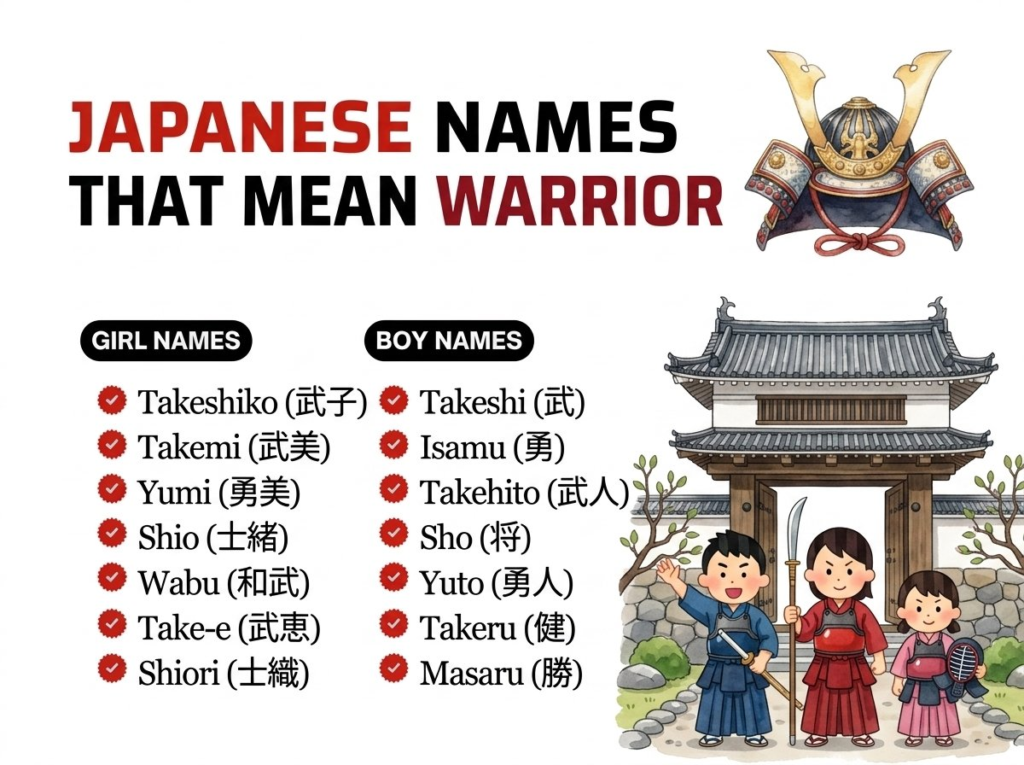
Japanese naming tradition treats the warrior concept with deep reverence. The kanji 武 (bu) has appeared in Japanese given names for centuries, carrying the weight of samurai heritage and bushido philosophy into modern nurseries. A name built around this character does more than sound strong. It connects a child to a lineage of discipline, honor, and quiet courage that runs through Japanese history.
The most authentic Japanese names that mean warrior draw from a small set of powerful kanji. You will see 武 (warrior), 士 (samurai), and 剣 (sword) recurring across generations. Each combination tells a slightly different story about the kind of strength a parent hopes to pass down.
What Are Some Japanese Names That Mean Warrior?
Popular Japanese names that mean warrior include Takeshi, Takeo, and Takeru for boys, and Takeko, Takemi, and Tomoe for girls. These names typically use the kanji 武 (bu), which directly translates to “warrior” or “martial.” Unisex options like Mamoru and Shinobu carry strong warrior spirit meanings rooted in samurai and bushido traditions.
Japanese Girl Names That Mean Warrior
Female warrior names in Japanese carry a distinct kind of power. They tend to be understated rather than loud, often pairing the martial kanji 武 with softer characters like 美 (beauty) or 子 (child). Many of these names trace back to the onna-musha, the female warriors of feudal Japan who fought alongside samurai. The result is a name that feels both grounded and graceful.
| Name | Origin | Meaning | Pronunciation | Popularity |
|---|---|---|---|---|
| Tomoe | Japanese | Legendary female warrior (Tomoe Gozen) | toh-moh-eh | Classic |
| Takeko | Japanese | Warrior child | tah-keh-koh | Rare |
| Takemi | Japanese | Martial beauty | tah-keh-mee | Unique |
| Takeyo | Japanese | Warrior generation | tah-keh-yoh | Rare |
| Isami | Japanese | Brave beauty | ee-sah-mee | Unique |
| Yūko | Japanese | Brave child | yoo-koh | Classic |
| Katsuko | Japanese | Victorious child | kaht-soo-koh | Rare |
| Katsue | Japanese | Victorious inlet | kaht-soo-eh | Rare |
| Tsuruhime | Japanese | Crane princess (warrior princess) | tsoo-roo-hee-meh | Mystic |
| Takeha | Japanese | Warrior leaf | tah-keh-hah | Unique |
| Masako | Japanese | Righteous child | mah-sah-koh | Classic |
| Yoshiko | Japanese | Righteous child | yoh-shee-koh | Classic |
| Yūna | Japanese | Brave, courageous | yoo-nah | Trending |
| Masayo | Japanese | Righteous generation | mah-sah-yoh | Rare |
| Isako | Japanese | Brave child | ee-sah-koh | Rare |
Japanese Boy Names That Mean Warrior
Boy names in this category hit with immediate force. The kanji 武 (bu) dominates the list, and for good reason. It has been a staple of Japanese masculine naming since the Heian period, appearing in the names of shoguns, daimyo, and foot soldiers alike. These names sound confident and direct, with a clipped strength that pairs well with both Japanese and international surnames.
| Name | Origin | Meaning | Pronunciation | Popularity |
|---|---|---|---|---|
| Takeshi | Japanese | Warrior, martial | tah-keh-shee | Classic |
| Takeo | Japanese | Warrior man | tah-keh-oh | Classic |
| Takeru | Japanese | Fierce warrior | tah-keh-roo | Trending |
| Takehiko | Japanese | Warrior prince | tah-keh-hee-koh | Rare |
| Kenshi | Japanese | Swordsman, warrior | ken-shee | Powerful |
| Kensei | Japanese | Sword saint | ken-say | Mystic |
| Masashi | Japanese | Righteous warrior | mah-sah-shee | Classic |
| Yoshitake | Japanese | Righteous warrior | yoh-shee-tah-keh | Rare |
| Takemasa | Japanese | Martial righteousness | tah-keh-mah-sah | Unique |
| Katsuro | Japanese | Victorious son | kaht-soo-roh | Classic |
| Isamu | Japanese | Courage, warrior spirit | ee-sah-moo | Powerful |
| Masakatsu | Japanese | Righteous victory | mah-sah-kaht-soo | Rare |
| Masanori | Japanese | Righteous code | mah-sah-noh-ree | Classic |
| Masamune | Japanese | True lineage (samurai) | mah-sah-moo-neh | Powerful |
| Takeharu | Japanese | Martial spring | tah-keh-hah-roo | Unique |
Naming Expert’s Note: Takeshi is the most internationally recognizable Japanese warrior name, and it earns that status honestly. The two-syllable rhythm works in English, Spanish, and Portuguese without awkward pronunciation shifts. If you want a name that reads as unmistakably Japanese but never needs a spelling explanation, Takeshi is the safest and strongest choice on this list.
Japanese Unisex Names That Mean Warrior
Gender-neutral warrior names in Japanese often pull from bushido virtues rather than battlefield imagery. Words like 守 (protect), 忍 (endure), and 誠 (sincerity) describe the inner qualities of a warrior rather than the act of fighting. This gives unisex options a more philosophical weight. They feel thoughtful and layered, suited to parents who want strength without aggression.
| Name | Origin | Meaning | Pronunciation | Popularity |
|---|---|---|---|---|
| Mamoru | Japanese | Protector, guardian | mah-moh-roo | Classic |
| Yū | Japanese | Courage, bravery | yoo | Soft |
| Shinobu | Japanese | Endurance, stealth | shee-noh-boo | Mystic |
| Katsu | Japanese | Victory | kaht-soo | Powerful |
| Makoto | Japanese | Sincerity (bushido virtue) | mah-koh-toh | Classic |
| Masaru | Japanese | Victory, triumph | mah-sah-roo | Classic |
| Sen | Japanese | Battle | sen | Dark |
| Tsuyoshi | Japanese | Strong, brave | tsoo-yoh-shee | Powerful |
| Take | Japanese | Warrior, martial | tah-keh | Rare |
| Isami | Japanese | Bravery | ee-sah-mee | Unique |
Also Read: Strong Names That Mean Warrior From Every Culture
The Cultural Roots of Japanese Warrior Names
The warrior concept runs deeper in Japanese naming than almost any other culture. This is not just about battlefield glory. It is about a philosophical system that shaped how families named their children for over 800 years.
The Kanji 武 and Samurai Naming Traditions
The character 武 (bu) is the backbone of Japanese warrior names. It appears in the word bushido (the way of the warrior) and bujutsu (martial arts). During the Edo period, samurai families frequently gave their sons names beginning with Take or Masa to signal martial heritage. The kanji itself combines two radicals: 止 (to stop) and 戈 (halberd). The original meaning suggests “stopping the weapon,” which frames the warrior not as someone who seeks conflict but as someone who ends it.
Bushido Virtues in Given Names
The bushido code emphasized seven virtues: righteousness, courage, benevolence, respect, sincerity, honor, and loyalty. Many Japanese warrior names encode these values directly. Makoto (sincerity), Isamu (courage), and Masashi (righteous warrior) all pull from this ethical framework. When you choose one of these names, you are referencing a moral philosophy, not just a fighting style. For parents drawn to names that mean brave, the bushido connection adds genuine historical depth.
Onna-Musha and Female Warrior Names
Japan has a documented tradition of female warriors called onna-musha. Tomoe Gozen, who fought in the Genpei War of the 12th century, remains the most famous. Her name, Tomoe, is now one of the most recognizable female warrior names in Japanese. Hangaku Gozen and Tsuruhime of Ōmishima are lesser-known but equally real historical figures whose names carry the same martial weight. Female warrior names in Japanese tend to be rarer than male ones, which makes them feel more distinctive when chosen today.
Japanese Names That Mean Sword
The sword holds a sacred place in Japanese warrior culture. The katana was considered the soul of the samurai, and names built around the kanji 剣 (ken) carry that spiritual weight. These names feel sharp and focused, with a precision that sets them apart from broader warrior names.
- Kenji (剣二) — second sword
- Kenta (剣太) — strong sword
- Kenzo (剣三) — third sword
- Kenichi (剣一) — first sword
- Kengo (剣吾) — sword self
- Kenshin (剣心) — sword heart
- Kenma (剣真) — true sword
- Kensei (剣聖) — sword saint
- Kenjiro (剣次郎) — sword second son
- Kento (剣人) — sword person
Japanese Names That Mean Victory
Victory names shift the focus from the fight itself to the outcome. The kanji 勝 (katsu) appears in dozens of Japanese given names, and these options feel optimistic without losing their edge. They suit parents who want a forward-looking warrior name rather than one rooted in combat. Many of these pair naturally with Japanese names that mean fire as middle name combinations.
- Katsuo (勝男) — victorious man
- Katsuya (勝也) — victorious
- Katsuhiro (勝博) — broad victory
- Katsuhiko (勝彦) — victorious prince
- Katsutoshi (勝敏) — swift victory
- Katsunori (勝則) — victorious rule
- Katsuki (勝希) — victorious hope
- Katsuji (勝治) — victorious ruler
- Katsura (勝良) — victorious and good
- Katsunobu (勝信) — victorious faith
Japanese Names That Mean Brave
Bravery names in Japanese center on the kanji 勇 (yū), which describes the inner fire of a warrior rather than the external act of fighting. These names feel warmer and more approachable than direct warrior names while still carrying unmistakable strength. They work especially well for parents who want a name that feels gentle on the surface but has real backbone underneath.
- Yūki (勇気) — courage
- Yūta (勇太) — brave and strong
- Yūto (勇人) — brave person
- Yūsei (勇星) — brave star
- Yūgo (勇吾) — brave self
- Yūma (勇真) — true bravery
- Yūhei (勇平) — brave and peaceful
- Yūji (勇二) — brave second
- Yūichi (勇一) — brave first
- Yūho (勇歩) — brave step
How to Choose the Right Warrior Name
Sound matters more than most parents expect. A name like Takeshi flows easily with short surnames but can feel heavy next to a long, multi-syllable last name. Say your top three choices out loud in a full sentence before committing.
Cultural connection deserves honest thought. If your family has Japanese heritage, a name like Takehiko or Tomoe carries real ancestral weight. If not, choose a name whose meaning you genuinely connect with rather than one that simply sounds interesting.
- Say the full name out loud with your surname
- Check the initials for unintended spellings
- Think about natural nicknames (Take, Ken, Yu)
- Research the specific kanji before committing
- Consider how the name sounds on a child and an adult
- Check current popularity if you want something less common
Also Read: Japanese Names That Mean Strong for Boys and Girls
Frequently Asked Questions
Q: What is the most popular Japanese name meaning warrior?
A: Takeshi is the most widely recognized Japanese name meaning warrior. It uses the kanji 武 (bu) directly and has been consistently used across generations. For girls, Tomoe holds the strongest cultural recognition thanks to the legendary warrior Tomoe Gozen.
Q: What does warrior mean in Japanese naming tradition?
A: The warrior concept in Japanese names goes beyond combat. It draws from bushido philosophy, emphasizing righteousness, courage, and protection. The kanji 武 (bu) literally combines “stop” and “weapon,” framing the warrior as a peacemaker. This layered meaning is what makes Japanese warrior names feel so much deeper than their English translations suggest.
Q: What are some rare Japanese warrior names?
A: Tsuruhime (crane princess, after the warrior priestess of Ōmishima), Kensei (sword saint), and Takeha (warrior leaf) are all genuinely rare choices. Sen, meaning “battle,” is almost never used as a given name, which makes it one of the most uncommon options on this list.
Q: What is a good middle name to pair with Takeshi?
A: Takeshi pairs well with short, clean middle names. Takeshi Ren, Takeshi Kai, or Takeshi Jin all flow naturally. If you want a Western middle name, Takeshi James or Takeshi Leo keeps the rhythm balanced without overwhelming the first name.
Q: Are Japanese warrior names still popular?
A: Traditional warrior names like Takeshi and Masashi have declined somewhat in Japan since the 1990s, as modern parents lean toward softer sounds. However, names like Takeru and Yūta have surged in recent years, showing that the warrior spirit still appeals to Japanese families in updated forms.
Q: Can girls have Japanese warrior names?
A: Absolutely. While warrior names skew masculine in Japanese tradition, names like Tomoe, Takeko, and Takemi have documented historical use for girls. The onna-musha tradition gives these names real cultural legitimacy. For parents interested in strong feminine names from other traditions, Japanese names that mean dragon offer a similarly bold alternative.
Conclusion
Japanese names that mean warrior span a wide range of tones, from the direct force of Takeshi to the quiet resolve of Shinobu. Whether you are drawn to the battlefield imagery of the kanji 武 or the philosophical depth of bushido virtues, these names carry centuries of meaning in just two or three syllables. The best warrior names endure because they speak to something universal: the hope that a child will face the world with courage. If you are exploring other powerful naming traditions, names that mean protector offer a natural next step.

3 thoughts on “114+ Japanese Names Meaning Warrior (With Meanings)”