Blue holds a special place in Japanese culture. The traditional Japanese word “ao” once covered the entire spectrum from green to blue, which is why you still hear “ao” used for green traffic lights in Tokyo. This linguistic history gives Japanese blue names a depth that goes well beyond a simple color label.
Choosing a Japanese name connected to blue means tapping into centuries of poetic tradition. These names carry associations with clear skies, deep oceans, and the quiet calm of mountain lakes. They feel grounded yet open, gentle yet strong.
What are some Japanese names that mean blue?
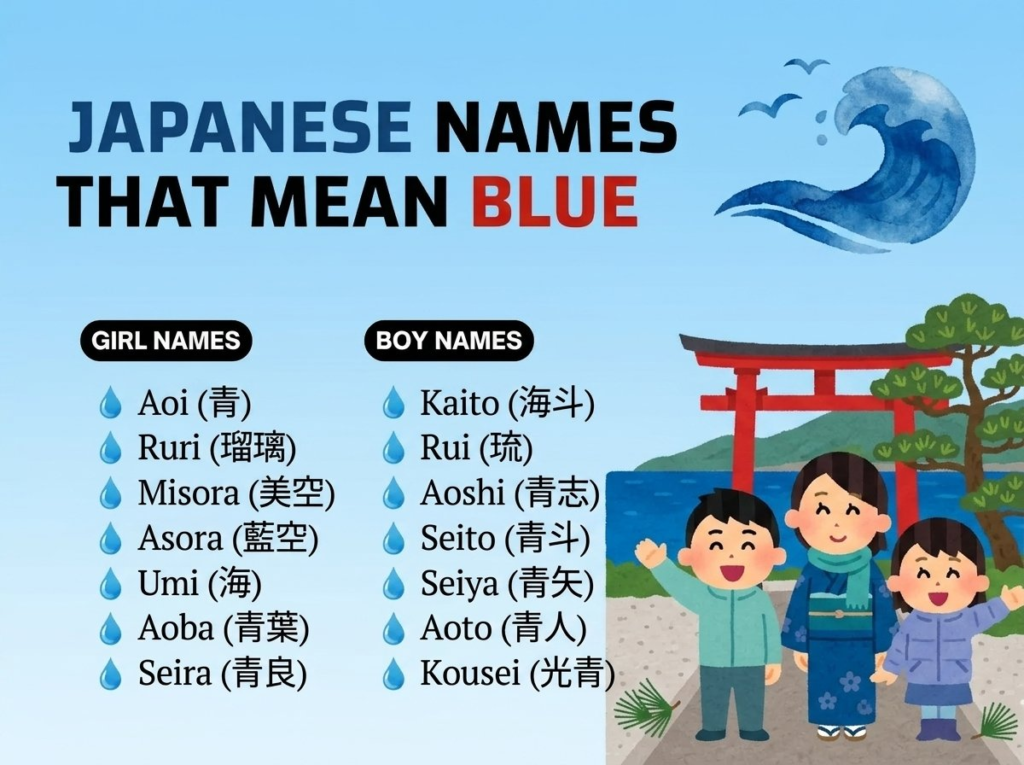
Popular Japanese names meaning blue include Aoi (碧), Sō (蒼), Ruri (瑠璃), Sōta (蒼太), Ao (青), Sōma (蒼真), Aika (碧華), and Sōra (蒼空). These names draw from three primary kanji characters for blue: 青, 蒼, and 碧, each carrying a slightly different shade and feeling. Japanese blue names work across genders and remain deeply rooted in the natural world.
Japanese Girl Names That Mean Blue
Blue names for girls in Japanese tend to feel soft and lyrical. The kanji 碧 (ao/heki) gives these names a jewel-like quality, while 蒼 (ao/sō) leans toward the pale, misty blue of early morning skies. Many of these names pair the blue kanji with characters for flowers, beauty, or sound, creating layered meanings that unfold over time.
| Name | Origin | Meaning | Pronunciation | Popularity |
|---|---|---|---|---|
| Aoi | Japanese | Blue, blue-green (碧) | ah-OH-ee | Trending |
| Ao | Japanese | Blue (青) | ah-OH | Rare |
| Aoko | Japanese | Blue child (青子) | ah-OH-koh | Unique |
| Aono | Japanese | Of blue, blue field (青乃) | ah-OH-noh | Unique |
| Aika | Japanese | Blue flower (碧華) | ah-EE-kah | Soft |
| Aine | Japanese | Blue sound (碧音) | ah-EE-neh | Soft |
| Aisa | Japanese | Blue sand (碧沙) | ah-EE-sah | Rare |
| Aomi | Japanese | Blue beauty (碧美) | ah-OH-mee | Classic |
| Sōko | Japanese | Pale blue child (蒼子) | SOH-koh | Rare |
| Sōka | Japanese | Blue flower (蒼花) | SOH-kah | Unique |
| Ruri | Japanese | Lapis lazuli, deep blue gem (瑠璃) | ROO-ree | Classic |
| Aoka | Japanese | Blue flower (青花) | ah-OH-kah | Mystic |
| Sōmi | Japanese | Blue beauty (蒼美) | SOH-mee | Soft |
| Aoha | Japanese | Blue leaf (碧葉) | ah-OH-hah | Unique |
| Aina | Japanese | Blue love (碧愛) | ah-EE-nah | Trending |
Naming Expert’s Note: Aoi is one of the most popular girl names in Japan right now, but here is where kanji knowledge matters. Written as 碧, Aoi genuinely means blue. Written as 葵, it means hollyhock. Both are beautiful, but they are entirely different names. If the blue meaning is what draws you to Aoi, make sure the kanji 碧 is the one you choose.
Japanese Boy Names That Mean Blue
Boy names built around blue kanji in Japanese carry a quiet, steady confidence. The character 蒼 (sō) dominates this category, lending names a pale, windswept quality that feels both modern and deeply traditional. These names often pair the blue kanji with characters for strength, truth, or the sky, giving them a grounded openness that ages well from childhood into adulthood.
| Name | Origin | Meaning | Pronunciation | Popularity |
|---|---|---|---|---|
| Sō | Japanese | Pale blue (蒼) | SOH | Trending |
| Sōta | Japanese | Blue, big (蒼太) | SOH-tah | Classic |
| Sōma | Japanese | Blue, genuine (蒼真) | SOH-mah | Powerful |
| Aoto | Japanese | Blue person (青人) | ah-OH-toh | Unique |
| Sōya | Japanese | Blue, to be (蒼也) | SOH-yah | Rare |
| Sōhei | Japanese | Blue, peaceful (蒼平) | SOH-hey | Classic |
| Sōsuke | Japanese | Blue, assist (蒼介) | SOH-soo-keh | Powerful |
| Sōji | Japanese | Blue, govern (蒼司) | SOH-jee | Rare |
| Sōtarō | Japanese | Blue, great son (蒼太郎) | soh-TAH-roh | Unique |
| Sōichi | Japanese | Blue, first (蒼一) | SOH-ee-chee | Unique |
| Sōten | Japanese | Blue heaven (蒼天) | SOH-ten | Mystic |
| Sōki | Japanese | Blue radiance (蒼輝) | SOH-kee | Powerful |
| Aoki | Japanese | Blue tree (青樹) | ah-OH-kee | Rare |
| Sōshi | Japanese | Blue, intention (蒼志) | SOH-shee | Soft |
| Sōrin | Japanese | Blue, dignified (蒼凛) | SOH-rin | Mystic |
Also Read: Japanese Names That Mean Water and Their Beautiful Origins
Japanese Unisex Names That Mean Blue
Some of the most striking Japanese blue names sit comfortably between genders. These names tend to be shorter, often one or two syllables, and rely on the raw beauty of the blue kanji itself rather than elaborate compound meanings. Their simplicity is their strength. A name like Ao or Sō needs no decoration.
| Name | Origin | Meaning | Pronunciation | Popularity |
|---|---|---|---|---|
| Aoi | Japanese | Blue (青) | ah-OH-ee | Classic |
| Ao | Japanese | Blue (青) | ah-OH | Rare |
| Sō | Japanese | Pale blue (蒼) | SOH | Trending |
| Ruri | Japanese | Lapis lazuli, deep blue (瑠璃) | ROO-ree | Soft |
| Aomi | Japanese | Blue sea (青海) | ah-OH-mee | Unique |
| Heki | Japanese | Jade blue (碧) | HEH-kee | Mystic |
| Sōra | Japanese | Blue sky (蒼空) | SOH-rah | Powerful |
| Aoha | Japanese | Blue wave (青波) | ah-OH-hah | Rare |
| Midori | Japanese | Blue-green (碧) | mee-DOH-ree | Classic |
| Seiran | Japanese | Blue mountain mist (青嵐) | say-RAHN | Mystic |
Blue Names Across Cultures
Blue is one of the last color words to appear in most languages. Ancient Greek, Hebrew, and Chinese texts famously lacked a dedicated word for blue. Yet once the concept took hold, it spread quickly into naming traditions around the world, often tied to gemstones, dyes, and the sky.
Sanskrit Names That Mean Blue
Sanskrit has deep connections to the color blue, largely through its association with the god Krishna, whose name literally means “dark blue” or “black-blue.” Blue in Hindu tradition represents the infinite and the divine.
| Name | Meaning | Gender |
|---|---|---|
| Nila | Blue, dark blue | Girl |
| Neelam | Sapphire, blue gem | Girl |
| Shyam | Dark blue | Boy |
| Neela | Blue | Girl |
| Nilan | Blue | Boy |
| Neelesh | Lord of blue, Krishna | Boy |
| Nilima | Blue sky | Girl |
| Neel | Blue | Boy |
| Shyama | Dark blue | Girl |
| Niladri | Blue mountain | Boy |
Persian Names That Mean Blue
Persian naming traditions connect blue to the lotus flower and to precious stones. The word “nil” for indigo blue traveled from Sanskrit into Persian, creating a shared naming vocabulary across South and Central Asia.
| Name | Meaning | Gender |
|---|---|---|
| Niloufar | Blue lotus | Girl |
| Nili | Blue | Girl |
| Nil | Indigo blue | Boy |
| Firouzeh | Turquoise, blue-green | Girl |
| Nila | Blue | Girl |
| Nilou | Blue lotus (short form) | Girl |
Turkish Names That Mean Blue
Turkish blue names draw heavily from the sky and the sea. The word “gök” means both sky and blue, and it appears in many traditional Turkish names that carry a sense of vastness and openness.
| Name | Meaning | Gender |
|---|---|---|
| Mavi | Blue | Unisex |
| Gökçe | Sky blue, beautiful sky | Girl |
| Gökhan | Blue sky ruler | Boy |
| Gökay | Blue moon | Unisex |
| Göksu | Blue water | Unisex |
| Maviş | Little blue one | Girl |
English and Western Names That Mean Blue
Western blue names are a relatively modern phenomenon. Most come directly from color words, gemstone names, or dye names that entered the naming pool during the 20th century. They feel fresh and unconventional.
| Name | Meaning | Gender |
|---|---|---|
| Azure | Sky blue | Girl |
| Indigo | Deep blue dye | Unisex |
| Cerulean | Deep sky blue | Girl |
| Blue | Blue | Unisex |
| Sapphire | Blue gemstone | Girl |
| Lapis | Lapis lazuli, blue stone | Boy |
Also Read: Beautiful Names That Mean Blue for Every Origin and Gender
Names That Mean Azure and Sky Blue
Azure names evoke the specific blue of a clear midday sky. They feel lighter and more open than deep blue names, carrying a sense of space and calm. These names work especially well for parents drawn to nature-inspired naming without wanting something too common.
- Azure
- Sōra (Japanese, blue sky)
- Gökçe (Turkish, sky blue)
- Ciel (French, sky)
- Aora (Japanese, blue sky)
- Neelambar (Sanskrit, blue sky)
- Akash (Sanskrit, sky, often associated with blue)
- Sora (Japanese, sky)
- Göksu (Turkish, blue water)
- Celeste (Latin, heavenly, sky blue)
Names That Mean Indigo
Indigo names carry a deeper, more mysterious tone. The color sits between blue and violet, and names in this category tend to feel richer and more distinctive. Indigo itself has become a genuinely popular choice in English-speaking countries over the last decade.
- Indigo
- Nila (Sanskrit, dark blue)
- Nil (Persian, indigo)
- Neelesh (Sanskrit, lord of blue)
- Ruri (Japanese, lapis lazuli)
- Lazuli (from lapis lazuli)
- Neelam (Sanskrit, sapphire)
- Shyam (Sanskrit, dark blue)
- Nili (Persian, blue)
- Niloufar (Persian, blue lotus)
Names That Mean Sapphire and Blue Gemstone
Gemstone blue names bring a sense of rarity and luxury. Sapphire, lapis lazuli, and turquoise all carry deep historical significance as protective stones. These names feel grounded in something tangible and ancient.
- Sapphire
- Ruri (Japanese, lapis lazuli)
- Neelam (Sanskrit, sapphire)
- Lapis (Latin, blue stone)
- Firouzeh (Persian, turquoise)
- Lazuli (Latin, blue stone)
- Heki (Japanese, jade blue)
- Niladri (Sanskrit, blue mountain)
- Sapphira (Greek, sapphire)
- Tarina (Finnish, associated with blue gemstone)
How to Choose the Right Blue Name
Sound matters more than you might think. A short name like Ao or Sō pairs well with longer surnames, while a three-syllable name like Sōsuke or Niloufar needs a shorter last name to avoid feeling heavy. Say the full name out loud several times before deciding.
Cultural connection is worth considering honestly. If Japanese heritage matters to your family, a name like Aoi or Sōta carries real linguistic weight. If you simply love the meaning, that is valid too, but understanding the origin helps you honor the name properly.
- Say the full name out loud with your last name
- Check the initials to avoid unintended spellings
- Think about natural nicknames your child might prefer
- Research the cultural origin before committing
- Consider how the name sounds on a child and on an adult
- Check current popularity if you want something less common
Frequently Asked Questions
Q: What is the most popular Japanese name meaning blue?
A: Aoi (碧) is currently one of the most popular names in Japan for girls, and it genuinely means blue when written with the 碧 kanji. For boys, Sōta (蒼太) and Sōma (蒼真) rank highly in recent Japanese baby name surveys.
Q: What does blue mean in Japanese naming culture?
A: Blue in Japanese naming tradition connects to the sky, the sea, and clarity of spirit. The traditional Japanese concept of “ao” is broader than the English word blue, historically covering shades from green to deep blue. This gives Japanese blue names a wider emotional range than their Western counterparts.
Q: What are some rare Japanese blue names?
A: Seiran (青嵐), meaning blue mountain mist, is quite rare and poetic. Heki (碧), meaning jade blue, is uncommon as a given name. Aoha (青波), meaning blue wave, is another distinctive choice you will not encounter often.
Q: What is a good middle name to pair with Aoi?
A: Aoi pairs well with short, soft middle names. Aoi Grace, Aoi Mae, or Aoi Ren all flow naturally. Since Aoi ends in a vowel sound, a middle name starting with a consonant tends to create the cleanest rhythm.
Q: Are Japanese blue names used for both boys and girls?
A: Yes. Many Japanese blue names are genuinely unisex. Aoi, Ao, and Sō are all used for children of any gender. The kanji choice and the accompanying characters often signal gender more than the blue element itself.
Q: What Japanese kanji characters mean blue?
A: The three primary kanji for blue are 青 (ao), the most common and traditional; 蒼 (ao/sō), which suggests a pale or grayish blue; and 碧 (ao/heki), which leans toward blue-green or jade blue. Each carries a slightly different shade and mood.
Conclusion
Japanese blue names offer a rare combination of simplicity and depth. Whether you choose the pale clarity of Sō, the jewel-toned beauty of Ruri, or the quiet openness of Ao, you are giving your child a name rooted in centuries of natural observation and poetic tradition. Blue names endure because the sky and sea never go out of style. If you are drawn to other nature-inspired Japanese names, you might also enjoy exploring Japanese names connected to the moon and its many meanings.