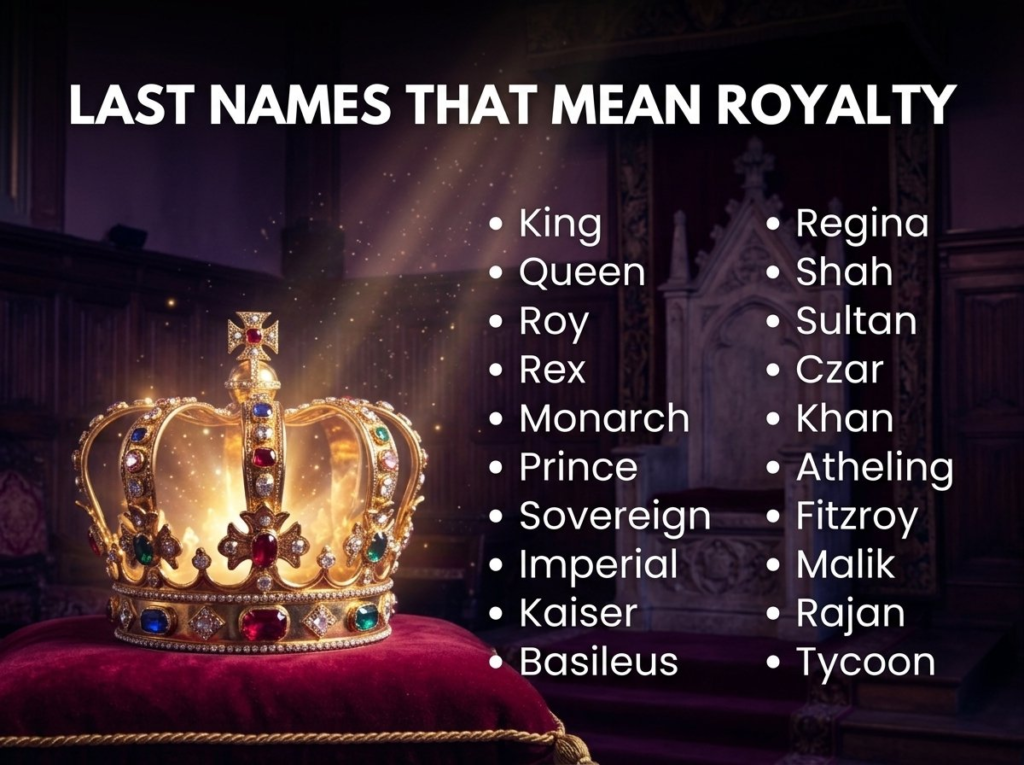
Some of the most recognizable last names that mean royalty include King and Prince from English, Roy and Leroy from French, Shah from Persian, Khan from Turkic roots, Malik from Arabic, and Raja from Sanskrit. These surnames originated as titles for kings, rulers, and nobles across multiple cultures and languages, and many remain widespread today.
Royal surnames carry a weight that most family names simply don’t. Whether your ancestors earned the name King through service to the crown or your family tree traces back to Persian shahs, these surnames tell a story of power and lineage that stretches back centuries.
Many last names that mean royalty started as nicknames, occupational titles, or markers of noble birth. Over time, they became fixed family names passed down through generations. Today, they appear across every continent, from the English countryside to the royal courts of Mughal India.
Last Names That Mean Royalty
Royal surnames tend to fall into two camps: the bold and declarative like King and Prince, and the quietly aristocratic like Fitzroy and Leroy. The first group announces its meaning the moment you hear it. The second rewards anyone curious enough to dig into the etymology. Both carry a sense of inherited authority that few other surname categories can match, and many sit comfortably alongside last names that mean power in terms of sheer presence.
| Surname | Origin | Meaning | Notable Bearers | Popularity |
|---|---|---|---|---|
| King | English | King, from Old English “cyning” | Martin Luther King Jr., Stephen King | Classic |
| Prince | English | Prince, from Old French “prince” | Prince (musician), Harold Prince | Classic |
| Roy | French/Scottish | King, from Old French “roi” | Arundhati Roy, Ram Mohan Roy | Classic |
| Leroy | French | The king, from “le roi” | Carl LeRoy (artist) | Classic |
| Rey | Spanish | King, from Spanish “rey” | Alain Rey (linguist) | Trending |
| Reyes | Spanish | Kings, plural of “rey” | Francisco Reyes (actor) | Classic |
| Rex | Latin | King, from Latin “rex” | Simon Rex (actor) | Rare |
| König | German | King, from German “König” | Leopold König (cyclist) | Classic |
| Malik | Arabic | King, ruler, from Arabic “malik” | Zayn Malik (singer) | Trending |
| Shah | Persian | King, from Persian “shah” | Various South Asian bearers | Classic |
| Khan | Turkic/Mongol | Ruler, sovereign | Imran Khan, Shah Rukh Khan | Powerful |
| Raja | Sanskrit | King, from Sanskrit “raja” | Raja Rao (novelist) | Classic |
| Duke | English | Noble title, from Old French “duc” | Duke Ellington (jazz legend) | Unique |
| Earl | English | Noble title, from Old English “eorl” | Ronnie Earl (blues guitarist) | Classic |
| Baron | English/French | Noble title, from Old French “baron” | Sacha Baron Cohen (actor) | Powerful |
| Fitzroy | Anglo-Norman | Son of the king, “fitz” + “roy” | Charles FitzRoy (son of Charles II) | Rare |
| Royal | English | Royal, from Old French “roial” | Ted Royal (composer) | Unique |
| Kingsley | English | King’s meadow, “cyning” + “leah” | Ben Kingsley (actor) | Trending |
| Kingston | English | King’s town, “cyning” + “tun” | Sean Kingston (musician) | Trending |
| Sultan | Arabic/Turkish | Ruler, authority, from Arabic “sultan” | Various Ottoman-era bearers | Powerful |
| Rajput | Indian | Son of a king, “raja” + “putra” | Various Rajput clan members | Classic |
| Reagan | Irish | Little king, from Irish “Ríagáin” | Ronald Reagan (US President) | Classic |
Naming Expert’s Note: Fitzroy is one of the most fascinating royal surnames in the English language. The prefix “fitz” comes from the Norman French word for “son of,” making Fitzroy literally “son of the king.” Historically, this name was given almost exclusively to illegitimate children of English monarchs, particularly Charles II, who fathered several Fitzroy children. It carries genuine royal DNA but with a complicated backstory that makes it far more interesting than a straightforward name like King.
Royal Surnames Across Cultures
The concept of kingship is universal, and so are the surnames it produced. Nearly every major language family developed its own word for ruler, and many of those words eventually became hereditary family names. This is why you’ll find royal surnames in Germanic, Romance, Semitic, and Indo-Aryan languages alike. The shared human impulse to name people after power and status created a surprisingly connected web of surnames around the world.
English and Anglo-Saxon Surnames That Mean Royalty
English produced the most direct royal surnames in the Western world. Many originated as nicknames for people who behaved regally, served in royal households, or played the part of a king in medieval pageants.
| Surname | Meaning | Origin |
|---|---|---|
| King | King | Old English |
| Prince | Prince | Old French via English |
| Duke | Noble rank | Old French via English |
| Earl | Noble rank | Old English |
| Kingsley | King’s meadow | Old English |
| Kingston | King’s town | Old English |
| Royal | Royal | Old French via English |
| Baron | Noble rank | Old French via English |
| Earlson | Son of the earl | Old English |
| Kingsman | King’s servant | Old English |
French and Norman Surnames That Mean Royalty
The Norman Conquest of 1066 flooded England with French vocabulary, including words for royalty. Many French-origin surnames entered the English naming pool during this period and never left.
| Surname | Meaning | Origin |
|---|---|---|
| Roy | King | Old French “roi” |
| Leroy | The king | French “le roi” |
| Fitzroy | Son of the king | Anglo-Norman |
| Marquis | Noble rank | Old French |
| De Roy | Of the king | French/Flemish |
| Regal | Royal | Latin via French |
| Le Prince | The prince | French |
| Royce | King (disputed) | Old French |
Spanish Surnames That Mean Royalty
Spanish royal surnames are among the most common in Latin America and the Philippines today. The word “rey” (king) produced several widespread family names during the colonial era.
| Surname | Meaning | Origin |
|---|---|---|
| Rey | King | Spanish |
| Reyes | Kings | Spanish |
| Del Rey | Of the king | Spanish |
| Real | Royal | Spanish |
| Coronado | Crowned | Spanish |
Arabic and Persian Surnames That Mean Royalty
The Islamic world developed a rich vocabulary of royal titles that became hereditary surnames across the Middle East, Central Asia, and South Asia. Names like Shah and Malik remain among the most common surnames in the region, and many connect to the same roots found in names that mean queen across Semitic languages.
| Surname | Meaning | Origin |
|---|---|---|
| Malik | King, ruler | Arabic |
| Shah | King | Persian |
| Khan | Ruler, sovereign | Turkic/Mongol |
| Sultan | Ruler, authority | Arabic |
| Emir | Commander, prince | Arabic |
| Shahzad | Son of the king | Persian |
Indian and Sanskrit Surnames That Mean Royalty
India’s caste and clan systems preserved royal titles as surnames more deliberately than almost any other culture. Many of these names still signal specific regional lineages and historical kingdoms.
| Surname | Meaning | Origin |
|---|---|---|
| Raja | King | Sanskrit |
| Rajput | Son of a king | Sanskrit |
| Rana | King, prince | Sanskrit |
| Maharaja | Great king | Sanskrit |
| Rajan | King | Sanskrit/Tamil |
Also Read: Beautiful First Names That Mean Royalty for Girls and Boys
Surnames That Mean King, Noble, and Ruler
The word “royalty” covers a wide spectrum of meaning. Some surnames point directly to the concept of a king. Others reference the broader world of nobility or the act of ruling itself. Breaking these apart helps you find the exact shade of royal meaning you want.
Surnames That Mean King
These surnames come from words that literally translate to “king” in their source languages. They are the most direct and unmistakable royal surnames you will find.
- King (English)
- Roy (French)
- Leroy (French)
- Rey (Spanish)
- Rex (Latin)
- König (German)
- Shah (Persian)
- Malik (Arabic)
- Raja (Sanskrit)
- Reagan (Irish, “little king”)
Surnames That Mean Noble
Noble surnames reference the aristocratic class rather than the throne itself. They tend to feel slightly softer and more refined than names meaning “king,” though they still carry clear social weight.
- Duke (English)
- Earl (English)
- Baron (English/French)
- Marquis (French)
- Noble (English, from Old French)
- Knight (English, medieval title)
- Squire (English, from Old French “esquier”)
- Count (English, from Latin “comes”)
- Lord (English, from Old English “hlaford”)
- Viscount (English/French, noble rank)
Surnames That Mean Ruler
Ruler surnames emphasize governance and command. Many of these names overlap with names that mean leader and carry a more active, authoritative energy than passive noble titles.
- Khan (Turkic/Mongol)
- Sultan (Arabic/Turkish)
- Kaiser (German, from Latin “Caesar”)
- Emir (Arabic)
- Rex (Latin)
- Raja (Sanskrit)
- Malik (Arabic)
- Shah (Persian)
- Czar (Russian, from Latin “Caesar”)
- Regis (Latin, “of the king”)
How to Choose the Right Royal Surname
Sound matters more than meaning when it comes to surnames you use daily. A name like Fitzroy pairs beautifully with short first names but can feel heavy with longer ones. Think about syllable count and rhythm before you commit.
Cultural origin is worth considering too, especially if the surname connects to your actual heritage. A name carries more weight when the backstory is real.
- Say the full name out loud several times to test the flow
- Check how the initials look on paper
- Think about how the name sounds in professional settings
- Research the cultural origin before adopting it
- Consider how it reads on a child and on an adult
- Look up current frequency data if rarity matters to you
Frequently Asked Questions
Q: What is the most common last name that means royalty?
A: King is the most widespread English-language surname meaning royalty. It ranks among the top 50 surnames in the United States and the United Kingdom. Reyes holds a similar position in Spanish-speaking countries.
Q: What does the surname Fitzroy mean?
A: Fitzroy comes from the Anglo-Norman French “fitz” (son of) and “roy” (king), making it literally “son of the king.” It was historically given to illegitimate children of English monarchs, most notably the sons of Charles II.
Q: Are royal surnames still used today?
A: Yes, very much so. Surnames like King, Shah, Khan, and Reyes are among the most common family names in their respective regions. They lost their literal royal associations centuries ago and now function as ordinary surnames.
Q: What are some rare last names that mean royalty?
A: Rarer royal surnames include Fitzroy, Rex, De Roy, and Kaiser. These names appear far less frequently in census records than King or Khan but carry equally strong etymological connections to royalty.
Q: Do royal surnames indicate actual royal ancestry?
A: Almost never. Most royal surnames originated as nicknames, occupational labels, or pageant roles. A family named King was far more likely to have worked in a royal household than to have sat on the throne.
Q: What is a good first name to pair with a royal surname?
A: Short, clean first names tend to balance heavy royal surnames well. For example, James Kingsley or Ava Reyes sound natural. Avoid pairing a royal first name with a royal surname, as combinations like Prince King can feel excessive.
Final Thoughts
Royal surnames span dozens of languages and thousands of years of human history. From the English King to the Persian Shah to the Sanskrit Raja, these names reveal how every culture found its own way to encode power into a family identity. The best royal surname for your family is one that sounds right, feels honest, and connects to a story worth telling. If you enjoyed exploring royal roots, you might also appreciate last names that mean strong for a similarly commanding feel.


1 thought on “91+ Surnames Meaning Royalty (With Meanings)”