There is something genuinely compelling about names rooted in magic, enchantment, and the supernatural feminine. Names that mean witch, fairy, or siren don’t just sound beautiful — they carry centuries of storytelling behind them. From the sorceresses of Greek mythology to the fae creatures of Celtic legend and the sea-dwelling sirens of ancient lore, these names connect a child to a lineage of powerful, otherworldly women who shaped the stories entire civilizations told about the world.
Parents drawn to these names tend to want something that holds depth and mystery without being dark for the sake of it. They want a name with genuine history — one that feels like it was pulled from an old manuscript or whispered at the edge of a forest. Whether you love the wild, herbalist energy of witch names, the delicate shimmer of fairy names, or the haunting pull of siren names, this guide covers authentic names with real etymological roots in enchantment and the magical feminine.
What Are Some Girl Names That Mean Witch, Fairy, or Siren?
Some of the strongest girl names rooted in witchcraft, fairy lore, and siren mythology include Circe, Morgan, Melusine, Thessaly, Alcina, Nimue, Ondine, Lorelei, Titania, and Viviane. These names span Greek, Celtic, Arthurian, and Germanic traditions. Each one carries a direct mythological or etymological link to enchantresses, fairy queens, or supernatural water spirits rather than just a vague magical vibe.
Girl Names That Mean Witch, Fairy, or Siren
Witch, fairy, and siren names for girls carry a rare kind of gravity. They sound feminine without being fragile. Many of them belonged to real mythological figures — enchantresses who turned sailors to stone, fairy queens who ruled hidden kingdoms, sorceresses who shaped the fates of kings. These are names with genuine cultural weight, not just pretty sounds.
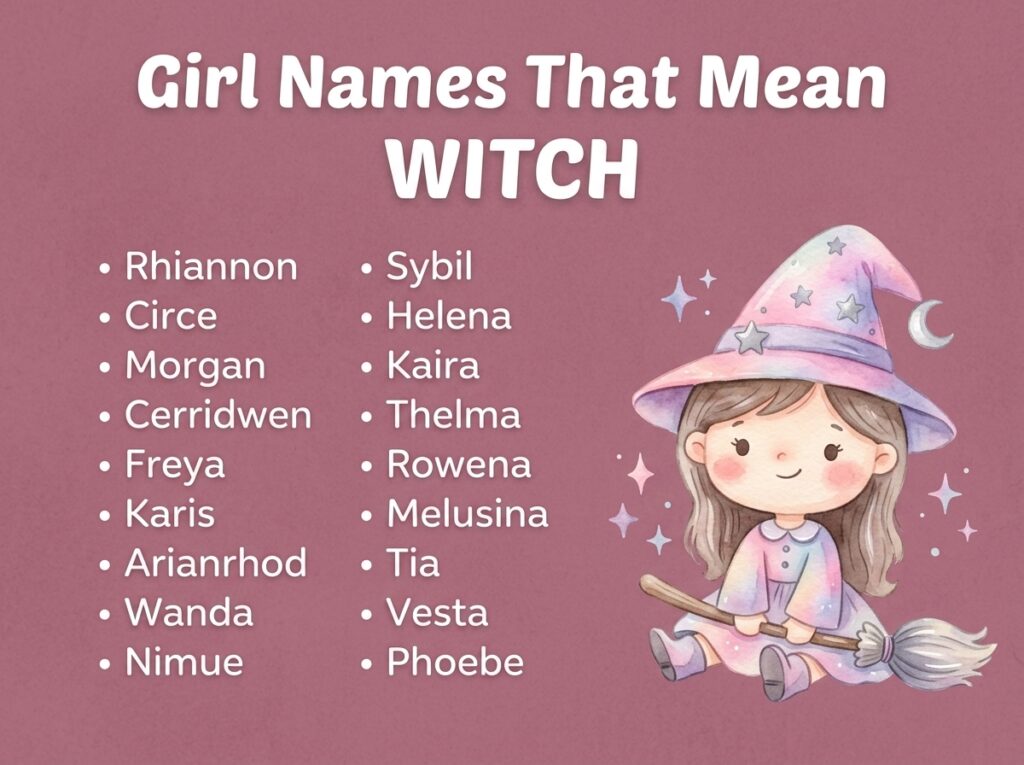
| Name | Origin | Meaning | Pronunciation | Popularity |
|---|---|---|---|---|
| Circe | Greek | Sorceress/Enchantress | SUR-see | Classic |
| Morgan | Welsh/Celtic | Sea-circle, associated with the enchantress Morgan le Fay | MOR-gan | Trending |
| Nimue | Arthurian/Celtic | Lady of the Lake, a powerful enchantress | NIM-yoo-ay | Rare |
| Viviane | French/Celtic | The Lady of the Lake, enchantress of Arthurian legend | VIV-ee-ann | Soft |
| Melusine | French/Germanic | Fairy water spirit of medieval European legend | mel-oo-ZEEN | Mystic |
| Lorelei | German | Luring enchantress; the siren of the Rhine River | LOR-uh-lye | Trending |
| Ondine | Latin/French | Female water spirit or undine; spirit of the waters | on-DEEN | Rare |
| Titania | Greek/Shakespearean | Queen of the Fairies in A Midsummer Night’s Dream | tih-TAY-nee-ah | Unique |
| Thessaly | Greek | A region in Greece historically associated with witchcraft | THES-uh-lee | Rare |
| Alcina | Italian/Greek | Enchantress sorceress of Ariosto’s Orlando Furioso | al-SEE-nah | Mystic |
| Hecate | Greek | Goddess of witchcraft, magic, and crossroads | HEK-ah-tee | Dark |
| Medea | Greek | Sorceress and priestess of Hecate in Greek mythology | meh-DEE-ah | Dark |
| Circea | Latin | Feminine variant related to Circe the enchantress | sir-SEE-ah | Unique |
| Faye | English | Fairy, derived from Middle English “faie” | FAY | Trending |
| Fay | English | Fairy; enchanted being | FAY | Classic |
| Aoife | Irish Gaelic | A warrior fairy woman in Irish mythology | EE-fah | Soft |
| Niamh | Irish Gaelic | Brightness; a fairy princess of the Otherworld in Irish myth | NEEV | Mystic |
| Morrigan | Irish Celtic | Phantom queen; a supernatural war goddess associated with fate and magic | MOR-ih-gan | Powerful |
| Etain | Irish Celtic | A fairy woman and divine queen in Irish mythology | AY-din | Rare |
| Caer | Irish/Welsh Celtic | Fairy woman associated with swans and enchantment in Celtic myth | KAIR | Unique |
| Selkie | Scottish/Norse | Shape-shifting seal fairy of Scottish and Norse legend | SEL-kee | Mystic |
| Medb | Irish Gaelic | A powerful fairy queen and goddess figure in Irish mythology | MAYV | Rare |
| Thessalonike | Greek | Associated with magical Thessaly, the seat of witchcraft in antiquity | thes-ah-LOH-nih-kee | Rare |
| Sycorax | Shakespearean/Greek | A powerful witch and sorceress in Shakespeare’s The Tempest | SIK-oh-raks | Dark |
| Lilith | Hebrew/Semitic | Night demon; associated with witchcraft and supernatural feminine power | LIL-ith | Trending |
Also Read: Names That Mean Siren — Enchanting and Mythological Choices
Witch, Fairy, and Siren Names Across Cultures
Magic is one of the few things every human culture has in common. Every civilization — from ancient Greece to medieval Ireland to Germanic riverside villages — had stories about enchanted women who operated outside the rules. That’s why witch, fairy, and siren names appear in so many languages. The specific form changes. The core idea never does.
Greek Names Meaning Witch or Enchantress
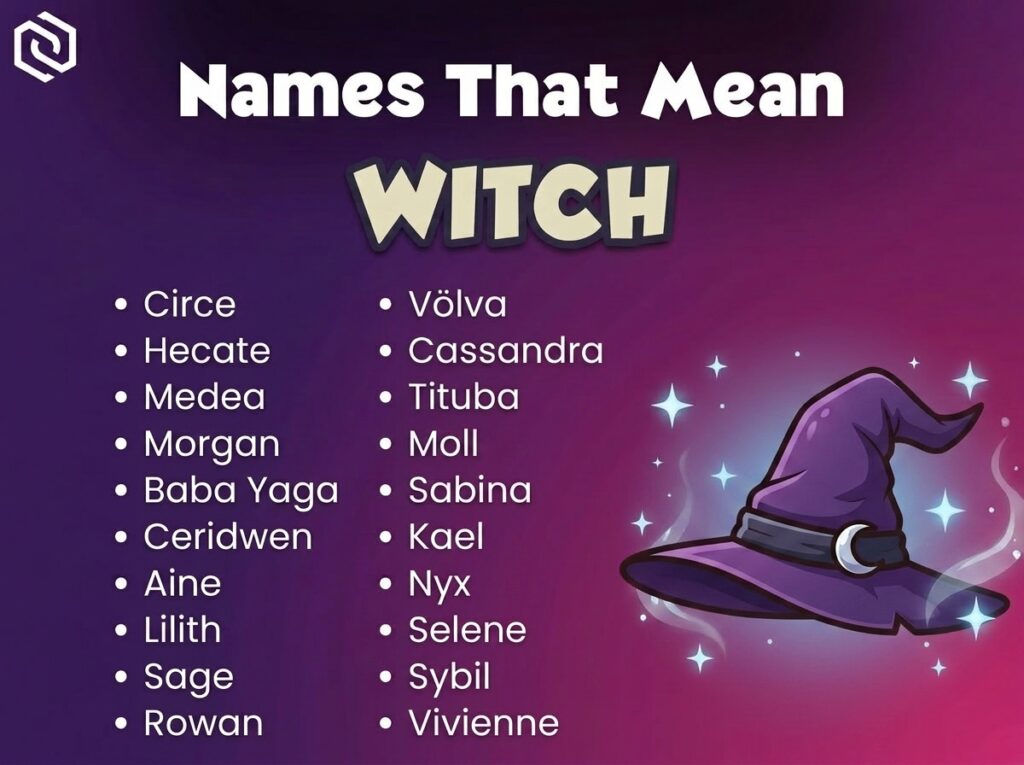
Greek mythology gave us some of the most enduring witch archetypes in Western literature. Circe and Medea are the obvious headliners, but the Greek tradition runs deep with enchantresses, sorceresses, and supernatural women.
| Name | Meaning | Gender |
|---|---|---|
| Circe | Sorceress who transformed men into animals | Girl |
| Medea | Sorceress, granddaughter of the sun god Helios | Girl |
| Hecate | Goddess of witchcraft, magic, ghosts, and crossroads | Girl |
| Agave | In myth, associated with Dionysian frenzied magic | Girl |
| Thessaly | Region historically called the land of witches | Girl |
| Alcmene | Associated with divine enchantment in Hercules’ birth myth | Girl |
| Calypso | A nymph who held Odysseus captive through enchantment | Girl |
| Pasiphae | A sorceress daughter of Helios in Greek mythology | Girl |
| Persephone | Queen of the Underworld, associated with chthonic magic | Girl |
| Lamia | A supernatural devouring spirit of Greek legend | Girl |
Celtic Names Meaning Fairy or Enchantress
Celtic traditions — Irish, Welsh, and Scottish — produced some of the richest fairy mythology in human history. The Otherworld was real in Celtic cosmology, and the beings who lived there had names that are still breathtakingly beautiful today.
| Name | Meaning | Gender |
|---|---|---|
| Niamh | Fairy princess of Tír na nÓg, the Celtic Otherworld | Girl |
| Morrigan | Phantom queen, supernatural goddess of fate and magic | Girl |
| Nimue | Lady of the Lake, the enchantress of Arthurian legend | Girl |
| Etain | Divine fairy queen in Irish mythology | Girl |
| Aoife | Warrior fairy woman in Irish legend | Girl |
| Morgan | Associated with Morgan le Fay, the fairy enchantress | Girl |
| Caer | Swan fairy woman of Celtic mythology | Girl |
| Medb | Fairy queen and goddess figure | Girl |
| Viviane | The enchantress Lady of the Lake | Girl |
| Rhiannon | A Welsh mythological figure associated with the Otherworld and magic | Girl |
Germanic and Norse Names Meaning Siren or Enchantress
Germanic and Norse traditions gave us some of the most haunting siren and enchantress figures in European mythology. The Rhine Maidens, the Lorelei, and the Norse völva (seeress) are part of this lineage.
| Name | Meaning | Gender |
|---|---|---|
| Lorelei | The siren of the Rhine; her name means “luring rock” | Girl |
| Melusine | Fairy water spirit of medieval French and Germanic legend | Girl |
| Undine | Spirit of the waters in Germanic elemental tradition | Girl |
| Selkie | Shape-shifting seal fairy of Norse and Scottish tradition | Girl |
| Rusalka | Slavic water fairy or siren spirit | Girl |
| Nix | Germanic water spirit or shape-shifting enchantress | Girl |
| Skuld | A Norn (fate-weaving figure) in Norse mythology | Girl |
| Skaði | Norse giantess associated with wild supernatural power | Girl |
Arthurian Names Meaning Enchantress or Fairy
The Arthurian literary tradition is one of the richest sources of enchantress names in Western culture. These names come from medieval French and Welsh manuscripts and carry a storybook quality that still feels fresh.
| Name | Meaning | Gender |
|---|---|---|
| Morgan | Morgan le Fay, the fairy enchantress of Arthurian legend | Girl |
| Nimue | The Lady of the Lake who imprisoned Merlin through enchantment | Girl |
| Viviane | Alternate name for the enchantress Lady of the Lake | Girl |
| Morgause | Half-sister of King Arthur, associated with sorcery | Girl |
| Elaine | In some versions of the legend, a figure associated with fairy-like enchantment | Girl |
Also Read: Names That Mean Mystery — Dark and Enchanting Choices
Names That Mean Fairy Queen, Sea Witch, and Night Enchantress
Names That Mean Fairy Queen
There is a distinct tier of fairy names that go beyond simply meaning “fairy” — these specifically reference fairy royalty or divine Otherworld queens. They feel elevated and ceremonial without being heavy.
- Titania — Shakespeare’s fairy queen in A Midsummer Night’s Dream, derived from Titans of Greek mythology
- Niamh — The fairy princess of Tír na nÓg in Irish legend
- Medb — A powerful Irish fairy queen with goddess-like attributes
- Etain — A radiant fairy queen who was transformed and reborn in Irish mythology
- Mab — Queen Mab, the fairy queen of English and Celtic folklore
- Caer — A swan fairy woman beloved by the god Aengus in Irish myth
- Rhiannon — A Welsh Otherworld queen with magical horses and birds
- Áine — An Irish fairy queen and goddess of summer and sovereignty
- Gloriana — Edmund Spenser’s fairy queen in The Faerie Queene
- Fionnuala — An Irish fairy woman transformed into a swan by enchantment
Names That Mean Sea Witch or Water Siren
Water-based enchantment has its own mythology — separate from land-dwelling fairies and forest witches. These names come specifically from traditions of water spirits, river sirens, and oceanic enchantresses.
- Lorelei — The Rhine River siren of German legend
- Ondine — A water nymph or undine from European elemental tradition
- Melusine — A serpentine water fairy of French and Germanic legend
- Rusalka — A Slavic water fairy or drowned spirit of the water
- Nix — A Germanic water spirit capable of shape-shifting
- Calypso — A nymph who held Odysseus through enchantment on her island
- Thessalonike — In legend, transformed into a mermaid after her death
- Selkie — A seal-fairy of Scottish and Icelandic coastal tradition
- Naiad — A freshwater nymph of Greek mythology
- Parthenope — One of the original Sirens of Greek mythology, whose name means “maiden face”
Names That Mean Night Witch or Dark Enchantress
Some witch names lean into the shadow side — the nocturnal sorceress, the goddess of the crossroads, the supernatural figure who operates after dark. These names are darker in flavor but still rooted in genuine mythology.
- Hecate — Greek goddess of witchcraft, the night, and crossroads
- Lilith — Associated with the night and supernatural feminine power in Semitic tradition
- Morrigan — The phantom queen of Irish mythology who appeared at dusk and dawn
- Sycorax — Shakespeare’s witch in The Tempest, rooted in Greek etymology
- Lamia — A Greek night-spirit and devouring enchantress
- Nyx — Greek goddess of the night, mother of supernatural forces
- Oya — Yoruba goddess associated with storms, magic, and transformation
- Skuld — A Norse Norn who weaves fate in darkness
- Proserpina — The Roman counterpart of Persephone, associated with underworld sorcery
- Ereshkigal — Sumerian goddess of the underworld, queen of the dead
Naming Expert’s Note
Circe is the name that deserves more attention than it gets. It’s one of the oldest named enchantresses in Western literature — appearing in Homer’s Odyssey — and its sound is clean, short, and genuinely distinctive. Two syllables. No awkward pronunciation. Strong mythological backbone. Yet it remains surprisingly uncommon on baby name charts, which means a child named Circe will be both immediately recognizable to anyone with a literary background and genuinely rare on a school roll. If you want a witch name that is historically accurate, easy to wear, and quietly powerful, Circe is the most underused option on this entire list.
How to Choose the Right Witch, Fairy, or Siren Name
Sound matters enormously with this category. Names like Melusine and Morrigan have real weight to them — they work for a child and an adult equally well, which is something worth testing out loud before committing. Short witch and fairy names like Fay, Mab, and Nix pair easily with longer surnames; longer names like Thessalonike or Morrigan may need a simpler last name to balance them.
Cultural origin matters here more than in most categories. Names like Hecate and Medea carry specific Greek mythological associations that some families may love and others may find too heavy. Knowing whether a name belongs to a tradition your family has connection to — or whether you simply love the sound — is worth thinking through honestly.
- Say the full name out loud with your last name at least ten times
- Check what the natural nickname would be and whether you like it
- Research the specific mythological figure behind the name before deciding
- Consider how the name reads on a professional document as well as a birth announcement
- Check current popularity if you want something genuinely rare rather than quietly common
- Think about whether the name’s dark or enchanting associations feel right for your family’s style
Also Read: Names That Mean Dark — Mysterious and Powerful Choices for Girls and Boys
Frequently Asked Questions
Q: What is the most popular girl name that means witch?
A: Morgan is currently the most popular name with genuine witch associations, largely due to Morgan le Fay of Arthurian legend. Lilith has also surged significantly on baby name charts in recent years, driven by its associations with supernatural feminine power. Circe and Hecate remain much rarer but are gaining attention among parents who want something more historically specific.
Q: What girl names literally mean fairy?
A: The most etymologically direct fairy names for girls are Faye and Fay, both derived from Middle English “faie” meaning fairy. Niamh, Etain, and Caer are Irish and Celtic names belonging to actual fairy women in mythology rather than names that simply mean fairy as a word. Melusine refers to a fairy water spirit by definition in medieval European legend.
Q: What are the rarest girl names that mean witch or enchantress?
A: Some of the rarest options with genuine mythological roots include Nimue, Melusine, Thessaly, Alcina, Etain, and Caer. These names appear almost nowhere on modern baby name charts but have clear, traceable connections to witchcraft, enchantment, or fairy mythology in their original cultures. Pasiphae and Sycorax are extremely rare and carry strong mythological credentials.
Q: What is a good middle name to pair with Circe?
A: Circe pairs beautifully with middle names that are soft and flowing to contrast its sharp ending. Options like Circe Isolde, Circe Viviane, Circe Elaine, or Circe Maeve all work well. A one-syllable middle name like Circe Rose or Circe Wren also creates a clean, balanced rhythm.
Q: Are witch and fairy names still popular for girls?
A: Yes, and they are growing. Names like Morgan, Lilith, and Lorelei are genuinely trending on naming charts. The broader cultural interest in mythology, fantasy literature, and supernatural storytelling has made this category more appealing than it has been in decades. Specific names like Hecate and Circe remain rare but have a clear upward trajectory among parents who follow naming trends closely.
Q: What is the difference between a siren name and a fairy name?
A: Siren names come specifically from water-based enchantment traditions — Greek sirens, Germanic Lorelei, Slavic Rusalka — and typically carry a more haunting, oceanic quality. Fairy names come from land-based Otherworld traditions, particularly Celtic mythology, and often feel more luminous and ethereal. Both categories belong to the broader world of enchantment names, but their mythological roots and emotional tones are genuinely different.
Conclusion
Witch, fairy, and siren names for girls span thousands of years and dozens of cultures, and what’s striking is how consistently powerful these names feel across all of them. From the Greek sorceresses of antiquity to the Celtic fairy queens of medieval Ireland to the Rhine sirens of Germanic legend, these names carry genuine mythological history. That depth is exactly why they endure. A name like Circe or Niamh or Lorelei isn’t just beautiful to say — it holds a whole world of stories behind it. If you love names rooted in the natural and supernatural feminine, you might also explore names that mean magic from every culture and tradition for even more options with genuine enchantment at their core.