The phoenix is one of the most enduring symbols in human mythology. A bird that burns completely and rises whole from its own ashes. Across Greek legend, Chinese folklore, Egyptian tradition, and Persian poetry, this image has carried the same message for thousands of years: that destruction is not the end, and that something extraordinary can emerge from loss. Naming a child after that idea carries enormous weight.
Parents who are drawn to phoenix names often have a story behind the choice. Maybe they went through something hard before or during the pregnancy. Maybe they want their child to carry a name that means more than beauty or strength alone. Names that mean phoenix, rebirth, or rising from fire speak to resilience in a way that few other names can. They feel mythic without being inaccessible, and powerful without being aggressive.
What Are the Best Names That Mean Phoenix?
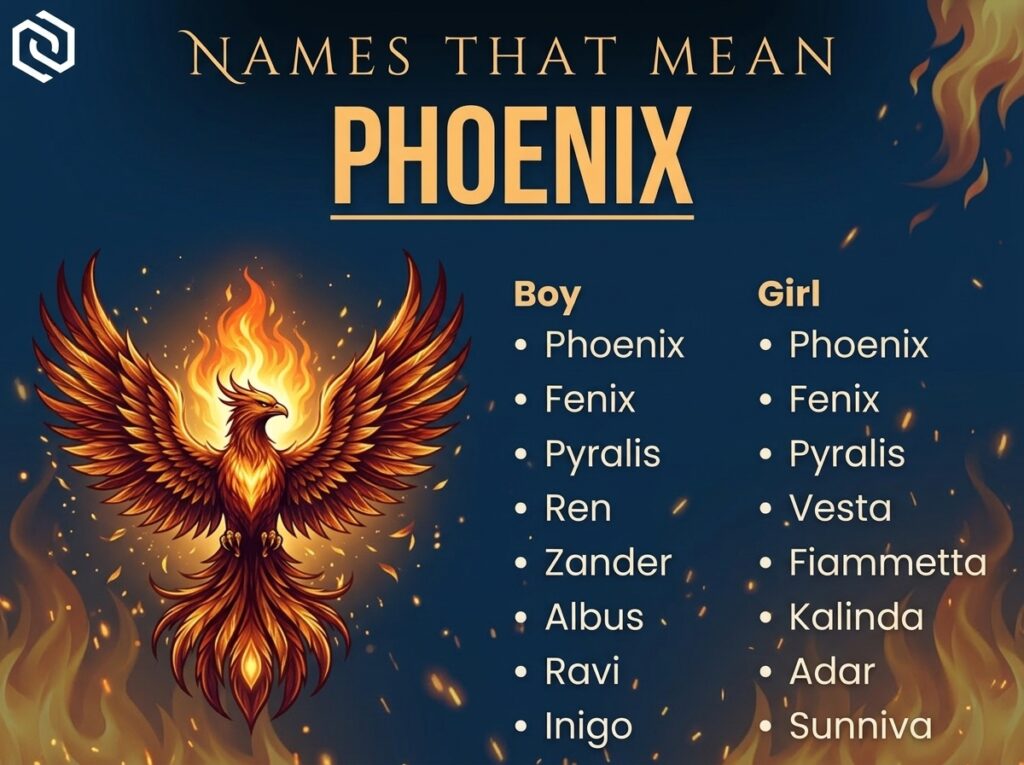
Some of the strongest names that directly mean phoenix or are rooted in phoenix mythology include Phoenix (Greek, the bird of fire and rebirth), Fenghuang (Chinese, the immortal phoenix bird), Zhu Que (Chinese, the Vermilion Bird associated with the southern fire phoenix), Anka (Turkish/Arabic, the legendary immortal bird), Simurgh (Persian, the mythical benevolent firebird), Benu (Egyptian, the phoenix-like solar bird), and Quetzal (Nahuatl, the sacred resplendent bird of Mesoamerican tradition). These names carry genuine mythological roots tied to the phoenix legend across multiple world cultures.
Girl Names That Mean Phoenix
Phoenix names for girls carry a quiet kind of fire. They don’t shout. They hold something deeper — a sense that the person wearing them has survived something, or will. Many of these names pull from ancient mythology, Eastern firebird legends, and solar bird traditions, giving them an otherworldly quality that still feels grounded.
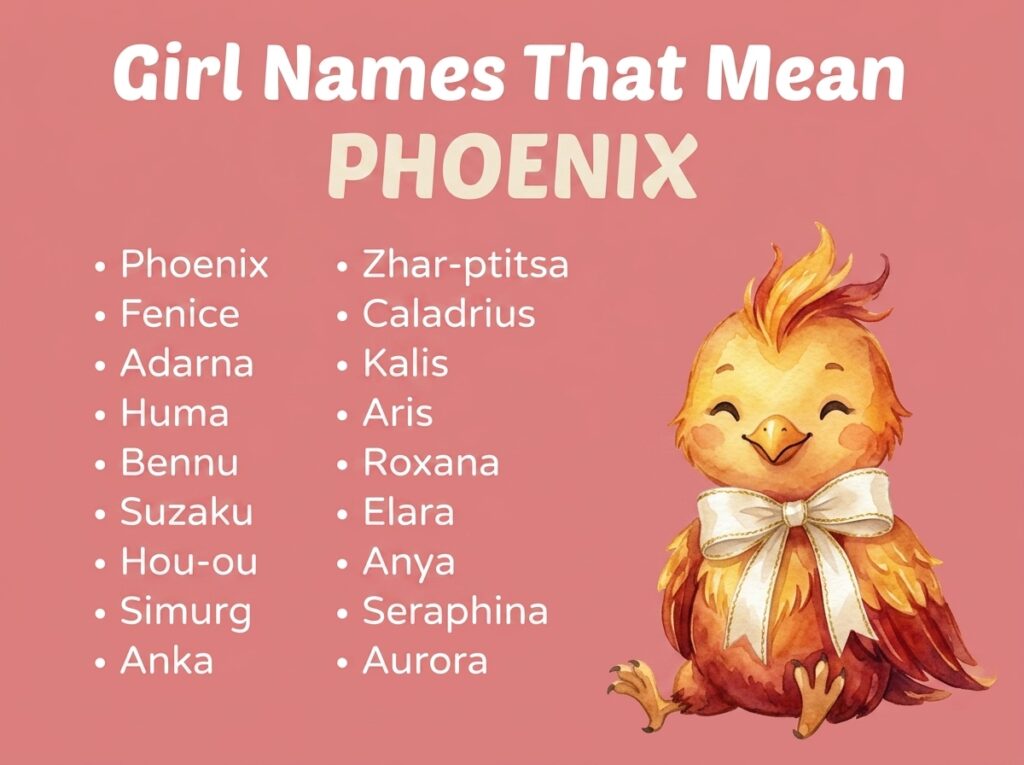
| Name | Origin | Meaning | Pronunciation | Popularity |
|---|---|---|---|---|
| Phoenix | Greek | The mythical firebird that rises from ashes | FEE-niks | Trending |
| Anka | Turkish/Arabic | The immortal firebird of legend | AHN-kah | Rare |
| Zümrüdüanka | Turkish | The mythical immortal phoenix bird | Zum-roo-doo-AHN-kah | Unique |
| Fenghuang | Chinese | The immortal phoenix, symbol of grace and fire | Fung-HWANG | Rare |
| Huma | Persian/Urdu | The mythical bird of paradise and fortune, often identified with the phoenix | HOO-mah | Soft |
| Simurgh | Persian | The benevolent mythical firebird of Persian legend | See-MURG | Mystic |
| Benu | Egyptian | The sacred solar bird closely associated with the phoenix myth | BEH-noo | Rare |
| Vermilia | Latin-inspired | Derived from vermilion, the color of the phoenix flame | Ver-MIL-ee-ah | Unique |
| Pyralis | Greek | From “pyr” meaning fire, associated with the firebird | PIE-rah-lis | Mystic |
| Zhuque | Chinese | The Vermilion Bird, the Chinese fire phoenix of the south | Joo-CHWAY | Rare |
| Quetzalli | Nahuatl | The sacred resplendent bird, revered as a divine firebird | Ket-SAL-ee | Rare |
| Nastaran | Persian | Wild rose, poetically linked to the undying Huma bird | Nas-tah-RAN | Soft |
| Anqa | Arabic | The mythical immortal bird of Arabic legend | AHN-kah | Mystic |
| Pyrene | Greek | Fiery one, from “pyr,” the same root that names the phoenix’s fire | PIE-reen | Unique |
| Phenix | French/Latin | Alternate spelling of Phoenix, the rising firebird | FEE-niks | Classic |
| Resheph | Semitic | The blazing one, connected to fire deity mythology | REH-shef | Dark |
| Aetos | Greek | Eagle-bird, a term used in some Greek phoenix retellings | AY-tos | Rare |
| Fyra | Scandinavian-inspired | From Norse “fyr,” meaning fire; used poetically for the firebird | FEE-rah | Unique |
| Layla al-Anka | Arabic | Poetic combination meaning “night of the immortal bird” | LAY-lah al-AHN-kah | Rare |
| Zara | Hebrew/Arabic | Dawning light; poetically associated with the phoenix’s rise at sunrise | ZAH-rah | Trending |
Boy Names That Mean Phoenix
Phoenix names for boys tend to sound bold and elemental. There’s something almost ancient about them. Many come from cultures where the firebird wasn’t just a symbol of hope — it was a divine creature, revered as both a solar force and a spiritual messenger. These names carry that weight naturally.
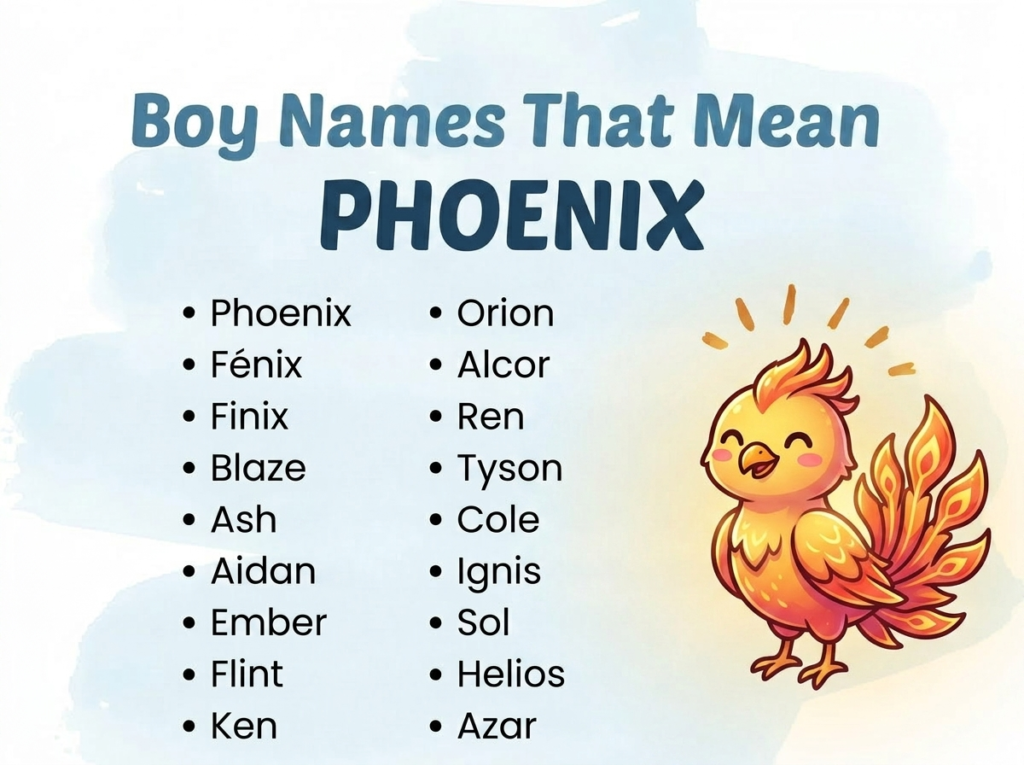
| Name | Origin | Meaning | Pronunciation | Popularity |
|---|---|---|---|---|
| Phoenix | Greek | The firebird that burns and rises again | FEE-niks | Trending |
| Bennu | Egyptian | The sacred solar bird of Egyptian mythology, the original phoenix | BEH-noo | Mystic |
| Zhuque | Chinese | The Vermilion Bird, the fire phoenix of the south in Chinese cosmology | Joo-CHWAY | Rare |
| Simurgh | Persian | The mythical firebird of Persian legend, wise and immortal | See-MURG | Mystic |
| Quetzal | Nahuatl | The divine resplendent firebird of Mesoamerican tradition | KET-sal | Rare |
| Pyrrhus | Greek | Flame-colored, from “pyr,” the fire root at the heart of the phoenix myth | PEER-us | Classic |
| Fen | Chinese | Derived from “fenghuang,” the Chinese immortal phoenix | FEN | Soft |
| Anka | Turkish/Arabic | The immortal bird of Arabic and Turkish mythology | AHN-kah | Rare |
| Feng | Chinese | The male aspect of fenghuang, the Chinese phoenix | FUNG | Unique |
| Ignis | Latin | Fire, the elemental force behind the phoenix | IG-nis | Powerful |
| Pyriel | Hebrew-influenced | “Fire of God,” linked to the divine fire of rebirth mythology | PEER-ee-el | Mystic |
| Embry | Old French | Immortal ruler, sometimes associated with the undying phoenix spirit | EM-bree | Trending |
| Resheph | Semitic | The blazing one, a fire deity whose imagery aligns with phoenix mythology | REH-shef | Dark |
| Phaon | Greek | Shining one, from the same Greek family as “phaenix,” the phoenix’s root | FAY-on | Rare |
| Thuban | Arabic | Dragon star; in Arabic astronomical tradition, associated with cycles of return | THOO-ban | Unique |
Also Read: Names That Mean Fire from Every Culture and Language
Unisex Names That Mean Phoenix
These names sit beautifully in the middle. They feel equally strong on any child, regardless of gender. Some are short and striking. Others carry a longer, more ceremonial feel. What they share is that each one connects — directly or through mythology — to the idea of the firebird, renewal, and rising from flame.
| Name | Origin | Meaning | Pronunciation | Popularity |
|---|---|---|---|---|
| Phoenix | Greek | The mythical firebird of rebirth | FEE-niks | Trending |
| Anka | Turkish/Arabic | Immortal mythological bird of fire | AHN-kah | Rare |
| Huma | Persian/Urdu | The legendary bird of paradise, often likened to the phoenix | HOO-mah | Soft |
| Quetzal | Nahuatl | The resplendent sacred firebird | KET-sal | Rare |
| Benu | Egyptian | The phoenix-like solar bird of ancient Egypt | BEH-noo | Mystic |
| Pyralis | Greek | Fire creature, from “pyr” (fire), associated with mythological firebirds | PIE-rah-lis | Unique |
| Ember | Old English | Burning coal, the smoldering fire that precedes a phoenix’s rise | EM-ber | Trending |
| Ignis | Latin | Fire, the primal source behind all phoenix symbolism | IG-nis | Powerful |
| Phenix | French/Latin | Classic alternate form of Phoenix | FEE-niks | Classic |
| Feng | Chinese | The fire-associated element of the Chinese phoenix fenghuang | FUNG | Rare |
Phoenix Names Across Cultures
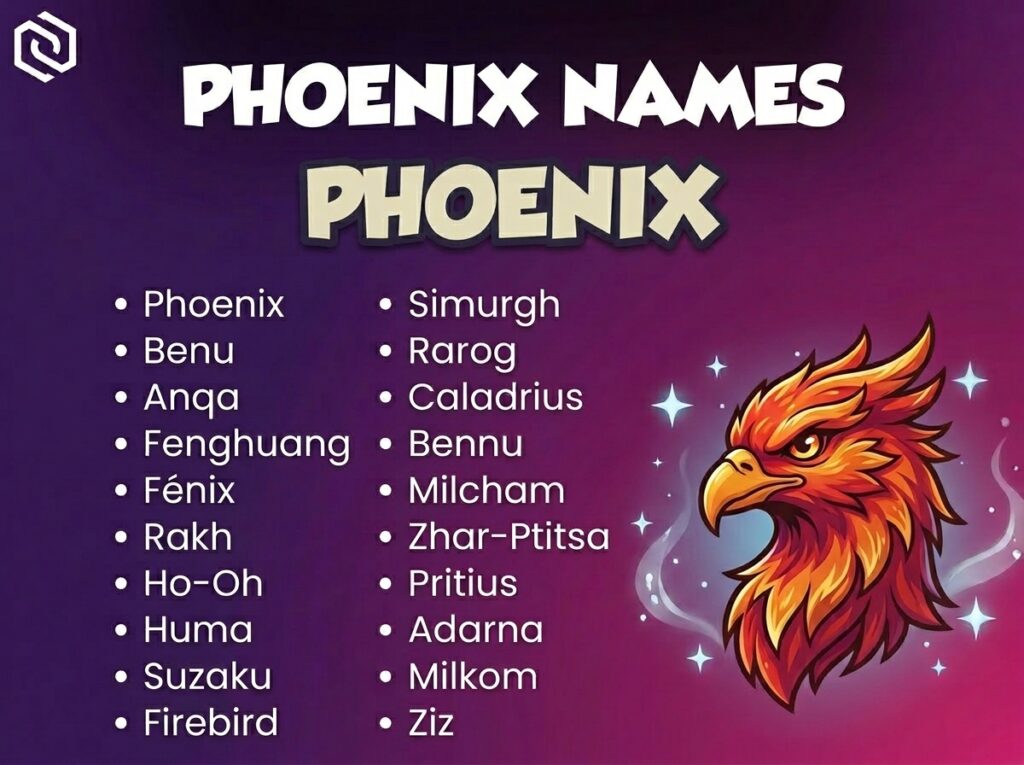
The phoenix doesn’t belong to one mythology. That’s what makes it so remarkable. Nearly every ancient culture developed its own version of the firebird independently, which tells you something true about human nature: the idea of burning down and rising again is universal. It appears in Greek texts, Egyptian solar religion, Chinese imperial tradition, Persian poetry, and Mesoamerican cosmology. The names tied to this symbol carry that same cross-cultural depth.
Greek Names Connected to the Phoenix
In Greek mythology, the phoenix was called “phoinix,” a word that also referred to the color crimson and to Phoenicia. The bird lived for centuries, then burst into flame and was reborn from its own ashes. Greek names rooted in this tradition draw from fire, light, and renewal.
| Name | Meaning | Gender |
|---|---|---|
| Phoenix | The mythical rising firebird | Unisex |
| Pyrrhus | Flame-colored | Boy |
| Pyrene | Fiery one | Girl |
| Phaon | The shining one | Boy |
| Pyralis | Fire creature | Unisex |
Chinese Names Connected to the Phoenix
In Chinese tradition, the fenghuang is a composite firebird representing virtue, grace, and cosmic balance. The “feng” refers to the male aspect and “huang” to the female. Together, the fenghuang is associated with the empress, the south, fire, and immortality. These names draw directly from that tradition.
| Name | Meaning | Gender |
|---|---|---|
| Fenghuang | The immortal Chinese phoenix | Girl |
| Feng | Phoenix (male aspect) | Boy/Unisex |
| Huang | Phoenix (female aspect), also means “magnificent” | Girl |
| Zhuque | The Vermilion Bird, the fire phoenix of the south | Unisex |
| Fen | Derived from fenghuang, the firebird | Boy |
Persian Names Connected to the Phoenix
Persian literature gave the world two legendary firebirds: the Simurgh and the Huma. The Simurgh appears in Ferdowsi’s Shahnameh and Attar’s Conference of the Birds — ancient, wise, and immortal. The Huma is the bird of fortune, said to never land, always in flight. Both carry phoenix-like qualities of renewal and divine grace.
| Name | Meaning | Gender |
|---|---|---|
| Simurgh | The immortal mythical firebird of Persian legend | Unisex |
| Huma | The bird of paradise and fortune | Unisex |
| Nastaran | Wild rose, poetically linked to the Huma’s eternal beauty | Girl |
| Anqa | The mythical immortal bird of Arabic-Persian legend | Girl/Unisex |
| Anka | The immortal bird, used in Turkish and Persian tradition | Unisex |
Egyptian Names Connected to the Phoenix
The Bennu bird of ancient Egypt is widely considered the oldest phoenix myth in recorded history. The Bennu was a solar deity associated with Ra and Osiris, said to land on the sacred benben stone at Heliopolis and embody the moment of creation. The Greeks who encountered it likely brought the phoenix concept back to Europe from Egypt.
| Name | Meaning | Gender |
|---|---|---|
| Bennu | The sacred solar phoenix of Egypt | Boy/Unisex |
| Benu | Variant of Bennu, the firebird of Egyptian solar religion | Unisex |
| Ra | The solar deity whose power the Bennu embodied | Boy |
| Khepri | The scarab god of the rising sun, linked to cyclical rebirth | Boy |
| Iaret | “The rising one,” used in Egyptian sacred contexts | Girl |
Nahuatl and Mesoamerican Names
In Mesoamerican tradition, the quetzal bird held a sacred place similar to the phoenix. The feathers of the resplendent quetzal were considered more valuable than gold. The bird was associated with Quetzalcoatl, the feathered serpent deity of wind, learning, and renewal. Names from this tradition carry a specific, sun-drenched mythological power.
| Name | Meaning | Gender |
|---|---|---|
| Quetzal | The sacred resplendent firebird | Unisex |
| Quetzalli | Precious feather of the sacred bird | Girl |
| Citlali | Star, associated with celestial rebirth in Nahuatl cosmology | Girl |
| Tlapalteotl | Deity of color and flame | Unisex |
Also Read: Names That Mean Immortal from Mythology and History
Names That Mean Rising From Ashes
This variation captures the most powerful aspect of phoenix symbolism specifically: the moment of resurrection, not the fire itself. Names in this category point directly to the idea of emerging from destruction whole. They suit children born after a period of difficulty, children who were premature or faced health challenges at birth, or simply parents who want a name that honors survival.
Some strong options here include:
- Anastasia (Greek) — “resurrection,” literally means “she who will rise again”
- Lazarus (Hebrew) — “God has helped,” rooted in the resurrection narrative
- Resurgam (Latin) — “I shall rise again,” used as a personal motto name in historical records
- Zendaya (Shona) — “to give thanks,” associated with grateful survival after hardship
- Alba (Latin) — “dawn,” the moment after darkness ends and the new day rises
- Orion (Greek) — the hunter reborn as stars; a figure of mythological renewal
- Anabasis (Greek) — “the journey upward,” used historically to mean return and rising
- Kiona (Native American, Nez Perce) — “brown hills,” poetically tied to land that survives fire
- Alinta (Warlpiri, Australian Aboriginal) — “flame,” associated with sacred fire and renewal
- Renata (Latin) — “born again,” one of the clearest rebirth names in the Western naming tradition
Names That Mean Firebird
The firebird is a specific archetype separate from the phoenix itself. In Slavic folklore, the Zhar-Ptitsa is a magical, glowing bird whose feathers light the dark and whose capture is a hero’s quest. In Stravinsky’s famous ballet, the firebird is both terrifying and beautiful. Names tied to this specific image tend to feel more folkloric and Slavic, with a different texture than Greek phoenix names.
- Zhar (Russian) — from “zhar-ptitsa,” the Slavic firebird; means “heat” or “ardor”
- Alkonost (Slavic myth) — the bird of paradise in Russian legend
- Sirin (Slavic myth) — the mythical bird-woman of joy and sorrow in Russian folklore
- Gamayun (Slavic myth) — the prophetic bird of Russian legend, a symbol of wisdom
- Ptica (Slavic) — simply “bird,” but used in the context of magical birds in Slavic tales
- Zharko (Slavic) — ardent, burning, from the same root as the firebird
- Vatra (Slavic) — fire, the sacred flame connected to the firebird’s essence
- Iskra (Slavic) — spark, the igniting moment before the firebird appears
- Plamen (South Slavic) — flame, directly linked to fire symbolism
- Svetlana (Slavic) — “light” or “luminous,” evoking the firebird’s radiant glow
Names That Mean Phoenix Rising
This variation focuses specifically on the upward movement — the ascent. These names carry momentum. They feel like names for children who are meant to push forward, climb higher, and outlast whatever tries to stop them.
- Ascella (Latin) — from the Latin for ascent and rising motion
- Anatole (Greek) — “rising sun,” from the east where the sun climbs
- Aloft (Old Norse-influenced) — used poetically for names meaning “lifted up”
- Ariel (Hebrew) — “lion of God,” associated with divine elevation
- Surge (Latin root) — from “surgere,” to rise; used in poetic naming
- Orla (Irish) — “golden princess,” poetically linked to the golden phoenix emerging from flame
- Zohar (Hebrew) — “radiance,” the blazing light of something that has emerged into brilliance
- Aeon (Greek) — “age” or “eternity,” the cycle that the phoenix completes and begins again
- Elara (Greek) — one of Jupiter’s moons; used to evoke the sense of something that endures in orbit
- Solange (French) — “solemn sun,” the solar fire at the heart of the phoenix’s resurrection
Also Read: Names That Mean Dawn for a Beautiful Fresh-Start Baby Name
🔖 Naming Expert’s Note
Phoenix is genuinely interesting as a name because it works across genders without feeling forced. It’s been climbing steadily for girls in the US — currently sitting in the top 300 for girls and top 300 for boys — which means it carries pop-culture recognition without yet feeling overused. The tricky part is the last name pairing. Phoenix works best with shorter surnames or surnames of two syllables. “Phoenix Lane” or “Phoenix Cole” flows well. “Phoenix Henderson-Whitmore” gets unwieldy. If you love Phoenix but want something slightly less expected, Anka or Huma carry the same mythological weight with considerably more rarity.
How to Choose the Right Phoenix Name
Sound and flow matter more than parents expect. A name like Simurgh is deeply meaningful but requires context almost every time you use it outside of Persian-speaking communities. Phoenix, Huma, or Anka are far easier to carry day to day. Think about whether you want a name your child can explain in one sentence or one that gets mispronounced regularly.
Cultural fit is worth taking seriously. If the origin has personal significance to your family, that adds genuine resonance. If you’re drawn to Zhuque or Fenghuang purely for sound, that’s valid too, but read into the tradition first.
- Say the name aloud with your last name at least ten times
- Check the initials before committing
- Think about natural nicknames — Phoenix easily becomes “Nix,” Huma stays Huma
- Research the cultural tradition behind the name you love
- Consider how it sounds on a seven-year-old and also a forty-five-year-old
- If rarity matters to you, check current rankings in your country
Frequently Asked Questions
Q: What is the most popular name that means phoenix?
A: Phoenix itself is the most widely used. It has climbed steadily in both the US and UK over the past decade and currently ranks in the top 300 for both boys and girls in the United States. It’s recognizable, easy to pronounce, and carries the full mythology behind it without explanation.
Q: What does “phoenix” mean in different languages?
A: In Greek, “phoinix” referred to the legendary firebird and also to the color crimson. In Chinese, the equivalent is “fenghuang.” In Persian, the Simurgh and Huma serve the same role. In Arabic and Turkish, the immortal bird is called “Anka” or “Anqa.” In Egyptian tradition, the Bennu bird is the oldest phoenix equivalent in recorded mythology.
Q: What are some rare names that mean phoenix?
A: Some genuinely rare options include Benu (Egyptian), Zhuque (Chinese), Simurgh (Persian), Anka (Turkish/Arabic), and Pyralis (Greek). These names have authentic roots in phoenix mythology but are almost never used as given names in English-speaking countries, making them distinctly uncommon.
Q: What is a good middle name to pair with Phoenix?
A: Phoenix pairs well with short, grounded middle names. Phoenix James, Phoenix Rae, Phoenix Cole, and Phoenix Sage all flow naturally. Avoid long or complex middle names since Phoenix already carries significant weight on its own. One or two syllables works best.
Q: Are phoenix names still popular?
A: Phoenix as a given name has been rising steadily since the early 2000s and shows no signs of slowing down. The broader category of phoenix-related names — particularly those tied to fire, rebirth, and rising — is genuinely trending, driven partly by pop culture and partly by parents seeking names with deeper symbolic meaning.
Q: Is Phoenix a boy name or a girl name?
A: It’s both, and it’s genuinely one of the more naturally unisex names in this category. It ranks in the top 300 for girls and boys in the US, though it trends slightly more toward boys historically. In recent years, its use for girls has been increasing faster. It sits comfortably on any gender.
Conclusion
From the Greek phoinix to the Egyptian Bennu, from China’s fenghuang to Persia’s Simurgh, the firebird appears in every major ancient culture. That kind of universality doesn’t happen by accident. These names carry something real — a belief that survival isn’t just possible, it’s transformative. Whether you choose the straightforward strength of Phoenix, the rareness of Anka, or the poetic resonance of Huma, you’re giving a child a name built on one of humanity’s oldest and most enduring hopes.
For more names with similarly powerful symbolism, explore this collection of names that mean rebirth across world cultures and languages.