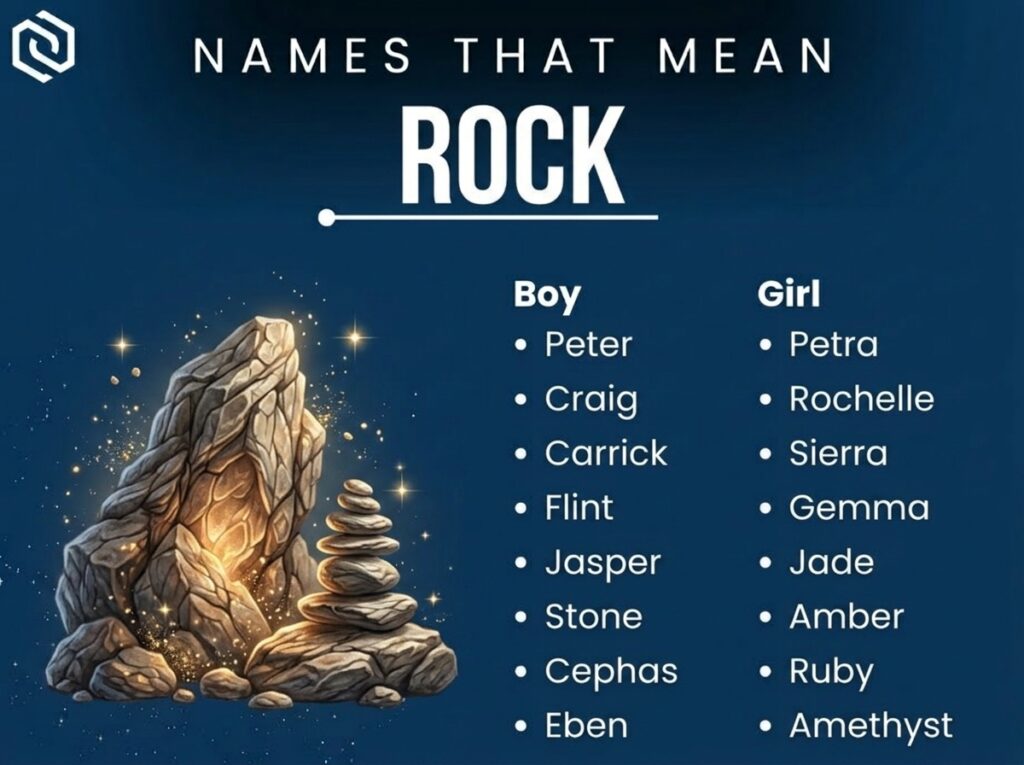
There is something deeply human about naming a child after stone. Rock has symbolized permanence, strength, and protection across nearly every civilization on earth. Mountains were sacred. Boulders marked burial grounds and sacred sites. Stone was the material of temples, thrones, and foundations. A name rooted in rock carries all of that weight quietly, without needing to announce itself.
Parents drawn to these names tend to want something solid. Not trendy. Not fleeting. They want a name that will age well, sit comfortably on both a newborn and a grown adult, and carry a meaning that actually matters. Rock and stone names pull from Aramaic, Greek, Latin, Norse, Celtic, Arabic, Sanskrit, and more. The meaning shows up everywhere, which says something real about how universally humans have valued the qualities stone represents.
What Are the Best Names That Mean Rock or Stone?
Some of the strongest names meaning rock or stone include Peter (Greek, “rock”), Crag (Old English, “rocky cliff”), Silex (Latin, “flint stone”), Petra (Greek, “rock”), Flint (Old English, “hard stone”), Rocco (Germanic, “rest/rock”), Saxe (Old English, “stone”), Sela (Hebrew, “rock”), and Tor (Old Norse, “rocky peak”). These names span centuries and cultures, each carrying the same essential meaning: something unshakeable, enduring, and grounded in the earth.
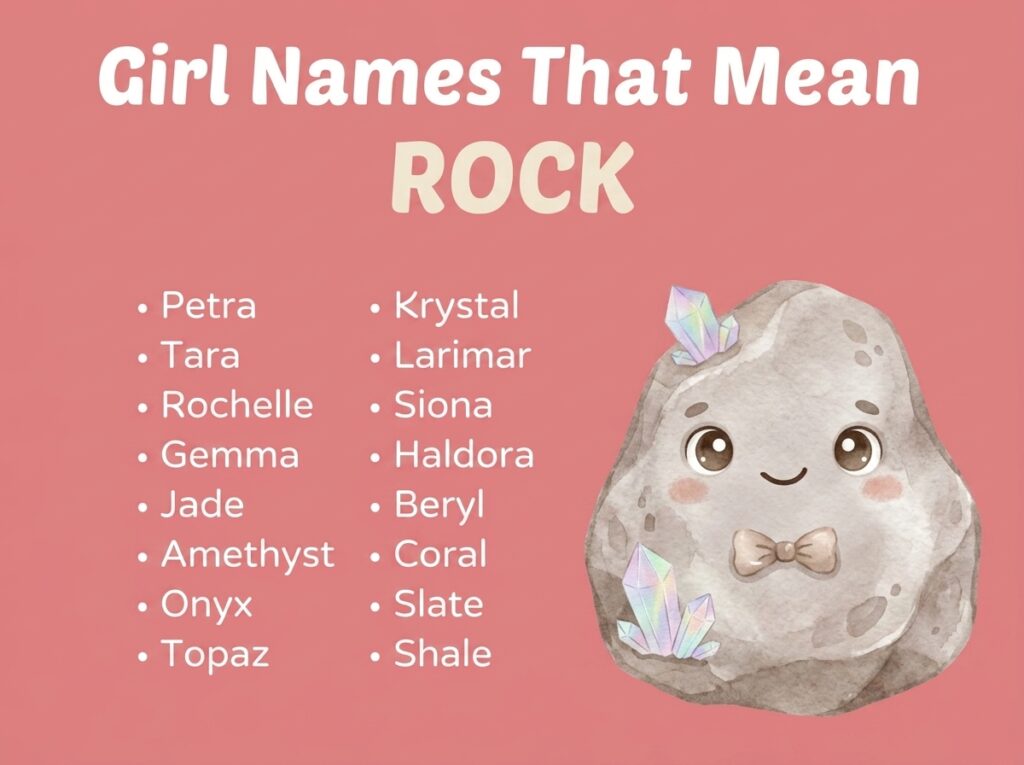
Girl Names That Mean Rock or Stone
Stone names for girls carry a quiet, commanding energy. They are not fussy or delicate. They tend to feel strong without being harsh, and many have a soft sound that balances the weight of their meaning. Whether you love the clean simplicity of Petra or the rarer Sidra, these names have staying power.
| Name | Origin | Meaning | Pronunciation | Popularity |
|---|---|---|---|---|
| Petra | Greek | Rock, stone | PEH-trah | Classic |
| Sela | Hebrew | Rock, cliff | SEE-lah | Soft |
| Silex | Latin | Flint stone | SY-lex | Rare |
| Flint | Old English | Hard stone | FLINT | Trending |
| Saxe | Old English | Stone | SAKS | Unique |
| Roca | Spanish | Rock | ROH-kah | Rare |
| Peta | Greek/English | Rock (variant of Petra) | PEE-tah | Soft |
| Sidra | Latin/Arabic | Of the stars/rocky stream | SID-rah | Unique |
| Gemma | Latin | Precious stone, gem | JEM-ah | Classic |
| Esme | Old French | Esteemed; associated with precious stone | EZ-may | Trending |
| Diamanta | Greek | Diamond, hard as stone | dee-ah-MAN-tah | Rare |
| Shila | Sanskrit | Stone, rock | SHEE-lah | Soft |
| Kaya | Turkish | Rock, cliff | KAY-ah | Trending |
| Cala | Arabic | Castle, rocky fortress | KAH-lah | Soft |
| Tsuru | Japanese | Derived from rocky, crane | TSOO-roo | Mystic |
| Vered | Hebrew | Rose/gem; stone association | VAY-red | Rare |
| Ebba | Germanic/Norse | Strength of stone | EH-bah | Classic |
| Ragnhild | Norse | Battle/stone power | RAHG-hild | Powerful |
| Galena | Greek | Lead ore, stone mineral | gah-LEE-nah | Rare |
| Marbre | French | Marble (stone) | MAR-bruh | Unique |
| Stein | Norse/German | Stone | STYNE | Rare |
| Stoney | English | Stony, of the rocks | STOH-nee | Unique |
Naming Expert’s Note: Kaya deserves more attention than it typically gets in rock and stone naming conversations. Its Turkish root, “kaya,” means precisely “rock” or “cliff face,” and unlike many names on this list, it sounds immediately wearable today. It is short, gentle on the ear, and cross-cultural without being hard to spell or pronounce. For parents who want a stone name that does not announce itself as one, Kaya is a genuinely underused choice.
Also Read: Strong Boy Names That Mean Mountain From Every Language
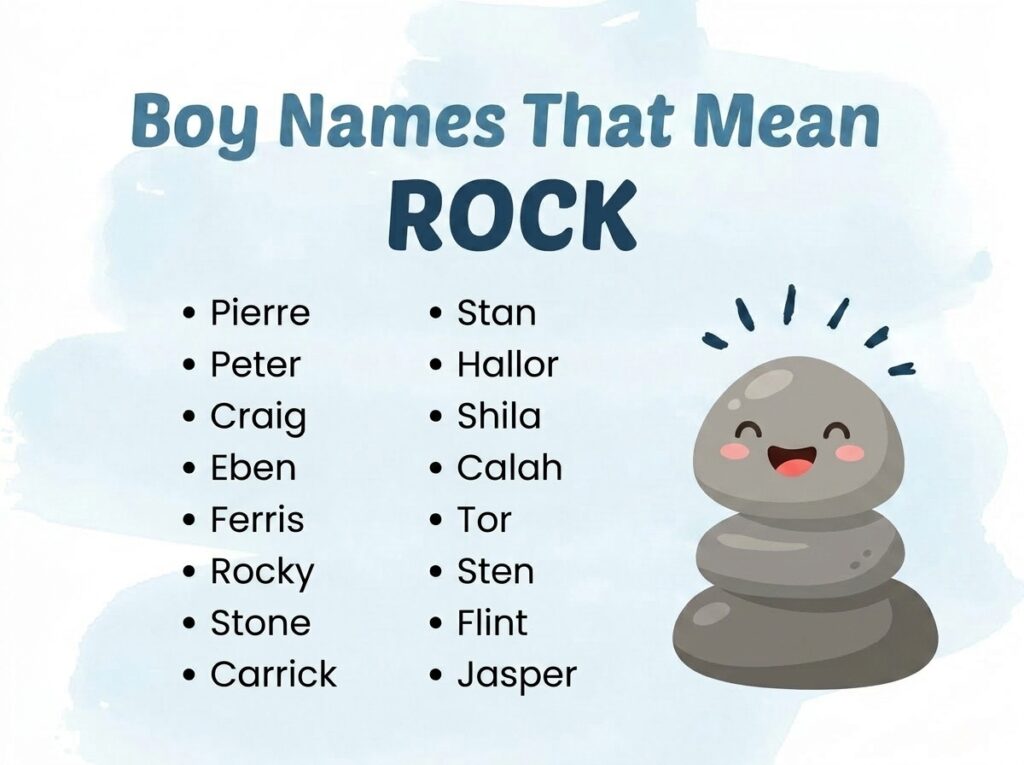
Boy Names That Mean Rock or Stone
Rock and stone names for boys have a long, rich history across cultures. Think of how many civilizations built their most important structures from stone and then named their sons after that same material. These names tend to feel grounded, masculine without being aggressive, and they age exceptionally well.
| Name | Origin | Meaning | Pronunciation | Popularity |
|---|---|---|---|---|
| Peter | Greek/Aramaic | Rock, stone | PEE-ter | Classic |
| Pierre | French | Rock, stone | PYAIR | Classic |
| Rocco | Germanic | Rest; associated with rock/stone | ROH-koh | Trending |
| Flint | Old English | Hard stone, flint rock | FLINT | Trending |
| Craig | Scottish Gaelic | Rocky crag, cliff | KRAYG | Classic |
| Tor | Old Norse | Rocky peak, rocky hill | TOR | Powerful |
| Saxon | Old English | Of the stone workers | SAK-son | Unique |
| Crag | Old English | Rocky cliff | KRAG | Rare |
| Eben | Hebrew | Stone | EH-ben | Soft |
| Ebenezer | Hebrew | Stone of help | eb-en-EE-zer | Classic |
| Petur | Icelandic | Rock, stone | PEH-tur | Rare |
| Peregrine | Latin | Stone traveler (disputed) | PEHR-eh-grin | Rare |
| Takoda | Sioux | Friend to all/stone ground | tah-KOH-dah | Unique |
| Silas | Latin/Aramaic | Of the forest/stone; associated with Aramaic “sheila” (stone) | SY-las | Trending |
| Cailean | Scottish Gaelic | Rock, pup; stone-like | KAL-en | Mystic |
| Jasper | Persian | Treasurer; also a form of stone | JAS-per | Trending |
| Rocky | English | Rocky, full of rocks | ROK-ee | Classic |
| Batu | Mongolian/Turkish | Stone, rock | BAH-too | Unique |
| Colm | Irish | Dove; linked to cliff rock origins | KOL-um | Soft |
| Stein | Norse/German | Stone | STYNE | Powerful |
| Knox | Scottish | From the round hill/rocky hill | NOKS | Trending |
| Colt | Old English | Young horse; also linked to rocky terrain names | KOHLT | Trending |
| Peder | Scandinavian | Rock, stone | PEH-der | Rare |
| Flintlock | English | Stone lock, flint mechanism | FLINT-lok | Dark |
| Saxby | Old English | Stone village | SAKS-bee | Rare |
Unisex Names That Mean Rock or Stone
These names sit comfortably outside any one gender. Some have been used across genders for generations. Others are newer to the gender-neutral space but carry stone meanings just as authentically. Many of these names feel strong on anyone.
| Name | Origin | Meaning | Pronunciation | Popularity |
|---|---|---|---|---|
| Flint | Old English | Hard stone | FLINT | Trending |
| Sela | Hebrew | Rock, cliff | SEE-lah | Soft |
| Kaya | Turkish | Rock, cliff | KAY-ah | Trending |
| Stein | Norse/German | Stone | STYNE | Powerful |
| Saxe | Old English | Stone | SAKS | Unique |
| Rocky | English | Full of rocks | ROK-ee | Classic |
| Gal | Hebrew | Wave/rock; stone mound | GAL | Unique |
| Batu | Mongolian/Turkish | Stone | BAH-too | Rare |
| Tor | Old Norse | Rocky peak | TOR | Powerful |
| Jasper | Persian | Stone gem/treasurer | JAS-per | Trending |
Also Read: Beautiful Names That Mean Crystal Across Cultures and Languages
Rock and Stone Names Across Cultures
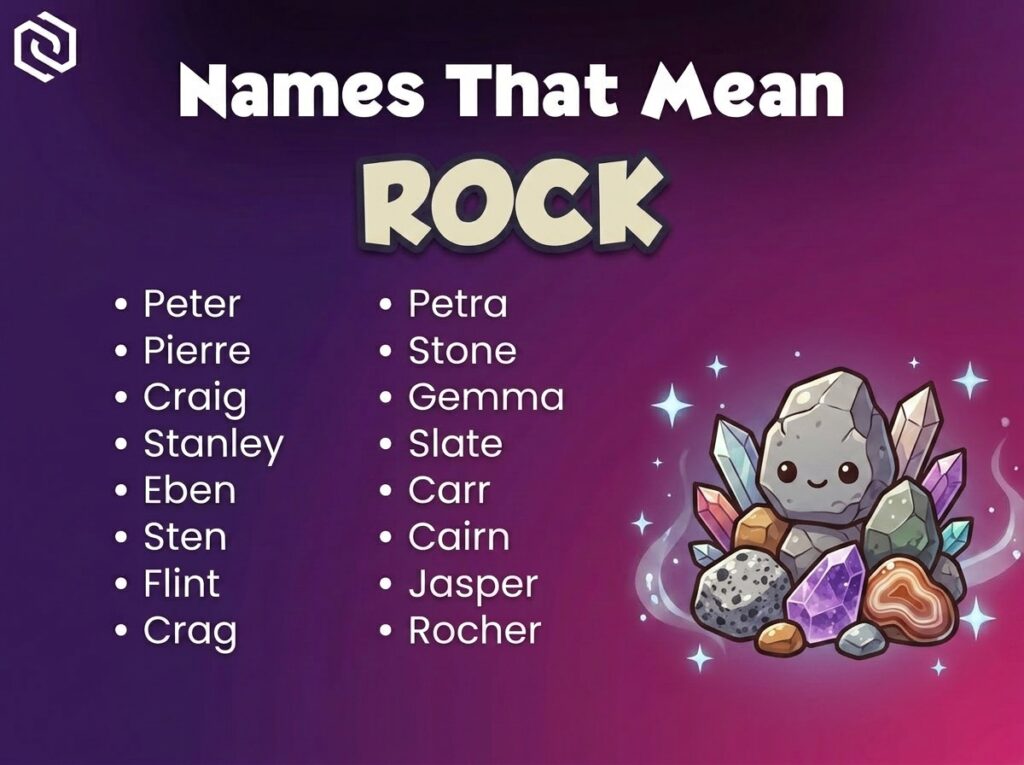
Stone is one of those rare meanings that crosses every border. You find it in Hebrew scripture, in Norse mythology, in Turkish place names, in Sanskrit poetry. That universality is not an accident. Rock was the most permanent material humans encountered. Of course they named their children after it.
Hebrew Names That Mean Rock or Stone
Hebrew offers some of the most well-known stone names in the Western world, largely because of their biblical roots. These names carry deep scriptural meaning alongside their literal translation.
| Name | Meaning | Gender |
|---|---|---|
| Peter | Rock (via Aramaic “Cephas”) | Boy |
| Sela | Rock, cliff | Girl/Unisex |
| Eben | Stone | Boy |
| Ebenezer | Stone of help | Boy |
| Gal | Stone mound, wave | Unisex |
| Cephas | Rock (Aramaic, used in New Testament) | Boy |
| Tzur | Rock, strength | Boy |
Greek Names That Mean Rock or Stone
Greek gave us some of the most widely used stone names in the modern world. The name Peter comes from the Greek word “petros,” which Simon was given by Jesus, making it one of the most historically significant stone names in existence.
| Name | Meaning | Gender |
|---|---|---|
| Petra | Rock | Girl |
| Petros | Rock | Boy |
| Peta | Rock (variant) | Girl |
| Galena | Lead stone mineral | Girl |
| Diamanta | Diamond, hard stone | Girl |
Norse and Germanic Names That Mean Rock or Stone
Norse culture placed stone at the center of their landscape and mythology. Rocky peaks, cliffs, and boulders were considered sacred or inhabited by powerful spirits. That reverence shows up in their names.
| Name | Meaning | Gender |
|---|---|---|
| Tor | Rocky peak | Boy |
| Stein | Stone | Unisex |
| Ragnhild | Battle stone power | Girl |
| Ebba | Strength, stone | Girl |
| Saxby | Stone village | Boy |
Celtic and Gaelic Names That Mean Rock or Stone
Scottish and Irish Gaelic traditions produced some genuinely distinctive stone names. Many are linked to the rugged highland landscapes that shaped Celtic culture. If you are drawn to names that mean strong, many of these Celtic stone names overlap beautifully.
| Name | Meaning | Gender |
|---|---|---|
| Craig | Rocky crag, cliff | Boy |
| Cailean | Rock, pup/stone-like | Boy |
| Creg | Rocky hill | Boy |
| Carraig | Rock (Irish) | Boy |
| Cala | Rocky fortress | Girl |
Turkish and Mongolian Names That Mean Rock or Stone
Turkish names rooted in stone tend to feel modern and wearable today, despite being ancient in origin. Mongolian stone names carry a different energy — vast, open, powerful.
| Name | Meaning | Gender |
|---|---|---|
| Kaya | Rock, cliff | Unisex |
| Batu | Stone, rock | Unisex/Boy |
| Taş | Stone (Turkish) | Boy |
Sanskrit Names That Mean Rock or Stone
Sanskrit stone names appear frequently in South Asian naming traditions and carry both spiritual and physical meanings. Stone in Sanskrit contexts often represents steadiness and the unchanging nature of the soul.
| Name | Meaning | Gender |
|---|---|---|
| Shila | Stone, rock | Girl |
| Asmita | Rock-like (from “asma,” stone) | Girl |
| Achal | Immovable like a rock | Boy |
| Pashana | Stone, rock | Boy |
Names That Mean Mountain
Mountains are stone taken to its highest form. These names carry all the weight and permanence of rock names but add a sense of scale and majesty. They feel less common, which is exactly what makes them interesting. A child named after a mountain is named after something that has stood for millions of years.
Some well-documented names meaning mountain include:
- ** Berg** (Germanic) — mountain
- Mont (French) — mountain
- Yama (Sanskrit/Japanese) — mountain
- Shan (Chinese) — mountain
- Dagr (Old Norse) — connected to mountain spirit
- Parvat (Sanskrit) — mountain, rocky mass
- Fuji (Japanese) — unsurpassable, linked to Mount Fuji
- Andes (from Quechua) — linked to high mountain ranges
- Alp (Germanic) — mountain peak, highland
- Montague (Old French) — pointed mountain
Names That Mean Hard as Stone
There is a subtle difference between naming a child “rock” and naming them “hard as stone.” These names carry a meaning that references the quality of stone, not just the material itself. They suggest resilience and endurance rather than the object itself.
- Achal (Sanskrit) — immovable, steady as rock
- Hardwin (Old English) — hard friend; stone-hard
- Jasper (Persian) — stone treasure; implied hardness of precious gems
- Adamant (Greek, via Latin) — unconquerable, originally referred to hard stone or diamond
- Ferrock (English variation) — iron-hard rock (rare, used in mineral naming)
- Constance (Latin) — steadfast, firm as stone
- Sterling (Old English) — of high quality; linked to stone-quality firmness
- Eidolon (Greek) — solid form (rare literary use)
- Aine (Irish) — brightness, linked to stone-bright qualities in Celtic tradition
- Solace (Latin) — comfort with roots in solid ground associations
Names That Mean Stone in Different Traditions
Not every culture uses the same word for stone, and not every tradition honors it the same way. This section looks at how specific linguistic traditions built names directly from their word for stone or rock.
Names in this category include direct translations rather than loose associations:
- Petros / Pierre / Pedro / Peder / Petur — all variants of the Greek “petros” meaning rock, spread across European languages through Christian naming traditions
- Cephas — the Aramaic word for rock used directly as a name in the New Testament
- Eben / Ebenezer — Hebrew “eben” (stone), with Ebenezer meaning “stone of help”
- Tzur — Hebrew word for rock used directly as a biblical name
- Batu — the Mongolian and Turkish word for stone, used as a personal name; Batu Khan was a famous 13th-century Mongol ruler
- Shila / Ashila — directly from Sanskrit “shila” meaning stone or rock
- Kaya — directly from Turkish “kaya” meaning rock or cliff
How to Choose the Right Rock or Stone Name
Sound matters more than you think. A one-syllable stone name like Flint or Tor hits differently than a three-syllable name like Ebenezer or Diamanta. Think about how it pairs with your last name and whether you want a short punch or something with more rhythm.
Cultural origin matters too. If your family has no connection to a particular culture, some names will sit more naturally than others. That does not mean you cannot choose across cultures, but knowing the background helps you commit with confidence.
- Say the full name out loud, first and last, at least ten times
- Check what the initials spell
- Think about what the natural nickname would be
- Research the cultural context of the origin before committing
- Consider how the name sounds on a kindergartner versus a 40-year-old
- Check current popularity if you want your child to be the only one in their class with that name
Frequently Asked Questions
Q: What is the most popular name that means rock or stone?
A: Peter is almost certainly the most widely used name meaning rock in the world. Derived from the Greek “petros,” it spread globally through Christianity and has been a top name across dozens of countries for over a thousand years. Jasper and Flint are currently trending as popular stone names for modern babies.
Q: What does rock mean in different languages?
A: Rock or stone translates across languages in ways that have become personal names. In Greek it is “petros,” in Hebrew “eben” or “tzur,” in Turkish “kaya,” in Mongolian “batu,” in Sanskrit “shila,” and in Norse “stein.” Each of these has produced real names used across generations.
Q: What are some rare names that mean rock or stone?
A: Some genuinely uncommon stone names include Cephas (Aramaic, “rock”), Pashana (Sanskrit, “stone”), Galena (Greek, a type of stone mineral), Saxby (Old English, “stone village”), and Roca (Spanish, “rock”). These are verifiable stone names that rarely appear on modern baby name charts.
Q: What is a good middle name to pair with Peter?
A: Peter pairs beautifully with single-syllable middle names. Peter James, Peter Cole, and Peter Lane all flow well. For something more unusual, Peter Cael or Peter Flynn give it a slightly fresher feel without losing the classic weight of the first name.
Q: Are rock and stone names still popular today?
A: Yes, and they are growing. Names like Jasper, Flint, Knox, and Kaya are all climbing in popularity in English-speaking countries. There is a broader shift toward nature-based and earth-element names right now, and rock names sit right at the center of that trend.
Q: Is Rocky a legitimate name or just a nickname?
A: Rocky functions as both. It has been used as a given name independently of Robert or Rocco for decades in the United States, popularized in part by the film character Rocky Balboa. Its root connects to Old English words for stone and rock terrain. It is absolutely a legitimate standalone name with genuine stone-related meaning.
Conclusion
Rock and stone names cover extraordinary ground. From the biblical weight of Ebenezer to the clean modern edge of Flint, from the Turkish softness of Kaya to the Norse power of Tor, these names span thousands of years and dozens of cultures. What holds them together is the same quality that makes stone itself valuable: permanence. Names rooted in rock do not go out of style because the thing they represent never does. If you are drawn to earth-element names more broadly, exploring names that mean mountain or names that mean nature will give you even more grounded, lasting choices to consider.