The deer is one of the most universally admired animals in human history. Across cultures, it has long symbolized grace, gentleness, swiftness, and an almost sacred connection to the natural world. In Celtic tradition, the deer was seen as a messenger between realms. In Hindu mythology, the deer appears beside goddesses as a creature of divine purity. In East Asian cultures, it represents longevity and good fortune. That depth of meaning is exactly why deer names carry such quiet power.
Parents drawn to names that mean deer tend to value something understated. They want a name with roots, one that carries a story without announcing itself loudly. These names suit families who love nature, mythology, or names that feel grounded and timeless rather than trendy. Whether you are looking for something soft and feminine, strong and earthy, or something beautifully in between, deer names offer far more variety than most people expect.
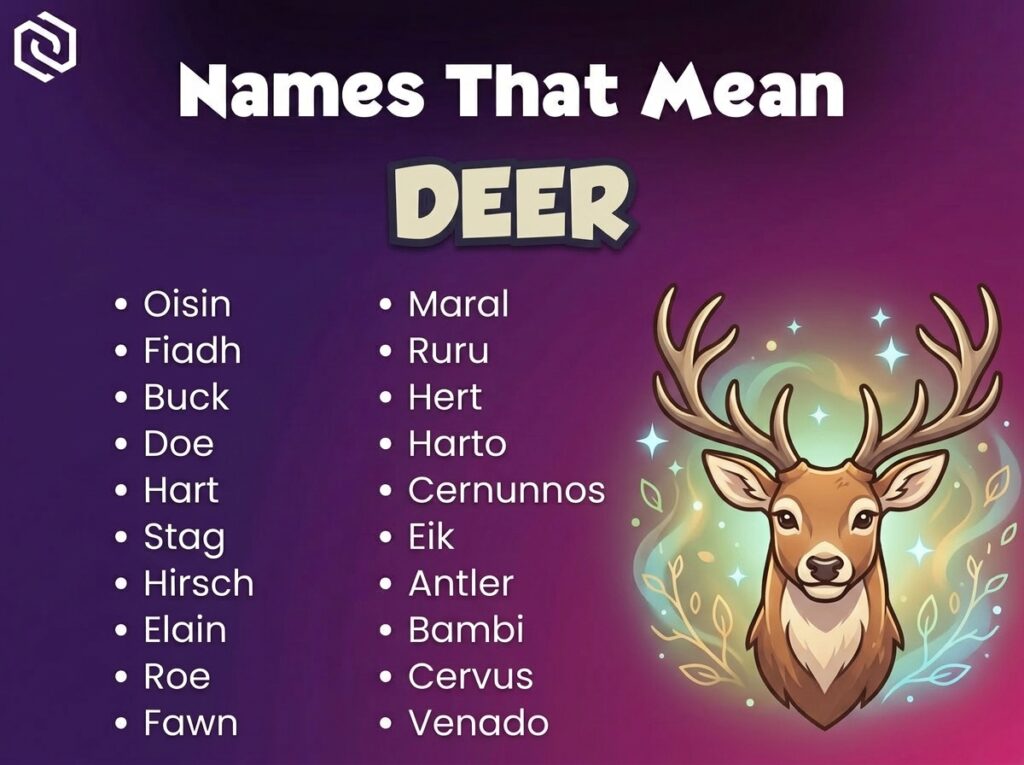
What Are Some Names That Mean Deer?
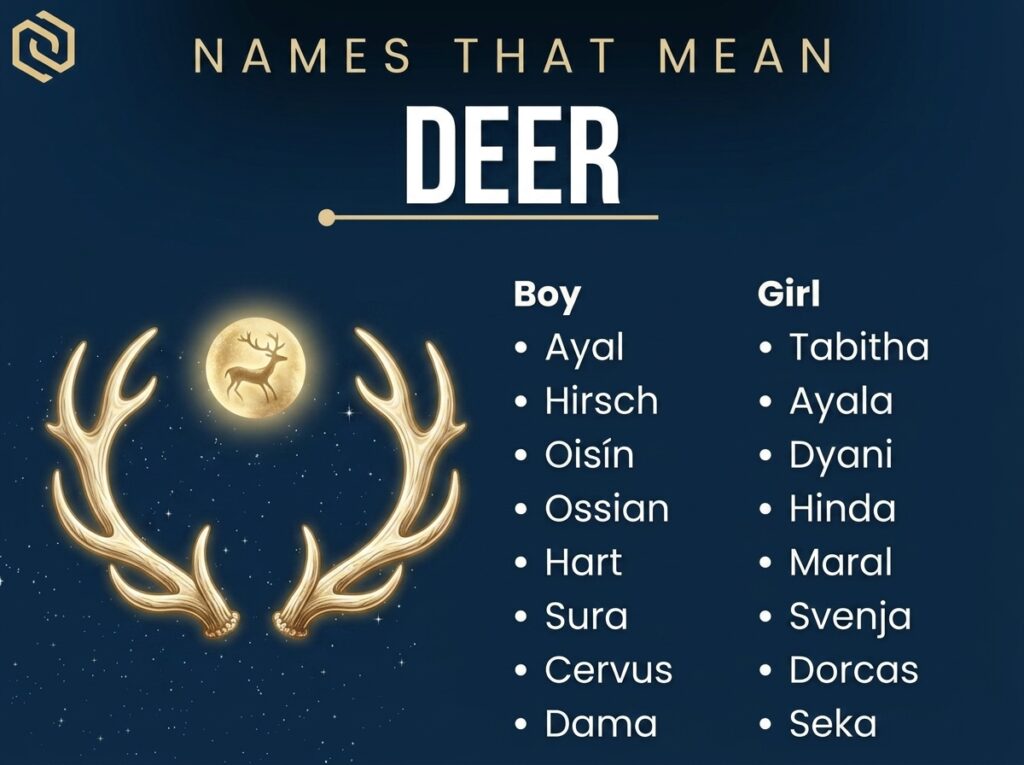
Some of the most compelling names that mean deer include Eilidh (Scottish Gaelic, meaning “deer”), Hinda (Yiddish/Hebrew, meaning “female deer”), Oisín (Irish, meaning “little deer”), Dara (Irish, connected to oak and deer symbolism), Ruko (Japanese, meaning “deer child”), Ayala (Hebrew, meaning “doe, female deer”), Buck (English, meaning “male deer”), and Roan (Irish, connected to deer in Gaelic tradition). These names span languages and continents, but they all carry that same quiet, nature-rooted elegance that makes deer names so enduring.
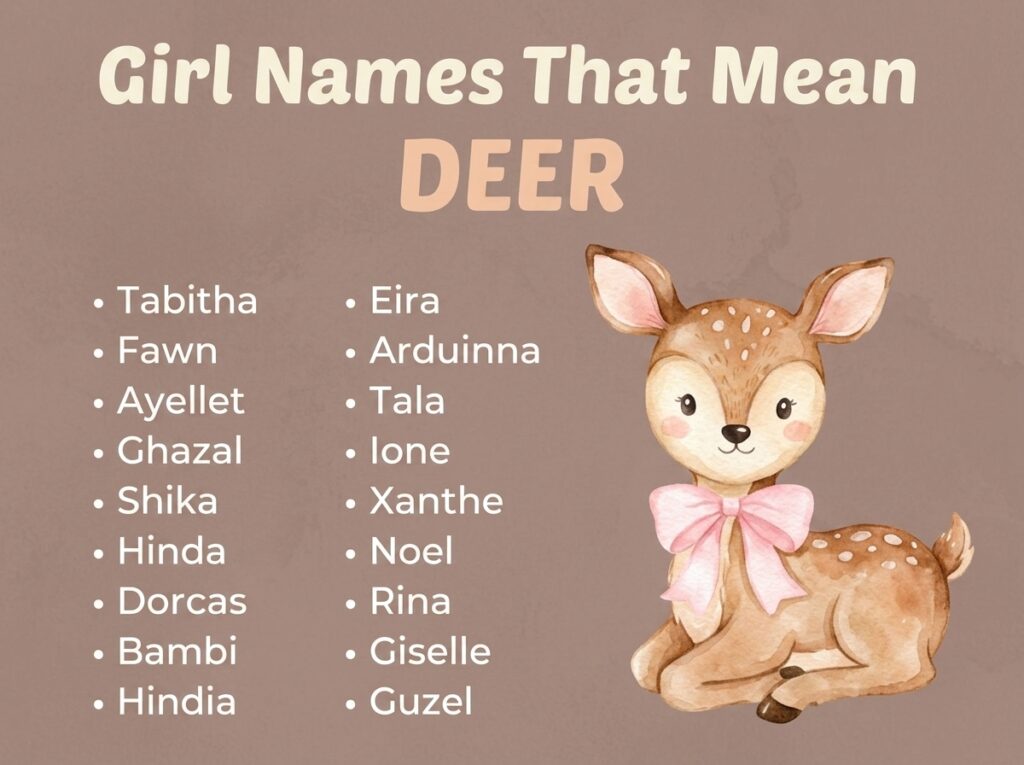
Girl Names That Mean Deer
Feminine deer names have a softness that feels both grounded and poetic. Many come from ancient Celtic, Hebrew, and Japanese traditions where the doe was associated with grace, motherhood, and the sacred feminine. These names tend to be gentle on the ear without feeling fragile. They carry a quiet strength, much like the animal itself.
| Name | Origin | Meaning | Pronunciation | Popularity |
|---|---|---|---|---|
| Ayala | Hebrew | Doe, female deer | ah-YAH-lah | Trending |
| Hinda | Yiddish/Hebrew | Female deer, doe | HIN-dah | Classic |
| Eilidh | Scottish Gaelic | Deer | AY-lee | Rare |
| Oisín (f. use) | Irish | Little deer | UH-sheen | Mystic |
| Ruko | Japanese | Deer child | ROO-koh | Unique |
| Hinako | Japanese | Deer child | hee-NAH-koh | Soft |
| Kanoko | Japanese | Deer child, fawn | kah-NOH-koh | Soft |
| Shika | Japanese | Deer | SHEE-kah | Rare |
| Doe | English | Female deer | DOH | Unique |
| Deerla | Modern English | Female deer | DEER-lah | Rare |
| Eila | Finnish/Hebrew | Oak tree / deer (variant) | AY-lah | Soft |
| Ayelet | Hebrew | Doe of the dawn | ah-YEH-let | Classic |
| Hind | Arabic | Female deer, doe | HIND | Classic |
| Hindah | Hebrew | Female deer | HIN-dah | Rare |
| Elen | Welsh | Deer goddess, nymph of the deer | EL-en | Mystic |
| Fawn | English | Young deer | FAWN | Soft |
| Vénusz | Hungarian | Doe variant (folk use) | VAY-nooss | Unique |
| Cervia | Latin/Italian | Of the deer (cervo) | CHEHR-vee-ah | Rare |
| Runa | Old Norse/Japanese | Secret lore / deer variant | ROO-nah | Trending |
| Herne (f. use) | English | Horned deer deity | HURN | Mystic |
Also Read: Names That Mean Nature From Cultures Around the World
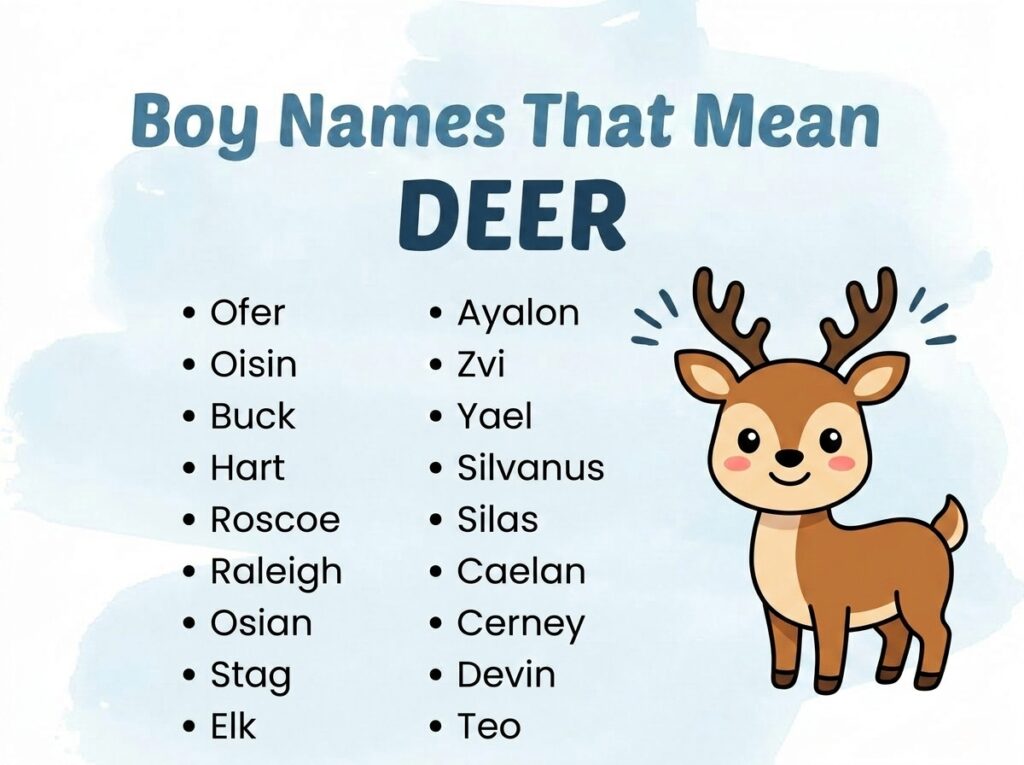
Boy Names That Mean Deer
Deer names for boys tend to have a grounded, earthy quality. Some are ancient warrior names from Celtic tradition, where the deer was a symbol of nobility and the hunt. Others come from Japanese and Hebrew roots, carrying a gentler but equally meaningful weight. These names feel substantial without being heavy.
| Name | Origin | Meaning | Pronunciation | Popularity |
|---|---|---|---|---|
| Oisín | Irish | Little deer | UH-sheen | Classic |
| Oscar | Old Norse/Irish | Deer lover, friend of deer | OS-kar | Trending |
| Buck | English | Male deer | BUK | Powerful |
| Hart | Old English | Adult male deer, stag | HART | Classic |
| Hiroshi | Japanese | Prosperous / deer connection | hee-ROH-shee | Trending |
| Hideo | Japanese | Excellent man / deer (alternate kanji) | hee-DAY-oh | Classic |
| Riku | Japanese | Land / can use deer kanji (鹿) | REE-koo | Trending |
| Buckley | Old English | Deer meadow | BUK-lee | Rare |
| Hartley | Old English | Deer meadow | HART-lee | Rare |
| Stagg | Old English | Male deer, stag | STAG | Unique |
| Roan | Irish Gaelic | Little seal / deer folk name | ROHN | Soft |
| Cernunnos | Celtic | Horned deer god | kur-NOO-nos | Mystic |
| Dara | Irish | Connected to deer and oak | DAR-ah | Rare |
| Hearn | Old English | Heron / deer-keeper | HURN | Dark |
| Osheen | Anglicized Irish | Little deer (variant of Oisín) | oh-SHEEN | Rare |
| Hiraku | Japanese | Open / deer kanji variant | hee-RAH-koo | Unique |
| Staghorn | English | Stag’s horn | STAG-horn | Rare |
| Ackerley | Old English | Meadow of oak and deer | AK-er-lee | Rare |
| Bucky | American English | Diminutive of Buck, male deer | BUK-ee | Classic |
| Herne | English | Horned deer deity of forests | HURN | Mystic |
Also Read: Names That Mean Hunter: Bold and Nature-Rooted Choices
Unisex Names That Mean Deer
Gender-neutral deer names tend to sit quietly at the crossroads of strength and softness. Many work beautifully across all genders precisely because the deer itself has never been exclusively one thing in world mythology. It is swift and fierce in some traditions, tender and gentle in others.
| Name | Origin | Meaning | Pronunciation | Popularity |
|---|---|---|---|---|
| Fawn | English | Young deer, baby deer | FAWN | Soft |
| Dara | Irish | Connected to deer/oak in Gaelic tradition | DAR-ah | Trending |
| Hartley | Old English | Deer meadow | HART-lee | Classic |
| Shika | Japanese | Deer | SHEE-kah | Unique |
| Ruko | Japanese | Deer child | ROO-koh | Soft |
| Roe | Old English | Roe deer, small deer species | ROH | Rare |
| Buckley | Old English | Deer meadow | BUK-lee | Rare |
| Eilidh | Scottish Gaelic | Deer | AY-lee | Mystic |
| Deer | English | Direct word name | DEER | Unique |
| Ackerley | Old English | Deer meadow clearing | AK-er-lee | Rare |
Deer Names Across Cultures
The deer appears in the mythologies, languages, and naming traditions of nearly every major civilization on Earth. That is not a coincidence. From the sacred deer of the Shinto forests in Japan to the goddess Artemis hunting alongside deer in ancient Greece, this animal has always carried profound meaning. Understanding where these names come from makes choosing one feel even more intentional.
Irish and Celtic Names That Mean Deer
The Celts held the deer in enormous reverence. The stag, in particular, was a symbol of the otherworld and divine kingship. Celtic deer names tend to sound ancient and poetic.
| Name | Meaning | Gender |
|---|---|---|
| Oisín | Little deer | Boy |
| Eilidh | Deer | Girl |
| Dara | Oak and deer (interlinked) | Unisex |
| Osheen | Little deer (anglicized) | Boy |
| Elen | Nymph of the deer, deer goddess | Girl |
| Cernunnos | Horned deer god | Boy |
| Herne | Forest deer deity | Unisex |
Hebrew and Yiddish Names That Mean Deer
In Biblical Hebrew, the deer (specifically the doe) is a symbol of beauty and swiftness. The word ayelet appears in the Psalms. These names have genuine religious and literary roots.
| Name | Meaning | Gender |
|---|---|---|
| Ayala | Female deer, doe | Girl |
| Ayelet | Doe of the dawn | Girl |
| Hinda | Female deer | Girl |
| Hindah | Female deer (variant) | Girl |
| Zvi | Deer, gazelle (used for deer family) | Boy |
| Tzvia | Female deer, doe | Girl |
Japanese Names That Mean Deer
In Japan, the deer (shika, 鹿) is sacred. The deer at Nara’s famous shrine are considered divine messengers. Japanese names incorporating the deer kanji carry a sense of spiritual calm and natural beauty.
| Name | Meaning | Gender |
|---|---|---|
| Shika | Deer | Unisex |
| Ruko | Deer child | Girl |
| Kanoko | Deer child, fawn | Girl |
| Hinako | Deer child | Girl |
| Riku (鹿久) | Deer/long (alternate kanji) | Boy |
| Shikao | Deer man | Boy |
Arabic Names That Mean Deer
In Arabic culture, the deer, particularly the doe, is a classical symbol of feminine beauty. Arabic poetry frequently references the hind (female deer) as the ideal of grace.
| Name | Meaning | Gender |
|---|---|---|
| Hind | Female deer, doe | Girl |
| Ghazal | Gazelle/deer (deer family) | Girl |
| Reem | White antelope/deer type | Girl |
Old English Names That Mean Deer
Old English has given us several place-name-derived surnames and given names rooted in deer. These tend to feel strong, earthy, and distinctly British in character.
| Name | Meaning | Gender |
|---|---|---|
| Hart | Adult male deer, stag | Boy |
| Buck | Male deer | Boy |
| Hartley | Deer meadow | Unisex |
| Buckley | Deer meadow | Unisex |
| Roe | Roe deer (small deer species) | Unisex |
| Ackerley | Deer meadow clearing | Unisex |
| Bucky | Little buck, male deer | Boy |
Also Read: Names That Mean Wolf: Wild and Powerful Choices for Any Gender
Names That Mean Fawn, Doe, or Stag
The deer family is broad, and naming traditions reflect that. Fawns, does, stags, and bucks each carry slightly different symbolic weight. It is worth exploring each variation, because a name that means “fawn” feels quite different from one that means “stag.”
Names That Mean Fawn
A fawn is a baby deer, and names with this meaning tend to carry softness and youth. They suit parents looking for something gentle and nature-connected without being too unusual.
- Fawn (English) — direct word name for a baby deer
- Kanoko (Japanese) — literally “deer child,” referring to a spotted fawn
- Faon (French) — French word for fawn, occasionally used as a name
- Hinako (Japanese) — deer child, fawn-like
- Ruko (Japanese) — deer child
- Deerla (Modern English) — feminine invented form referencing the deer
- Fauve (French) — wild, tawny; associated with the color of a young deer
- Eila (Finnish) — soft name associated with the deer tradition in Northern Europe
- Cerva (Latin/Italian) — female deer, doe or fawn
- Doewyn (Welsh-inspired) — white doe
Names That Mean Doe
The doe, the adult female deer, is one of the most poetic animals in world literature. Names meaning “doe” carry grace, femininity, and quiet strength.
- Ayala (Hebrew) — doe, female deer
- Hinda (Yiddish) — female deer
- Hind (Arabic) — female deer, doe
- Tzvia (Hebrew) — female deer
- Ayelet (Hebrew) — doe of the dawn
- Doe (English) — direct word name
- Hindah (Hebrew) — variant of Hinda
- Cervia (Latin) — of the female deer
- Reem (Arabic) — a type of female deer or antelope
- Eilidh (Scottish Gaelic) — deer (feminine form dominant)
Names That Mean Stag or Buck
Stag names feel bold and ancestral. These are the names with spine, carrying connotations of the hunt, wild forests, and ancient nobility.
- Hart (Old English) — adult male deer, stag
- Buck (Old English) — male deer
- Herne (English) — forest god associated with the stag
- Cernunnos (Celtic) — the horned deer deity
- Oscar (Irish/Old Norse) — deer lover or friend of deer
- Oisín (Irish) — little deer, son of the great hunter Fionn
- Stagg (Old English) — direct stag name
- Hirschel (Yiddish) — little deer/stag
- Buck (American English) — male deer
- Hartley (Old English) — stag’s meadow
Also Read: Names That Mean Forest for Nature-Loving Families
🔖 Naming Expert’s Note
Oisín deserves far more attention outside of Ireland. It is one of the oldest and most storied names in Celtic mythology, belonging to the legendary poet-warrior son of Fionn mac Cumhaill. The name literally means “little deer,” rooted in the Irish word os for deer. In the myth, Oisín’s mother was a woman transformed into a deer, making the name carry real narrative weight, not just pleasant meaning. The pronunciation (UH-sheen) can feel unfamiliar to non-Irish speakers at first, but once you hear it a few times, it clicks. If you want a name that is genuinely rare in English-speaking countries while being deeply rooted in real mythology, Oisín is one of the best options in this entire category.
How to Choose the Right Deer Name
Sound matters enormously with nature names. A name like Hart feels punchy and strong, while Ayala has three flowing syllables that move gently. Think about how the name pairs with your last name and whether you want something that sounds soft or grounded.
Cultural origin matters too. If you have Irish heritage, Oisín carries a lineage you can trace. If the name has no connection to your background, that is still fine, but it is worth understanding what tradition you are drawing from.
- Say it out loud with your last name at least ten times
- Check the initials, particularly if the last name starts with a vowel
- Consider natural nicknames (Hart stays Hart, but Hartley becomes Harte or Lee)
- Research the cultural origin before committing, especially for Irish or Japanese names
- Think about how the name sounds on a child and also on a forty-year-old professional
- Check current popularity if you want something less expected
Frequently Asked Questions
Q: What is the most popular name that means deer?
A: Oscar is arguably the most widely used name with a deer connection, derived from Old Norse and Irish roots meaning “deer lover” or “friend of deer.” However, for a more direct meaning, Ayala is increasingly popular in English-speaking countries and explicitly means “doe” in Hebrew.
Q: What does deer mean in different languages?
A: The word for deer varies widely. In Irish Gaelic it is os or fia, in Japanese it is shika (鹿), in Arabic the female deer is hind, in Hebrew it is ayalah, in Latin it is cervus (male) or cerva (female), and in Old English it was heorot (stag) or hind (doe). Each of these root words has produced distinct naming traditions.
Q: What are some rare names that mean deer?
A: Some genuinely rare options include Eilidh (Scottish Gaelic, meaning deer), Cervia (Latin, female deer), Ackerley (Old English, deer meadow), Kanoko (Japanese, fawn/deer child), and Tzvia (Hebrew, female deer). These names are rarely used outside their cultures of origin, which makes them distinctive choices.
Q: What is a good middle name to pair with Oisín?
A: Oisín pairs beautifully with single-syllable or two-syllable middle names that do not compete with its three-syllable flow. Options like Oisín James, Oisín Finn, Oisín Cole, or Oisín Blaise all work well. For a more Irish-rooted combination, Oisín Cormac or Oisín Tadhg are both compelling.
Q: Are deer names still popular?
A: Deer names are genuinely having a quiet moment. As nature names trend upward across English-speaking countries, names like Fawn, Hart, and Ayala are being rediscovered. Fawn in particular has shown renewed interest, and Ayala is climbing steadily in the U.S. and U.K. These names feel fresh without being invented.
Q: Is there a deer goddess or deity whose name I could use?
A: Yes. Elen of the Ways is a Welsh deer goddess associated with ancient forest paths and the migration of deer herds. Her name, Elen, is a usable, soft, and beautiful option for girls. Cernunnos is the Celtic horned deer god, whose name is more evocative than practical for everyday use. In Shinto tradition, the sacred deer of Nara are considered messengers of the gods, though no single named deity is associated with them specifically.
Conclusion
Deer names span an extraordinary range, from the ancient Celtic mythology of Oisín to the Hebrew grace of Ayala, the Japanese spirituality of Kanoko, and the earthy Old English directness of Hart. What connects them all is that same quality the deer has always represented: something that moves through the world quietly but leaves an impression. These names age beautifully precisely because they are rooted in something real.
If you love names drawn from the natural world, you might also enjoy exploring Names That Mean Wolf for Every Gender or Beautiful Names That Mean Nature Across Cultures.