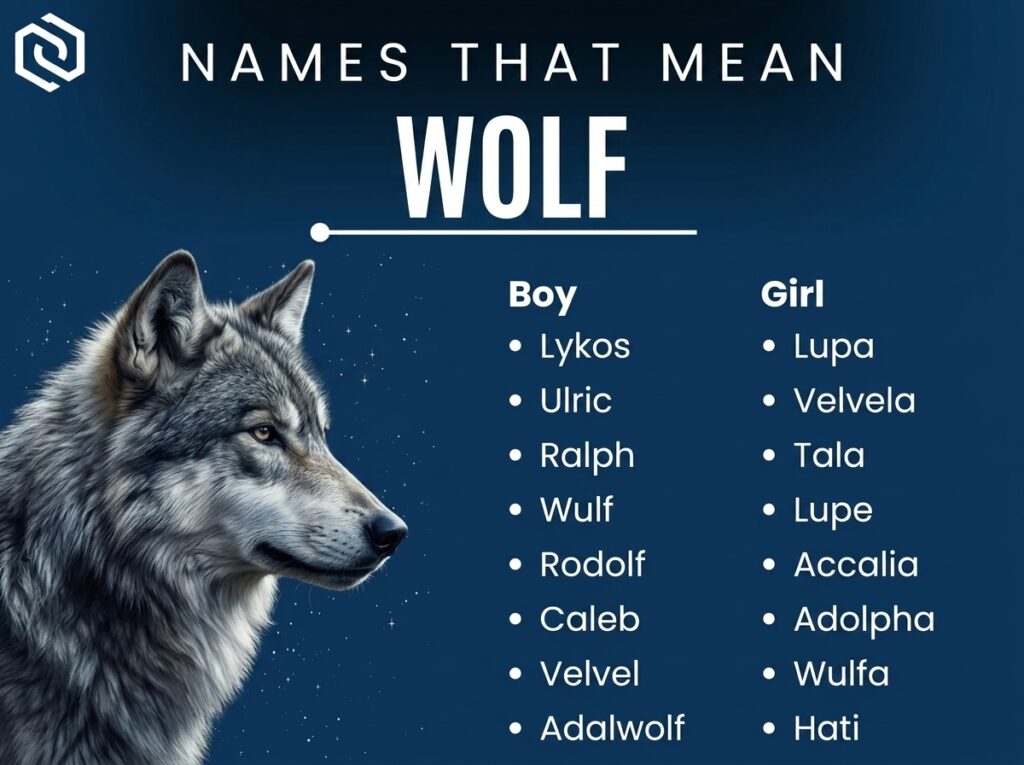
The wolf has carried powerful meaning across human cultures for thousands of years. Not just as a predator, but as a symbol of loyalty, instinct, wild intelligence, and fierce protection. Wolves run in packs. They’re devoted to their family. They’re strategic hunters and deeply intuitive creatures. A name rooted in wolf energy carries all of that.
Parents drawn to wolf names tend to want something with real weight behind it. Not trendy for the sake of trending. Something that feels ancient and strong. These names come from Norse mythology, Germanic tribal traditions, Native American languages, Old English, Latin, and more — each one carrying a genuine etymological or mythological connection to the wolf itself.
What Are the Best Names That Mean Wolf?
Some of the strongest names with a direct wolf meaning include Lycan (from the Greek lykos, meaning wolf), Ulric (Old English, “wolf power”), Lupa (Latin, “she-wolf”), Channing (Old English, “wolf cub”), Adolfo (Germanic, “noble wolf”), Lykos (Greek, directly meaning wolf), Skoll (Norse wolf mythology), and Ylva (Old Norse, “she-wolf”). These names span continents and centuries, but all share a genuine, direct connection to the wolf as a word, symbol, or living mythological figure.
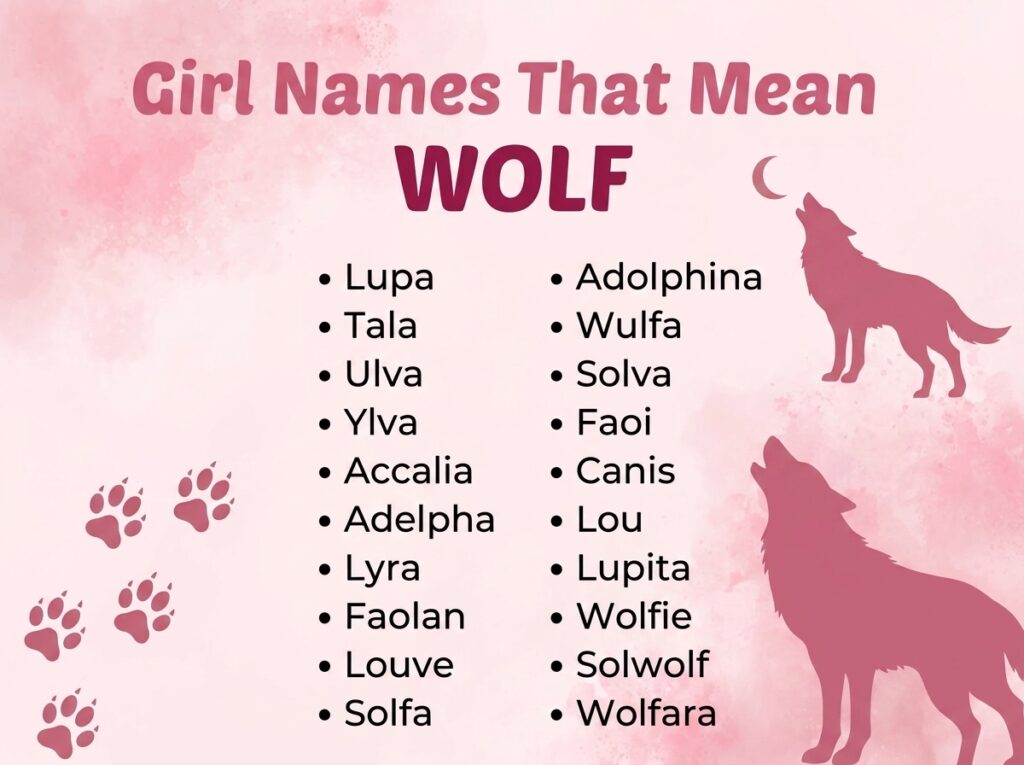
Girl Names That Mean Wolf
She-wolf names have a rare kind of strength. They’re not soft or decorative — they carry an edge, a wildness, a loyalty that feels earned. Many of the most compelling girl names with wolf meanings come from Old Norse and Germanic roots, cultures where the wolf was treated as a sacred and respected animal, not a villain. These names suit girls who feel like they were born running.
| Name | Origin | Meaning | Pronunciation | Popularity |
|---|---|---|---|---|
| Ylva | Old Norse | She-wolf | ILL-vah | Trending |
| Lupa | Latin | She-wolf | LOO-pah | Mystic |
| Adolfa | Germanic | Noble she-wolf | ah-DOLF-ah | Rare |
| Lovota | Lakota | She-wolf who hunts | loh-VOH-tah | Unique |
| Lycanis | Greek | She-wolf | LYE-kan-iss | Rare |
| Ulrika | Old Norse/German | Wolf ruler (feminine) | ul-REE-kah | Classic |
| Skade | Old Norse | Wolf-related huntress figure | SKAH-deh | Mystic |
| Vulfila | Gothic | Little wolf | vul-FEE-lah | Rare |
| Ragnhild | Old Norse | Battle wolf or counsel wolf | RAHN-hild | Dark |
| Channing | Old English | Wolf cub | CHAN-ing | Trending |
| Liulfr (Liulfa) | Old Norse | Love-wolf (feminine form) | LYOOL-fah | Rare |
| Adolpha | Old High German | Noble wolf | ah-DOLF-ah | Rare |
| Wulfrun | Old English | Wolf secret or wolf counsel | WULF-run | Unique |
| Fennir | Old Norse (variant) | Fen wolf, inspired by Fenrir | FEN-ir | Dark |
| Belva | Latin-influenced | Beautiful wolf (variant lupa root) | BEL-vah | Soft |
| Ulfheiðr | Old Norse | Wolf heath, she-wolf warrior | ULF-hayth | Mystic |
| Gunnulf (Gunna) | Old Norse | Battle wolf (feminine use) | GUN-ah | Powerful |
| Zéva | Greek (feminine of Zeus-wolf root) | She-wolf; related to Zev | ZAY-vah | Trending |
| Vargr | Old Norse | Wolf (used in modern Scandi naming) | VAR-gr | Dark |
| Lykaina | Greek | She-wolf | ly-KAY-nah | Mystic |
Also Read: Girl Names That Mean Dark, Shadow, or Night for Your Daughter
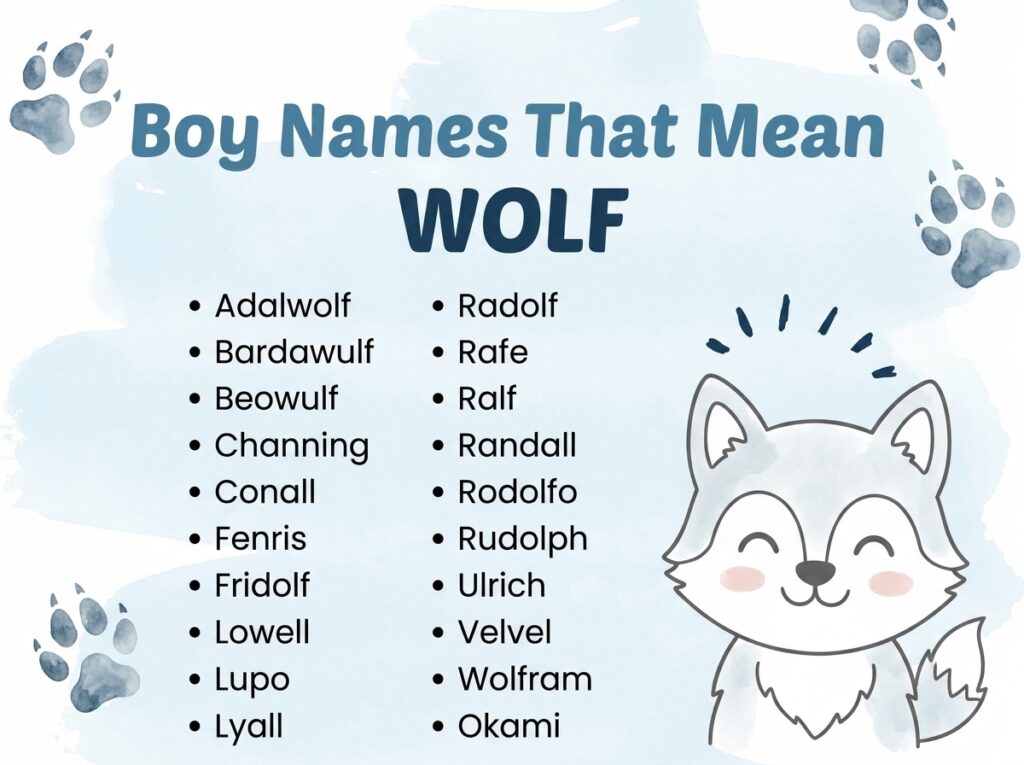
Boy Names That Mean Wolf
Wolf names for boys have been around for as long as people have had names. The Germanic tribes named their sons after wolves deliberately — it wasn’t metaphorical, it was aspirational. Names like Wolfgang and Adolf were given to future leaders, warriors, and chiefs. These aren’t names parents chose because they sounded cool. They chose them because wolves meant something. Today, they still do.
| Name | Origin | Meaning | Pronunciation | Popularity |
|---|---|---|---|---|
| Wolfgang | German | Wolf path / traveling wolf | WOLF-gang | Classic |
| Ulric | Old English | Wolf power / wolf ruler | UL-rik | Powerful |
| Adolfo | Germanic/Spanish | Noble wolf | ah-DOL-foh | Classic |
| Lycan | Greek | Wolf (from lykos) | LYE-kan | Trending |
| Lykos | Greek | Wolf (direct meaning) | LYE-kos | Mystic |
| Fenrir | Old Norse | Fen-dwelling wolf (mythological) | FEN-reer | Dark |
| Zev | Hebrew | Wolf | ZEV | Trending |
| Varg | Old Norse | Wolf | VARG | Dark |
| Ulf | Old Norse/Scandinavian | Wolf | OOLF | Classic |
| Conan | Celtic/Irish | Little wolf (disputed, but strong tradition) | KOH-nan | Classic |
| Rudolph | Old High German | Famous wolf | ROO-dolf | Classic |
| Randolph | Old English | Shield-wolf | RAN-dolf | Classic |
| Wulfric | Old English | Wolf power | WULF-rik | Powerful |
| Odolf | Old High German | Prosperous wolf | OH-dolf | Rare |
| Lovell | Old French | Little wolf | LUV-el | Unique |
| Guadalupe | Arabic/Spanish | Valley of the wolf | gwah-dah-LOO-pay | Classic |
| Adalwulf | Old High German | Noble wolf | ah-DAHL-woolf | Rare |
| Skoll | Old Norse | Mythological wolf who chases the sun | SKOLL | Mystic |
| Bardolph | Old English | Bright wolf / ax-wolf | BAR-dolf | Rare |
| Styrbiörn | Old Norse | Battle-bear wolf compound | STEER-byorn | Unique |
Also Read: Strong Boy Names That Mean Warrior From Every Language
Unisex Names That Mean Wolf
Some wolf names sit beautifully in the middle — strong enough for any child, regardless of gender. These tend to be shorter, more stripped-back names. They carry the wolf’s essence without leaning into traditionally masculine or feminine sounds. If you want a wolf name that ages well and crosses cultural lines, this is a good place to start.
| Name | Origin | Meaning | Pronunciation | Popularity |
|---|---|---|---|---|
| Zev | Hebrew | Wolf | ZEV | Trending |
| Lycan | Greek | Wolf | LYE-kan | Trending |
| Varg | Old Norse | Wolf | VARG | Dark |
| Ulv | Scandinavian | Wolf | OOLVV | Unique |
| Ulf | Old Norse | Wolf | OOLF | Classic |
| Channing | Old English | Wolf cub | CHAN-ing | Soft |
| Lovell | Old French/Norman | Little wolf | LUV-el | Unique |
| Rolf | Old Norse | Fame + wolf | ROLF | Classic |
| Adalwulf | Old High German | Noble wolf | ah-DAHL-woolf | Rare |
| Adan | Old Norse variant | Little wolf fire | AH-dan | Soft |
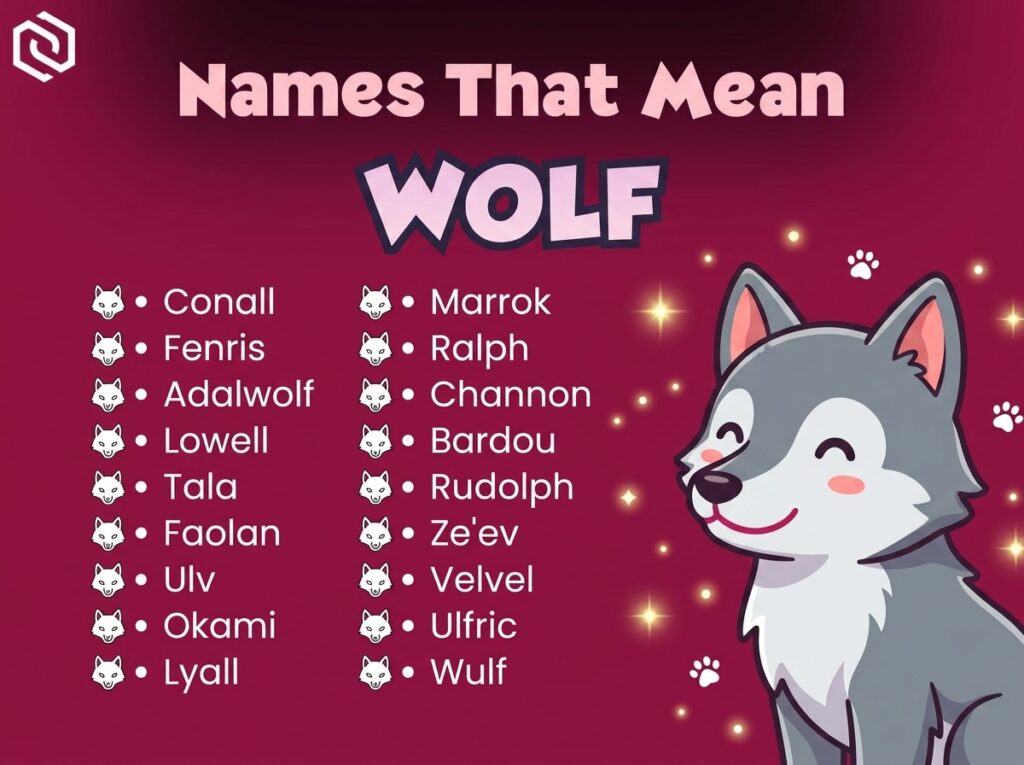
Wolf Names Across Cultures
The wolf appears in the mythology and language of nearly every culture on earth. That’s not a coincidence. Before written history, wolves were everywhere humans were — competing for the same prey, watching from the same forests, raising young in tight family groups. The word for wolf became a word for power, for wildness, for survival. And that meaning got folded into names.
Germanic and Old High German Names That Mean Wolf
The Germanic naming tradition is where wolf names are most dense. Old High German names built meaning by combining elements — “wolf” paired with “noble,” “battle,” “power,” or “famous” created full name compounds. Many modern names we use today descend directly from these roots.
| Name | Meaning | Gender |
|---|---|---|
| Wolfgang | Traveling wolf / wolf path | Boy |
| Adolfo | Noble wolf | Boy |
| Ulrich | Wolf ruler | Boy |
| Wulfric | Wolf power | Boy |
| Rudolph | Famous wolf | Boy |
| Randolph | Shield-wolf | Boy |
| Bardolph | Bright wolf | Boy |
| Adolfa | Noble she-wolf | Girl |
| Adalwulf | Noble wolf | Unisex |
| Odolf | Prosperous wolf | Boy |
Old Norse Names That Mean Wolf
The Norse had a complicated and sacred relationship with the wolf. Odin’s wolves — Geri and Freki — were his constant companions. Fenrir, the great wolf of Norse mythology, was a cosmic force. Wolf imagery ran through Norse poetry, warrior culture, and naming tradition. These names carry that weight.
| Name | Meaning | Gender |
|---|---|---|
| Ulf | Wolf | Boy |
| Varg | Wolf | Unisex |
| Fenrir | Fen wolf (mythological) | Boy |
| Ylva | She-wolf | Girl |
| Skoll | The wolf who chases the sun | Boy |
| Rolf | Fame + wolf | Unisex |
| Ulfheiðr | Wolf heath / she-wolf warrior | Girl |
| Gunnulf | Battle wolf | Boy |
| Liulfa | Love-wolf | Girl |
| Ulrika | Wolf ruler (feminine) | Girl |
Greek and Latin Names That Mean Wolf
In ancient Greece, the wolf was associated with Apollo Lykaios — Apollo in his wolf form. The word lykos (wolf) gave rise to names, places (like Lycia), and even concepts. In Latin, lupa meant she-wolf and was culturally significant: the she-wolf who nursed Romulus and Remus is one of Rome’s founding images.
| Name | Meaning | Gender |
|---|---|---|
| Lykos | Wolf | Boy |
| Lykan | Wolf | Unisex |
| Lupa | She-wolf | Girl |
| Lykaina | She-wolf | Girl |
| Lycanis | She-wolf | Girl |
| Lycopolis | City of the wolf (name inspiration) | Neutral |
| Lukos | Variant of lykos, wolf | Boy |
Hebrew Names That Mean Wolf
In Hebrew, the word for wolf is ze’ev (זאב). It appears in the Bible as the name of a Midianite prince in the Book of Judges, and later became a legitimate given name in Jewish tradition. Zev remains widely used today and is one of the cleanest, most wearable wolf names in any language.
| Name | Meaning | Gender |
|---|---|---|
| Zev | Wolf | Boy/Unisex |
| Zeev | Wolf (fuller spelling) | Boy |
| Ze’eva | She-wolf | Girl |
| Zéva | She-wolf | Girl |
Old English Names That Mean Wolf
Old English names featuring the element wulf were common throughout Anglo-Saxon England. Kings, saints, and warriors all bore wolf names. The element didn’t just mean the animal — it carried connotations of bravery, speed, and ferocity in battle.
| Name | Meaning | Gender |
|---|---|---|
| Wulfric | Wolf power | Boy |
| Wulfrun | Wolf counsel / wolf secret | Girl |
| Ulric | Wolf power (Latinized form) | Boy |
| Channing | Wolf cub | Unisex |
| Randolph | Shield-wolf | Boy |
Also Read: Names That Mean Hunter From Every Culture and Language
Names That Mean Werewolf, She-Wolf, and Wolf Spirit
Names That Mean Werewolf
The word werewolf comes from Old English wer (man) and wulf (wolf). Names directly tied to the werewolf concept are rarer — because most cultures didn’t name children after shape-shifters. But some names have a strong etymological or mythological link to the lycanthropy tradition. These tend to work well for fictional characters, fantasy settings, or parents who want something genuinely dark and distinctive.
- Lycan (Greek, from lykos + anthropos, wolf-man)
- Lycaon (Greek mythological king cursed to become a wolf by Zeus)
- Lyncus (Greek king transformed into a wolf-like creature in myth)
- Faoladh (Irish, “werewolf” — a protective werewolf figure in Irish folklore)
- Versipellis (Latin, “skin-changer,” historical Latin term for werewolf)
- Ulfhedinn (Old Norse, “wolf-skin” — Norse berserkers who wore wolf pelts)
- Garwulf (Old English, “spear-wolf,” used in early werewolf literature)
- Loup-garou (French, “werewolf” — the French term used in Louisiana folklore)
Also Read: Names That Mean Werewolf Across Mythology and Language
Names That Mean She-Wolf
She-wolf names are their own category — and a genuinely compelling one. The she-wolf carries different symbolism than the male wolf. In Roman tradition, the lupa was a protector, a nurturer, the creature who saved Rome’s founders. In Norse culture, she-wolf warriors were figures of ferocity and honor. These names work beautifully for girls.
- Lupa (Latin, she-wolf, directly)
- Ylva (Old Norse, she-wolf)
- Lykaina (Greek, she-wolf)
- Ze’eva / Zéva (Hebrew, she-wolf)
- Adolfa (Germanic, noble she-wolf)
- Lycanis (Greek, she-wolf)
- Ulfheiðr (Old Norse, wolf-heath, associated with female wolf warriors)
- Wulfrun (Old English, she-wolf / wolf counsel)
- Louve (French, she-wolf, from lupa)
- Lykina (Greek variant, she-wolf)
Names That Mean Wolf Spirit or Wolf Power
Beyond direct translations, some names carry the spirit of the wolf through their compound meaning — wolf + power, wolf + spirit, wolf + strength. These feel less raw and more regal.
- Ulric (Old English, wolf power)
- Ulrika (Old Norse/Germanic, wolf ruler)
- Wulfric (Old English, wolf power)
- Ragnhild (Old Norse, wolf counsel + battle)
- Randolph (Old English, shield-wolf)
- Gunnulf (Old Norse, battle wolf)
- Lovell (Old French, little wolf)
- Rudolph (Old High German, famous wolf)
- Odolf (Old High German, prosperous wolf)
- Adalwulf (Old High German, noble wolf)
Last Names That Mean Wolf
Wolf surnames are spread across Europe and beyond. Many developed as occupational or descriptive surnames in the Middle Ages — some describing a hunter who specialized in wolves, others derived directly from a family’s regional dialect word for wolf. A good number of these surnames have also crossed over into first-name use today.
| Surname | Origin | Meaning | Notable Bearers | Popularity |
|---|---|---|---|---|
| Wolf | German/English | Wolf | Hugo Wolf (composer) | Classic |
| Wolfe | English | Wolf | Thomas Wolfe (author) | Classic |
| Wolfgang | German | Wolf path | Wolfgang Amadeus Mozart | Classic |
| Lovell | Norman/Old French | Little wolf | Lord Lovell (English history) | Unique |
| Ulrich | German | Wolf ruler | Ulrich Zwingli (reformer) | Classic |
| Lupus | Latin | Wolf | Saint Lupus of Troyes | Rare |
| Varga | Hungarian | Wolf (occupational variant) | Common Hungarian surname | Classic |
| Vilkas | Lithuanian | Wolf | Traditional Lithuanian surname | Rare |
| Lupo | Italian | Wolf | Mario Lupo (historical) | Unique |
| Rolf | Scandinavian | Fame + wolf | Rolf of Normandy (Rollo) | Classic |
| Volk | German/Russian | Wolf / people | Various Slavic bearers | Classic |
| Wolfram | German | Wolf raven | Wolfram von Eschenbach | Powerful |
| Rudolph | German | Famous wolf | Various European bearers | Classic |
| Ylveson | Old Norse | Son of the she-wolf | Scandinavian surname origin | Rare |
| Wilk | Polish | Wolf | Common Polish surname | Classic |
| Lobo | Spanish/Portuguese | Wolf | Edu Lobo (musician) | Trending |
| Wolff | German variant | Wolf | Albert Wolff (conductor) | Classic |
| Vacek | Czech/Slovak | Little wolf | Traditional Czech surnames | Rare |
| Bardolph | Old English | Bright wolf | Character in Shakespeare | Dark |
| Wulf | Old English | Wolf | Wulf (Anglo-Saxon poem figure) | Powerful |
Also Read: Last Names That Mean Wolf — Surnames With Real History Behind Them
🐺 Naming Expert’s Note
Zev is the name I’d recommend first to any parent seriously considering a wolf name. It’s two letters in Hebrew (זאב), one syllable in English, and it has been used in Jewish communities for centuries without ever feeling dated. It works in boardrooms and playgrounds equally well. It pairs effortlessly with long last names and most middle names. And its meaning — wolf — is direct, ancient, and undeniable. Among all the wolf names out there, Zev is the one that asks for the least explanation while delivering the most impact.
How to Choose the Right Wolf Name
Sound is everything. A name like Fenrir hits differently than Lovell — both mean wolf, but they feel worlds apart. Think about whether you want something subtle (Zev, Rolf, Ulric) or something unmistakably wild (Lycan, Varg, Fenrir). Short names pair well with long surnames; longer names like Wolfgang or Randolph need a bit more breathing room.
Cultural fit matters too. A name like Faoladh is deeply Irish and may feel out of place without that heritage. Names like Adolfo or Lobo carry Spanish-language rhythm and suit families with that connection.
- Say it out loud with your last name at least ten times
- Check what the natural nickname would be (Wolfgang becomes Wolf; Rudolph becomes Rudy)
- Look up the initials before committing
- Research any mythological or historical figures who bore the name
- Consider how it sounds on a five-year-old and a forty-year-old
- Check current popularity if a unique name matters to you
Frequently Asked Questions
Q: What is the most popular name that means wolf?
A: Among given names, Wolfgang has the longest documented history of use and remains well-recognized globally. For modern parents, Zev and Lycan are currently seeing the strongest interest. Rudolph is the most widely recognized historically, even if its wolf meaning surprises most people today.
Q: What does “wolf” mean in different languages?
A: Wolf translates to Ulf or Varg in Old Norse, Lykos in Greek, Lupus or Lupa in Latin, Wolf in German, Lobo in Spanish and Portuguese, Lupo in Italian, Wilk in Polish, Vilkas in Lithuanian, Volk in Russian, and Ze’ev in Hebrew. Each of these root words has contributed real given names across history.
Q: What are some rare names that mean wolf?
A: Some genuinely rare wolf names include Odolf (Old High German, prosperous wolf), Vulfila (Gothic, little wolf), Ulfheiðr (Old Norse, she-wolf warrior), Lycanis (Greek, she-wolf), and Faoladh (Irish, protective werewolf figure). These are uncommon enough that most people won’t recognize them immediately.
Q: What is a good middle name to pair with Zev?
A: Zev works beautifully with strong, one or two-syllable middle names. Try Zev Alexander, Zev Orion, Zev Matthias, or Zev Theodore. Because Zev is so short and punchy, a longer middle name creates a natural rhythm. Avoid middle names starting with V or hard consonants that clash with the Z sound.
Q: Are wolf names still popular today?
A: Yes, and they’re growing. Names like Zev, Lycan, and Ylva are appearing more frequently in naming communities and social forums. The broader trend toward nature-rooted, mythologically significant names has pushed wolf names into the spotlight. Lobo and Rolf are also seeing quiet revivals in certain regions.
Q: What is the difference between a name that means wolf and a name that means werewolf?
A: Names that mean wolf come from words directly meaning the animal — like lykos (Greek), lupus (Latin), or ze’ev (Hebrew). Names connected to werewolf mythology specifically come from the shape-shifting tradition — like Lycaon (the Greek king transformed into a wolf), Ulfhedinn (the Norse wolf-skin warrior), or Faoladh (the Irish protective werewolf). The distinction is etymological: wolf names are animal names; werewolf names carry the man-into-wolf transformation symbolism.
Conclusion
Wolf names span every major language family and naming tradition on earth. From the ancient Latin Lupa to the Hebrew Zev to the Old Norse Fenrir, the wolf has always meant something worth naming a child after. These aren’t names chosen for aesthetics alone. They carry real history — of warriors, myths, pack loyalty, and wild intelligence.
If you’re drawn to names rooted in the natural world and older naming traditions, you might also enjoy exploring names that mean hunter from every culture and language or names that mean warrior — both share that same sense of strength and purpose that wolf names carry so well. The wolf endures as a naming symbol because it represents something humans have always respected: the kind of strength that runs in packs, and the kind of loyalty that doesn’t break.