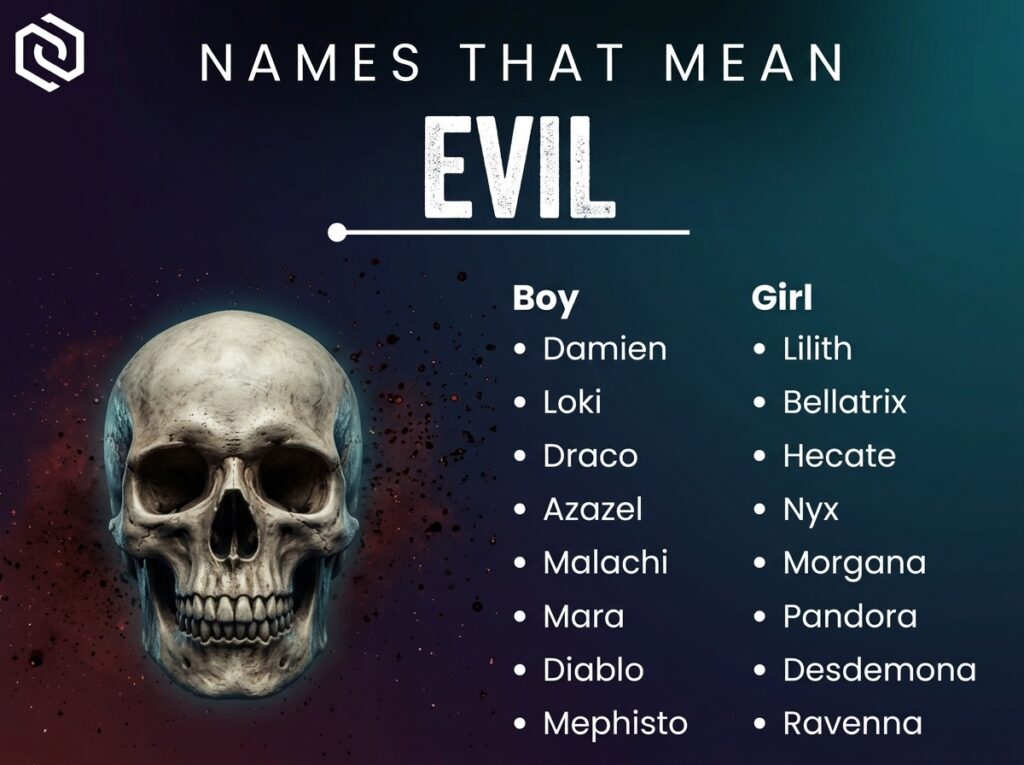
There is something undeniably compelling about names rooted in darkness. Names that mean evil, demon, or devil have been part of human storytelling for thousands of years. They appear in ancient mythology, religious texts, folklore, and literature. These names were not always given to villains. Many were the names of powerful spirits, feared gods, and complex forces that ancient cultures believed shaped the world. The line between evil and power was often blurry in those traditions, and that ambiguity is part of what makes these names so fascinating today.
Parents drawn to these names are not looking to curse their child. Most are fiction writers searching for a compelling character name, fantasy worldbuilders building mythology, or parents who simply love dark, edgy sounds with serious depth. Names rooted in the concept of evil often carry a raw, ancient energy that softer names simply cannot match. They sound like they carry weight, history, and story. And honestly? That is exactly what they do.
What Are Some Names That Mean Evil or Demon?
Some of the strongest names that mean evil or demon include Mara (Sanskrit/Hebrew for “bitter evil”), Lilith (Hebrew, associated with dark spirits), Samael (Hebrew, meaning “venom of God” or the angel of death), Ahriman (Avestan, the supreme spirit of evil in Zoroastrianism), Diablo (Spanish for “devil”), Abaddon (Hebrew, meaning “place of destruction”), and Nyx (Greek goddess of night and darkness). These names come from genuine mythological and etymological roots, spanning cultures from Hebrew scripture to Persian cosmology to Greek mythology.
Girl Names That Mean Evil, Demon, or Dark Spirit
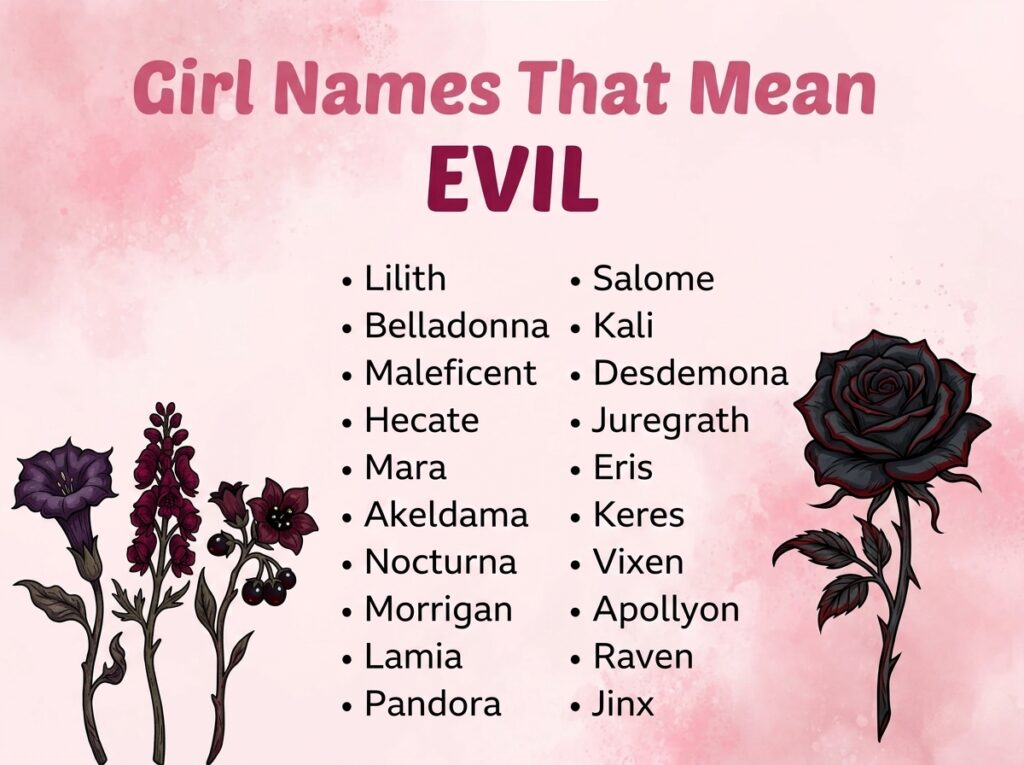
These names carry a shadowy feminine energy that is genuinely rare in naming culture. Some are rooted in ancient goddess mythology where female figures embodied chaos, wrath, or destructive power. Others come directly from religious or folkloric traditions that personified evil as feminine. They sound striking, and most wear surprisingly well as real names.
| Name | Origin | Meaning | Pronunciation | Popularity |
|---|---|---|---|---|
| Lilith | Hebrew | “Night monster” or “storm demon” | LIL-ith | Trending |
| Mara | Hebrew/Sanskrit | “Bitter evil”; also the demon of temptation in Buddhism | MAH-rah | Classic |
| Hecate | Greek | Goddess of witchcraft, ghosts, and the underworld | HEK-uh-tee | Mystic |
| Lamia | Greek | A child-devouring demon or monster of evil | LAY-mee-uh | Dark |
| Kali | Sanskrit | “The black one”; goddess of destruction and death | KAH-lee | Powerful |
| Naamah | Hebrew | Associated in Jewish tradition with evil spirits and seduction | NAH-ah-mah | Rare |
| Empusa | Greek | A shape-shifting demonic female figure in Greek myth | em-PYOO-sah | Unique |
| Jezebel | Hebrew | Associated with wickedness and moral corruption in scripture | JEZ-uh-bel | Dark |
| Aello | Greek | A harpy whose name means “storm swift,” a spirit of violent death | ay-EL-oh | Rare |
| Lerna | Greek | Connected to the Lernaean Hydra, a monster of destruction | LER-nah | Unique |
| Mormo | Greek | A spirit used to frighten children; associated with evil female spirits | MOR-moh | Rare |
| Algea | Greek | Goddess of pain, grief, and suffering in Greek mythology | AL-jee-uh | Rare |
| Erida | Greek | Derived from Eris, goddess of discord and strife | eh-REE-dah | Dark |
| Nemain | Irish/Celtic | A goddess of battle frenzy and panic, one of the war furies | NEH-van | Mystic |
| Phobetor | Greek | Spirit of fear and nightmares (used historically for female personifications) | foh-BEE-tor | Unique |
| Nyx | Greek | Goddess of night; mother of dark forces including death and strife | NIKS | Trending |
| Rangda | Balinese | The demon queen of witches in Balinese Hindu tradition | RANG-dah | Rare |
| Aswang | Filipino | A shape-shifting evil spirit central to Philippine mythology | AHS-wang | Rare |
| Ardat | Akkadian | A female demon in Mesopotamian mythology associated with death | AR-dat | Unique |
| Lilu | Akkadian | Female demon of the night wind in ancient Mesopotamian belief | LEE-loo | Rare |
Boy Names That Mean Evil, Demon, or Devil
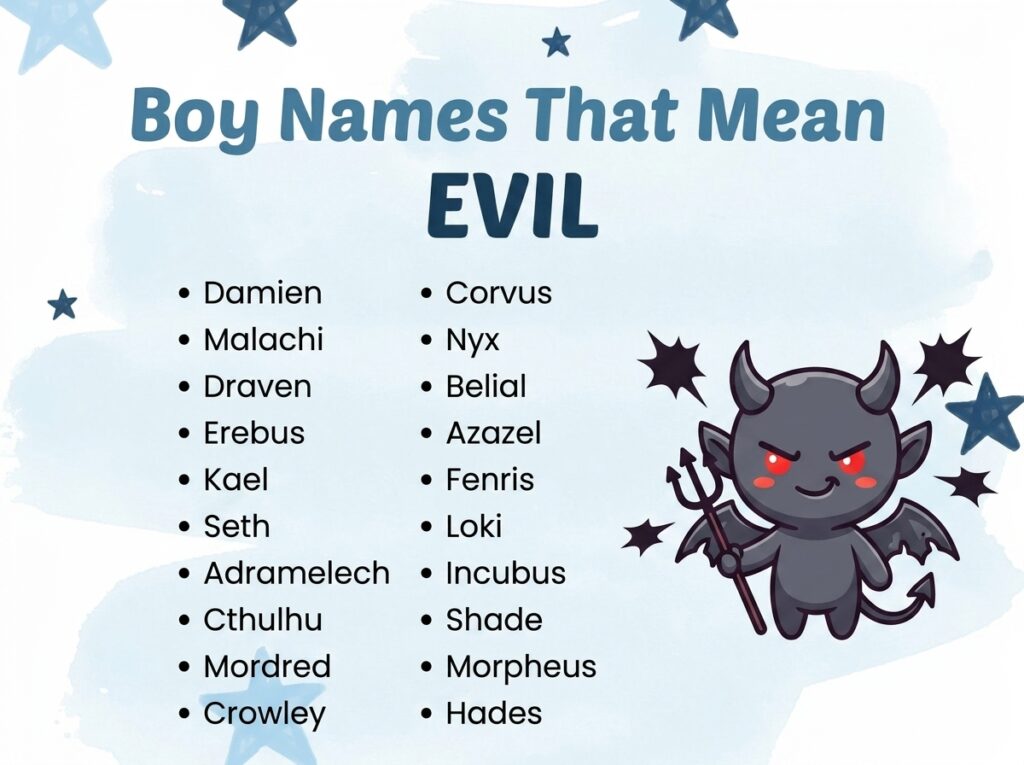
Dark masculine names have always appeared in mythology, scripture, and epic storytelling. From Hebrew tradition’s fallen angels to Greek underworld figures to Sanskrit demons, male names with evil meanings carry a mythological weight that few other name types can touch. These names sound strong, serious, and layered.
| Name | Origin | Meaning | Pronunciation | Popularity |
|---|---|---|---|---|
| Abaddon | Hebrew | “Destruction” or “place of ruin”; the angel of the abyss | ah-BAD-on | Dark |
| Samael | Hebrew | “Venom of God”; archangel associated with death and evil | SAM-ay-el | Mystic |
| Ahriman | Avestan/Persian | The supreme spirit of evil and darkness in Zoroastrianism | AH-ree-man | Rare |
| Malphas | Demonology | A great president of Hell in medieval demonological texts | MAL-fas | Dark |
| Caim | Latin/Demonology | Derived from Cain; also a demon in the Ars Goetia | KAYM | Rare |
| Typhon | Greek | A monstrous serpentine giant; the “father of all monsters” | TY-fon | Powerful |
| Set | Egyptian | God of chaos, violence, and evil in ancient Egyptian religion | SET | Powerful |
| Diablo | Spanish | Directly means “devil” in Spanish | dee-AH-blo | Dark |
| Abalam | Demonology | A demon king listed in historical demonological grimoires | AB-ah-lam | Unique |
| Beleth | Hebrew/Demonology | A terrifying king of Hell in medieval demonology texts | BEH-leth | Rare |
| Mephisto | Greek/German | Short form of Mephistopheles; the devil figure in Faust | meh-FIS-toh | Dark |
| Asmodeus | Hebrew/Persian | A king of demons in Jewish and Christian tradition | az-moh-DEE-us | Mystic |
| Fenrir | Norse | The monstrous wolf son of Loki; destined to devour the world | FEN-reer | Powerful |
| Belphegor | Hebrew | A demon associated with sloth and evil temptation | bel-FEE-gor | Rare |
| Chernobog | Slavic | “Black god”; deity of evil, darkness, and misfortune | CHER-noh-bog | Dark |
Also Read: Names That Mean Demon: Mythology, History, and Dark Power
Unisex Names That Mean Evil or Sinister Power
Some names rooted in dark mythology carry no fixed gender. They come from concepts, ancient spirits, and forces of nature that transcend gender entirely. These work powerfully for any child and are especially popular in fiction writing and character naming.
| Name | Origin | Meaning | Pronunciation | Popularity |
|---|---|---|---|---|
| Mara | Hebrew/Buddhist | “Evil” or “the tempter”; demon of illusion in Buddhism | MAH-rah | Classic |
| Mania | Latin/Greek | Goddess of the dead and the insane; also a spirit of madness | MAY-nee-uh | Rare |
| Aži | Avestan | A serpentine evil being in Zoroastrian myth | AH-zhee | Unique |
| Cacos | Greek | Derived from “kakos” meaning “evil” or “bad” | KAY-kos | Rare |
| Erebus | Greek | The primordial deity of deep darkness and shadow | EH-reh-bus | Dark |
| Rahu | Sanskrit | A demon who swallows the sun in Hindu mythology | RAH-hoo | Mystic |
| Apep | Egyptian | The serpent god of chaos and evil; enemy of Ra | AH-pep | Rare |
| Angra | Avestan | From Angra Mainyu; means “destructive spirit” | ANG-rah | Unique |
| Onyx | Greek | While “onyx” means “claw/nail,” it carries deep dark associations in modern use | ON-iks | Trending |
| Moros | Greek | Personification of doom and evil fate | MOR-os | Rare |
Evil Names Across Cultures
The idea of evil as a named, personified force appears in virtually every major world tradition. That is not a coincidence. Ancient peoples needed to name the things they feared. Giving evil a name made it something that could be understood, confronted, even bargained with. That impulse shows up from Mesopotamia to Mesoamerica, from Hebrew scripture to Hindu cosmology.
Hebrew and Jewish Names That Mean Evil
Hebrew tradition has one of the richest demonological naming traditions in the world, shaped by scripture, the Talmud, and mystical texts like the Zohar. Names from this tradition carry enormous mythological weight.
| Name | Meaning | Gender |
|---|---|---|
| Lilith | Night demon; evil female spirit | Girl |
| Samael | Venom of God; angel of death | Boy |
| Abaddon | Place of destruction; the destroyer | Boy |
| Naamah | Associated with evil seduction in Kabbalistic texts | Girl |
| Belial | “Without worth”; a demon and a name for evil itself | Boy |
| Asmodeus | Demon king of lust and destruction | Boy |
| Azazel | The scapegoat demon; associated with sin and the fallen | Boy |
| Astaroth | A grand duke of Hell derived from the Canaanite goddess Astarte | Unisex |
| Beelzebub | “Lord of the flies”; one of the primary princes of evil | Boy |
| Gadreel | A fallen angel blamed for leading Eve astray | Boy |
Greek Names That Mean Evil, Monster, or Destruction
Greek mythology did not shy away from dark figures. The Greeks named their monsters, their furies, and their gods of destruction with extraordinary detail.
| Name | Meaning | Gender |
|---|---|---|
| Typhon | Father of monsters; the most feared enemy of the gods | Boy |
| Lamia | A devouring demon who preys on children | Girl |
| Empusa | Shape-shifting demonic spirit of evil | Girl |
| Hecate | Goddess of dark magic and underworld spirits | Girl |
| Eris | Goddess of discord, strife, and conflict | Girl |
| Mormo | A female evil spirit used to frighten | Girl |
| Erebus | Primordial darkness, child of Chaos | Unisex |
| Moros | Personification of doom and evil fate | Boy |
| Algea | Goddess of pain and suffering | Girl |
| Achlys | Spirit of the death-mist and misery | Girl |
Sanskrit and Hindu Names That Mean Evil or Demonic
In Hindu tradition, evil forces known as Asuras and Rakshasas have distinct names drawn from Sanskrit roots. Many carry direct meanings connected to wickedness, destruction, or chaos.
| Name | Meaning | Gender |
|---|---|---|
| Kali | The fierce, destructive aspect; “the dark one” | Girl |
| Rahu | The demon who swallows the sun | Boy |
| Mara | The demon of temptation and illusion | Unisex |
| Ravana | The demon king; “one who makes the universe scream” | Boy |
| Vritra | A serpent demon; “the enveloper” or obstructer of rivers | Boy |
| Mahishasura | The buffalo demon of evil; slain by goddess Durga | Boy |
| Ketu | The shadow demon paired with Rahu | Boy |
| Taraka | A powerful demon who terrorized the gods | Boy |
| Namuci | A demon whose name means “not releasing” or “captivating” | Boy |
| Shumbha | A demon of pride and evil in Hindu texts | Boy |
Slavic Names That Mean Evil or Dark Spirit
Slavic mythology is full of dark spirits and malevolent forces, many of whom carry names that directly translate to evil, darkness, or corruption.
| Name | Meaning | Gender |
|---|---|---|
| Chernobog | “Black god”; deity of evil and misfortune | Boy |
| Morozko | Associated with cruel cold and death in Russian folk tradition | Boy |
| Kikimora | A household evil spirit who brings misfortune | Girl |
| Viy | A spirit of destruction in Ukrainian folklore | Boy |
| Mara | Evil spirit that causes nightmares; related to the word “nightmare” itself | Unisex |
| Poludnitsa | “Lady Midday”; a deadly demon spirit of the harvest | Girl |
| Striga | A malevolent female spirit that feeds on humans | Girl |
| Zly | Directly means “evil” or “bad” in several Slavic languages | Boy |
| Chuma | Spirit of plague and evil | Girl |
| Likho | Personification of evil fate and misfortune | Unisex |
Also Read: Names That Mean Death: Ancient, Mythological, and Modern Picks
Avestan and Persian Names That Mean Evil
Zoroastrianism gave us one of the earliest named cosmic battles between good and evil. The Avestan language produced some of the most striking names for evil forces ever recorded.
| Name | Meaning | Gender |
|---|---|---|
| Ahriman | Supreme spirit of evil and destruction | Boy |
| Angra Mainyu | “Destructive spirit”; the source of evil | Unisex |
| Aži Dahaka | Serpentine demon king with snakes growing from his shoulders | Boy |
| Nasu | The demon of corruption and death | Unisex |
| Aešma | Demon of wrath and violence in Zoroastrian texts | Boy |
| Druj | Means “lie” or “evil”; the embodiment of deceit | Unisex |
| Vizaresh | A demon who drags evil souls to the underworld | Boy |
| Apaosha | The demon of drought and evil environmental destruction | Boy |
| Jahi | The demon of licentiousness who revived Ahriman | Girl |
| Zarich | The demon of aging and slow death | Girl |
Names That Mean Devil, Demon, or Monster (Semantic Variations)
Names That Mean Demon
The concept of a demon is distinct from evil in some traditions. Demons are specific beings, spirits with purpose and rank, not simply abstract wickedness. Names tied directly to demonic beings carry a very specific kind of weight.
- Asmodeus (Hebrew): The king of demons in Talmudic and Christian tradition
- Samael (Hebrew): Angel of death and chief demon in Kabbalistic texts
- Beleth (Demonology): A terrifying king of Hell in the Ars Goetia
- Succubus (Latin): A demon who visits people in their sleep
- Malphas (Demonology): A powerful demon prince who appears as a crow
- Phenex (Demonology): A demon marquis associated with fire and poetry
- Abalam (Demonology): A demon king in historical grimoires
- Bael (Demonology): The first and chief king of Hell in Goetic tradition
- Ronove (Demonology): A marquis of Hell who teaches languages and gives familiars
- Agares (Demonology): A duke of Hell who returns runaways and causes earthquakes
Names That Mean Monster
Some names do not just suggest evil. They specifically refer to monstrous beings, creatures of destruction that exist beyond morality itself.
- Typhon (Greek): The last great monster of Greek myth, half-man half-serpent
- Fenrir (Norse): The wolf-monster who breaks his chains at the end of the world
- Apep (Egyptian): The great serpent of chaos who battles Ra every night
- Vritra (Sanskrit): The cosmic serpent-monster who blocked all rivers
- Lamia (Greek): The monster who devours children, born of grief and madness
- Rangda (Balinese): The demon queen of witches in Balinese tradition
- Charybdis (Greek): The monstrous whirlpool creature who devoured ships
- Scylla (Greek): A six-headed sea monster created to destroy sailors
- Leviathan (Hebrew): The primordial sea monster embodying chaos and evil
- Jormungandr (Norse): The world-serpent child of Loki who encircles the earth
Names That Mean Devil
The “devil” is a specific concept in Abrahamic religions and cultures they influenced. Names in this category are tied directly to the figure of the adversary, the tempter, or the ruler of the underworld.
- Diablo (Spanish): Literally “devil”
- Lucifer (Latin): “Light-bringer”; the fallen angel whose name became synonymous with the devil
- Mephistopheles (German/Greek): The devil figure in Faustian legend
- Iblis (Arabic): The Islamic name for the devil, the fallen jinn
- Shaitan (Arabic): Directly means “devil” or “adversary” in Arabic
- Beelzebub (Hebrew/Philistine): “Lord of the flies”; one of the chief princes of Hell
- Baphomet (Medieval Latin): A symbol of evil and the occult in medieval tradition
- Mastema (Hebrew): A fallen angel whose name means “hostility” or “enmity”
- Belial (Hebrew): Means “without worth”; used as a name for evil itself in scripture
- Sammael (Hebrew): A variant spelling of Samael; the accusing angel
Also Read: Names That Mean Shadow: Dark, Mysterious, and Beautifully Layered
Naming Expert’s Note
Lilith is the one name on this list that has genuinely crossed over into mainstream use. It ranked in the U.S. Social Security Administration’s top 200 for the first time in recent years. That is remarkable for a name rooted in ancient demonic mythology. The reason it works is phonetic: two soft syllables, an open ending, and a sound that has nothing harsh about it. Parents choosing Lilith today are often unaware of the full extent of the mythology. Those who are aware tend to love it more for it. If you want a genuinely dark name that holds up in any setting, Lilith is the rare one that truly does.
How to Choose the Right Evil or Dark Name
Sound matters more than meaning when it comes to names rooted in darkness. A name like Mara wears beautifully in daily life because it sounds soft and simple, even though its meaning is deeply tied to evil and suffering. On the other hand, a name like Ahriman is historically rich but phonetically difficult for English speakers and would require explanation at every doctor’s appointment.
Cultural fit matters here more than in most name categories. Names like Samael, Asmodeus, or Lucifer carry enormous religious weight. Before choosing a name with demonic or devil-specific roots, consider how it will land in your family’s cultural and religious context.
- Say it out loud with your last name, ten times fast
- Check what the initials spell when combined
- Research whether the name has a usable nickname form
- Consider how a teacher, employer, or stranger will receive the name
- Think about the child using this name at every stage of life, not just infancy
- If the name comes from a specific mythology, learn that story fully before choosing
Frequently Asked Questions
Q: What is the most popular name that means evil?
A: Lilith is currently the most popular name with direct evil or demonic mythology attached to it. It entered the U.S. top 200 baby names in recent years. Mara is also widely used and carries Buddhist and Hebrew associations with evil and temptation. Both have the advantage of sounding accessible while carrying genuinely dark roots.
Q: What name directly means “evil” in different languages?
A: In Spanish, “Diablo” means devil/evil. In Avestan, “Angra” (from Angra Mainyu) means destructive or evil spirit. In Slavic languages, “Zly” means evil or bad. In Hebrew, “Belial” is used to name evil itself. In Arabic, “Shaitan” means devil or adversary. In Sanskrit, “Papa” is the word for evil or sin, though it is not used as a personal name.
Q: What are some rare names that mean evil or demonic?
A: For genuinely rare options, consider Aešma (the Zoroastrian demon of wrath), Naamah (a female demon from Kabbalistic tradition), Ardat (an Akkadian night demon), Mormo (a Greek spirit of evil), or Vizaresh (the Zoroastrian demon who drags evil souls to the underworld). None of these appear in modern baby name databases, making them truly uncommon.
Q: What is a good middle name to pair with Lilith?
A: Lilith pairs well with short, grounded middle names that balance its mystical quality. Lilith Rose, Lilith June, Lilith Claire, and Lilith Eve all work beautifully. If you want to lean further into the dark theme, Lilith Mara or Lilith Nyx creates a striking combination.
Q: Are names that mean evil or demon becoming more popular?
A: Yes, gradually. Names like Lilith, Mara, and Nyx are appearing more frequently on birth records, especially in Western countries. The rise of dark fantasy media, gothic aesthetics, and mythology-driven parenting communities has contributed to this shift. Names like Lucifer and Diablo remain rare in actual use due to their direct cultural weight.
Q: Is it appropriate to name a child after a demon or evil figure?
A: This depends entirely on the family’s cultural, religious, and personal values. Many of these names have significant mythological depth that goes far beyond simple “evil” branding. Lilith, for example, has been reclaimed in feminist discourse as a symbol of independence. Mara is a common name in Scandinavian countries where its darker etymology is rarely the primary association. Context and intention matter enormously.
Conclusion
Names rooted in evil, demons, and dark mythology are some of the most etymologically rich names in existence. They come from Hebrew scripture, Greek myth, Hindu cosmology, Zoroastrian theology, and Slavic folklore. Choosing one is not about embracing wickedness. It is about choosing a name with genuine depth, ancient history, and undeniable power. If you are drawn to the darker edges of naming tradition, you might also find inspiration in names that mean death from mythology and history or explore names that mean chaos for names rooted in primordial disorder. These names endure because darkness has always been part of the human story, and names help us make sense of it.