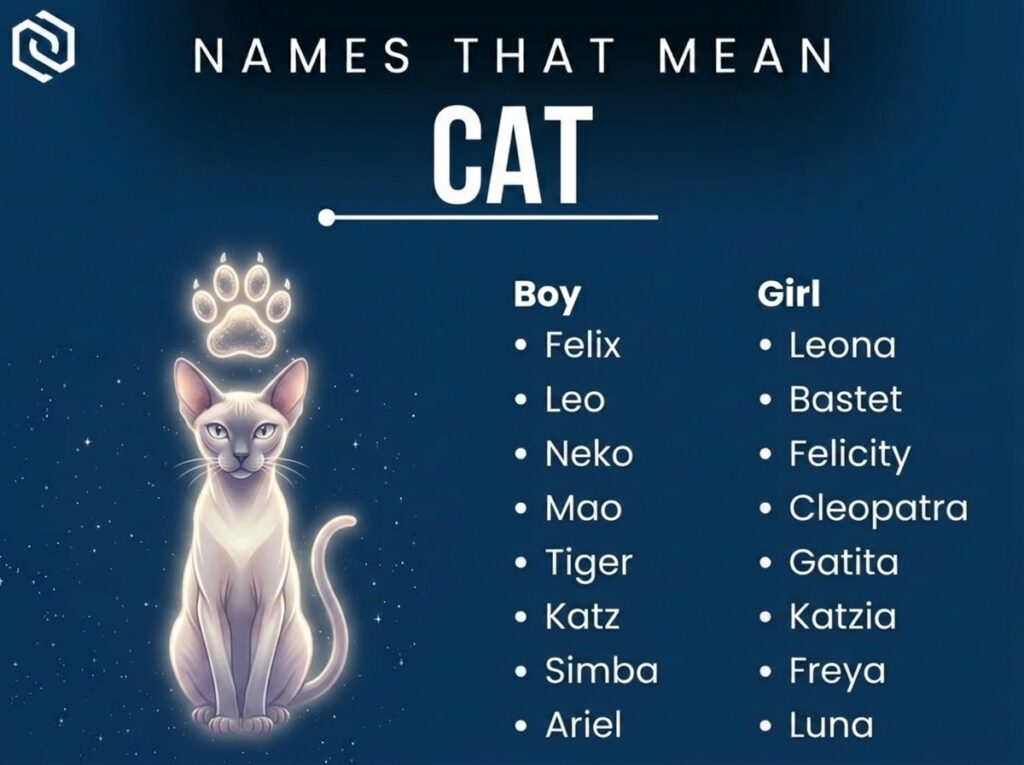
Cats have occupied a very specific place in human culture for thousands of years. They were sacred in ancient Egypt, feared and revered in medieval Europe, and celebrated as spirit animals across Asia. A name that genuinely means cat carries all of that history with it. It speaks to independence, mystery, and a quiet kind of power that people have always projected onto felines.
Parents drawn to these names tend to love animals deeply, or they want a name that feels earthy and specific rather than vague and aspirational. Sometimes it’s simpler than that. They have a beloved cat at home, or they were born under the Leo zodiac sign and want something that honors that feline energy through language. Whatever the reason, names meaning cat span an impressive range of languages and cultures, from ancient Egyptian goddess names to modern Japanese given names, and they carry more weight and history than most people expect.
What are some names that mean cat?
Some of the strongest names that genuinely mean cat include Bastet, the Egyptian goddess of cats; Cait, a Gaelic form meaning pure but tied to the cat symbol in Celtic folklore; Neko, the Japanese word for cat used as a given name; Kissa, a Finnish word for cat; Cattleya, a name used in Japanese culture referencing feline imagery; and Gato, the Spanish word for cat occasionally used as a name. These names come from real languages and mythologies where cats held genuine cultural meaning.
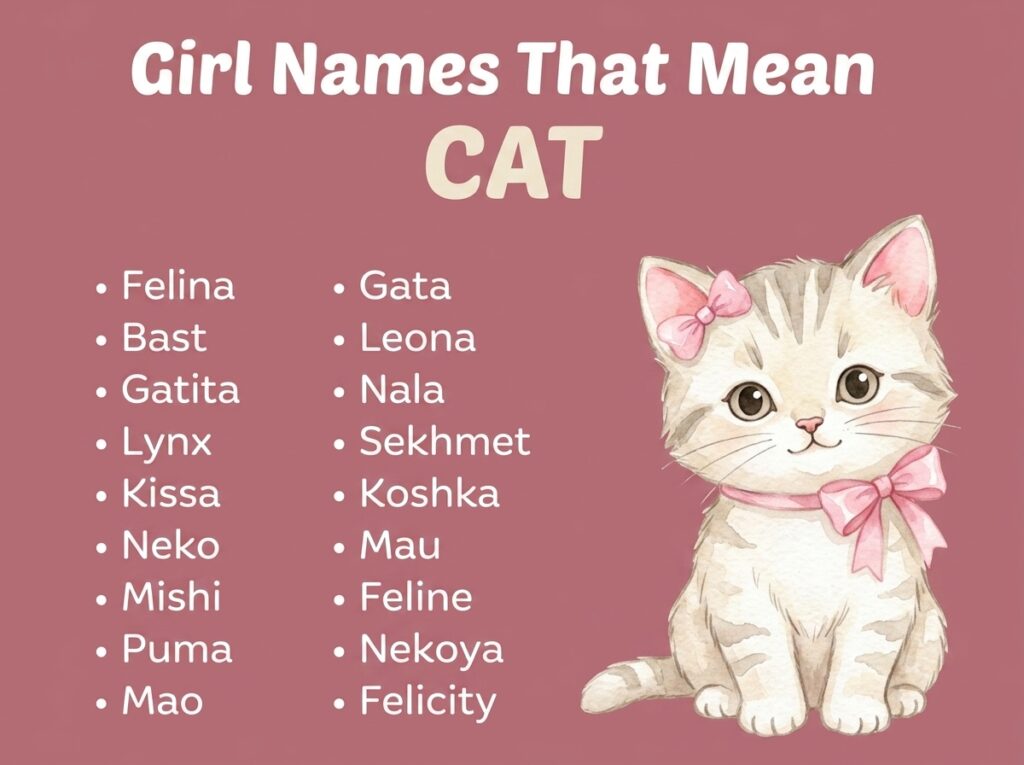
Girl Names That Mean Cat
Feline names for girls carry a natural elegance that doesn’t need to try too hard. There’s something in the cat archetype, the grace, the self-sufficiency, the quiet observation, that lends itself beautifully to feminine names. Many of these names come from goddess mythology or from languages where the cat was considered a symbol of protection, intuition, and feminine power.
| Name | Origin | Meaning | Pronunciation | Popularity |
|---|---|---|---|---|
| Bastet | Egyptian | Goddess of cats and protection | BAS-tet | Mystic |
| Ailuros | Greek | Cat (name of the Egyptian cat goddess in Greek sources) | ay-LOO-ros | Rare |
| Kissa | Finnish | Cat | KIS-sah | Unique |
| Neko | Japanese | Cat | NEH-koh | Trending |
| Cattleya | Japanese (adapted) | Associated with cat imagery in anime/naming culture | KAT-lee-ah | Soft |
| Pakhet | Egyptian | She who scratches (lioness/cat goddess) | PAH-ket | Rare |
| Mafdet | Egyptian | Ancient Egyptian cat and panther goddess | MAF-det | Mystic |
| Sekhmet | Egyptian | Lioness goddess; associated with feline power | SEK-met | Powerful |
| Gatta | Italian | Cat (female form) | GAT-tah | Unique |
| Chatte | French | Cat (female) | SHAT | Rare |
| Kotka | Finnish/Slavic | Cat (used informally as a name) | KOT-kah | Unique |
| Miu | Egyptian/Chinese | Sound a cat makes; used as a name in Egypt and China | MEW | Soft |
| Felina | Latin | Cat-like, feline | feh-LEE-nah | Classic |
| Felicity | Latin | Derived from “felis” meaning cat (also means happiness) | feh-LIS-ih-tee | Classic |
| Koty | Polish | Cats (used as a nickname name) | KOH-tee | Rare |
| Nekomi | Japanese | Cat beauty; “neko” (cat) + “mi” (beauty) | neh-KOH-mee | Soft |
| Chatty | English/French | Diminutive of “chat” (French for cat) | CHAT-ee | Unique |
| Gatita | Spanish | Little cat (female diminutive) | gah-TEE-tah | Soft |
| Caitria | Gaelic | Variant of Cait; linked to cat symbolism in Celtic culture | KAT-ree-ah | Rare |
| Felis | Latin | Cat (genus name, used as a given name) | FEE-lis | Mystic |
Also Read: Names That Mean Tiger: Bold and Fierce Baby Name Ideas
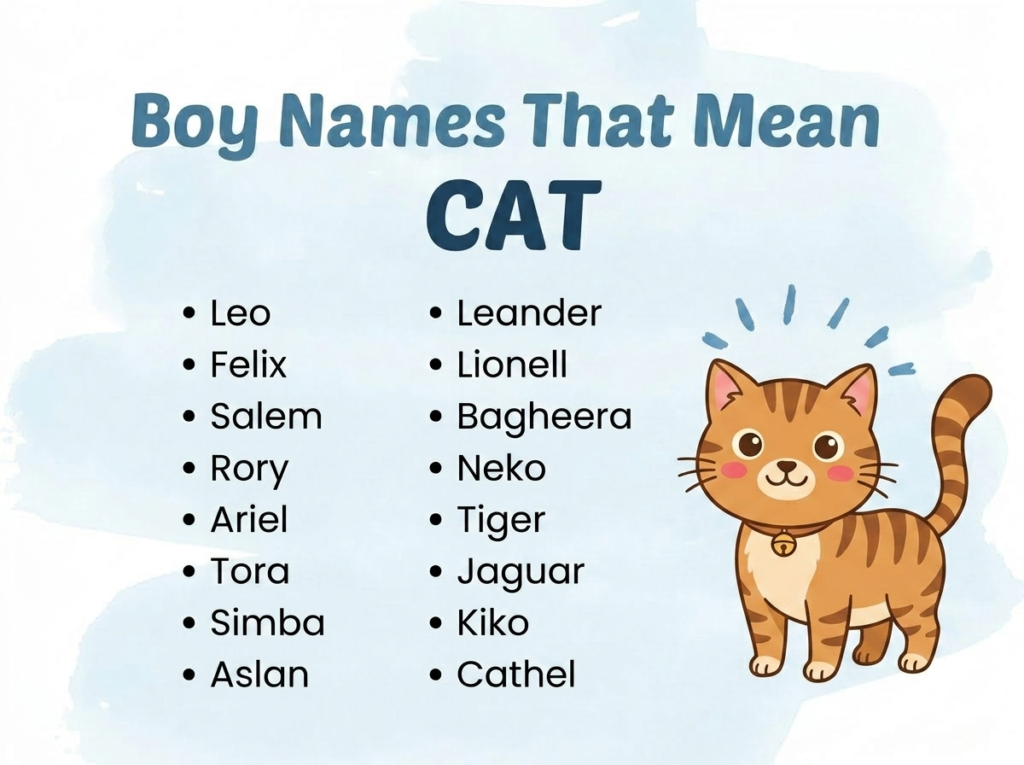
Boy Names That Mean Cat
Cat names for boys are rarer, but that’s part of their appeal. They tend to sound grounded and strong, sometimes a little wild. Feline symbolism in male-coded mythology often leaned toward the panther, the lion, and the leopard rather than the house cat, so several of these names carry a broader big-cat energy that still traces directly back to the feline root.
| Name | Origin | Meaning | Pronunciation | Popularity |
|---|---|---|---|---|
| Gato | Spanish | Cat | GAH-toh | Unique |
| Kater | German | Male cat, tomcat | KAH-ter | Rare |
| Kot | Polish/Slavic | Cat | KOT | Dark |
| Nekota | Japanese (compound) | “Neko” (cat) + “ta” (thick, plentiful); feline-rooted name | neh-KOH-tah | Rare |
| Felio | Latin | Derived from “felis,” meaning cat | FEE-lee-oh | Rare |
| Chatton | French/English | Little cat; from Old French “chat” | SHAT-on | Rare |
| Kater | Dutch/German | Tomcat | KAH-ter | Dark |
| Miw | Ancient Egyptian | Cat; used historically as a name in ancient Egypt | MYOO | Mystic |
| Gatino | Italian | Little cat (male) | gah-TEE-noh | Unique |
| Kedi | Turkish | Cat | KEH-dee | Unique |
| Catt | Old English | Cat; used as a surname-turned-given name | KAT | Rare |
| Felin | Welsh | Relating to cats; feline | FEH-lin | Soft |
| Neko | Japanese | Cat (used for both genders in Japan) | NEH-koh | Trending |
| Kotaro | Japanese | “Ko” (small) + “taro” (firstborn son); cat-small association in some compounds | koh-TAH-roh | Classic |
| Paka | Swahili | Cat | PAH-kah | Unique |
Also Read: Names That Mean Lion: Strong and Symbolic Picks for Your Baby
Unisex Names That Mean Cat
These names sit comfortably across genders. Some are short and punchy. Others feel soft and flowing. What they share is a connection to the cat that doesn’t depend on gender to land properly. In many of the cultures they come from, the names were never gendered to begin with.
| Name | Origin | Meaning | Pronunciation | Popularity |
|---|---|---|---|---|
| Neko | Japanese | Cat | NEH-koh | Trending |
| Paka | Swahili | Cat | PAH-kah | Unique |
| Miu | Egyptian/Chinese | Cat sound; used as a name across cultures | MEW | Soft |
| Kedi | Turkish | Cat | KEH-dee | Unique |
| Felis | Latin | Cat (scientific genus name, used as a given name) | FEE-lis | Mystic |
| Kissa | Finnish | Cat | KIS-sah | Rare |
| Kot | Polish/Slavic | Cat | KOT | Dark |
| Chat | French | Cat | SHAH | Rare |
| Koty | Polish | Cats | KOH-tee | Unique |
| Gata/Gato | Spanish | Cat (female/male form) | GAH-tah / GAH-toh | Unique |
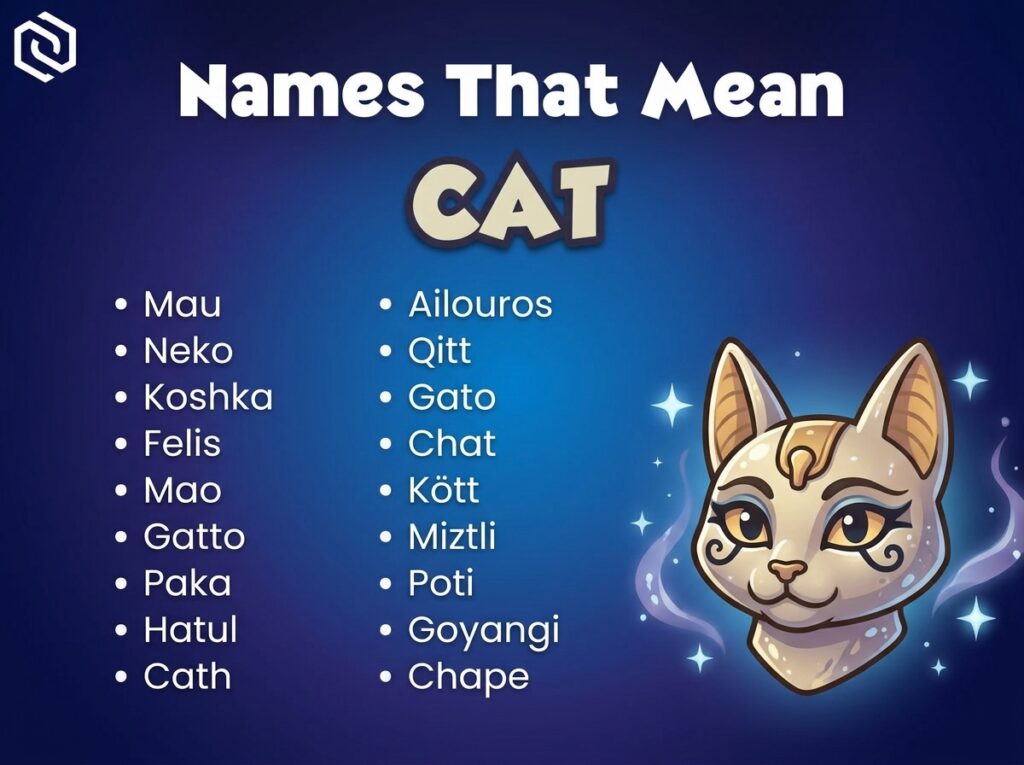
Cat Names Across Cultures
The word for cat changes dramatically across languages, but the cultural weight of the animal stays surprisingly consistent. Cats were worshipped in ancient Egypt, respected as protectors in Turkish and Japanese folklore, and woven into the domestic and spiritual life of dozens of civilizations. That’s why so many languages have produced names rooted in the cat, not just the word itself, but the full idea of what a cat represents.
Egyptian Names That Mean Cat
Ancient Egypt is where feline reverence reached its peak. The goddess Bastet was depicted as a cat or a woman with a cat’s head, and she governed protection, fertility, and the home. Several Egyptian names connect directly to this tradition.
| Name | Meaning | Gender |
|---|---|---|
| Bastet | Goddess of cats; “she of the ointment jar” in cat form | Girl |
| Pakhet | She who scratches; lioness/cat goddess | Girl |
| Mafdet | First cat deity in Egyptian records; panther/cat goddess | Girl |
| Miw | Ancient Egyptian word for cat, used as a name | Unisex |
| Miu | Variant of Miw; the sound a cat makes | Unisex |
| Sekhmet | Lioness goddess; feline power deity | Girl |
Japanese Names That Mean Cat
In Japan, the cat holds a special cultural place. The Maneki-neko (beckoning cat) is one of the most recognized symbols of good fortune across East Asia. The word “neko” appears in compound names and is used directly as a given name, particularly for girls. Japanese cat names tend to feel gentle and modern at the same time.
| Name | Meaning | Gender |
|---|---|---|
| Neko | Cat | Unisex |
| Nekomi | Cat + beauty | Girl |
| Nekota | Cat + plentiful/thick | Boy |
| Nekoha | Cat + feather/leaf | Girl |
| Nekohana | Cat + flower | Girl |
| Mikeneko | Calico cat | Girl |
Also Read: Japanese Names That Mean Cat: Origins, Meanings, and Cultural Context
Latin Names That Mean Cat
Latin gave us the genus name Felis for the domestic cat family, and from that root came several names used across European languages. These names feel classic and slightly scholarly, which makes them quietly distinctive.
| Name | Meaning | Gender |
|---|---|---|
| Felis | Cat (Latin genus) | Unisex |
| Felina | Cat-like, of the cat family | Girl |
| Felio | Derived from felis, cat | Boy |
| Felin | Relating to cats | Boy |
Swahili & African Names That Mean Cat
Swahili is a particularly rich source for animal names. “Paka” is the direct Swahili word for cat, used as a given name in East African naming traditions. The word is short, strong, and easy to pronounce across language backgrounds.
| Name | Meaning | Gender |
|---|---|---|
| Paka | Cat | Unisex |
| Chui | Leopard (large feline) | Boy |
Turkish Names That Mean Cat
The Turkish word “kedi” for cat is well known across the Middle East and Central Asia. In Turkey, cats are beloved urban companions, particularly in Istanbul, where the city’s feral cat population is a point of cultural pride. “Kedi” appears as a nickname name and occasionally as a given name.
| Name | Meaning | Gender |
|---|---|---|
| Kedi | Cat | Unisex |
| Tekir | Tabby cat; common Turkish name for striped cats | Boy |
Finnish & Slavic Names That Mean Cat
Finnish and Slavic languages use “kissa” and “kot” respectively for cat. “Kissa” in particular has a soft, Scandinavian-adjacent sound that works naturally as a feminine given name in Nordic naming traditions.
| Name | Meaning | Gender |
|---|---|---|
| Kissa | Cat (Finnish) | Girl |
| Kot | Cat (Polish/Slavic) | Boy |
| Kotek | Little cat (Polish diminutive) | Boy |
| Kotka | Cat (used informally as a name in Slavic cultures) | Girl |
Names That Mean Cat Goddess
The connection between cats and the divine is ancient and worldwide. In Egypt alone, at least three major deities took feline form. These aren’t just pretty names with a faint cat association. They are the actual names of goddesses who were worshipped, prayed to, and depicted with cat bodies for thousands of years.
- Bastet (Egyptian goddess of cats, home, and protection)
- Pakhet (Egyptian cat goddess “she who scratches”)
- Mafdet (earliest known Egyptian feline deity)
- Sekhmet (Egyptian lioness goddess of power and healing)
- Ailuros (Greek name for the Egyptian cat goddess)
- Ubaste (variant of Bastet used in some ancient texts)
- Tefnut (Egyptian lioness goddess of moisture and dew)
- Bast (shortened form of Bastet, used independently)
Names That Mean Feline or Cat-Like
Some names don’t mean “cat” directly but refer to the quality of being cat-like, to feline grace, sharpness of instinct, or the physical attributes associated with cats. These names work for parents who love the cat connection but want something that doesn’t sound like a pet name.
- Felina (Latin: feline, cat-like)
- Felin (Welsh: relating to cats)
- Felicity (Latin: rooted in “felis” meaning cat, though it evolved to mean happiness)
- Lynx (used as a name; the lynx is a wild cat genus)
- Pantera (from Panther; used in some European cultures as a surname-turned-given-name)
- Ailurophile (not a name but a term for cat lovers, root “ailuros” has generated name use)
- Chatte (French: female cat)
- Gatita (Spanish: little female cat)
Names That Mean Wild Cat
There’s a step up in energy when you move from “cat” to “wild cat.” These names feel more commanding, more untamed. Several come from cultures where the distinction between a house cat and a wild cat was less defined, and all of them carry a sense of animal power.
- Lynx (Latin/Greek: the wild cat genus)
- Chui (Swahili: leopard)
- Mafdet (Egyptian: the first panther/cat goddess)
- Pakhet (Egyptian: lioness goddess who hunted in the desert)
- Tekir (Turkish: tabby, striped wild appearance)
- Sekhmet (Egyptian: the fierce lioness)
- Pantera (Latin roots: panther, wild cat)
- Tygrys (Polish: tiger, large wild cat)
How to Choose the Right Cat Name
Sound matters first. A one-syllable name like “Kot” or “Paka” hits differently than a four-syllable name like “Bastet” or “Felina.” Think about how the name sits next to your last name, and whether you want something clipped and strong or flowing and soft.
Cultural fit is worth considering too. Names like Bastet and Mafdet carry real religious history. Using them means carrying that history with the name.
- Say it out loud with your last name at least ten times before deciding
- Check the initials to avoid unintended combinations
- Think about natural nicknames, “Felina” becomes “Fee” or “Lina” quite naturally
- Research the cultural origin, especially for Egyptian goddess names
- Consider how the name sounds on a child at seven and on an adult at forty
- If you want something uncommon, names like Kissa, Paka, or Miu are genuinely rare
Also Read: Names That Mean Fox: Clever and Cunning Baby Names From Around the World
Naming Expert’s Note
Bastet is the one name on this list that deserves special attention. It’s the most historically documented cat name in human civilization. Ancient Egyptians didn’t just name their goddess after a cat. They built temples to her, held annual festivals in her honor, and mummified cats as offerings. Using Bastet as a given name today carries that full story. It sounds strong and modern at the same time, sitting in the same phonetic space as names like Harriet or Juliet, which makes it far more wearable than people initially expect.
Frequently Asked Questions
Q: What is the most popular name that means cat?
A: Bastet is arguably the most recognized name with a direct cat meaning, given her status as the Egyptian goddess of cats. In modern naming, Neko has grown steadily in popularity, particularly in Japanese-influenced naming circles and among anime culture enthusiasts. Felina, derived from the Latin “felis” meaning cat, is the most commonly used in Western European naming traditions.
Q: What does cat mean in different languages?
A: Cat translates as “neko” in Japanese, “kedi” in Turkish, “chat” in French, “gato/gata” in Spanish, “kot” in Polish, “kissa” in Finnish, “paka” in Swahili, “katze” in German, and “kater” (tomcat) in Dutch and German. Many of these words have crossed over into use as given names or nicknames in their respective cultures.
Q: What are some rare names that mean cat?
A: Some genuinely rare options include Kissa (Finnish), Paka (Swahili), Mafdet (Egyptian), Miw (Ancient Egyptian), Pakhet (Egyptian), and Felio (Latin). These names are barely used outside their cultural contexts, which makes them distinctive choices for parents who want something truly uncommon.
Q: What is a good middle name to pair with Bastet?
A: Bastet pairs well with shorter middle names that don’t compete with its strong ending. Options like Bastet Rae, Bastet Zoe, Bastet Lou, or Bastet Claire all flow naturally. If you want to lean into the Egyptian mythology theme, Bastet Nile or Bastet Isis work beautifully and stay thematically consistent.
Q: Are cat names still popular for babies?
A: Cat-meaning names are a niche but growing category. Names like Neko have gained traction through anime and Japanese pop culture, while Bastet has seen a small surge alongside the broader trend toward mythology-inspired names. Felina and Felicity, both rooted in the Latin “felis” for cat, remain popular without most parents knowing the feline connection.
Q: Is Felicity really a cat name?
A: Felicity derives from the Latin “felicitas,” meaning happiness or good fortune, which itself traces back to the root “felis,” the Latin word for cat. Etymologists generally agree on this chain. The cat connection is real but distant, as the name’s dominant meaning today is clearly “happiness.” It’s worth knowing if the feline link matters to you, but the name doesn’t read as a cat name in everyday use.
Conclusion
Cat names span an extraordinary range, from ancient Egyptian goddess names that carry thousands of years of religious history to gentle Japanese compounds that feel fresh and modern. Whether you’re drawn to the mythological weight of Bastet, the soft simplicity of Neko, or the quiet rarity of Kissa, there’s something genuinely interesting in each of these choices. Cats have always represented independence and quiet power, and the names that carry their meaning tend to do the same. If you love animal-rooted names, you might also enjoy exploring names that mean wolf or names that mean tiger for more wild and grounded options.