Death carries a heavy silence in Japanese naming culture. The kanji for death, 死 (shi), is so deeply avoided that even the number four, which shares the same pronunciation, is considered unlucky in hospitals and hotels across Japan. This means genuine Japanese names that mean death are extraordinarily rare, and almost all of them come from mythology and religious tradition rather than everyday naming practice.
If you are drawn to these names for a character, a creative project, or out of genuine cultural curiosity, understanding the Shinto and Buddhist roots behind them matters more than the names themselves. These are names with weight, history, and real spiritual significance.
What Japanese names mean death?
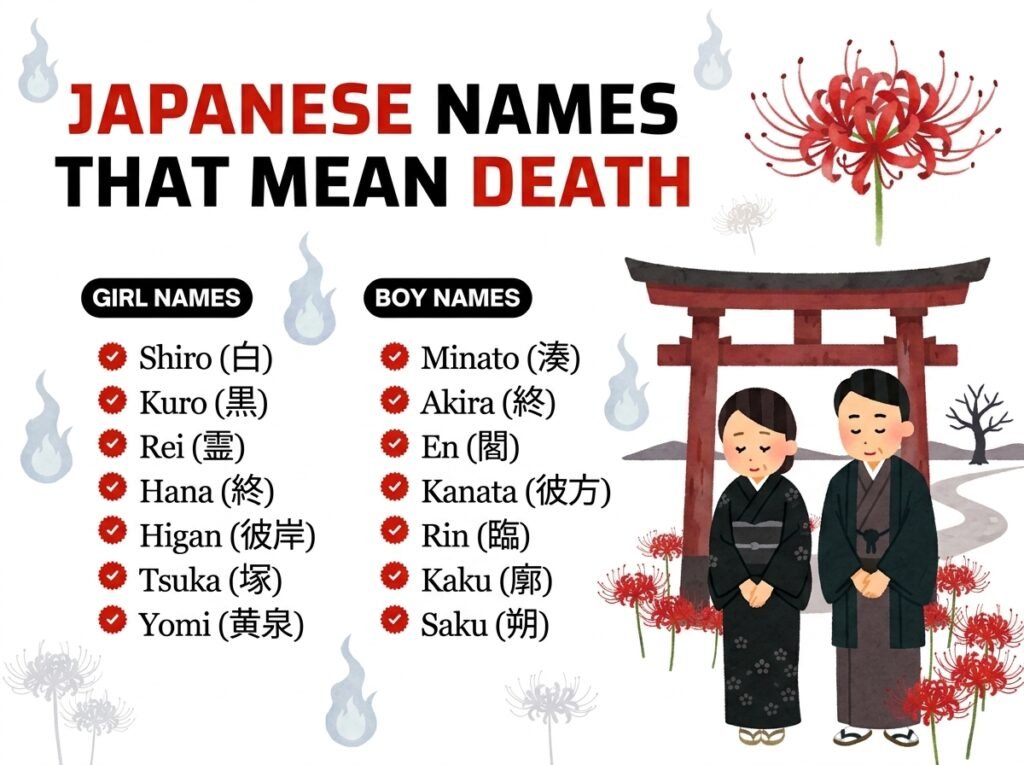
The most recognized Japanese names meaning death come from Shinto mythology and Buddhist tradition. Izanami is the goddess of the dead, Enma is the Buddhist judge of the underworld, and Yomi refers to the land of the dead itself. Names like Shide, Yomotsu, and Shikome also carry direct connections to death and the afterlife. Most are mythological rather than used in modern naming, since the death kanji (死) is considered deeply taboo in Japanese culture.
Japanese Girl Names That Mean Death
Names for girls connected to death in Japanese tradition almost entirely trace back to Shinto creation myths and the underworld of Yomi. They carry a solemn, ancient quality that feels more like incantation than casual naming. These names suit characters, creative works, or anyone with a deep respect for Japanese mythology who understands the gravity behind the meanings.
| Name | Origin | Meaning | Pronunciation | Popularity |
|---|---|---|---|---|
| Izanami | Japanese (Shinto) | Goddess of creation who became queen of the dead | ee-zah-NAH-mee | Mystic |
| Yomi | Japanese (Shinto) | The underworld; land of the dead | YOH-mee | Rare |
| Yomotsu | Japanese (Shinto) | Of the underworld; belonging to Yomi | yoh-MOH-tsoo | Rare |
| Shikome | Japanese (Shinto) | Underworld hags who guard the land of the dead | shee-KOH-meh | Dark |
| Shide | Japanese (Buddhist) | Death journey; the road departing from life | SHEE-deh | Unique |
| Rei | Japanese | Spirit; soul (when written with the kanji 霊) | RAY | Classic |
| Yū | Japanese | Ghostly; otherworldly; of the hidden world (幽) | YOO | Soft |
| Tamayori | Japanese (Shinto) | Spirit vessel; maiden possessed by divine spirits | tah-mah-YOH-ree | Mystic |
Naming Expert’s Note: Izanami is the single most recognizable Japanese name connected to death, and it carries genuine mythological authority. In the Kojiki, Japan’s oldest written record, Izanami dies giving birth to the fire god Kagutsuchi and descends to Yomi, where she becomes the ruler of the dead. The name sounds lyrical and feminine to Western ears, which creates a striking contrast with its dark meaning. If you use it for a character or creative project, that contrast is exactly what makes it memorable. Just know that no Japanese parent would give this name to a child in real life.
Japanese Boy Names That Mean Death
Boy names tied to death in Japanese culture lean heavily on Buddhist cosmology and the imagery of judgment and the afterlife. They tend to sound sharper and more commanding than the girl names, with harder consonants and shorter syllables. Most of these names appear in religious texts and folklore rather than on birth certificates.
| Name | Origin | Meaning | Pronunciation | Popularity |
|---|---|---|---|---|
| Enma | Japanese (Buddhist) | King and supreme judge of the dead | EN-mah | Dark |
| Yomotsu | Japanese (Shinto) | Of the underworld; guardian of Yomi’s border | yoh-MOH-tsoo | Rare |
| Shide | Japanese (Buddhist) | Death passage; the journey beyond life | SHEE-deh | Unique |
| Rei | Japanese | Spirit of the dead (when written 霊) | RAY | Classic |
| Yū | Japanese | Phantom; hidden spirit (when written 幽) | YOO | Soft |
| Shura | Japanese (Buddhist) | Realm of endless battle and suffering after death | SHOO-rah | Powerful |
Japanese Unisex Names That Mean Death
The gender-neutral names in this category tend to be single-syllable or two-syllable words drawn from spiritual vocabulary rather than personal naming traditions. They work across genders because they describe concepts and places rather than human roles. Their brevity gives them a quiet, almost whispered quality.
| Name | Origin | Meaning | Pronunciation | Popularity |
|---|---|---|---|---|
| Yomi | Japanese (Shinto) | The land of the dead; the underworld | YOH-mee | Rare |
| Rei | Japanese | Spirit; soul; ghost (霊) | RAY | Classic |
| Yū | Japanese | Ghostly; faint; otherworldly (幽) | YOO | Soft |
| Shide | Japanese (Buddhist) | Departure through death; the death road | SHEE-deh | Unique |
| Yomotsu | Japanese (Shinto) | Belonging to the underworld | yoh-MOH-tsoo | Rare |
Also Read: Japanese Names That Mean Dark and Their Shadowy Origins
The Cultural Roots of Japanese Death Names
The reason this list is shorter than most naming articles is not a lack of research. It is a reflection of real Japanese cultural practice. In Japan, the concept of imi (忌み), or ritual avoidance, shapes naming more than almost any other culture. The syllable “shi” is avoided in hospitals, where room 4 and floor 4 often do not exist. The death kanji 死 has never been part of mainstream personal naming, and using it would be seen as inviting misfortune.
This means the names that do exist come almost exclusively from two sources: Shinto creation mythology and Buddhist eschatology.
Shinto Mythology Names Connected to Death
Shinto, Japan’s indigenous spiritual tradition, tells the story of how death entered the world through the goddess Izanami. After her death, she became the ruler of Yomi, a dark and polluted underworld beneath the earth. The names from this tradition are ancient and carry the weight of origin stories.
| Name | Meaning | Gender |
|---|---|---|
| Izanami | Goddess who became queen of the dead | Girl |
| Yomi | The underworld; land of the dead | Unisex |
| Yomotsu | Of the underworld | Unisex |
| Shikome | Hags of the underworld | Girl |
| Yomotsu Hirasaka | The slope between the living world and Yomi | Place name |
| Tamayori | Spirit vessel; bridge between worlds | Girl |
Buddhist Tradition Names Connected to Death
Buddhism arrived in Japan in the sixth century and brought with it a detailed cosmology of the afterlife, including judgment, punishment, and rebirth. The most prominent figure is Enma, the king who judges the dead. Buddhist death-related names carry a more structured, moral quality compared to the older Shinto names.
| Name | Meaning | Gender |
|---|---|---|
| Enma | King and judge of the dead | Boy |
| Shide | The death journey; departure from life | Unisex |
| Shura | Realm of suffering and endless conflict | Boy |
| Gaki | Hungry ghost; spirit trapped by desire | Boy |
| Sanzu | The river the dead must cross (as in Sanzu no Kawa) | Unisex |
Japanese Folklore Names Connected to Death
Beyond formal religion, Japanese folklore is rich with spirits, ghosts, and supernatural beings associated with death. These names appear in regional legends, Noh theater, and kaidan (ghost stories) rather than in official records.
| Name | Meaning | Gender |
|---|---|---|
| Yūrei | Ghost; faint spirit (幽霊) | Unisex |
| Onryō | Vengeful spirit of the dead | Girl |
| Shiryō | Spirit of a deceased person (死霊) | Unisex |
| Ikiryō | Living ghost; spirit that leaves the body | Unisex |
Also Read: Japanese Names That Mean Evil and Their Folklore Origins
Names That Mean the Underworld
The underworld in Japanese tradition is not a place of fire and punishment like the Western concept of hell. Yomi is dark, stagnant, and polluted, a place of decay rather than torment. Names drawn from this imagery carry a quiet, heavy atmosphere rather than aggressive darkness.
- Yomi
- Yomotsu
- Yomotsu Hirasaka
- Ne no Kuni (the “root land,” an older name for the underworld)
- Soko no Kuni (the “bottom land”)
- Enma Daiou (the great king Enma)
- Jigoku (hell, from Buddhist tradition)
- Meifu (the dark realm of the dead)
- Kakuriyo (the hidden world, opposite of the living world)
- Yomikai (the underworld gathering)
Names That Mean Spirit or Ghost
Japanese has an unusually rich vocabulary for different types of spirits, and each word describes a specific kind of supernatural presence. These names work well for creative projects because they carry precise, layered meanings that go beyond a simple “ghost” translation.
- Rei (霊, spirit or soul)
- Yū (幽, ghostly or hidden)
- Yūrei (幽霊, a traditional ghost)
- Shiryō (死霊, spirit of the dead)
- Ikiryō (生霊, a living person’s wandering spirit)
- Onryō (怨霊, a vengeful ghost)
- Tamashii (魂, the soul or essence)
- Konpaku (魂魄, the dual soul in Taoist-Japanese belief)
- Mononoke (物の怪, a shape-shifting spirit)
- Hitodama (人魂, a floating soul flame)
Names That Mean the Afterlife or Rebirth
Death in Japanese spiritual thought is rarely an ending. Buddhist tradition emphasizes the cycle of death and rebirth (rinne, 輪廻), and many concepts blur the line between the two. These names capture the transitional space between what ends and what begins again.
- Rinne (輪廻, the cycle of rebirth)
- Sanzu (三途, the river between life and death)
- Shide (死出, the departure through death)
- Ōjō (往生, peaceful death leading to the Pure Land)
- Genshō (現生, the present life, implying past lives)
- Raisei (来世, the next life)
- Meio (冥王, king of the dark realm)
- Jōdo (浄土, the Pure Land after death)
- Higan (彼岸, the “other shore” of enlightenment beyond death)
- Mukō (向こう, the other side)
Also Read: Beautiful Names That Mean Rebirth and New Beginnings
How to Choose the Right Death-Related Japanese Name
Sound matters more than you might expect with these names. Many of them contain the “shi” syllable, which Japanese speakers instinctively associate with death and bad luck. If you are choosing a name for a character or creative work, consider how the name sounds in context and whether the heaviness of the meaning matches the tone you want.
Cultural accuracy matters just as much. Using a name like Izanami without understanding her full mythological story can come across as shallow. Take time to learn the origin before committing.
- Say the name aloud and notice whether the sounds feel sharp or soft
- Research the specific kanji, since different characters change the meaning entirely
- Understand the mythological or religious story behind the name
- Consider whether the name suits a real person, a character, or a creative project
- Check how the name reads to both Japanese and non-Japanese audiences
- Be aware that using death kanji in real-life naming is culturally inappropriate in Japan
Frequently Asked Questions
Q: What is the most well-known Japanese name that means death?
A: Izanami is the most widely recognized Japanese name connected to death. She is the Shinto goddess of creation who died in childbirth and became the ruler of Yomi, the underworld. Her story appears in the Kojiki, Japan’s oldest surviving text, making her one of the most significant figures in all of Japanese mythology.
Q: Are there any common Japanese given names that mean death?
A: No. In everyday Japanese naming practice, the death kanji 死 is never used. The syllable “shi” is actively avoided due to its association with death and misfortune. Names that do relate to death, like Enma or Yomi, come from mythology and religion and are not given to children in modern Japan.
Q: What does Yomi mean in Japanese?
A: Yomi (黄泉) is the Shinto underworld, the land where the dead reside. It is described in the Kojiki as a dark, polluted place beneath the earth. Izanami rules Yomi after her death, and her husband Izanagi famously flees from it after seeing her decayed form.
Q: What are some rare Japanese names related to death?
A: Shikome (the underworld hags), Yomotsu (of the underworld), and Shide (the death journey) are all rare names drawn from Japanese mythology. Shura, from Buddhist cosmology, describes a realm of suffering after death. These names are almost never used outside of mythological or creative contexts.
Q: Is Rei a Japanese name that means death?
A: Rei can mean “spirit” or “soul” when written with the kanji 霊, which connects it to the spirit world and the afterlife. However, Rei is a very common Japanese name that is more frequently written with kanji meaning “lovely” (麗) or “bell” (鈴). The death-related meaning only applies with the specific spirit kanji.
Q: Why are Japanese death names so rare compared to other cultures?
A: Japanese culture practices imi, or ritual avoidance of unlucky words and symbols. The death kanji and the “shi” sound are considered deeply inauspicious. This is why even the number four is skipped in many Japanese buildings. Names related to death survive only in mythology and religious texts, not in personal naming traditions.
Final Thoughts
Japanese names that mean death exist almost entirely in the space between mythology and spiritual tradition. From Izanami’s descent into Yomi to Enma’s courtroom of judgment, these names carry centuries of cultural meaning that most naming lists simply cannot capture. Their power comes not from quantity but from the depth of the stories behind them. If this topic fascinates you, you might also enjoy exploring names that mean life across different cultures for a meaningful contrast.