Japanese naming tradition overwhelmingly favors positive meanings like beauty, strength, and nature. Finding Japanese names that mean evil requires looking past the modern nursery and into mythology, folklore, and historical warrior culture. These names carry serious weight. They come from Shinto death deities, Buddhist demon realms, and centuries-old tales of oni that still shape Japanese storytelling today. Most are not common baby names in modern Japan, but they hold deep cultural and literary significance. If you are drawn to names with a darker edge, understanding where they come from matters more than anything.
What are some Japanese names that mean evil?
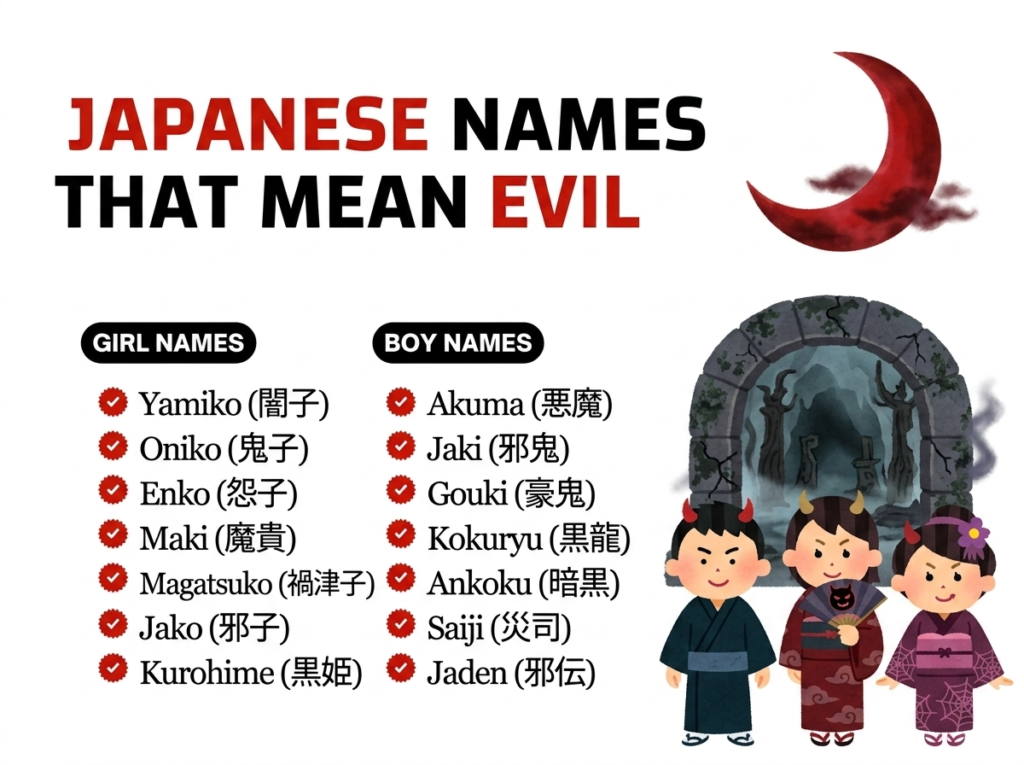
Japanese names connected to evil draw from Shinto mythology, Buddhist demon lore, and oni folklore. Notable examples include Izanami (goddess of death), Onimaru (demon circle), Yasha (demon), Shura (asura warrior), Yami (darkness), Rasetsu (demon), Kage (shadow), and Jaki (evil spirit). Most of these appear in mythology, literature, and fiction rather than modern birth registries, making them powerful choices for characters or symbolic naming.
Japanese Girl Names That Mean Evil
Names in this category pull from some of the most striking figures in Japanese mythology. Many trace back to goddesses of the underworld, demonesses from Buddhist scripture, and fox spirits from Edo-period folklore. They sound sharp and deliberate. Most carry an intensity that softer Japanese girl names simply do not. These are names with teeth, rooted in stories that have survived for over a thousand years.
| Name | Origin | Meaning | Pronunciation | Popularity |
|---|---|---|---|---|
| Izanami | Shinto mythology | Goddess of death and the underworld | ee-zah-NAH-mee | Mystic |
| Yami | Japanese (闇) | Darkness, the void | YAH-mee | Dark |
| Yasha | Buddhist-Japanese | Female demon, yaksha spirit | YAH-shah | Rare |
| Rasetsu | Buddhist-Japanese | Female demon, rakshasa | rah-SET-soo | Dark |
| Oniko | Japanese (鬼子) | Demon child | oh-NEE-koh | Rare |
| Kage | Japanese (影) | Shadow, silhouette | KAH-geh | Mystic |
| Shura | Buddhist-Japanese | Asura, wrathful fighting demon | SHOO-rah | Powerful |
| Yōko | Japanese (妖狐) | Bewitching fox spirit | YOH-koh | Mystic |
| Jaki | Japanese (邪気) | Evil spirit, wicked energy | JAH-kee | Dark |
| Tatari | Japanese (祟) | Divine curse, spiritual punishment | tah-TAH-ree | Rare |
| Kuro | Japanese (黒) | Black, darkness | KOO-roh | Unique |
| Noroi | Japanese (呪) | Curse, hex | noh-ROH-ee | Dark |
| Majin | Japanese (魔神) | Demon deity, evil god | MAH-jeen | Powerful |
| Kyōka | Japanese (凶花) | Calamity flower | KYOH-kah | Unique |
| Akuma | Japanese (悪魔) | Devil, demon | ah-KOO-mah | Dark |
Naming Expert’s Note: Izanami is the most culturally significant name on this list. In Shinto creation mythology, she is the goddess who gave birth to the Japanese islands before descending into Yomi, the land of the dead. Her story is one of grief and rage, not simple villainy. If you choose this name, know that it carries an entire origin myth on its shoulders. It works beautifully for a fictional character but would raise eyebrows as a legal given name in Japan.
Japanese Boy Names That Mean Evil
Boy names tied to evil in Japanese tradition often come from the battlefield and the demon realm. Historical warriors sometimes adopted oni-related names to project fearlessness. Buddhist texts introduced layers of demon hierarchy that gave rise to names like Shura and Rasetsu. These names feel heavy and commanding. They suit characters, pen names, or anyone drawn to the warrior-demon archetype that runs deep through Japanese storytelling.
| Name | Origin | Meaning | Pronunciation | Popularity |
|---|---|---|---|---|
| Onimaru | Japanese (鬼丸) | Demon circle, historical warrior name | oh-nee-MAH-roo | Powerful |
| Shuten | Japanese folklore | From Shuten-dōji, legendary demon king | SHOO-ten | Rare |
| Yasha | Buddhist-Japanese | Yaksha demon warrior | YAH-shah | Mystic |
| Shura | Buddhist-Japanese | Asura, wrathful fighting demon | SHOO-rah | Powerful |
| Kage | Japanese (影) | Shadow, shade | KAH-geh | Dark |
| Yami | Japanese (闇) | Darkness, abyss | YAH-mee | Dark |
| Rasetsu | Buddhist-Japanese | Rakshasa, man-eating demon | rah-SET-soo | Rare |
| Akki | Japanese (悪鬼) | Evil demon, wicked ogre | AHK-kee | Dark |
| Majin | Japanese (魔神) | Demon god, evil deity | MAH-jeen | Powerful |
| Jaki | Japanese (邪気) | Evil energy, malevolent force | JAH-kee | Dark |
| Kuro | Japanese (黒) | Black, dark | KOO-roh | Unique |
| Tatari | Japanese (祟) | Curse, divine retribution | tah-TAH-ree | Rare |
| Kyō | Japanese (凶) | Misfortune, villainy | KYOH | Rare |
| Oni | Japanese (鬼) | Demon, ogre | OH-nee | Dark |
| Jaaku | Japanese (邪悪) | Wickedness, pure evil | JAH-ah-koo | Rare |
Also Read: Japanese Names That Mean Dark With Deep Mythological Roots
Japanese Unisex Names That Mean Evil
The gender-neutral names in this group tend to be shorter and more elemental. They reference concepts like darkness, shadow, and spiritual corruption rather than specific mythological figures. This makes them feel more abstract and atmospheric. Many work equally well for any gender because they describe forces of nature or spiritual states rather than human roles.
| Name | Origin | Meaning | Pronunciation | Popularity |
|---|---|---|---|---|
| Yami | Japanese (闇) | Darkness, the void | YAH-mee | Dark |
| Kage | Japanese (影) | Shadow, silhouette | KAH-geh | Mystic |
| Shura | Buddhist-Japanese | Asura demon, realm of wrath | SHOO-rah | Powerful |
| Yasha | Buddhist-Japanese | Demon, yaksha spirit | YAH-shah | Rare |
| Kuro | Japanese (黒) | Black, darkness | KOO-roh | Unique |
| Majin | Japanese (魔神) | Demon deity | MAH-jeen | Dark |
| Jaki | Japanese (邪気) | Evil spirit, wicked energy | JAH-kee | Rare |
| Tatari | Japanese (祟) | Curse, divine punishment | tah-TAH-ree | Mystic |
| Rasetsu | Buddhist-Japanese | Rakshasa demon | rah-SET-soo | Dark |
| Noroi | Japanese (呪) | Curse, hex | noh-ROH-ee | Rare |
The Cultural Roots of Japanese Evil Names
The concept of evil in Japanese naming does not come from a single source. It layers together Shinto creation myths, Buddhist demon cosmology, and centuries of folk tales about oni, yōkai, and vengeful spirits. Each tradition contributed different vocabulary and different emotional weight to these names. Understanding which layer a name comes from helps you understand what it actually communicates.
Shinto Mythology Names That Mean Evil
Shinto, Japan’s indigenous religion, frames evil less as moral corruption and more as spiritual pollution or death-related impurity. The most prominent figure is Izanami, whose transformation from creation goddess to ruler of the underworld gives her name its dark association.
| Name | Meaning | Gender |
|---|---|---|
| Izanami | Goddess of death, ruler of Yomi | Girl |
| Yomi | The underworld, land of the dead | Unisex |
| Tatari | Divine curse, spiritual retribution | Unisex |
| Magatsuhi | Calamity gods born from Izanami’s decay | Boy |
| Ōmagatoki | The hour of great evil, twilight | Unisex |
Buddhist Demon Names That Mean Evil
Buddhism introduced a detailed hierarchy of demons and hostile spirits to Japanese culture. The asura realm (Shura) and the rakshasa (Rasetsu) became embedded in the language and eventually in naming traditions, especially in literary and theatrical contexts.
| Name | Meaning | Gender |
|---|---|---|
| Shura | Asura, wrathful fighting demon | Unisex |
| Rasetsu | Rakshasa, flesh-eating demon | Unisex |
| Yasha | Yaksha, nature demon | Unisex |
| Gaki | Hungry ghost, tormented spirit | Boy |
| Majin | Demon god, evil deity | Unisex |
| Akuryō | Evil spirit, malevolent ghost | Boy |
Oni and Folklore Names That Mean Evil
Oni are the most recognizable demons in Japanese folklore. They appear in everything from children’s stories to Noh theater. Names incorporating the kanji 鬼 (oni) were occasionally used by historical warriors who wanted to project an aura of invincibility.
| Name | Meaning | Gender |
|---|---|---|
| Onimaru | Demon circle, warrior name | Boy |
| Oniko | Demon child | Girl |
| Oni | Demon, ogre | Boy |
| Shuten | From Shuten-dōji, the demon king | Boy |
| Ibaraki | From Ibaraki-dōji, demon of Rashōmon | Boy |
Also Read: Japanese Names That Mean Death From Shinto and Buddhist Tradition
Names That Mean Demon in Japanese
Demon names in Japanese center on the kanji 鬼 (oni), 魔 (ma), and 邪 (ja). These characters appear across mythology, martial arts terminology, and modern anime. A demon name in Japanese tends to sound percussive and short, with hard consonants that mirror the aggressive nature of the beings they describe.
- Akuma (悪魔)
- Oni (鬼)
- Majin (魔神)
- Akki (悪鬼)
- Yasha (夜叉)
- Rasetsu (羅刹)
- Shuten (酒天)
- Onimaru (鬼丸)
- Gaki (餓鬼)
- Jaki (邪気)
Names That Mean Darkness in Japanese
Darkness names in Japanese lean on the kanji 闇 (yami), 暗 (an), and 黒 (kuro). These feel more atmospheric than outright malevolent. They evoke the absence of light rather than the presence of malice, which gives them a slightly softer edge compared to demon names.
- Yami (闇)
- Kuro (黒)
- Kurayami (暗闇)
- An (暗)
- Kage (影)
- Yoru (夜)
- Shikkoku (漆黒)
- Ankoku (暗黒)
- Yūgure (夕暮)
- Shin’en (深淵)
Names That Mean Curse in Japanese
Curse names are among the rarest in any naming tradition, and Japanese is no exception. The kanji 呪 (noro/ju) and 祟 (tatari) carry heavy spiritual weight. In Shinto belief, a tatari is not a casual hex but a serious spiritual consequence, often tied to an angry deity or restless ghost.
- Tatari (祟)
- Noroi (呪)
- Jujutsu (呪術)
- Noro (呪)
- Tatari-gami (祟神)
- Ju (呪)
- Onryō (怨霊)
- Sawa (障)
- Wazawai (禍)
- Magatama (曲玉, associated with spiritual power and warding)
Also Read: Japanese Names That Mean Shadow for Boys and Girls
How to Choose the Right Japanese Evil Name
Sound matters more than you might think with Japanese names. Short two-syllable names like Yami and Kage hit harder than longer options. Consider how the name sounds alongside a surname or middle name, and whether the rhythm feels natural in your language.
Cultural context is equally important. Many of these names carry specific mythological baggage that Japanese speakers will immediately recognize. Knowing the full story behind a name like Izanami or Shuten prevents awkward misunderstandings later.
- Say the name out loud with your last name to test the flow
- Check the initials to avoid unintended acronyms
- Research the specific kanji and its mythological associations
- Understand that the same pronunciation can have entirely different meanings depending on kanji choice
- Consider whether the name works for a child, a teenager, and an adult
- Be aware that most of these names are literary or mythological rather than common given names in Japan
Frequently Asked Questions
Q: What is the most well-known Japanese name meaning evil?
A: Izanami is the most recognized. She is the Shinto goddess of creation who became ruler of Yomi, the Japanese underworld, after her death. Her name is deeply embedded in Japanese mythology and appears frequently in literature, anime, and gaming.
Q: Do Japanese parents actually name their children after evil concepts?
A: Very rarely. Japanese naming culture strongly favors positive meanings like beauty, light, and virtue. Names with explicitly evil meanings are almost exclusively found in mythology, fiction, and historical warrior traditions. Modern parents would not typically choose a name like Akuma or Jaaku for a child.
Q: What does “oni” mean in Japanese names?
A: Oni (鬼) means demon or ogre. It appears in historical names like Onimaru and Oniko. In Japanese folklore, oni are powerful supernatural beings associated with chaos and destruction. The kanji was sometimes used in warrior names to project strength and fearlessness.
Q: What is a good middle name to pair with Izanami?
A: Since Izanami is already four syllables, a short middle name works best. Options like Rei, Kai, or Ren create a clean rhythm. Pairing it with a Japanese name that means light creates an interesting contrast between darkness and brightness.
Q: Are Japanese evil names popular in anime and manga?
A: Yes, extensively. Names like Shura, Yami, Kage, and Majin appear across hundreds of anime and manga series. Creators choose these names specifically because Japanese audiences immediately understand the dark connotations. This is where most people outside Japan encounter these names for the first time.
Q: Can the same Japanese name mean both good and evil?
A: Absolutely. Japanese names depend entirely on kanji choice. The name Yōko, for example, most commonly means “sun child” (陽子) or “ocean child” (洋子). Only when written as 妖狐 does it mean “bewitching fox spirit.” Always verify the kanji before assuming a name’s meaning.
Final Thoughts
Japanese names that mean evil open a window into the darker corners of Shinto mythology, Buddhist cosmology, and centuries of oni folklore. These names are not everyday choices, and that is exactly what makes them compelling. They carry the weight of ancient stories about death, wrath, and the supernatural forces that Japanese culture has wrestled with for over a millennium. Whether you are naming a character, exploring your heritage, or simply fascinated by the language, these names reward anyone willing to learn the full story behind them. For more names rooted in Japanese tradition, explore Japanese names that mean mischievous for a lighter take on the trickster archetype.