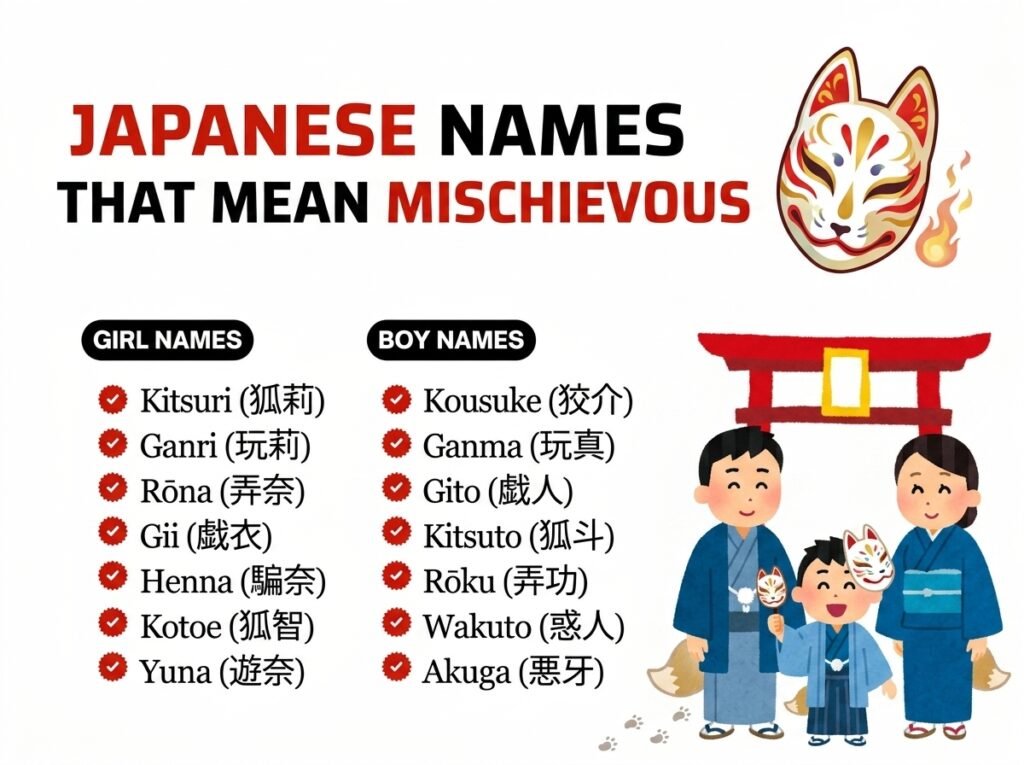
Japanese naming tradition leans heavily toward meanings like beauty, strength, and nature. So finding Japanese names that mean mischievous takes a bit more digging than you might expect. The concept of mischief in Japan lives mostly in folklore and mythology rather than in the kanji parents choose for their babies.
That said, the playful spirit does show up in real names. The kanji 遊 (yū), meaning “play” or “playfulness,” appears in genuine Japanese given names and carries that lighthearted, slightly cheeky energy. A few mythological trickster figures also lend their names to modern use. This guide covers what actually exists, without stretching meanings to fill a list.
What Japanese names mean mischievous?
Genuine Japanese names meaning mischievous are rare because the culture favors positive, aspirational kanji. The closest authentic options use the kanji 遊 (yū), meaning “play” or “playfulness.” Real examples include Yūta, Yūna, Yūto, Yūka, Yūma, Susanoo (the trickster storm god), and Uzume (the playful goddess). These names carry a spirited, lighthearted energy rooted in actual Japanese naming tradition.
Japanese Girl Names That Mean Mischievous
Names for girls in this category almost all center on the kanji 遊 (yū), which translates to “play” or “amusement.” In Japanese, this kanji carries a warm, lighthearted tone. It suggests a child who is spirited and curious rather than troublemaking. These names feel bright and energetic, with a softness that comes from the feminine kanji pairings that follow.
| Name | Origin | Meaning | Pronunciation | Popularity |
|---|---|---|---|---|
| Yūna | Japanese | Playful, graceful | YOO-nah | Rare |
| Yūmi | Japanese | Playful beauty | YOO-mee | Unique |
| Yūka | Japanese | Playful flower | YOO-kah | Rare |
| Yūri | Japanese | Playful jasmine | YOO-ree | Soft |
| Yūko | Japanese | Playful child | YOO-koh | Classic |
| Yūa | Japanese | Playful love | YOO-ah | Trending |
| Yūho | Japanese | Playful stroll | YOO-hoh | Rare |
| Yūki | Japanese | Playful hope | YOO-kee | Unique |
| Yūna | Japanese | Playful greens | YOO-nah | Rare |
| Uzume | Japanese | Playful goddess of mirth | OO-zoo-meh | Mystic |
| Yūmi | Japanese | Playful truth | YOO-mee | Unique |
| Yūka | Japanese | Playful fragrance | YOO-kah | Soft |
Japanese Boy Names That Mean Mischievous
Boy names with a mischievous edge tend to feel bold and energetic. The 遊 (yū) kanji gives these names a sense of movement and fun, while the second kanji adds weight and character. You will also find Susanoo here, the original trickster of Japanese mythology. His name carries centuries of storytelling about a god who refused to follow the rules.
| Name | Origin | Meaning | Pronunciation | Popularity |
|---|---|---|---|---|
| Susanoo | Japanese | Mischievous storm god | SOO-sah-noh | Mystic |
| Yūta | Japanese | Playful, great | YOO-tah | Trending |
| Yūto | Japanese | Playful person | YOO-toh | Classic |
| Yūya | Japanese | Playful, gentle | YOO-yah | Rare |
| Yūki | Japanese | Playful, noble | YOO-kee | Unique |
| Yūma | Japanese | Playful, genuine | YOO-mah | Trending |
| Yūsuke | Japanese | Playful, helpful | YOO-soo-keh | Classic |
| Yūgo | Japanese | Playful, self | YOO-goh | Rare |
| Yūsei | Japanese | Playful star | YOO-seh-ee | Unique |
| Yūhei | Japanese | Playful, peaceful | YOO-heh-ee | Rare |
| Yūto | Japanese | Playful, Big Dipper | YOO-toh | Unique |
| Yūki | Japanese | Playful radiance | YOO-kee | Powerful |
Also Read: Japanese Names That Mean Fox From Myth and Modern Use
Japanese Unisex Names That Mean Mischievous
Gender-neutral options in this space are minimal but genuine. The standalone kanji 遊 works beautifully on its own as a short, punchy name. When paired with neutral second kanji, these names suit any child and carry that same spirited, playful energy without leaning masculine or feminine.
| Name | Origin | Meaning | Pronunciation | Popularity |
|---|---|---|---|---|
| Yū | Japanese | Play, playfulness | YOO | Rare |
| Yūki | Japanese | Playful joy | YOO-kee | Unique |
| Yū | Japanese | Carefree, leisurely | YOO | Soft |
| Yūmi | Japanese | Playful sea | YOO-mee | Mystic |
| Yū | Japanese | Playful feather | YOO | Rare |
| Yūki | Japanese | Playful life | YOO-kee | Unique |
The Cultural Roots of Mischievous Names in Japan
Mischief in Japanese culture has a complicated reputation. Unlike Western traditions where tricksters are often villains, Japanese folklore treats playful deception as a form of intelligence. Fox spirits, tanuki, and even certain Shinto gods use mischief to teach lessons or expose hypocrisy. This cultural backdrop explains why the concept exists in storytelling but rarely makes it into baby names.
Shinto Mythology and the Trickster God Susanoo
Susanoo is the most famous trickster in all of Japanese mythology. The storm god threw a flayed horse into his sister Amaterasu’s weaving hall, which drove her to hide in a cave and plunge the world into darkness. His name is synonymous with unruly, mischievous power.
| Name | Meaning | Gender |
|---|---|---|
| Susanoo | Mischievous storm god | Boy |
| Uzume | Playful goddess who lured Amaterasu out | Girl |
| Ame-no-Uzume | Heavenly playful goddess | Girl |
Yokai Folklore and Fox Spirits
Fox spirits (kitsune) are the quintessential tricksters of Japanese folklore. They shape-shift, play pranks, and sometimes fall in love with humans. While “Kitsune” itself is not used as a given name, the fox association runs deep in Japanese culture. Names connected to fox spirits and their clever nature carry an indirect link to mischief.
| Name | Meaning | Gender |
|---|---|---|
| Inari | Fox deity of rice and prosperity | Unisex |
| Kon | Fox sound, clever | Unisex |
The Kanji 遊 in Everyday Japanese Naming
The kanji 遊 appears in real Japanese names and carries the meaning of “play,” “amusement,” or “leisure.” It is the closest kanji to “mischievous” that parents actually use. The distinction matters. Playfulness is celebrated in Japanese naming. Outright mischief is not.
| Name | Meaning | Gender |
|---|---|---|
| Yūta | Playful, great | Boy |
| Yūna | Playful, graceful | Girl |
| Yūto | Playful person | Boy |
| Yūka | Playful flower | Girl |
| Yūma | Playful, genuine | Boy |
| Yūa | Playful love | Girl |
Also Read: Japanese Names That Mean Fire With Strong Kanji Roots
Names That Mean Playful and Names That Mean Trickster
The word “mischievous” sits between “playful” and “trickster” on a spectrum. Understanding these related meanings helps you find the right name if the exact word “mischievous” feels too narrow or too broad for what you have in mind.
Names That Mean Playful
Playful names carry a lighter, more innocent energy than mischievous ones. In Japanese, the 遊 kanji covers this ground naturally. These names feel joyful and free-spirited without any hint of trouble.
- Yūta (遊太)
- Yūna (遊奈)
- Yūto (遊人)
- Yūka (遊花)
- Yūma (遊真)
- Yūa (遊愛)
- Yūsei (遊星)
- Yūho (遊歩)
- Yūko (遊子)
- Yūhei (遊平)
Names That Mean Trickster
Trickster names pull from mythology and folklore. These carry more weight and storytelling than simple “playful” names. They suit parents who want a name with a narrative behind it.
- Susanoo (須佐之男)
- Uzume (宇受売)
- Loki (Norse, not Japanese but widely recognized)
- Hermes (Greek trickster messenger)
- Anansi (West African spider trickster)
- Coyote (Native American trickster figure)
- Eshu (Yoruba trickster deity)
- Puck (English folklore sprite)
- Reynard (European fox trickster)
- Maui (Polynesian trickster hero)
Names That Mean Clever
Cleverness and mischief often overlap. A clever name suggests sharp wit and quick thinking, qualities that connect to the trickster archetype without the negative connotations.
- Takumi (巧)
- Satoshi (聡)
- Kenji (賢二)
- Akira (明)
- Chie (知恵)
- Noriko (法子)
- Hideki (秀樹)
- Satoru (悟)
- Tomoko (智子)
- Keiko (慧子)
Also Read: Names That Mean Trickster From Mythology and Folklore
How to Choose the Right Mischievous Name
Sound matters more than you think. A name like Yūta rolls off the tongue easily in English and Japanese, while Susanoo requires more explanation. Try pairing your favorites with your last name and listen to the rhythm.
Cultural connection matters too. If your family has Japanese heritage, the 遊 kanji names carry genuine meaning. If you are drawn to the mythology, Susanoo and Uzume tell a story every time someone asks about the name.
- Say the full name out loud several times before deciding
- Check how the initials look written down
- Think about what nicknames will emerge naturally
- Research the specific kanji combination, not just the sound
- Consider how the name will feel on a teenager and an adult
- Look up current popularity in Japan if authenticity matters to you
Frequently Asked Questions
Q: What is the most popular Japanese name meaning mischievous?
A: Yūta (遊太) is the most commonly used name in this category. The 遊 kanji gives it a playful meaning, and it has been a popular boys’ name in Japan for decades. For girls, Yūna (遊奈) is the most recognizable option.
Q: What does mischievous mean in Japanese naming tradition?
A: The direct Japanese word for mischievous is “itazura” (いたずら), but this word is not used in given names. Japanese parents favor positive kanji, so the closest authentic option is 遊 (yū), meaning “play” or “playfulness.” The concept of mischief appears more in folklore than in naming.
Q: What are some rare Japanese mischievous names?
A: Uzume (宇受売), drawn from the Shinto goddess of mirth, is extremely rare and carries a playful, mischievous mythological connection. Yūsei (遊星), meaning “playful star,” is also uncommon outside of Japan.
Q: What is a good middle name to pair with Yūta?
A: Yūta pairs well with short, grounded middle names. Options like James, Kai, Ren, or Leo balance the two-syllable Japanese first name without competing for attention.
Q: Are Japanese names that mean mischievous still popular?
A: Names using the 遊 kanji remain in steady use in Japan, though they are not among the top ten most popular choices. The playful meaning appeals to parents who want something lighthearted without being unusual.
Q: Is Susanoo used as a real baby name in Japan?
A: Susanoo is recognized as a mythological name and occasionally appears in modern use, but it remains very rare. Most Japanese parents associate it strongly with the Shinto storm god and his destructive, mischievous legends. It works best for families who want a bold mythological connection.
Conclusion
Japanese names that mean mischievous are a small but genuine corner of the naming world. The 遊 kanji gives parents a real, culturally grounded way to capture playful energy, while figures like Susanoo and Uzume connect a child’s name to some of the oldest stories in Japanese mythology. Names with this meaning endure because every culture recognizes that a little mischief is just another word for curiosity and spirit. If you are exploring other spirited meanings, you might enjoy browsing Japanese names that mean fire for a bolder alternative.