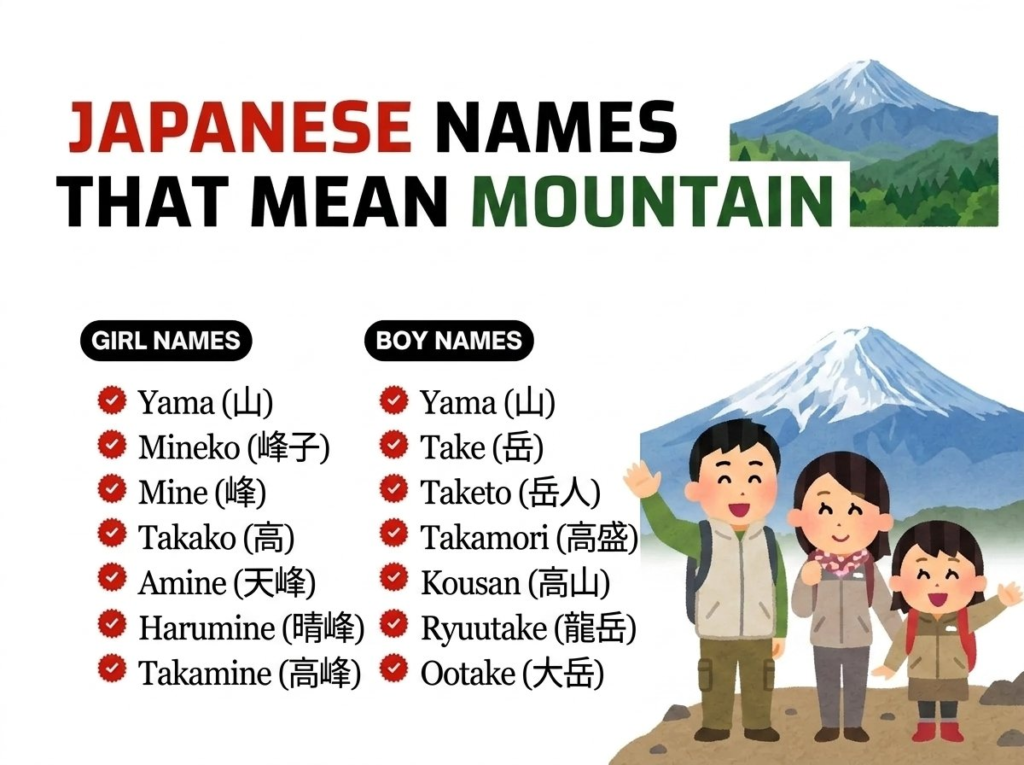
Mountains hold deep spiritual meaning in Japanese culture. From the sacred slopes of Mount Fuji to the misty ridgelines of the Japanese Alps, these towering landscapes have shaped art, Shinto tradition, and naming customs for centuries.
Japanese names connected to mountains typically use kanji like 岳 (gaku, peak), 峰 (mine, summit), and 山 (yama, mountain). Each character carries a sense of grounded strength and quiet endurance. If you want a name rooted in the natural world with genuine cultural depth, mountain-inspired names deserve a close look.
What are some Japanese names that mean mountain?
Popular Japanese names meaning mountain include Gaku (岳, peak), Arashi (嵐, mountain storm), Takeru (岳, fierce peak), Mineko (峰子, child of the summit), and Takane (高嶺, high peak). These names draw from kanji characters directly tied to mountain imagery, peaks, and ridgelines. Many have been used in Japan for generations and remain meaningful choices today.
Japanese Girl Names That Mean Mountain
Mountain names for girls in Japanese tend to feel graceful yet solid. They pair the strength of peak and summit kanji with softer elements like flowers, beauty, and spring. The result is a name that sounds gentle on the surface but carries real backbone underneath. These names work well for parents who want nature-inspired meaning without something overly whimsical.
| Name | Origin | Meaning | Pronunciation | Popularity |
|---|---|---|---|---|
| Mineko | Japanese | Child of the peak | MEE-neh-ko | Classic |
| Takane | Japanese | High peak | TAH-kah-neh | Rare |
| Miyama | Japanese | Beautiful mountain | MEE-yah-mah | Unique |
| Yamako | Japanese | Mountain child | YAH-mah-ko | Rare |
| Reika | Japanese | Peak flower | RAY-kah | Unique |
| Mine | Japanese | Summit, peak | MEE-neh | Rare |
| Takako | Japanese | Lofty child | TAH-kah-ko | Classic |
| Kayama | Japanese | Fragrant mountain | KAH-yah-mah | Rare |
| Haruyama | Japanese | Spring mountain | HAH-roo-yah-mah | Rare |
| Kiyama | Japanese | Precious mountain | KEE-yah-mah | Rare |
| Sayama | Japanese | Sand mountain | SAH-yah-mah | Rare |
| Yamane | Japanese | Mountain sound | YAH-mah-neh | Unique |
| Reimi | Japanese | Beautiful ridge | RAY-mee | Unique |
| Takami | Japanese | High mountain view | TAH-kah-mee | Rare |
| Yamabuki | Japanese | Mountain rose | YAH-mah-boo-kee | Mystic |
Naming Expert’s Note: Takane is one of my favorite finds in this category. In Japanese, the phrase “takane no hana” (flower on a high peak) describes something beautiful but out of reach. As a given name, it carries that same poetic tension: delicate and aspirational at once. It is rare outside Japan, which gives it real distinction for families with Japanese heritage.
Japanese Boy Names That Mean Mountain
Boy names tied to mountains in Japanese lean into strength and stature. The kanji 岳 (gaku, peak) and 嵐 (arashi, mountain storm) show up frequently, giving these names a bold, grounded energy. Many of these choices feel commanding without being aggressive. They suit parents drawn to names with a strong natural backbone and deep roots in Japanese naming tradition.
| Name | Origin | Meaning | Pronunciation | Popularity |
|---|---|---|---|---|
| Gaku | Japanese | Mountain peak | GAH-koo | Classic |
| Takeru | Japanese | Fierce peak | TAH-keh-roo | Trending |
| Arashi | Japanese | Mountain storm | AH-rah-shee | Trending |
| Takashi | Japanese | Lofty, towering | TAH-kah-shee | Classic |
| Mineo | Japanese | Man of the peak | MEE-neh-oh | Rare |
| Takeo | Japanese | Mountain man | TAH-keh-oh | Classic |
| Gakuto | Japanese | Mountain person | GAH-koo-toh | Unique |
| Reiji | Japanese | Ridge ruler | RAY-jee | Rare |
| Takayuki | Japanese | Lofty journey | TAH-kah-yoo-kee | Classic |
| Mineharu | Japanese | Peak of spring | MEE-neh-hah-roo | Rare |
| Sozan | Japanese | Revered mountain | SOH-zahn | Rare |
| Ryuzan | Japanese | Dragon mountain | RYOO-zahn | Powerful |
| Mineichi | Japanese | First peak | MEE-neh-ee-chee | Rare |
| Takahiro | Japanese | Greatly lofty | TAH-kah-hee-roh | Classic |
| Seizan | Japanese | Green mountain | SAY-zahn | Unique |
Also Read: Japanese Names That Mean Earth and Grounded Nature
Japanese Unisex Names That Mean Mountain
Gender-neutral mountain names in Japanese are less common than their gendered counterparts, but the ones that exist carry a striking simplicity. Names like Arashi and Mine work across genders because their kanji meanings speak for themselves. A peak is a peak. A storm is a storm. These names feel modern precisely because they let the natural imagery do the talking.
| Name | Origin | Meaning | Pronunciation | Popularity |
|---|---|---|---|---|
| Arashi | Japanese | Mountain storm | AH-rah-shee | Trending |
| Mine | Japanese | Summit, peak | MEE-neh | Rare |
| Takami | Japanese | High mountain view | TAH-kah-mee | Unique |
| Miyama | Japanese | Deep mountain | MEE-yah-mah | Rare |
| Reizan | Japanese | Sacred mountain | RAY-zahn | Mystic |
| Seizan | Japanese | Blue-green mountain | SAY-zahn | Unique |
| Mineaki | Japanese | Bright peak | MEE-neh-ah-kee | Rare |
| Gaku | Japanese | Mountain peak | GAH-koo | Classic |
| Yamabuki | Japanese | Mountain rose | YAH-mah-boo-kee | Soft |
| Hayama | Japanese | Leaf mountain | HAH-yah-mah | Unique |
Mountain Names Across Cultures
Mountains appear in naming traditions worldwide, not just in Japan. Every culture that lives near towering peaks has found ways to weave that landscape into the names they give their children. The meaning shifts slightly from place to place, but the core idea stays the same: mountains represent permanence, strength, and spiritual elevation.
Japanese Kanji Traditions for Mountain Names
Japanese mountain names rely heavily on kanji composition. The character 山 (yama) appears in hundreds of surnames but fewer given names. For first names, parents more often reach for 岳 (peak), 峰 (summit), or 嶺 (ridge), which feel more poetic and personal.
| Name | Meaning | Gender |
|---|---|---|
| Gaku | Mountain peak | Boy |
| Mineko | Child of the peak | Girl |
| Arashi | Mountain storm | Unisex |
| Takane | High peak | Girl |
| Takeru | Fierce peak | Boy |
| Reizan | Sacred mountain | Unisex |
| Sozan | Revered mountain | Boy |
| Yamabuki | Mountain rose | Unisex |
| Miyama | Deep mountain | Unisex |
| Mineo | Man of the peak | Boy |
Sanskrit and Hindi Mountain Names
The Himalayas have shaped naming traditions across South Asia for millennia. Sanskrit offers some of the oldest mountain-related names still in use today.
| Name | Meaning | Gender |
|---|---|---|
| Parvat | Mountain | Boy |
| Shaila | Mountain peak | Girl |
| Himadri | Snowy mountain | Girl |
| Girish | Lord of the mountain | Boy |
| Nagendra | Mountain king | Boy |
| Shailaja | Born of the mountain | Girl |
| Achal | Immovable mountain | Boy |
| Parvati | Daughter of the mountain | Girl |
| Giri | Mountain | Boy |
| Shikhar | Mountain summit | Boy |
Greek Mountain Names
Ancient Greek mythology placed gods and titans on mountain peaks. Mount Olympus alone gave the language several enduring name roots.
| Name | Meaning | Gender |
|---|---|---|
| Orea | Mountain | Girl |
| Oreios | Of the mountain | Boy |
| Olympus | Sacred mountain | Boy |
| Ida | Mountain (Mount Ida) | Girl |
| Helicon | Mountain of the Muses | Boy |
| Parnassus | Mountain peak | Boy |
| Cyllene | Mountain nymph | Girl |
| Cithaeron | Sacred mountain | Boy |
| Dikte | Mountain cave | Girl |
| Taygetus | Mountain range | Boy |
Hawaiian Mountain Names
In Hawaiian culture, mountains are considered ancestors. The word “mauna” (mountain) appears in some of the most sacred place names in the islands.
| Name | Meaning | Gender |
|---|---|---|
| Mauna | Mountain | Unisex |
| Maunakea | White mountain | Boy |
| Kalani | The heavens (mountain sky) | Unisex |
| Pu’u | Hill, peak | Unisex |
| Maunaloa | Long mountain | Boy |
Korean Mountain Names
Korean mountain names share some roots with Japanese through Chinese characters (hanja). The word “san” (산) means mountain and appears in several given names.
| Name | Meaning | Gender |
|---|---|---|
| San | Mountain | Boy |
| Misan | Beautiful mountain | Girl |
| Sanyoung | Mountain glory | Boy |
| Jisan | Wise mountain | Boy |
| Yusan | Willow mountain | Girl |
Also Read: Japanese Names That Mean Wind and Storm for Your Baby
Names That Mean Mountain Peak
Names focused specifically on the peak or summit of a mountain carry a slightly different energy than general mountain names. They suggest ambition, clarity, and the idea of reaching the highest point. In Japanese, the kanji 岳 and 峰 do most of this work.
- Gaku (岳, peak)
- Takeru (岳, fierce peak)
- Mine (峰, summit)
- Mineko (峰子, peak child)
- Takane (高嶺, high peak)
- Mineo (峰男, peak man)
- Shikhar (Sanskrit, summit)
- Reiji (嶺司, ridge ruler)
- Mineharu (峰春, spring peak)
- Mineichi (峰一, first peak)
Names That Mean Sacred Mountain
Sacred mountain names carry spiritual weight. In Japan, mountains like Fuji and Hiei have been sites of Shinto and Buddhist worship for over a thousand years. Names in this category often include characters for spirit (霊) or reverence (崇).
- Reizan (霊山, sacred mountain)
- Sozan (崇山, revered mountain)
- Parvati (Sanskrit, daughter of the mountain goddess)
- Girish (Sanskrit, lord of the mountain)
- Olympus (Greek, home of the gods)
- Miyama (深山, deep sacred mountain)
- Ida (Greek, sacred Mount Ida)
- Himadri (Sanskrit, sacred snowy peak)
- Maunakea (Hawaiian, white sacred mountain)
- Seizan (青山, green mountain temple)
Names That Mean Highland and Ridge
Highland and ridge names evoke wide open spaces and long sweeping views. These names feel expansive rather than towering. In Japanese, the kanji 嶺 (ridge) and 高 (high) create this sense of broad elevation.
- Takami (高見, high view)
- Reika (嶺花, ridge flower)
- Reimi (嶺美, beautiful ridge)
- Takashi (嵩, lofty highland)
- Takahiro (嵩大, great highland)
- Takayuki (嵩之, lofty journey)
- Hayama (葉山, leafy highland)
- Orea (Greek, mountain highland)
- Kalani (Hawaiian, high heavens)
- Achal (Sanskrit, immovable highland)
Also Read: Japanese Names That Mean Strong and Powerful
How to Choose the Right Mountain Name
Sound matters more than most parents realize at first. A name like Arashi rolls off the tongue easily in English, while something like Mineharu may need more explanation. Try pairing your favorite choices with your last name and listen for rhythm.
Cultural connection is equally important. If your family has Japanese heritage, a name like Gaku or Mineko carries authentic roots. If you are drawn to the meaning from outside the culture, take time to understand the kanji and the traditions behind it.
- Say the full name out loud several times before deciding
- Check the initials to avoid unintended spellings
- Think about natural nicknames your child might prefer
- Research the specific kanji used, since meanings shift with character choice
- Consider how the name sounds on both a toddler and a grown adult
- Look up current popularity if you want something less common
Frequently Asked Questions
Q: What is the most popular Japanese name meaning mountain?
A: Arashi (嵐, mountain storm) is currently the most popular Japanese name with a direct mountain connection. It gained global recognition through the famous Japanese boy band Arashi and remains a trendy choice for boys in Japan. Gaku (岳, mountain peak) is another widely used option.
Q: What does mountain mean in different languages?
A: In Japanese, mountain is “yama” (山). In Sanskrit, it is “parvat” or “giri.” In Greek, “oros.” In Hawaiian, “mauna.” In Korean, “san” (산). Each language carries its own cultural associations with mountain landscapes.
Q: What are some rare Japanese mountain names?
A: Some rare Japanese mountain names include Yamabuki (山吹, mountain rose), Reizan (霊山, sacred mountain), Sozan (崇山, revered mountain), and Yamane (山音, mountain sound). These names are uncommon even within Japan, making them distinctive choices.
Q: What is a good middle name to pair with Arashi?
A: Arashi pairs well with short, grounded middle names. Options like Ren, Kai, Jin, or Hiro complement its three-syllable rhythm without competing for attention. For a more nature-forward pairing, consider Arashi Ren (lotus) or Arashi Sora (sky).
Q: Are Japanese mountain names still popular today?
A: Yes, though the style has shifted. Traditional names like Takashi and Takeo remain classic choices, while modern parents increasingly favor shorter names like Gaku and Arashi. Mountain-adjacent names using 岳 (peak) are especially trendy in contemporary Japanese naming.
Q: Can non-Japanese families use Japanese mountain names?
A: Families of any background can choose Japanese names, but it helps to understand the kanji meanings and cultural context first. Names like Arashi and Gaku are relatively easy to pronounce in English and carry meanings that translate well across cultures.
Conclusion
Japanese mountain names span a wide emotional range, from the stormy energy of Arashi to the quiet dignity of Mineko. Whether you are drawn to the sharp clarity of a peak name like Gaku or the layered beauty of Yamabuki, these choices connect your child to one of Japan’s most enduring natural symbols. Mountains have represented strength and stillness in Japanese culture for over a thousand years, and names carrying that meaning tend to age beautifully. If you are exploring other nature-rooted Japanese options, Japanese names that mean fire offer a striking contrast worth considering.