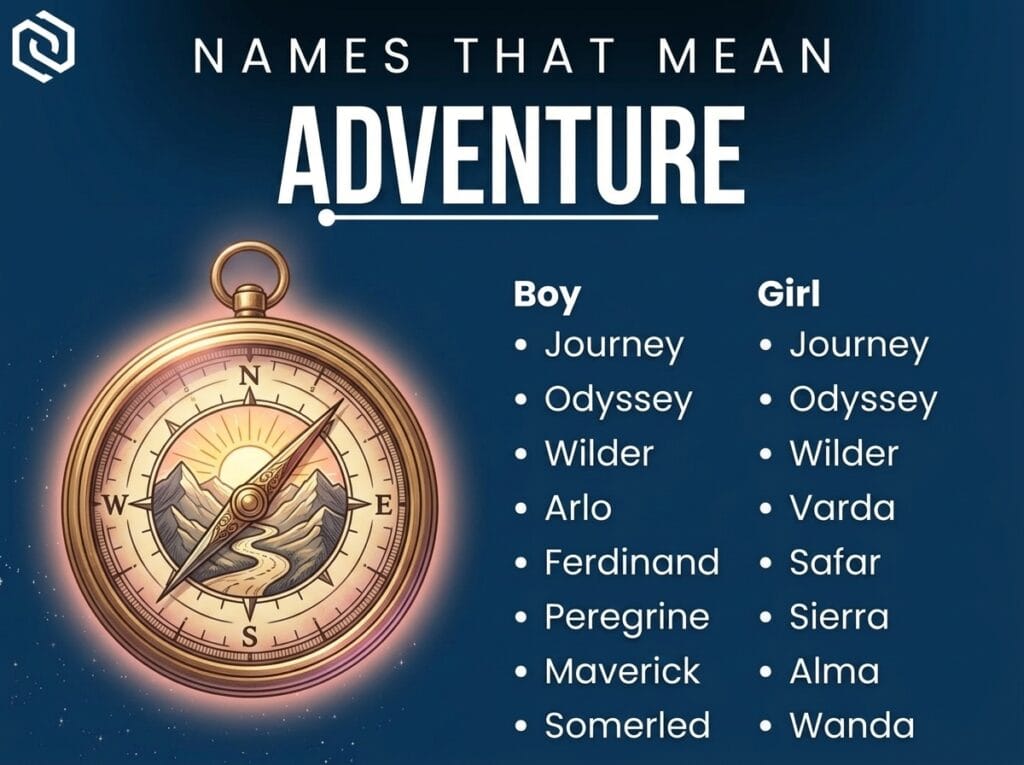
Few qualities feel more alive than a spirit that craves movement, discovery, and new horizons. Names that mean adventure, traveler, or wanderer carry an inherent restlessness, a refusal to stay tethered to one place or one way of thinking. They evoke open roads, uncharted maps, and the courage it takes to step into the unfamiliar. These names come from cultures that honored pilgrims, nomads, seafarers, and those brave enough to journey beyond what was known.
Parents drawn to these names often value curiosity over comfort. They might be travelers themselves, or they hope to raise children who see the world as something to explore rather than something to fear. Whether rooted in ancient languages that praised the wayfarer or modern words that celebrate the journey itself, these names suit a child you hope will move through life with open eyes and a fearless heart.
What are some names that mean adventure or traveler?
Strong options include Peregrine (Latin for “pilgrim”), Odessa (from “odyssey,” meaning long journey), Journey (literally “a trip”), Wendell (Germanic for “wanderer”), and Ryoko (Japanese for “journey child”). Names like Nomad, Sojourner, and Tabi directly reference travel, while Perry, Perrin, and Peregrina derive from the Latin root for pilgrim. These names span cultures that honored movement, whether across seas, deserts, or mountain passes.
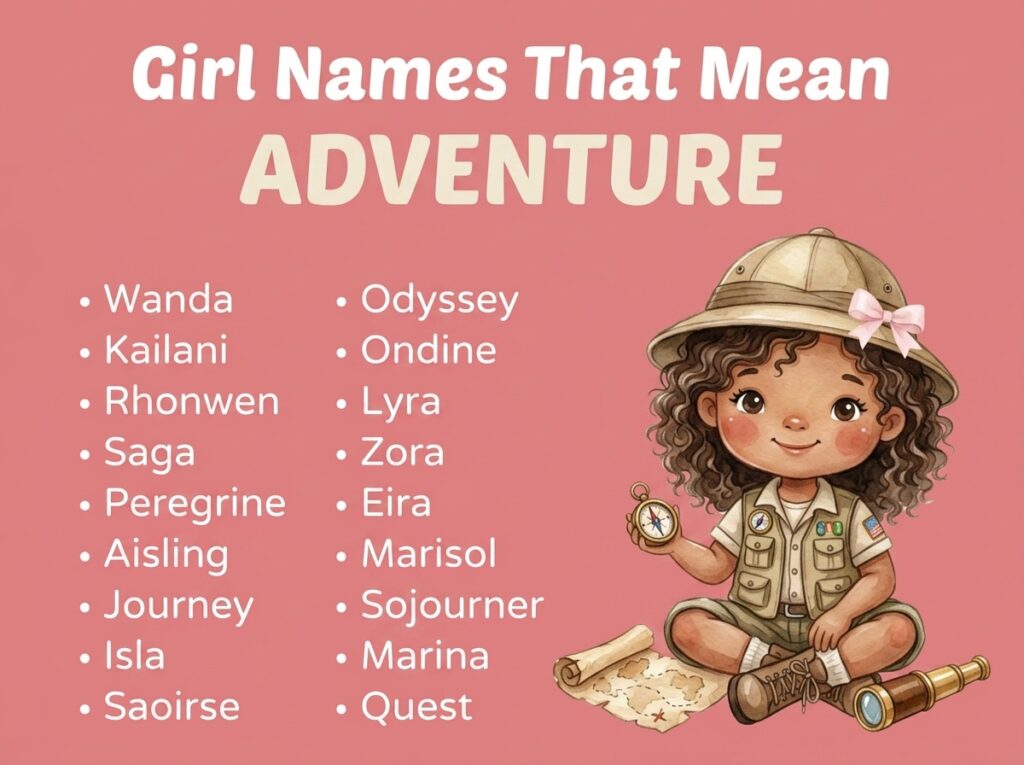
Girl Names That Mean Adventure
Adventure names for girls often carry a lyrical quality without losing their edge. They sound poetic but grounded, gentle but unafraid. Many come from languages that celebrated storytelling, seafaring, or spiritual pilgrimage. These aren’t delicate flower names; they belong to girls who might grow up to lead expeditions, write novels about distant places, or simply refuse to live a small life.
| Name | Origin | Meaning | Pronunciation | Popularity |
|---|---|---|---|---|
| Odessa | Greek | Long journey, odyssey | oh-DESS-ah | Trending |
| Journey | English | A traveling from one place to another | JER-nee | Trending |
| Ryoko | Japanese | Journey child, traveling child | ree-YOH-koh | Unique |
| Tabi | Japanese | Journey, travel | TAH-bee | Rare |
| Peregrina | Spanish/Latin | Pilgrim, traveler | peh-reh-GREE-nah | Rare |
| Sojourner | English | Temporary dweller, traveler | SOH-jer-ner | Unique |
| Safara | Arabic | Journey, travel | sah-FAR-ah | Rare |
| Hagar | Hebrew | Flight, forsaken (biblical wanderer) | HAY-gar | Classic |
| Fara | Norse | To travel, journey | FAR-ah | Soft |
| Perry | English | From Peregrine, traveler | PAIR-ee | Classic |
| Viatrix | Latin | Female traveler, voyager | vee-AH-triks | Mystic |
| Wendeline | Germanic | Wanderer (feminine) | WEN-deh-leen | Rare |
| Yatri | Sanskrit | Traveler, pilgrim | YAH-tree | Unique |
| Saga | Old Norse | Story, tale (of adventures) | SAH-gah | Trending |
| Perrin | French | From Peregrine, traveler | PAIR-in | Soft |
| Moana | Polynesian | Ocean, deep sea (voyaging culture) | moh-AH-nah | Trending |
| Saffara | Arabic | Journey, expedition | sah-FAR-ah | Rare |
| Viadora | Latin | She who travels | vee-ah-DOR-ah | Mystic |
| Nomada | Spanish | Nomad, wanderer | noh-MAH-dah | Unique |
| Edda | Old Norse | Great-grandmother, poetry (sagas) | EDD-ah | Classic |
| Kainoa | Hawaiian | The free-roaming sea | kai-NOH-ah | Unique |
| Rhosyn | Welsh | Rose (but also means wanderer in some dialects) | ROSS-in | Soft |
Also Read: Beautiful Names That Mean Freedom for Your Independent Spirit
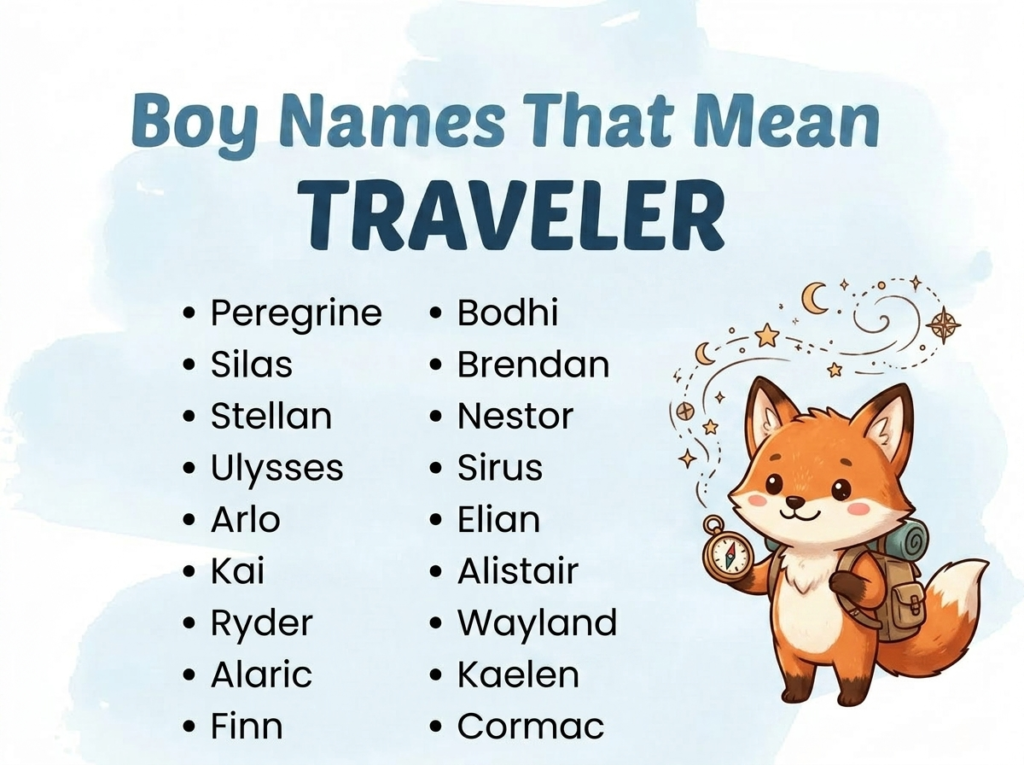
Boy Names That Mean Adventure
Boy names tied to travel and adventure tend to sound solid and purposeful. They evoke medieval pilgrims, Norse explorers, and desert wanderers who crossed impossible distances. These names often have a quiet confidence, the kind that doesn’t announce itself but carries weight. They suit boys who might grow restless in one place, who ask endless questions, who want to see what’s on the other side of the hill.
| Name | Origin | Meaning | Pronunciation | Pronunciation | Popularity |
|---|---|---|---|---|---|
| Peregrine | Latin | Pilgrim, traveler, wanderer | PAIR-eh-grin | Classic | |
| Wendell | Germanic | Wanderer, seeker | WEN-dell | Classic | |
| Viator | Latin | Traveler, wayfarer | vee-AH-tor | Rare | |
| Tabito | Japanese | Traveler, journey person | tah-BEE-toh | Unique | |
| Saffar | Arabic | Traveler, coppersmith | sah-FAR | Rare | |
| Musafir | Arabic/Urdu | Traveler, passenger | moo-SAH-feer | Rare | |
| Safar | Persian/Arabic | Journey, travel, voyage | sah-FAR | Unique | |
| Peregrino | Spanish | Pilgrim, stranger | peh-reh-GREE-noh | Rare | |
| Xeno | Greek | Stranger, foreigner, guest | ZEE-noh | Unique | |
| Atithi | Sanskrit | Guest, traveler | ah-TIH-thee | Rare | |
| Yatri | Sanskrit | Traveler, pilgrim, journeyer | YAH-tree | Unique | |
| Gandr | Old Norse | Wand, also journeyer | GAHN-der | Mystic | |
| Sinbad | Arabic | From legendary sailor/adventurer | SIN-bad | Classic | |
| Odysseus | Greek | Wrathful (embodies the epic journey) | oh-DISS-ee-us | Powerful | |
| Kainoa | Hawaiian | The free one, roaming ocean | kai-NOH-ah | Unique | |
| Fiachra | Irish | Raven (patron of travelers) | FEE-ah-krah | Rare | |
| Wayfarer | English | Traveler on foot | WAY-fair-er | Mystic | |
| Ranger | English | Forest wanderer, keeper | RAIN-jer | Trending | |
| Scout | English | Explorer, one who searches ahead | SKOUT | Trending | |
| Atlas | Greek | Bearer, endurer (map/exploration symbol) | AT-lass | Trending | |
| Marco | Latin/Italian | Associated with explorer Marco Polo | MAR-koh | Classic | |
| Nomad | English | Wanderer, roamer | NOH-mad | Unique | |
| Gezgin | Turkish | Traveler, wanderer | gez-GEEN | Rare | |
| Yolcu | Turkish | Passenger, traveler | yohl-JOO | Rare |
Unisex Names That Mean Adventure
Gender-neutral adventure names have a modern, unfussy energy. They work equally well for any child, and many of them are word names borrowed from the English language or simplified versions of longer, gendered forms. These names don’t whisper; they announce intention. They suit families who want a name that feels open-ended, unbound by tradition.
| Name | Origin | Meaning | Pronunciation | Popularity |
|---|---|---|---|---|
| Journey | English | Act of traveling, expedition | JER-nee | Trending |
| Nomad | English | Wanderer, roamer | NOH-mad | Unique |
| Perry | English | From Peregrine, traveler | PAIR-ee | Classic |
| Sora | Japanese | Sky, heaven (freedom of flight) | SOR-ah | Soft |
| Tabi | Japanese | Journey, travel, voyage | TAH-bee | Rare |
| Scout | English | Explorer, advance guard | SKOUT | Trending |
| Ranger | English | Wanderer, forest keeper | RAIN-jer | Powerful |
| Wayfarer | English | One who travels on foot | WAY-fair-er | Mystic |
| Quest | English | Journey, search, pursuit | KWEST | Unique |
| Roam | English | To wander, travel aimlessly | ROHM | Rare |
| Atlas | Greek | Endurer (symbol of exploration) | AT-lass | Trending |
| River | English | Flowing water (pathway of travel) | RIV-er | Trending |
| Ever | English | Always (endless journey) | EV-er | Soft |
Also Read: Names That Mean Wanderer: Free-Spirited & Nomadic Names
Adventure Names Across Cultures
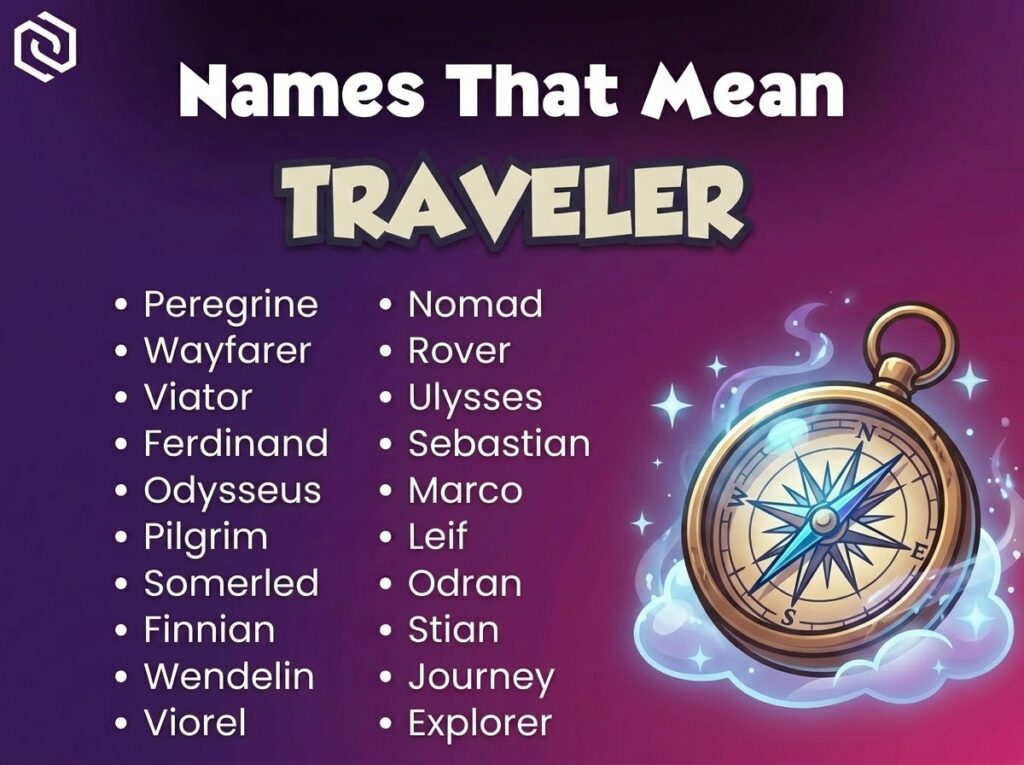
The idea of the traveler appears in nearly every language, but each culture imagined the journey differently. Some honored the religious pilgrim. Others celebrated the merchant who crossed deserts, the sailor who navigated by stars, or the nomad who followed seasons instead of settling. These cultural variations reveal what each society valued about movement and what they feared about staying still.
Latin Names That Mean Traveler
Latin gave us the root peregrinus, meaning “foreigner” or “pilgrim,” which evolved into some of the most enduring travel names in Western languages. Rome was an empire built on roads, and the language reflects a civilization that understood journeys as both literal and spiritual.
| Name | Meaning | Gender |
|---|---|---|
| Peregrine | Pilgrim, traveler | M |
| Peregrina | Pilgrim, traveler | F |
| Viator | Traveler, wayfarer | M |
| Viatrix | Female traveler | F |
| Perry | From Peregrine | U |
| Perrin | From Peregrine | U |
| Via | Way, road, path | F |
| Viadora | She who travels | F |
Japanese Names That Mean Journey
In Japanese, travel names often include the characters 旅 (tabi, journey) or 行 (kou, to go). These names reflect a culture that saw pilgrimage as spiritual practice and movement as a form of meditation. The famous poet Bashō embodied this philosophy in his wandering haiku journeys.
| Name | Meaning | Gender |
|---|---|---|
| Ryoko | Journey child | F |
| Tabi | Journey, travel | U |
| Tabito | Traveler, journey person | M |
| Yukiko | Snow child, journey child | F |
| Kouji | Journey path | M |
| Michiko | Child of the path | F |
| Sora | Sky (freedom to roam) | U |
| Ayumu | Walk, step, journey | M |
Arabic Names That Mean Traveler
Arabic cultures historically revered the merchant traveler and the hajj pilgrim. The root safara (to travel) appears in multiple names, and desert navigation by stars created a rich vocabulary around journeying.
| Name | Meaning | Gender |
|---|---|---|
| Safar | Journey, voyage | M |
| Safara | Journey, expedition | F |
| Saffara | Journey | F |
| Saffar | Traveler, coppersmith | M |
| Musafir | Traveler, voyager | M |
| Rahil | Traveler, one who travels | F |
| Rahal | Nomad, wanderer | M |
Germanic Names That Mean Wanderer
Old Germanic languages had words for different types of wandering: those who sought, those who were exiled, those who chose the road. The most famous is the root Wendel, referring to the Wends, a Slavic people, but it came to mean “wanderer.”
| Name | Meaning | Gender |
|---|---|---|
| Wendell | Wanderer, seeker | M |
| Wendeline | Female wanderer | F |
| Walden | Valley of the Welsh (foreigners) | M |
| Rainard | Strong counselor (also journey) | M |
Sanskrit Names That Mean Traveler
Sanskrit, the liturgical language of Hinduism and Buddhism, has ancient words for pilgrimage and spiritual journey. The concept of yatra (pilgrimage) is central to many religious practices.
| Name | Meaning | Gender |
|---|---|---|
| Yatri | Traveler, pilgrim | U |
| Atithi | Guest, traveler | M |
| Yatra | Pilgrimage, journey | F |
| Safar | Journey (borrowed into Sanskrit) | M |
Norse Names That Mean Journey
The Norse were seafarers, raiders, and explorers who reached North America centuries before Columbus. Their language reflects this: words for journey often involved ships, seas, and sagas of distant lands.
| Name | Meaning | Gender |
|---|---|---|
| Fara | To travel, journey | F |
| Gandr | Wand, magical journey | M |
| Saga | Story, tale (of adventures) | F |
| Fara | To go, journey | F |
Also Read: Names That Mean Storm: Powerful & Tempestuous Names
Names That Mean Explorer
While “traveler” suggests someone passing through, “explorer” implies intention and discovery. These names carry a slightly different energy: less about the journey itself and more about what you find at the end. Some are modern English word names; others reference famous explorers whose names became symbols.
Explorer and Discovery Names:
- Scout (English) – One who explores ahead, searches
- Quest (English) – A journey undertaken in search of something
- Discovery (English) – The act of finding the unknown
- Ranger (English) – One who roams and protects wild places
- Atlas (Greek) – Bearer of the heavens, symbol of maps
- Marco (Italian) – Associated with Marco Polo, though the name itself means “warlike”
- Vasco (Basque) – Crow, but forever linked to Vasco da Gama
- Magellan (Portuguese) – Surname of famous explorer, meaning uncertain
- Drake (English) – Dragon, but tied to Sir Francis Drake
- Hudson (English) – Hugh’s son, tied to explorer Henry Hudson
- Argo (Greek) – Swift, name of Jason’s ship
- Sinbad (Arabic) – From the legendary sailor’s tales
Note: Some of these names gained “explorer” associations through famous bearers rather than direct etymology. If you prefer authentic meanings over cultural associations, stick to Scout, Quest, and Ranger.
Names That Mean Journey
The word “journey” itself makes a beautiful name, but other languages have equally poetic ways to describe the act of moving from one place to another. These names often sound softer than “traveler” names, more contemplative than restless.
Journey and Path Names:
- Journey (English) – The act of traveling
- Ryoko (Japanese) – Journey child, travel
- Tabi (Japanese) – Trip, journey, voyage
- Yatra (Sanskrit) – Pilgrimage, journey
- Safar (Arabic/Persian) – Journey, expedition
- Odessa (Greek) – From odyssey, long journey
- Via (Latin) – Way, road, path
- Viaje (Spanish) – Journey, trip
- Michiko (Japanese) – Beautiful child of the path
- Camino (Spanish) – Path, road, way (as in Camino de Santiago)
- Shiloh (Hebrew) – Peaceful, but also “his gift” (place of pilgrimage)
- Michi (Japanese) – Path, way, road
Names That Mean Quest or Seeker
Quest names imply purpose. They’re for children you hope will grow up asking the big questions, searching for meaning, refusing easy answers. These names feel slightly more philosophical than pure travel names.
Quest and Seeker Names:
- Quest (English) – A search, journey with purpose
- Seeker (English) – One who searches
- Wendell (Germanic) – Wanderer, seeker
- Finder (English) – One who discovers
- Hunter (English) – One who searches and pursues
- Sage (Latin) – Wise one, seeker of wisdom (though primarily means the herb)
- Bodhi (Sanskrit) – Awakening, enlightenment (spiritual journey)
How to Choose the Right Adventure Name
Sound matters as much as meaning when you’re choosing a name your child will carry for life. Say the full name out loud with your last name. Does “Peregrine Williams” flow smoothly, or does it stumble? Short last names often pair well with longer adventure names like Peregrino or Sojourner, while longer surnames might sound better with crisp choices like Scout or Quest.
Consider cultural fit and pronunciation. If you love the name Musafir but have no connection to Arabic or Urdu, your child may spend their life explaining both the spelling and the story. That’s not necessarily a dealbreaker, but it’s worth thinking through.
Practical considerations:
- Say it out loud with your last name and listen for awkward rhythms
- Check the initials (Sojourner Olivia Brown = SOB, for example)
- Think about natural nicknames (Peregrine becomes Perry, Peregrino becomes Perri or Gino)
- Research the cultural origin before committing, especially for non-English names
- Consider how it sounds on a child, a teenager, and an adult professional
- Check current popularity if you want something less common or more recognizable
Naming Expert’s Note: Peregrine has quietly become one of my favorite underused names. It sounds British and slightly posh, but the meaning (pilgrim, wanderer) keeps it from feeling stuffy. The built-in nickname Perry makes it accessible for a child, while the full name Peregrine has enough presence for adulthood. It’s rare enough to feel special but recognizable enough that people won’t constantly ask, “How do you spell that?”
Frequently Asked Questions
Q: What is the most popular name meaning adventure or traveler?
A: Journey is currently the most popular adventure name, particularly for girls, though it’s used across genders. It ranked in the top 200 U.S. baby names in recent years. Scout has also gained traction, boosted by celebrity use and literary associations. Among traditional names, Atlas is trending for boys, though its connection to travel is more symbolic (maps, exploration) than etymological.
Q: What does “traveler” mean in different languages?
A: The concept translates beautifully across languages: viator in Latin, musafir in Arabic and Urdu, tabibito in Japanese, yatri in Sanskrit, gezgin in Turkish, viajero in Spanish, and reisender in German. Each culture has subtle variations – some languages distinguish between religious pilgrims and secular travelers, while others have different words for those who wander by choice versus necessity.
Q: What are some rare adventure names?
A: Viatrix (Latin for female traveler), Gandr (Norse for journeyer), Atithi (Sanskrit for guest/traveler), and Tabito (Japanese for traveler) are authentically rare. Modern word names like Wayfarer, Quest, and Roam are also uncommon, though they risk sounding more like concepts than names. If you want rare but usable, consider Fara, Saffara, or Perrin.
Q: What is a good middle name to pair with Journey?
A: Journey works well with classic, grounding middle names that provide balance. Journey Elizabeth, Journey Rose, Journey Mae, or Journey Claire for girls; Journey Alexander, Journey James, or Journey Cole for boys. Because Journey is a modern, word-based first name, a traditional middle name gives the child options if they prefer to go by their middle name later.
Q: Are adventure and traveler names still popular?
A: Yes, particularly word names like Journey, Scout, and Atlas, which fit into broader trends favoring nature names and virtue names. Traditional travel names like Peregrine remain rare but have a devoted following among parents seeking literary or historical names. The rise of “wanderlust” culture and social media travel content has kept these names feeling current rather than dated.
Q: Can I use a name like Odysseus if I’m not Greek?
A: You can, but be prepared for questions and possible mispronunciations. Odysseus is a heavy name with strong mythological associations, so it works best for families who genuinely love Greek mythology and don’t mind the attention the name will draw. Consider whether you’d be comfortable with the nickname Odie or Ody, which will likely emerge naturally. If you love the meaning but want something more accessible, Odessa (for girls) or Atlas (for boys) might suit better.
Conclusion
Adventure names span cultures and centuries, but they share a common thread: they belong to people who refuse to stand still. Whether you choose a name rooted in Latin pilgrimage, Japanese poetry, Arabic desert crossings, or simple English words, you’re giving your child a meaning that celebrates curiosity and courage. These names work for bookish kids who travel in their imagination and outdoorsy kids who need to see the next mountain. They suit the restless and the dreaming, the brave and the questioning.
The best adventure names feel authentic to your family while opening a door to something larger. They remind a child that the world is wide, that movement is natural, that home can be a starting point rather than a boundary.