There is something genuinely humbling about the word galaxy. It comes from the Greek galaxias, meaning “milky,” a direct reference to the Milky Way stretching across the ancient night sky. The Greeks looked up, saw that pale river of light, and named it after milk. That image, earthy and cosmic at once, tells you everything about why galaxy names carry such weight. They connect the smallest human moment, a baby being named, to something incomprehensibly vast.
Parents drawn to galaxy names tend to share a certain quality. They are dreamers who also do their research. They want a name that feels expansive, a little otherworldly, but still wearable in real life. These names often pull from astronomy, mythology, and ancient languages, and they span cultures from Greek and Latin to Sanskrit and Japanese. Whether you want something lyrical and soft or bold and striking, names rooted in the cosmos rarely disappoint.
What Are Some Names That Mean Galaxy?
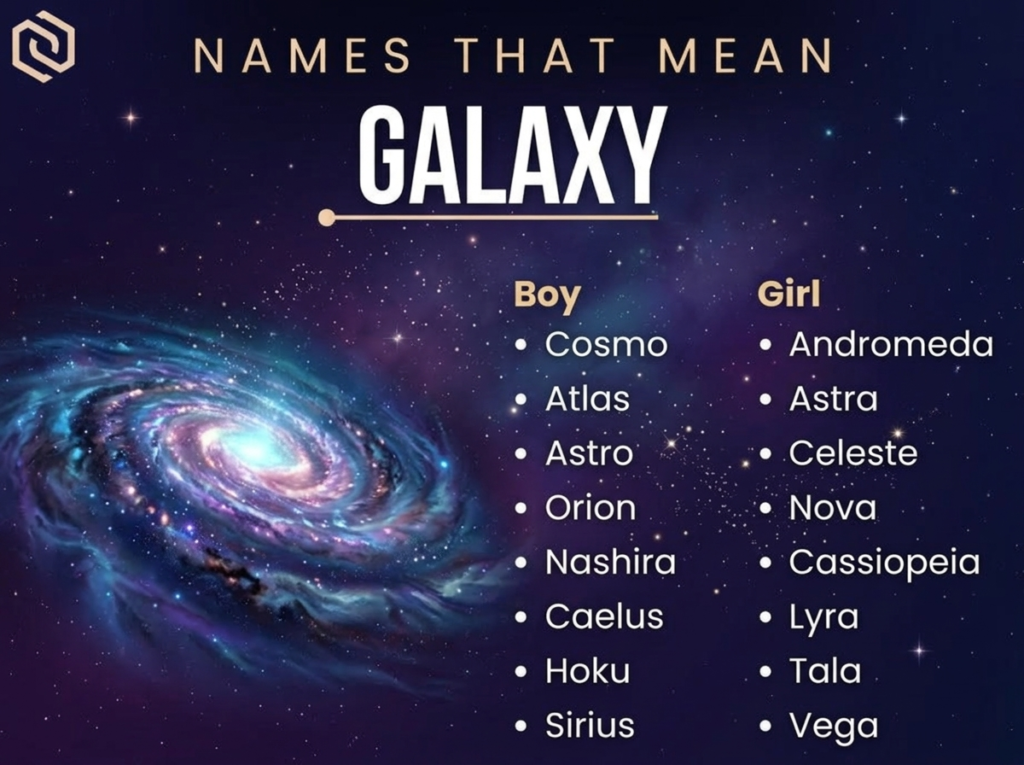
Some of the strongest names that mean galaxy or are directly rooted in cosmic, stellar, or galactic meaning include Galaxy, Andromeda, Via (from Via Lactea, the Latin name for the Milky Way), Aakash (Sanskrit for “sky and cosmic space”), Caelum (Latin for “sky/heaven”), Galaxia, MaVia, and Cosmos. These names carry genuine etymological or mythological ties to the galaxy or the vast night sky, not just a loose celestial vibe.
Girl Names That Mean Galaxy
Girls’ names in this space tend to sit somewhere between poetic and powerful. Many come from Greek mythology, where the night sky was populated with goddesses, queens, and heroines immortalized among the stars. Others draw from Latin astronomical tradition, where the Milky Way, the most visible feature of our galaxy, was given names that still carry beauty today. These names feel elevated without being inaccessible, and most wear well from childhood into adulthood.
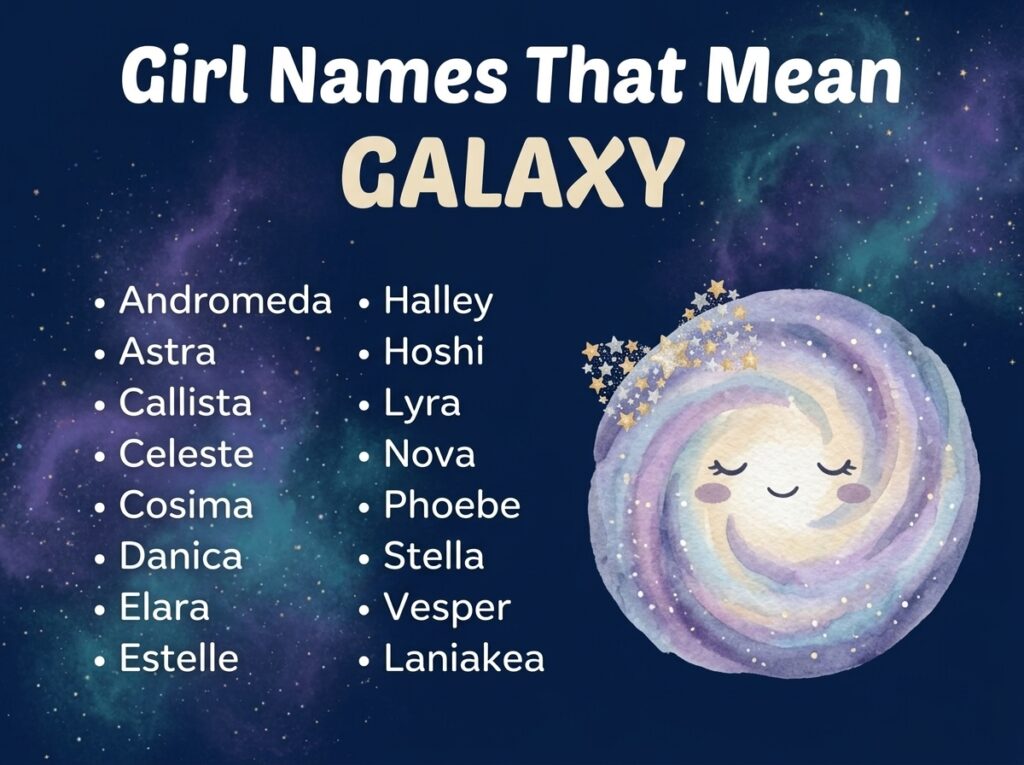
| Name | Origin | Meaning | Pronunciation | Popularity |
|---|---|---|---|---|
| Galaxy | English/Greek | Directly means “galaxy,” from Greek galaxias | GAL-ak-see | Trending |
| Galaxia | Greek/Latin | “Of the galaxy” or “milky way”; used as a poetic feminine form | gal-AK-see-ah | Unique |
| Andromeda | Greek | Princess of the night sky; the nearest galaxy to the Milky Way bears her name | an-DROM-eh-dah | Rare |
| Via | Latin | Short form of Via Lactea, the Latin name for the Milky Way | VEE-ah | Soft |
| Caelia | Latin | From caelum, meaning “sky” or “heaven,” the vast celestial vault | SEE-lee-ah | Rare |
| Astra | Greek/Latin | “Star,” specifically used in ancient texts to refer to the starry cosmos | AS-trah | Trending |
| Nebula | Latin | “Mist” or “cloud” in space; the birthplace of stars within a galaxy | NEB-yoo-lah | Unique |
| Cosima | Greek | Feminine of Cosmos; “order of the universe” | KOH-zee-mah | Classic |
| Lyra | Greek | The constellation and cosmic harp; representing the music of the night sky | LY-rah | Trending |
| Vega | Arabic | The brightest star in the Lyra constellation; from Arabic waqi, “swooping eagle” | VAY-gah | Mystic |
| Elara | Greek | Moon of Jupiter; name of an Oceanid in Greek myth connected to the heavens | eh-LAR-ah | Soft |
| Callisto | Greek | One of Jupiter’s largest moons; in myth, a nymph placed among the stars | kah-LIS-toh | Rare |
| Cressida | Greek | A moon of Uranus; derives from a Trojan tale, name later tied to the cosmos | KRES-ih-dah | Unique |
| Tethys | Greek | Moon of Saturn; a Titaness associated with the primordial sea and sky | TEE-this | Rare |
| Amalthea | Greek | Moon of Jupiter; the nurturing goat-nymph set among the stars by Zeus | am-al-THEE-ah | Mystic |
| Phoebe | Greek | Moon of Saturn; Titaness associated with radiant celestial light | FEE-bee | Classic |
| Titania | Greek/Shakespearean | Largest moon of Uranus; name rooted in the Titan race, rulers of the ancient cosmos | tih-TAY-nee-ah | Unique |
| Ariel | Hebrew/Astronomical | Moon of Uranus; in astronomical tradition tied to the light of the heavens | AIR-ee-el | Classic |
| Cassini | Latin | Inspired by the Saturn mission; from the astronomer who mapped the cosmos | kah-SEE-nee | Rare |
| Mira | Latin | “Wonderful” star; Mira is one of the most famous variable stars in the night sky | MEER-ah | Trending |
| Solange | French/Latin | From sol (sun) and angelus; celestial light across the cosmic sky | so-LAHNZH | Soft |
| Kepler | German | After Johannes Kepler, who described the motion of planets across the galaxy | KEP-ler | Unique |
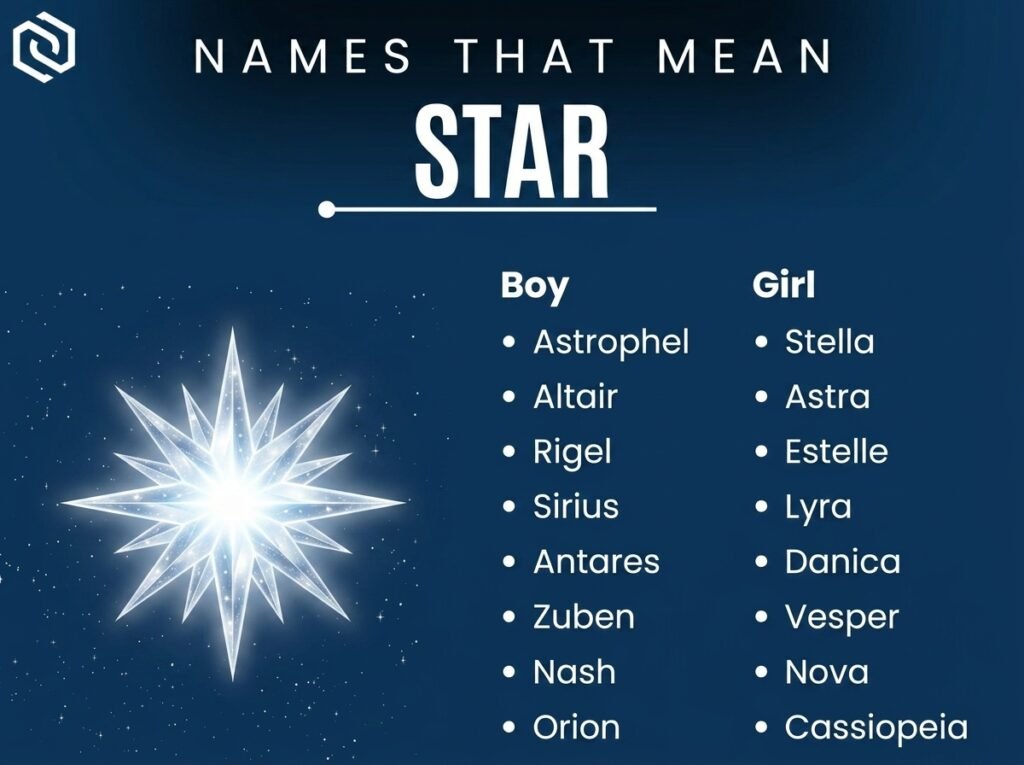
Also Read: Names That Mean Star for Girls, Boys, and Every Baby in Between
Boy Names That Mean Galaxy
Boys’ galaxy names tend to carry a grounded kind of grandeur. They sound like names for explorers, thinkers, and quiet leaders. Many come from Latin and Greek astronomical vocabulary, while others pull from Sanskrit and Arabic, two traditions with deep astronomical roots. These are names that feel substantial. They work on a toddler and on a grown man equally well, which is always the test worth applying.
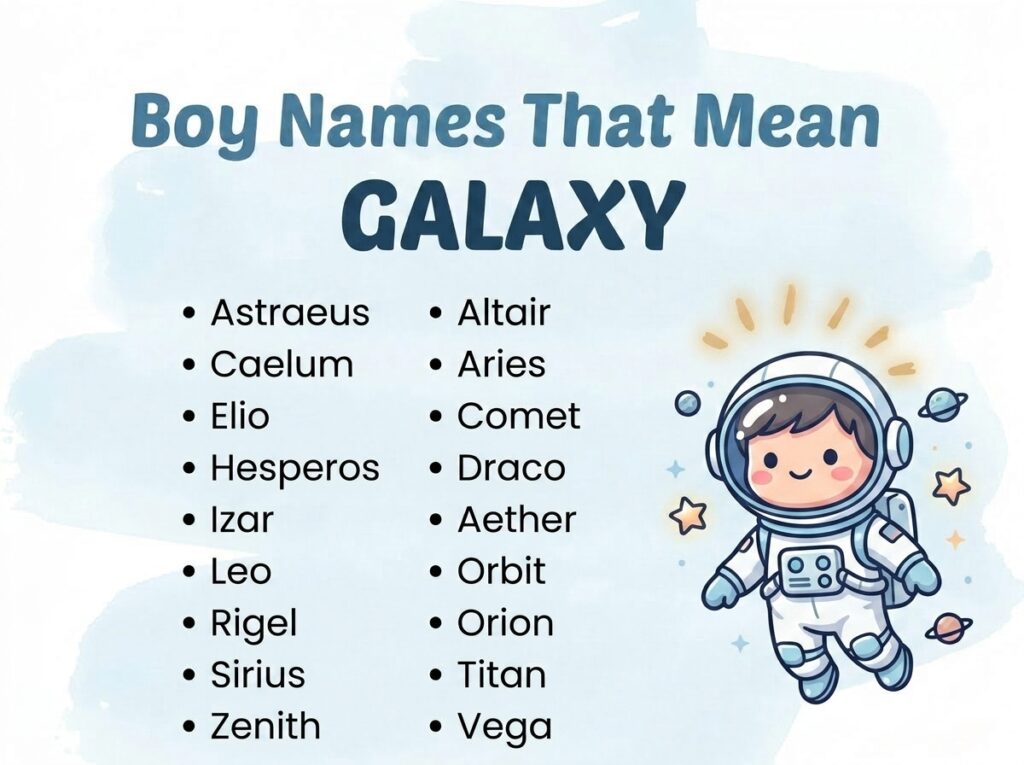
| Name | Origin | Meaning | Pronunciation | Popularity |
|---|---|---|---|---|
| Cosmos | Greek | “Order of the universe”; the structured expanse of all space | KOZ-mos | Unique |
| Aakash | Sanskrit | “Sky” and “cosmic space”; used in Hindu texts to describe the vast heavens | AH-kash | Trending |
| Caelum | Latin | “Sky” or “heaven”; also a constellation name representing the cosmic canopy | SEE-lum | Rare |
| Orion | Greek | One of the most prominent constellations in the night sky; the great hunter | oh-RY-on | Trending |
| Atlas | Greek | Titan who held up the celestial sphere; directly connected to cosmic structure | AT-las | Powerful |
| Perseus | Greek | Hero associated with the Perseus galaxy cluster; his myth is literally mapped to the night sky | PUR-see-us | Mystic |
| Draco | Latin/Greek | Constellation meaning “dragon”; one of the largest constellations in the night sky | DRAY-koh | Dark |
| Aquilo | Latin | Ancient Roman name for the north wind; tied to the northern reaches of the sky | AH-kwih-loh | Rare |
| Oberon | English/Astronomical | Largest moon of Uranus; a name of Old French/Germanic origin placed among the stars | OH-beh-ron | Unique |
| Vega | Arabic | Brightest star in the Lyra constellation; from Arabic waqi, meaning “swooping eagle” | VAY-gah | Mystic |
| Rigel | Arabic | The brightest star in Orion; from Arabic rijl, meaning “foot of the great one” | RY-jel | Rare |
| Altair | Arabic | Brightest star in Aquila the Eagle; from Arabic al-ta’ir, “the flying eagle” | al-TAIR | Unique |
| Kepler | German | After Johannes Kepler; the scientist who defined planetary motion within our galaxy | KEP-ler | Rare |
| Izar | Basque | Means “star”; also the name of a binary star system in the Boötes constellation | EE-zar | Unique |
| Corvus | Latin | Constellation meaning “crow”; one of the 48 constellations catalogued by Ptolemy | KOR-vus | Dark |
| Cygnus | Latin | Constellation meaning “swan”; contains some of the Milky Way’s brightest star clusters | SIG-nus | Rare |
| Ptolemy | Greek | After the astronomer who mapped the ancient night sky and catalogued the constellations | TOL-eh-mee | Classic |
| Tauri | Latin | Derived from Taurus; the bull constellation holding the Pleiades star cluster | TAW-ree | Unique |
| Helios | Greek | God of the sun and the solar system’s central star; deeply embedded in cosmic myth | HEE-lee-os | Powerful |
| Rasalas | Arabic | Star in the Leo constellation; from Arabic meaning “the head of the lion” | rah-SAH-las | Rare |
Unisex Names That Mean Galaxy
Some of the most striking galaxy-inspired names sit comfortably outside any gender category. These tend to be names borrowed directly from astronomy, places where Latin, Greek, and Arabic naming traditions handed us words so strong and self-contained that they work for anyone. They feel modern in the best way, not because they are trendy, but because they carry meaning that transcends the moment.
| Name | Origin | Meaning | Pronunciation | Popularity |
|---|---|---|---|---|
| Lyra | Greek | Constellation; the harp of Orpheus placed among the stars of the night sky | LY-rah | Trending |
| Zenith | Arabic/English | The highest point of the celestial sphere directly above the observer | ZEE-nith | Unique |
| Aries | Latin | Constellation and zodiac sign; one of the oldest recognized star patterns | AIR-eez | Trending |
| Ciel | French | “Sky”; used in both masculine and feminine French naming tradition | see-EL | Soft |
| Aether | Greek | The pure upper air of the heavens; the substance the ancient Greeks believed filled cosmic space | EE-ther | Mystic |
| Soleil | French | “Sun”; a poetic gender-neutral option rooted in the light at the center of our solar system | so-LAY | Soft |
| Indra | Sanskrit | Vedic sky god who ruled the heavens and cosmic storms | IN-drah | Powerful |
| Nova | Latin | “New star”; the astronomical event where a star dramatically brightens in the galaxy | NOH-vah | Trending |
| Vesper | Latin | “Evening star”; the name ancient Romans gave to Venus as the night sky darkened | VES-per | Mystic |
| Caelestis | Latin | “Heavenly” or “of the sky”; a direct reference to the celestial and cosmic | seh-LES-tis | Rare |
Galaxy Names Across Cultures
The idea of the galaxy, that vast river of stars overhead, has captured human imagination in every culture that ever looked up at the night sky. What is remarkable is how differently each language found words for it. Greeks saw milk. Hindus felt infinite space. Arabic scholars named individual stars with the same precision a botanist uses for flowers. The names that emerge from these traditions carry that same specificity, that grounded wonder.
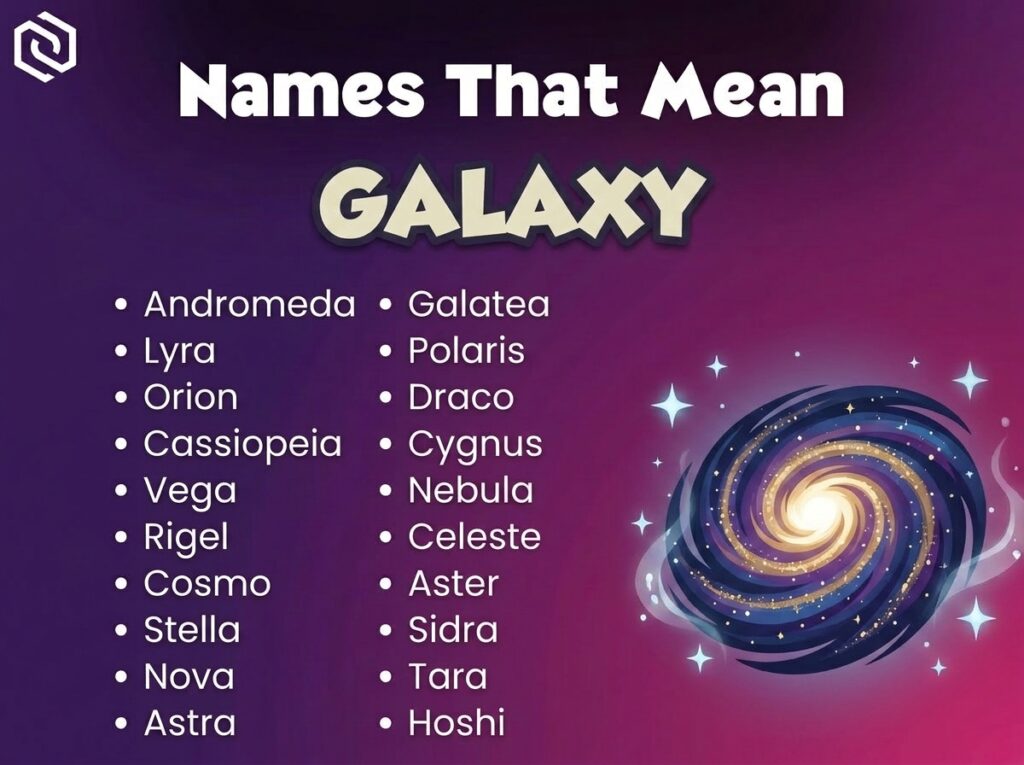
Greek Names That Mean Galaxy
Greek is the language that literally gave us the word galaxy, from gala meaning milk. Greek mythology placed heroes, gods, and creatures among the stars, turning the night sky into a living narrative.
| Name | Meaning | Gender |
|---|---|---|
| Andromeda | Galaxy nearest to the Milky Way; name of the mythic princess placed among the stars | Girl |
| Cosmos | The ordered universe and all its cosmic structure | Boy/Unisex |
| Aether | The upper air and substance of the cosmic heavens | Unisex |
| Perseus | Hero whose myth is mapped directly onto the Perseus galaxy cluster | Boy |
| Callisto | Moon of Jupiter; a myth about a nymph transformed and placed in the stars | Girl |
| Helios | God of the sun, the star at the center of our solar system | Boy |
| Phoebe | Titaness; also the name of Saturn’s outer moon | Girl |
| Atlas | Titan who bore the celestial sphere on his shoulders | Boy |
| Lyra | Constellation named for Orpheus’ harp; represents music in the cosmos | Unisex |
| Titania | Largest moon of Uranus; rooted in the Titan dynasty of the ancient heavens | Girl |
Latin Names That Mean Galaxy
Latin gave astronomers a formal vocabulary for the cosmos. Via Lactea, the Latin name for the Milky Way, literally means “road of milk.” Many of the constellation names we still use today come directly from Roman Latin tradition.
| Name | Meaning | Gender |
|---|---|---|
| Via | From Via Lactea, the Latin name for the Milky Way | Girl |
| Caelum | “Sky” or “heaven”; also a southern constellation | Boy |
| Nebula | “Mist” or “cloud”; the cosmic structures where stars are born | Girl |
| Nova | “New star”; an astronomical brightening event within a galaxy | Unisex |
| Caelestis | “Of the sky” or “heavenly” | Unisex |
| Corvus | Constellation name meaning “crow”; part of the ancient night sky map | Boy |
| Cygnus | “Swan”; a constellation rich with Milky Way star clusters | Boy |
| Draco | “Dragon”; a circumpolar constellation winding through the northern sky | Boy |
| Vesper | “Evening star”; Venus seen against the deepening night sky | Unisex |
| Mira | Famous variable star; from Latin mirus, “wonderful” or “astonishing” | Girl |
Arabic Names That Mean Galaxy
Medieval Arabic astronomers were the most precise star-namers in history. Hundreds of star names we use today in English come directly from Arabic. These names carry a quiet authority because they were chosen by people who spent lifetimes studying the sky.
| Name | Meaning | Gender |
|---|---|---|
| Vega | Brightest star in Lyra; from waqi, “swooping eagle” | Unisex |
| Rigel | Brightest star in Orion; from rijl, “foot of the great one” | Boy |
| Altair | Brightest star in Aquila; from al-ta’ir, “the flying eagle” | Boy |
| Rasalas | Star in Leo; from Arabic “head of the lion” | Boy |
| Deneb | Tail of the Swan constellation; from dhanab, “tail” | Boy |
| Thuban | Former pole star in Draco; from thu’ban, “serpent” | Boy |
| Fomalhaut | Brightest star in Piscis Austrinus; from “mouth of the southern fish” | Girl |
| Achernar | Brightest star in Eridanus; from “end of the river” in Arabic | Boy |
| Zubenelgenubi | Star in Libra; means “southern claw” in Arabic | Unisex |
| Izar | A binary star in Boötes; Basque for “star,” used in Arabic astronomical tradition | Unisex |
Sanskrit Names That Mean Galaxy
Sanskrit has one of the richest vocabularies for cosmic space in any ancient language. Hindu cosmology described multiple universes, infinite skies, and divine heavens with a precision that still resonates today.
| Name | Meaning | Gender |
|---|---|---|
| Aakash | “Sky” and the infinite cosmic space above | Boy |
| Indra | The Vedic god of heaven who ruled the cosmic sky and storms | Unisex |
| Tara | “Star”; a celestial being in Hindu and Buddhist tradition | Girl |
| Akasha | The element of infinite space in Hindu cosmological thought | Girl/Unisex |
| Nakshatra | “Star cluster”; the lunar mansions used in Vedic astronomy | Girl |
| Dyaus | “Sky” or “heaven”; the Vedic sky deity, cognate with the Greek Zeus | Boy |
| Rohini | A red star (Aldebaran in Western astronomy); a lunar mansion in Vedic tradition | Girl |
| Chandra | “Luminous” or “moon”; the cosmic light of the night sky | Unisex |
| Pushya | A star cluster in the Cancer constellation in Vedic astronomy | Boy |
| Shravan | Named after a prominent star in Aquila; a sacred Vedic nakshatra | Boy |
Names That Mean Night Sky
The night sky is the canvas on which the galaxy lives. These names are not purely about one star or one constellation. They refer to the whole expanse of darkness and light overhead when the sun goes down. This variation captures something slightly different from pure galaxy names. It is more atmospheric, more about mood and mystery than specific astronomical structures.
The night sky has inspired poets, astronomers, and parents in equal measure. Names in this category tend to feel darker and more lyrical. They work especially well as middle names, where the dramatic quality can shine without overwhelming a first name.
- Nox (Latin, “night”)
- Noctis (Latin, “of the night”)
- Selene (Greek, moon goddess of the night sky)
- Hesper (Greek, “evening”; the western night sky)
- Vesper (Latin, “evening star”)
- Ciel (French, “sky”)
- Aether (Greek, the upper air of the cosmic night)
- Nisha (Sanskrit, “night”)
- Leila (Arabic, “night”)
- Orpheus (Greek, whose music could move the night sky itself)
Names That Mean Milky Way
The Milky Way is our home galaxy, and it has been named in almost every language on earth. These names are the most directly tied to galaxy meaning because they reference the actual structure we live within.
The Latin phrase Via Lactea and the Greek galaxias both described that pale band of light crossing the sky. Names that reference the Milky Way feel intimate in a way that broader cosmic names do not. They are not just about space generally. They are about here, about our specific galaxy, our home in the universe.
- Via (Latin, from Via Lactea, “road of milk”)
- Galaxy (English/Greek, directly from galaxias)
- Galaxia (Greek/Latin, poetic feminine of galaxy)
- Lacta (Latin, from lactea, “milky”)
- Laktea (variant of Lactea)
- Galaad (variant root connected to gala, milk)
- Maeve (Irish; not a galaxy name etymologically, exclude)
- Galaxis (Greek root form of the galaxy word)
- Kyanos (Greek, “blue-white,” the color of the Milky Way arc)
- Helion (Greek, related to the solar system sitting within the galactic arm)
Names That Mean Cosmic Space
This is the broadest variation of the galaxy theme. Cosmic space names refer to the totality of the universe, the infinite expanse that contains all galaxies, stars, and matter. They feel philosophical as much as astronomical.
Parents who like these names tend to be drawn to the idea of boundlessness. They want a name that points outward and upward, that carries a sense of possibility without being pinned to one specific myth or place.
- Cosmos (Greek, “the ordered universe”)
- Aether (Greek, the substance of cosmic space in ancient thought)
- Caelestis (Latin, “heavenly” or “of the sky”)
- Akasha (Sanskrit, the fifth element: infinite space)
- Zephyr (Greek, associated with the western winds of the upper sky)
- Caelum (Latin, “sky/heaven”)
- Indra (Sanskrit, the Vedic ruler of the cosmic heavens)
- Aakash (Sanskrit, “cosmic sky”)
- Astra (Greek/Latin, “stars” or the starry cosmos)
- Solaris (Latin, relating to the sun and the solar system within the galaxy)
Also Read: Names That Mean Moon: Lunar Names for Girls and Boys
Naming Expert’s Note
Andromeda is, in many ways, the definitive galaxy name. It is the only name on this list that is both a recognized mythological figure and a literal galaxy. The Andromeda Galaxy (M31) is the closest major galaxy to our own Milky Way and is named after the princess from Greek mythology. That double weight, mythological and astronomical, makes it remarkably rich for a baby name. The challenge is length and the middle syllable stress, which can feel formal. But the nickname Andy or Romy solves that instantly. It is one of those names that seems intimidating until you live with it for five minutes.
How to Choose the Right Galaxy Name
Sound matters before meaning does. A name that feels cosmic on paper but clunky out loud will frustrate you at every school pickup and family dinner. Say it full name, first and last, at least a dozen times before deciding.
Cultural origin matters too, especially for names pulled from Arabic, Sanskrit, or Latin astronomical traditions. A name like Aakash carries specific cultural weight in South Asian communities, while Rigel reads as purely astronomical to most Western ears. Neither is wrong, but knowing where a name comes from helps you own it confidently.
- Say it out loud paired with your last name
- Test both formal and casual versions (does it shorten naturally?)
- Check the initials
- Research the astronomical or mythological origin fully
- Consider how it sounds at age five and age forty-five
- Look up current popularity if you want something genuinely uncommon
Frequently Asked Questions
Q: What is the most popular name that means galaxy?
A: Galaxy itself has been climbing the charts in English-speaking countries, particularly in the United States. Andromeda is the most recognizable name with direct galaxy meaning from a classical tradition. Nova and Lyra are trending strongly as galaxy-adjacent names rooted in genuine astronomical vocabulary.
Q: What does “galaxy” mean in different languages?
A: The word galaxy comes from Greek galaxias, meaning “milky,” which itself comes from gala (milk), referencing the Milky Way’s appearance. In Latin it became Via Lactea, “road of milk.” Sanskrit describes cosmic space as akasha. Arabic astronomers used precise star names rather than a single word for galaxy, but the concept of the heavens was sama.
Q: What are some rare galaxy names?
A: Some genuinely rare options with authentic galaxy or cosmic connections include Caelum (a Latin constellation name), Galaxia (the poetic Latin-Greek feminine form), Izar (a Basque-origin star name), Corvus (a Latin constellation), and Amalthea (one of Jupiter’s inner moons). These see almost no mainstream use, which makes them distinctive without being invented.
Q: What is a good middle name to pair with Andromeda?
A: Andromeda pairs beautifully with shorter, grounded middle names that balance its four syllables. Andromeda Rose, Andromeda Faye, Andromeda June, and Andromeda Claire all work well. If you want to double down on the cosmic theme, Andromeda Lyra or Andromeda Nova both flow naturally.
Q: Are galaxy names still popular in 2024 and 2025?
A: Yes, and they are growing. Cosmic and astronomical names have been rising steadily since the mid-2010s. Nova, Lyra, Orion, and Andromeda are all seeing increased use. The name Galaxy itself entered U.S. naming data and has been gradually rising. Interest in space exploration and astronomy in popular culture has kept this category relevant and growing.
Q: Can galaxy names work as middle names?
A: Absolutely, and they often work better there. A name like Nebula, Caelestis, or Andromeda can feel dramatic as a first name but sits beautifully in the middle position, adding depth without the daily weight of being the primary name. Many parents choose a familiar first name with a galaxy middle name as a way to honor their love of astronomy more quietly.
Conclusion
Galaxy names stretch across Greek mythology, Latin astronomy, Sanskrit cosmology, and Arabic star charts. Whether you are drawn to the directness of Galaxy, the mythological depth of Andromeda, the Arabic precision of Rigel, or the Sanskrit openness of Aakash, there is genuinely something here from every corner of human sky-gazing history. These names endure because the night sky itself endures. Every generation looks up and feels the same pull, and names that carry that feeling tend to stay meaningful for a lifetime.
For more cosmic inspiration, explore names that mean star from cultures around the world or discover the full range of names that mean night sky and darkness.