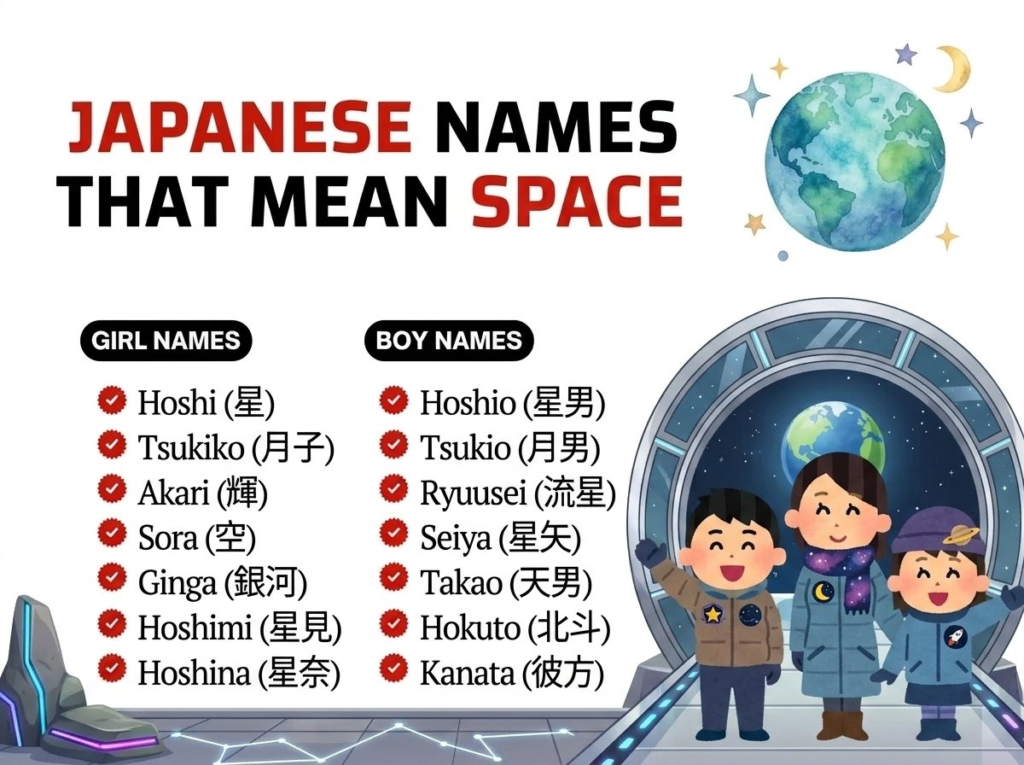
Space holds a special place in Japanese culture. Long before modern astronomy, Japanese mythology described the cosmos as a vast, layered expanse stretching far beyond the visible heavens. Today, that fascination lives on in naming traditions across Japan.
Parents choose kanji like 宙 (chū) and 宇 (u) to give their children a quiet connection to the infinite. These Japanese names that mean space carry a sense of boundless possibility. They feel modern yet deeply rooted in centuries of cultural tradition. If the cosmos speaks to you, these names offer a meaningful way to honor that feeling.
What are some Japanese names that mean space?
The most authentic Japanese names that mean space use the kanji 宙 (chū), meaning “space” or “the void,” and 宇 (u), meaning “universe.” Popular choices include Sora (宙), Uchū (宇宙), Ginga (銀河), and Sōta (宙太). These names draw directly from Japanese words for the cosmos and outer space, making them some of the most literal space names in any language.
Japanese Girl Names That Mean Space
Space-inspired names for girls in Japan tend to feel open and airy. The kanji 宙 and 宇 give these names a sense of vastness without sounding heavy. Many pair the “space” character with softer elements like flowers, beauty, or sound, creating a balance between the infinite and the intimate.
| Name | Origin | Meaning | Pronunciation | Popularity |
|---|---|---|---|---|
| Sora | Japanese | Space, the void | SO-rah | Trending |
| Chūka | Japanese | Space and flower | CHOO-kah | Rare |
| Sorami | Japanese | Space and sea | so-RAH-mee | Unique |
| Chūna | Japanese | Space, graceful | CHOO-nah | Soft |
| Sorano | Japanese | Space, of the cosmos | so-RAH-no | Classic |
| Chūne | Japanese | Space and sound | CHOO-neh | Rare |
| Umi | Japanese | Universe and sea | OO-mee | Trending |
| Uno | Japanese | Universe, gentle | OO-no | Soft |
| Une | Japanese | Universe and sound | OO-neh | Rare |
| Uzuki | Japanese | Universe and moon | oo-ZOO-kee | Mystic |
| Uka | Japanese | Universe and flower | OO-kah | Unique |
| Una | Japanese | Universe, graceful | OO-nah | Soft |
| Sorami | Japanese | Space and beauty | so-RAH-mee | Rare |
| Chūwa | Japanese | Space and harmony | CHOO-wah | Unique |
| Soramu | Japanese | Space and dream | so-RAH-moo | Mystic |
Naming Expert’s Note: Sora (宙) is one of the most versatile Japanese names in use today. While it technically means “space” or “the void,” most Japanese speakers also associate it with the sky. This dual meaning gives it a warmth that purely scientific space names lack. It works beautifully for girls and boys, and it travels well outside Japan since the pronunciation is intuitive in English.
Japanese Boy Names That Mean Space
Boy names tied to space in Japanese often pair the cosmos kanji with characters for strength, truth, or ambition. The result feels grounded and forward-looking at the same time. These names suggest a child who reaches beyond what is visible, carrying the quiet confidence of the night sky.
| Name | Origin | Meaning | Pronunciation | Popularity |
|---|---|---|---|---|
| Sōta | Japanese | Space, great and thick | SO-tah | Trending |
| Sorato | Japanese | Space and soaring | so-RAH-to | Classic |
| Chūto | Japanese | Space and the Big Dipper | CHOO-to | Unique |
| Sorato | Japanese | Space and person | so-RAH-to | Trending |
| Chūma | Japanese | Space and truth | CHOO-mah | Rare |
| Soraki | Japanese | Space and hope | so-RAH-kee | Soft |
| Chūhei | Japanese | Space and peace | CHOO-hay | Classic |
| Soraichi | Japanese | Space and one | so-RAH-ee-chee | Rare |
| Usō | Japanese | Universe and soaring | OO-so | Unique |
| Uta | Japanese | Universe, great | OO-tah | Powerful |
| Uma | Japanese | Universe and truth | OO-mah | Rare |
| Uto | Japanese | Universe and measure | OO-to | Soft |
| Ujin | Japanese | Universe and person | OO-jeen | Unique |
| Ginga | Japanese | Galaxy, Milky Way | GEEN-gah | Mystic |
| Uchū | Japanese | Outer space, universe | OO-choo | Rare |
Also Read: Japanese Names That Mean Star and Their Cosmic Origins
Japanese Unisex Names That Mean Space
Gender-neutral space names in Japanese are surprisingly natural. The kanji 宙 and 宇 work beautifully on their own or with minimal pairing, creating names that feel clean and open. Many of these names have grown in popularity as Japanese parents move toward simpler, more flexible naming choices.
| Name | Origin | Meaning | Pronunciation | Popularity |
|---|---|---|---|---|
| Sora | Japanese | Space, the void | SO-rah | Trending |
| U | Japanese | Universe, cosmos | OO | Rare |
| Uchū | Japanese | Outer space, universe | OO-choo | Unique |
| Chūwa | Japanese | Space and harmony | CHOO-wah | Soft |
| Uho | Japanese | Universe and sail | OO-ho | Rare |
| Chūkō | Japanese | Space and light | CHOO-ko | Mystic |
| Usora | Japanese | Universe and sky | OO-so-rah | Unique |
| Soramu | Japanese | Space and dream | so-RAH-moo | Mystic |
| Ukokoro | Japanese | Universe and heart | oo-KO-ko-ro | Rare |
| Chūfū | Japanese | Space and wind | CHOO-foo | Powerful |
The Cultural Roots of Space Names in Japan
Space is not a new concept in Japanese thought. The idea of a vast, layered cosmos appears in some of the oldest Japanese texts, including the Kojiki and the Nihon Shoki. Understanding where these names come from helps you choose one that carries real cultural weight rather than just a surface-level association.
Kanji Origins Behind Japanese Space Names
The two most important kanji for space names are 宙 (chū) and 宇 (u). On their own, 宙 refers to the infinite expanse overhead, the void between heaven and earth. 宇 originally meant “eaves” or “roof,” but over centuries it expanded to mean the entire universe, the space that contains all things. Together, they form 宇宙 (uchū), the standard Japanese word for outer space. When parents use these characters in names, they are drawing on a linguistic tradition that stretches back over a thousand years.
Space in Japanese Mythology and Naming
In Japanese creation mythology, the first deity to emerge was Ame-no-Minakanushi, the “Lord of the Center of Heaven.” This figure represents the cosmic void before creation, the primordial space from which everything else unfolded. While Ame-no-Minakanushi is not used as a personal name, the concept behind it, that space came before all things, deeply influences how Japanese culture views the cosmos. Names using 宙 and 宇 carry a whisper of that origin story. If you are drawn to Japanese names that mean moon, you will find similar mythological depth in those choices as well.
Modern Space Age Influence on Japanese Names
Japan’s active role in space exploration through JAXA (the Japan Aerospace Exploration Agency) has given space-related names a modern boost. Since the early 2000s, names featuring 宙 have climbed in popularity on Japanese birth registries. The kanji feels fresh and forward-thinking to young parents, even as it connects to ancient ideas about the void and the infinite. This blend of old and new is part of what makes Japanese space names so appealing right now.
Also Read: Japanese Names That Mean Light From Ancient to Modern
Names That Mean Universe, Galaxy, and the Void
The concept of space branches into several related ideas in Japanese naming. Each variation carries a slightly different feeling, from the scientific to the philosophical.
Names That Mean Universe
Universe names in Japanese center on the compound 宇宙 (uchū) and the standalone kanji 宇 (u). These names feel expansive and philosophical. They suggest wholeness and totality rather than the cold emptiness of deep space.
- Uchū (宇宙)
- U (宇)
- Uta (宇太)
- Uma (宇真)
- Umi (宇海)
- Uno (宇乃)
- Ujin (宇人)
- Uho (宇帆)
- Uzuki (宇月)
- Usora (宇空)
Names That Mean Galaxy
Galaxy names in Japanese revolve around 銀河 (ginga), the word for the Milky Way. These names are rarer and more distinctive. They carry a sense of wonder and scale that goes beyond the solar system. If you love the idea of names that mean galaxy across multiple languages, the Japanese options are among the most poetic.
- Ginga (銀河)
- Ginka (銀河, alternate reading)
- Ginga (銀雅, galaxy and elegance)
Names That Mean the Void
Void names in Japanese touch on the philosophical side of space. The kanji 空 (sora) can mean “emptiness” or “the void” in Buddhist contexts, though it more commonly reads as “sky.” These names carry a meditative quality that appeals to parents interested in Zen philosophy and the idea of space as a state of mind rather than a physical place.
- Sora (空)
- Kū (空)
- Kokū (虚空)
- Soramu (空夢)
- Sorano (空乃)
- Sorami (空美)
- Sorata (空太)
- Sorato (空翔)
- Soraichi (空一)
- Soraha (空葉)
Also Read: Names That Mean Void and Emptiness Across Cultures
How to Choose the Right Space Name
Sound matters more than you might think. A name like Sora flows easily in English and Japanese alike, while a name like Uchū requires more explanation outside of Japan. Think about how the name will sound in the language your child will use most often.
Cultural connection is equally important. If your family has Japanese heritage, a name with deep kanji roots like 宙 or 宇 will carry more personal meaning. If you are drawn to Japanese culture from the outside, take time to understand the kanji before committing.
- Say the name out loud with your last name several times
- Check the initials to avoid unintended combinations
- Think about natural nicknames your child might prefer
- Research the specific kanji meaning before finalizing your choice
- Consider how the name sounds on both a child and an adult
- Check current popularity in Japan if you want something less common
Frequently Asked Questions
Q: What is the most popular Japanese name that means space?
A: Sora (宙) is the most popular Japanese name meaning space. It has risen steadily on Japanese birth registries over the past two decades and works for both boys and girls. Its simple two-syllable sound makes it accessible even outside Japan.
Q: What does space mean in Japanese naming tradition?
A: In Japanese naming, “space” is expressed primarily through the kanji 宙 (chū), meaning the infinite void, and 宇 (u), meaning the universe. The compound 宇宙 (uchū) is the standard word for outer space. These characters convey vastness, possibility, and a connection to the cosmos.
Q: What are some rare Japanese space names?
A: Ginga (銀河), meaning “galaxy,” is one of the rarest authentic Japanese space names. Uchū (宇宙), meaning “outer space,” is also uncommon as a given name despite being the everyday word for the universe. Both are striking choices for parents who want something truly distinctive.
Q: What is a good middle name to pair with Sora?
A: Sora pairs well with short, grounded middle names. Options like James, Ren, Kai, or Mae create a nice contrast between the cosmic first name and a more earthy middle. The key is to avoid another space-themed name, which can feel redundant.
Q: Are Japanese space names still popular?
A: Yes. Names featuring the kanji 宙 have grown more popular in Japan since the early 2000s, partly influenced by Japan’s space exploration achievements. Sora remains a top choice for both genders, while compound names like Sōta (宙太) continue to appear on modern birth registries.
Q: Can non-Japanese families use Japanese space names?
A: Absolutely. Names like Sora are already used by families worldwide because the pronunciation is simple and the meaning is universal. The key is to understand the kanji and cultural context behind the name so your choice feels informed and respectful.
Conclusion
Japanese names that mean space draw from a rich tradition of cosmic imagery, ancient mythology, and modern exploration. Whether you choose the simplicity of Sora, the boldness of Ginga, or the philosophical depth of Uchū, these names connect your child to something far larger than everyday life. Space names endure because they speak to a feeling every parent knows: that their child’s potential is limitless. If you want to explore more celestial options, browse our full guide to names that mean space across every culture.