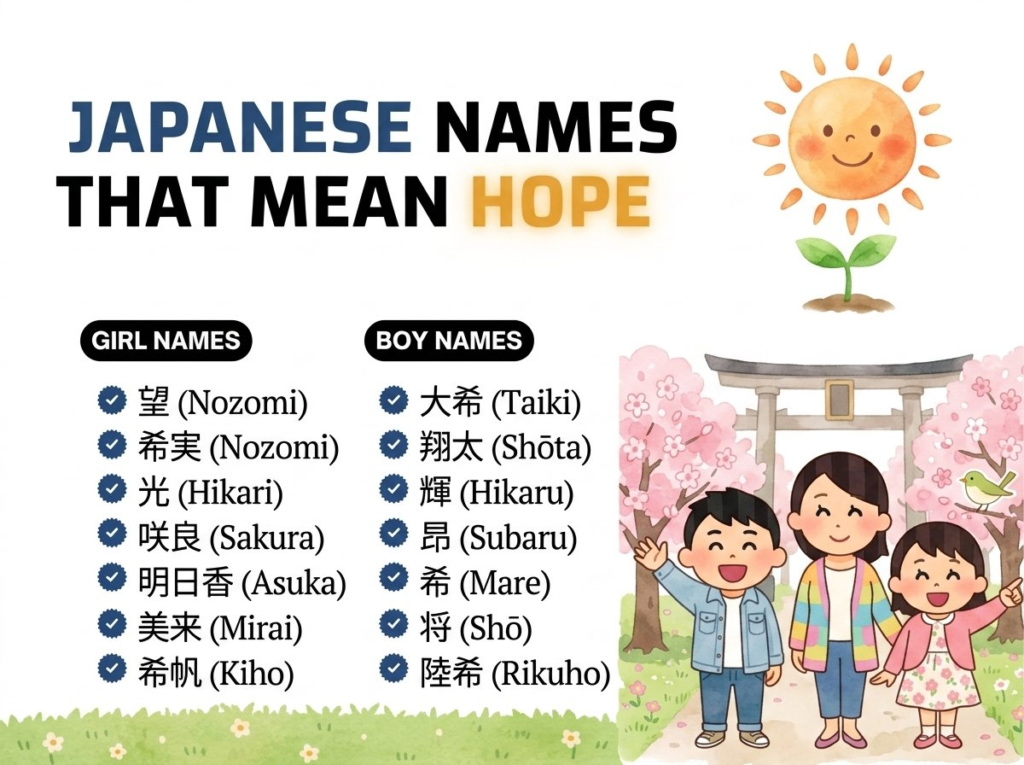
In Japanese naming tradition, hope carries a quiet kind of strength. The kanji for hope, 望 (nozomi) and 希 (ki), appear in some of the most beloved given names across Japan. These characters suggest looking forward, wishing for something better, and holding onto light even during uncertain seasons of life.
Choosing a Japanese name that means hope connects your child to a culture that deeply values resilience and gentle optimism. Whether you have Japanese heritage or simply feel drawn to the language, these names pack real meaning into just a few syllables.
What Japanese Names Mean Hope?
The most recognized Japanese names meaning hope include Nozomi (望) for girls and Nozomu (望) for boys, both drawn directly from the kanji for wish and expectation. Other popular choices are Kiko, Haruki, Inori, and Kibo. These names rely on the kanji 希 (ki) or 望 (nozomi), which translate to hope, wish, or aspiration in Japanese.
Japanese Girl Names That Mean Hope
Hope names for girls in Japanese tend to feel soft without being fragile. The most common readings use 望 (nozomi) or 希 (ki), and parents often pair these kanji with characters for beauty, flowers, or the sea to create layered meanings. The result is a name that sounds gentle on the tongue but carries real emotional weight underneath.
| Name | Origin | Meaning | Pronunciation | Popularity |
|---|---|---|---|---|
| Nozomi | Japanese | Hope, wish | noh-ZOH-mee | Classic |
| Kiko | Japanese | Hope child | KEE-koh | Soft |
| Kina | Japanese | Hope, graceful | KEE-nah | Trending |
| Nozoka | Japanese | Hope flower | noh-ZOH-kah | Rare |
| Kiyomi | Japanese | Hope, beauty | kee-YOH-mee | Classic |
| Inori | Japanese | Prayer, hope | ee-NOH-ree | Unique |
| Kira | Japanese | Hope, good | KEE-rah | Trending |
| Kiharu | Japanese | Hope, spring | kee-HAH-roo | Rare |
| Kiyoko | Japanese | Hope, pure child | kee-YOH-koh | Classic |
| Nozomi (希実) | Japanese | Hope, truth | noh-ZOH-mee | Soft |
| Kanna | Japanese | Hope, south | KAHN-nah | Trending |
| Kisaki | Japanese | Hope, bloom | kee-SAH-kee | Unique |
| Nozoe | Japanese | Hope, inlet | noh-ZOH-eh | Rare |
| Kinoa | Japanese | Hope, love | kee-NOH-ah | Trending |
| Nozomi (望海) | Japanese | Hope, ocean | noh-ZOH-mee | Mystic |
Naming Expert’s Note: Nozomi is the quintessential Japanese hope name, and for good reason. It works beautifully across cultures because the three-syllable rhythm feels natural in English, Spanish, and many other languages. If you want a name that travels well and never needs explanation, Nozomi is the one to beat.
Japanese Boy Names That Mean Hope
Boy names carrying the meaning of hope in Japanese often use 希 (ki) as the second kanji in a two-character compound. The first kanji sets the tone (spring, light, wisdom) while 希 anchors the name in hope. This structure gives parents enormous flexibility. The single-kanji name Nozomu remains a strong, traditional choice for families who prefer simplicity.
| Name | Origin | Meaning | Pronunciation | Popularity |
|---|---|---|---|---|
| Nozomu | Japanese | Hope, wish | noh-ZOH-moo | Classic |
| Haruki | Japanese | Spring hope | hah-ROO-kee | Trending |
| Kazuki | Japanese | Harmony, hope | kah-ZOO-kee | Classic |
| Naoki | Japanese | Honest hope | now-OH-kee | Classic |
| Kouki | Japanese | Light, hope | KOH-kee | Trending |
| Hiroki | Japanese | Great hope | hee-ROH-kee | Classic |
| Tomoki | Japanese | Wisdom, hope | toh-MOH-kee | Trending |
| Masaki | Japanese | True hope | mah-SAH-kee | Powerful |
| Yuki | Japanese | Gentle hope | YOO-kee | Soft |
| Daiki | Japanese | Great hope | dah-EE-kee | Powerful |
| Kaito | Japanese | Hope, soar | KIGH-toh | Trending |
| Shoki | Japanese | Soar, hope | SHOH-kee | Rare |
| Kibo | Japanese | Hope | KEE-boh | Rare |
| Itsuki | Japanese | Tree, hope | ee-TSOO-kee | Trending |
| Soki | Japanese | Blue hope | SOH-kee | Unique |
Unisex Japanese Names That Mean Hope
Gender-neutral naming is growing in Japan, and hope names adapt well to this trend. Many of these names use a single kanji or a simple two-kanji pairing that reads naturally regardless of gender. The sound tends to be open and vowel-forward, which gives these names a modern, approachable quality.
| Name | Origin | Meaning | Pronunciation | Popularity |
|---|---|---|---|---|
| Nozomi | Japanese | Hope, wish | noh-ZOH-mee | Classic |
| Inori | Japanese | Prayer, hope | ee-NOH-ree | Unique |
| Kibo | Japanese | Hope | KEE-boh | Rare |
| Nozomu | Japanese | To hope | noh-ZOH-moo | Classic |
| Kizuki | Japanese | Hope, moon | kee-ZOO-kee | Mystic |
| Kano | Japanese | Hope, grace | KAH-noh | Soft |
| Kion | Japanese | Hope, sound | kee-OHN | Trending |
| Nozomi (望生) | Japanese | Hope, life | noh-ZOH-mee | Unique |
| Kiseki | Japanese | Hope, miracle | kee-SEH-kee | Rare |
| Nozomi (希望) | Japanese | Hope, wish | noh-ZOH-mee | Classic |
Also Read: Beautiful Names That Mean Hope Across Every Language
The Kanji Behind Japanese Hope Names
Japanese is a language where meaning lives inside the written character, not just the sound. The same pronunciation can carry completely different meanings depending on which kanji a parent selects. For hope names, three kanji do most of the heavy lifting. Understanding the difference between them helps you choose a name with precision rather than guesswork.
Names Using 望 (Nozomi): Hope and Wish
The kanji 望 is the most direct Japanese character for hope. It originally depicted a person standing on the ground gazing at the moon, which gives it a poetic layer of longing and expectation. Names built on this kanji feel traditional and grounded.
| Name | Meaning | Gender |
|---|---|---|
| Nozomi | Hope, wish | Girl |
| Nozomu | To hope, to wish | Boy |
| Nozoka | Hope flower | Girl |
| Nozoe | Hope inlet | Girl |
| Mochizuki | Full moon hope | Unisex |
Names Using 希 (Ki): Hope and Rarity
The kanji 希 carries a dual meaning of hope and rarity. In classical Chinese, from which Japanese borrowed the character, it referred to something precious because it was scarce. Modern Japanese parents love this kanji because it suggests their child is both hopeful and one of a kind. It appears most often as the second character in compound boy names.
| Name | Meaning | Gender |
|---|---|---|
| Kiko | Hope child | Girl |
| Haruki | Spring hope | Boy |
| Kazuki | Harmony hope | Boy |
| Kina | Hope graceful | Girl |
| Kion | Hope sound | Unisex |
Names Using 祈 (Inori): Prayer and Hope
The kanji 祈 literally means prayer, but in Japanese naming it functions as a close synonym for hope. A prayer is, after all, a hope spoken aloud. Names using this kanji are less common and carry a spiritual, contemplative quality that many parents find appealing.
| Name | Meaning | Gender |
|---|---|---|
| Inori | Prayer, hope | Unisex |
| Inori (祈望) | Prayer hope | Girl |
| Kisei | Hope, prayer | Boy |
Also Read: Japanese Names That Mean Light for Girls and Boys
Japanese Names That Mean Wish and Prayer
The line between hope, wish, and prayer blurs beautifully in Japanese. The kanji 望 covers both hope and wish, while 祈 bridges prayer and hope. These variations let you fine-tune the exact shade of meaning you want your child’s name to carry.
Names That Mean Wish
The concept of wishing overlaps heavily with hoping in Japanese. The kanji 望 (nozomi) serves double duty for both ideas. Names in this category feel aspirational and forward-looking.
- Nozomi (望)
- Nozomu (望)
- Nozoka (望花)
- Nozoe (望江)
- Nozomi (望美)
- Kano (希乃)
- Kibo (希望)
- Nozomi (望海)
- Kiyomi (希美)
- Nozomi (望生)
Names That Mean Prayer
Prayer names carry a quieter, more spiritual energy. They suit families who want a name rooted in intention and mindfulness rather than bold ambition.
- Inori (祈)
- Inori (祈望)
- Kisei (祈星)
- Kiseki (希祈)
- Inori (祈里)
How to Choose the Right Japanese Hope Name
Sound matters more than most parents realize at first. A name like Haruki flows easily with short English surnames, while a longer name like Kiyomi pairs better with a one-syllable last name. Say the full name out loud several times before committing.
Cultural context deserves your attention too. If you have Japanese heritage, a traditional kanji like 望 may feel most authentic. If you are drawn to Japanese culture from the outside, choosing a name that is easy to pronounce in your home language will save your child a lifetime of corrections.
- Say the full name out loud with your last name
- Check the initials for unintended meanings
- Think about natural nicknames (Nozomi becomes Noz or Zomi)
- Research the specific kanji before committing to a reading
- Consider how the name sounds on both a child and an adult
- Check current popularity in Japan if you want something less common
Frequently Asked Questions
Q: What is the most popular Japanese name meaning hope?
A: Nozomi is the most widely recognized Japanese name that means hope. It uses the kanji 望 (wish, expectation) and has been a consistent favorite for girls in Japan for decades. For boys, Haruki and Kazuki are among the most popular hope names currently in use.
Q: What does hope mean in Japanese?
A: The Japanese word for hope is 希望 (kibou). In naming, the individual kanji 望 (nozomi, meaning wish or expectation) and 希 (ki, meaning hope or rarity) are used more frequently than the full compound. Both kanji carry the core meaning of looking forward with optimism.
Q: What are some rare Japanese hope names?
A: Rarer options include Kiseki (hope miracle), Shoki (soar hope), Nozoe (hope inlet), and Kibo (the direct word for hope used as a given name). These names are uncommon even in Japan, which makes them distinctive choices for families seeking something unusual.
Q: What is a good middle name to pair with Nozomi?
A: Nozomi pairs well with short, soft middle names like Rose, Grace, Mae, or Jade. Since Nozomi is three syllables, a one-syllable middle name creates a clean rhythm. Avoid middle names that end in “ee” sounds, as they blur into Nozomi’s final syllable.
Q: Are Japanese hope names still popular in Japan?
A: Yes. Names using the 希 (ki) kanji have actually surged in popularity over the last two decades, especially for boys. Haruki, Kazuki, and Itsuki consistently rank in Japan’s top baby name lists. The 望 (nozomi) kanji remains a steady classic for girls.
Q: Can non-Japanese families use Japanese hope names?
A: Absolutely. Names like Nozomi, Haruki, and Inori are increasingly used by families worldwide. The key is to understand the kanji meaning behind the name and to pronounce it respectfully. Learning the correct reading shows genuine appreciation for the culture.
Conclusion
Japanese hope names range from the timeless simplicity of Nozomi to the modern energy of Kion and Haruki. The kanji system gives you remarkable control over meaning, letting you layer hope with beauty, spring, light, or the sea. Names rooted in hope endure because every generation needs a reminder that looking forward is its own kind of courage. If you want to explore similar meanings beyond Japanese, browse our collection of names that mean light across cultures.