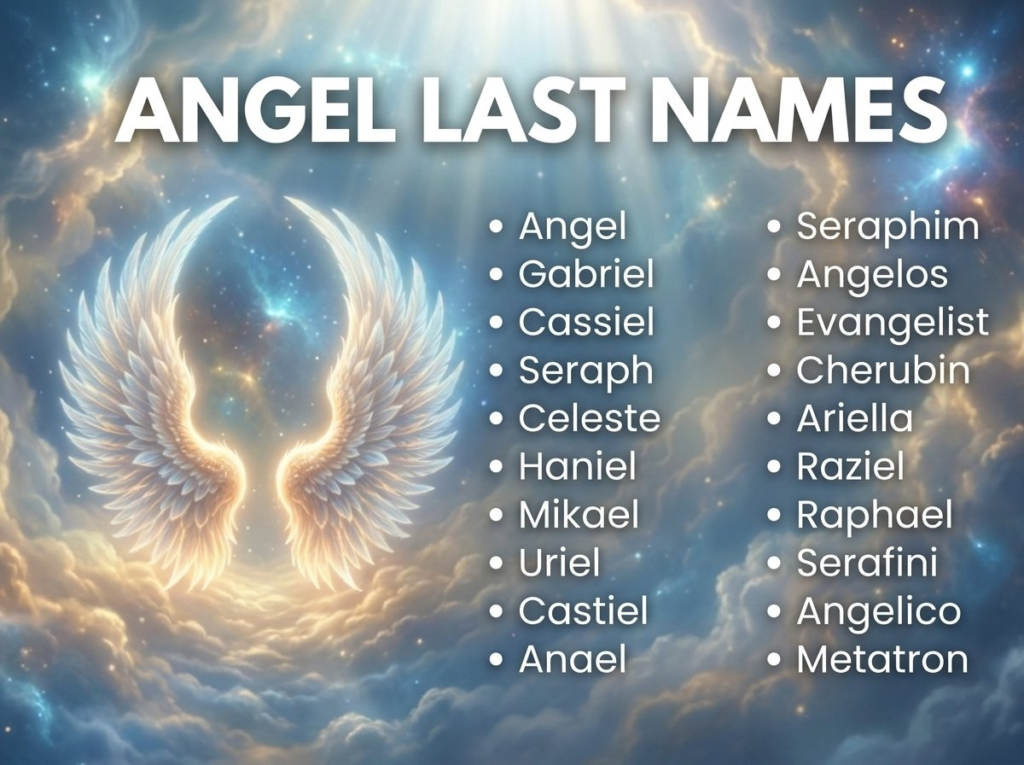
Some of the most recognized last names that mean angel include Engel (German), Angel (English and Spanish), Angeli (Italian), Angelov (Bulgarian), Malakhov (Russian), Melek (Turkish), Angeles (Spanish), and D’Angelo (Italian). These surnames trace back to the Greek word “angelos,” meaning heavenly messenger, and appear across European, Slavic, and Middle Eastern naming traditions.
The word “angel” has traveled through more languages than almost any other spiritual term. It began as the Greek “angelos,” meaning messenger, then moved through Latin, Arabic, Hebrew, and dozens of European tongues. Along the way, it settled into family names across cultures that had very little else in common.
Surnames meaning angel show up most often in regions with deep Christian, Jewish, or Islamic heritage. They carry a quiet weight. Whether your family name already holds this meaning or you are researching it for genealogy, a character, or pure curiosity, these names connect ordinary families to something much older than themselves.
Last Names That Mean Angel
Angel surnames carry a certain quiet dignity. They do not announce themselves loudly, but they hold centuries of spiritual and linguistic history in just a few syllables. Most trace directly to the Greek “angelos,” though some branch off through Hebrew and Arabic roots that actually predate the Greek entirely.
| Surname | Origin | Meaning | Notable Bearers | Popularity |
|---|---|---|---|---|
| Angel | English, Spanish | Angel, heavenly messenger | Criss Angel (illusionist) | Classic |
| Angell | English | Angel, divine messenger | Roger Angell (writer, New Yorker) | Rare |
| Angelo | Italian | Angel, messenger of God | Mike Angelo (Thai actor) | Classic |
| D’Angelo | Italian | Of the angel, son of Angelo | D’Angelo (R&B singer) | Trending |
| Angeli | Italian | Angels, descendants of Angelo | Giuseppe Angeli (18th-century painter) | Rare |
| Angelini | Italian | Little angel, of the angel family | Francesca Angelini (Italian politician) | Unique |
| Angelucci | Italian | Descendant of Angeluccio | Libero Angelucci (historical figure) | Rare |
| Angeletti | Italian | Little angel | Marco Angeletti (Italian athlete) | Rare |
| Angelis | Greek | Of the angel, from Angelos | Michael Angelis (British actor) | Unique |
| Angelopoulos | Greek | Son of Angelos | Theo Angelopoulos (Greek filmmaker) | Rare |
| Engel | German | Angel | Friedrich Engel (mathematician) | Classic |
| Engels | German, Dutch | Angel, son of Engel | Friedrich Engels (philosopher) | Classic |
| Engelmann | German | Angel man | George Engelmann (botanist) | Rare |
| Engelhardt | German | Brave angel | Adalbert Engelhardt (historian) | Unique |
| Engelbrecht | German | Bright angel | Engelbrecht Engelbrechtsson (Swedish regent) | Rare |
| Angelov | Bulgarian | Son of Angel | Georgi Angelov (Bulgarian footballer) | Trending |
| Malakhov | Russian | Son of the angel | Vladimir Malakhov (ballet dancer) | Unique |
| Melek | Turkish | Angel (from Arabic malak) | Various across Turkey | Soft |
| Angeles | Spanish | Of the angels | Feliciano Angeles (Filipino politician) | Classic |
| Malak | Arabic | Angel, messenger | Various across the Middle East | Mystic |
Naming Expert’s Note: Engel is one of those rare surnames that works across almost every European language without losing its meaning. A German Engel, a Dutch Engels, and a Bulgarian Angelov all point back to the same root. If you are tracing family history and hit a dead end with one spelling, try the others. The name migrated far more than most people realize.
Angel Surnames Across Cultures
The concept of a heavenly messenger appears in nearly every major religious tradition. That shared belief gave rise to angel surnames independently across continents and centuries. The root word changes from language to language, but the core meaning stays remarkably consistent from German villages to Turkish cities to Bulgarian towns.
Italian Surnames That Mean Angel
Italian naming traditions produced the richest collection of angel surnames in Europe. Most stem from the given name Angelo, which became a hereditary family identifier during the medieval period, especially in Tuscany and the southern regions.
| Surname | Meaning | Region |
|---|---|---|
| Angelo | Angel | Southern Italy |
| D’Angelo | Of the angel | Campania, Sicily |
| Angeli | Angels, of Angelo | Tuscany, Veneto |
| Angelini | Little angel | Central Italy |
| Angeloni | Great angel | Lazio, Abruzzo |
| Angeletti | Little angel | Marche, Umbria |
| Angelucci | Descendant of Angeluccio | Central Italy |
| Angiolini | Of Angiolo (angel variant) | Tuscany |
| Di Angelo | Of the angel | Southern Italy |
| Angelotti | Descendant of Angelotto | Northern Italy |
German Surnames That Mean Angel
The German word “Engel” became a surname as early as the 13th century. It often started as a nickname for someone with a gentle disposition or a close connection to the local church. Over time, compound forms like Engelhardt and Engelbrecht added layers of meaning.
| Surname | Meaning | Region |
|---|---|---|
| Engel | Angel | Bavaria, Rhineland |
| Engels | Son of Engel | Westphalia, Netherlands |
| Engelmann | Angel man | Northern Germany |
| Engelhardt | Brave angel | Franconia |
| Engelbrecht | Bright angel | Lower Saxony |
| Engelke | Little angel | Northern Germany |
| Engelmeyer | Angel steward | Westphalia |
| Engelking | Angel king | Lower Saxony |
Also Read: Beautiful First Names That Mean Angel for Girls and Boys
Greek Surnames That Mean Angel
Greek surnames preserve the original “angelos” root more directly than any other European tradition. The patronymic “-opoulos” ending is especially common in the Peloponnese, while “-idis” appears more often in northern Greece and among Pontic Greek families.
| Surname | Meaning | Region |
|---|---|---|
| Angelis | Of the angel | Mainland Greece |
| Angelopoulos | Son of Angelos | Peloponnese |
| Angelidis | Son of Angel | Northern Greece |
| Angelakis | Little Angel | Crete |
| Angelou | Of Angelos | Central Greece |
| Angelatos | Descendant of Angel | Ionian Islands |
Slavic Surnames That Mean Angel
Slavic angel surnames follow two distinct paths. Bulgarian families often derive theirs from the given name Angel, which remains popular in Bulgaria to this day. Russian and Ukrainian families more commonly trace their angel surnames through “malakh,” borrowed from the Hebrew “mal’akh.”
| Surname | Meaning | Region |
|---|---|---|
| Angelov | Son of Angel | Bulgaria |
| Angelova | Daughter of Angel | Bulgaria |
| Malakhov | Son of the angel | Russia |
| Malakh | Angel, messenger | Russia, Ukraine |
| Anđelković | Son of Anđelko (angel) | Serbia, Croatia |
| Anđelić | Of the angel | Serbia, Bosnia |
Arabic and Turkish Surnames That Mean Angel
The Arabic word “malak” (angel) shares the same Semitic root as the Hebrew “mal’akh.” Both predate the Greek “angelos” by centuries. Turkish adopted the word as “melek” through Ottoman-era Islamic influence, and it remains a recognizable surname in modern Turkey.
| Surname | Meaning | Region |
|---|---|---|
| Malak | Angel, messenger | Lebanon, Syria, Egypt |
| Malaki | Of the angel | Middle East |
| Melek | Angel | Turkey |
| Melekoğlu | Son of the angel | Turkey |
| Malaika | Angels | North Africa, Swahili coast |
| Farishta | Angel | Iran, Afghanistan, Pakistan |
Surnames Related to Heavenly Messengers and Divine Names
Surnames That Mean Messenger of God
The original Greek “angelos” literally translates to “messenger.” Several surnames preserve this older, more specific meaning rather than the modern image of a winged celestial figure. These names appear most often in Semitic language traditions where the messenger role was always the primary emphasis.
- Malak (Arabic)
- Malakh (Hebrew)
- Malakhov (Russian, via Hebrew)
- Malaika (Swahili and Arabic)
- Melek (Turkish)
- Rasulov (Uzbek, “messenger” root)
- Farishta (Persian and Urdu)
- Angelus (Latin)
- Angelides (Greek Cypriot)
- Malaki (Arabic, “of the angel”)
Surnames Derived from Archangel Names
Some families took their surnames not from the general word for angel but from specific archangels. Michael, Gabriel, and Raphael all generated family lines across Europe and the Middle East. These names carry the angel connection through a named spiritual figure rather than the abstract concept. If you are interested in names tied to celestial light, many of these archangel surnames overlap with that tradition.
- Michaelis (Greek, “of Michael”)
- Gabrielov (Bulgarian, “son of Gabriel”)
- Gabrielli (Italian, “of Gabriel”)
- Raffaele (Italian, “of Raphael”)
- Mikhailov (Russian, “son of Michael”)
- Gavrilović (Serbian, “son of Gavril”)
- Michelangelo (Italian, compound of two archangels)
- Urieli (Hebrew, “of Uriel”)
- Jibril (Arabic, Gabriel)
- Mikaelian (Armenian, “son of Michael”)
Surnames That Mean Guardian Angel or Heavenly Protector
A smaller group of surnames blends the angel concept with ideas of guardianship and protection. These names suggest a family identity rooted in spiritual watchfulness rather than simple devotion. They are rarer than straightforward angel surnames but carry a layered meaning that rewards a closer look.
- Engelhardt (German, “brave angel”)
- Engelbrecht (German, “bright angel”)
- De Los Angeles (Spanish, “of the angels”)
- Custodio (Spanish and Portuguese, “guardian,” often paired with “de los Angeles”)
- Guardangelo (Italian, “guardian angel”)
- Schützengel (German, “guardian angel,” extremely rare)
- Angelis (Greek, “of the angel”)
- Anđelković (Serbian, “of the little angel”)
- Engelwacht (German, “angel watch,” historical)
- Angelopoulos (Greek, “son of Angelos,” implies lineage of protection)
Also Read: Last Names That Mean Heaven and Their Spiritual Origins
How to Choose the Right Angel Surname
Sound matters more than you might think with surnames. A name like Engel reads short and clean next to a longer first name, while Angelopoulos carries a rhythmic weight that pairs better with something simple up front. Think about how the full name sounds spoken aloud in everyday conversation.
Origin can matter deeply if your family has specific cultural roots. An Italian-American family might feel a stronger connection to D’Angelo than to Engel, even though both carry the same core meaning.
- Say the full name out loud to test rhythm and flow
- Check how the surname looks in writing alongside a first name
- Research whether the name has regional spelling variants in your family’s country of origin
- Consider how easy the name is to pronounce in your primary language
- Look into whether the surname carries any unexpected historical associations
- Think about whether you want a name that clearly signals “angel” or one that hides the meaning more subtly
Frequently Asked Questions
Q: What is the most common last name that means angel?
A: Angelov is one of the most widespread angel surnames in the world, particularly in Bulgaria where the given name Angel has been popular for centuries. In Western Europe, Engel and its variants (Engels, Engelmann) are the most frequently encountered. In Italian-speaking regions, Angelo and D’Angelo dominate.
Q: What does the surname Engel mean?
A: Engel is a German surname that directly translates to “angel.” It originated as a medieval nickname, often given to someone known for a gentle temperament or someone who played an angel in church pageants. The name dates back to at least the 13th century in German-speaking regions.
Q: Are there Arabic last names that mean angel?
A: Yes. The most common is Malak, derived from the Arabic word for angel. This shares the same Semitic root as the Hebrew “mal’akh,” which is actually older than the Greek “angelos.” Related forms include Malaki (of the angel) and Malaika (angels), found across the Middle East and North Africa.
Q: What is the difference between Angel and Angelo as surnames?
A: Angel is the English and Spanish form, while Angelo is Italian. Both trace back to the same Greek root “angelos.” The Italian version often generated additional family names through diminutives and patronymics (Angelini, Angeletti, D’Angelo), making the Italian angel surname tradition far more varied than the English one.
Q: Are angel surnames still common today?
A: Yes, especially in Southern and Eastern Europe. Angelov remains a top surname in Bulgaria. D’Angelo is well established in Italy and among Italian diaspora communities. Engel and Engels continue to appear frequently in Germany and the Netherlands. The meaning may not be obvious to everyone who carries these names, but the surnames themselves are very much alive.
Q: What Slavic last names mean angel?
A: Bulgarian families most commonly carry Angelov (son of Angel) and Angelova (daughter of Angel). Russian and Ukrainian families with angel-connected surnames more often carry Malakhov or Malakh, which derive from the Hebrew “mal’akh” rather than the Greek root. Serbian and Croatian families may carry Anđelković or Anđelić.
Conclusion
Angel surnames span an unusually wide geographic range for a single concept. From the German Engel to the Turkish Melek to the Bulgarian Angelov, these names all circle back to the same ancient idea of a heavenly messenger. That shared thread across so many unrelated languages says something real about how deeply this concept shaped family identity. If you enjoyed exploring these surnames, you might also like browsing last names that mean light and their luminous origins.