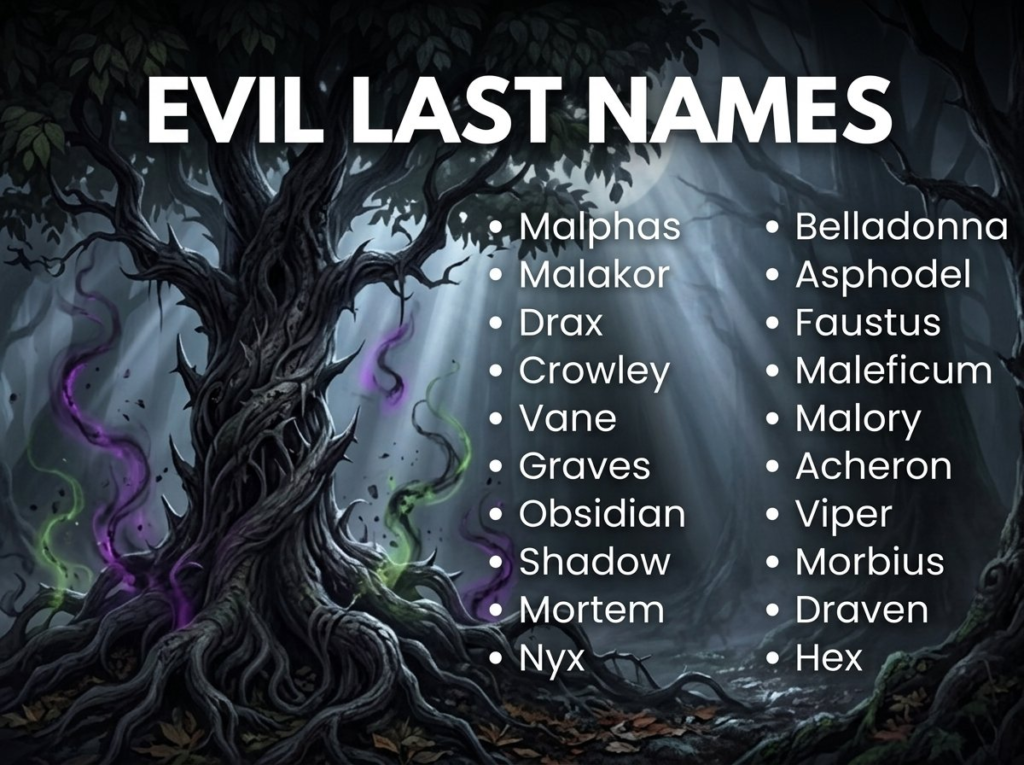
Most surnames come from trades, places, or family lines. A few carry much darker roots. Last names that mean evil often started as nicknames, warnings, or blunt descriptions of temperament that stuck across generations.
These surnames appear in German, French, Russian, Italian, and Arabic records. Some trace back to words for “devil,” “wicked,” or “malice.” Others evolved from terms that once meant something milder but darkened over centuries. Understanding their origins reveals how language, folklore, and social reputation shaped family identity in unexpected ways.
What are some last names that mean evil?
Surnames meaning evil include Böse (German, “evil”), Teufel (German, “devil”), Zlobin (Russian, “malice”), Malatesta (Italian, “bad head”), Badman (English), Malebranche (French, “bad claw”), Lihodeyev (Russian, “evildoer”), and Mauvais (French, “wicked”). Most originated as medieval nicknames or descriptive labels that became hereditary over time.
Last Names That Mean Evil
Surnames connected to evil carry a weight that most family names simply do not. They tend to be short, sharp, and rooted in old European languages where words for wickedness were used more casually as everyday descriptors. Many began as ironic nicknames or blunt character assessments in small medieval communities, then hardened into permanent family markers over centuries.
| Surname | Origin | Meaning | Notable Bearers | Popularity |
|---|---|---|---|---|
| Böse | German | Evil, wicked, angry | Heinrich Böse, German merchant families | Dark |
| Teufel | German | Devil | Various German noble and common families | Rare |
| Badman | English | Bad man | Historical English parish records | Rare |
| Malatesta | Italian | Bad head, stubborn | Sigismondo Malatesta, 15th-century Italian lord | Classic |
| Malebranche | French | Bad claw, evil branch | Nicolas Malebranche, French philosopher | Rare |
| Villain | French | Wicked person, peasant | Historical French and Norman records | Unique |
| Zlobin | Russian | Malice, spite, evil | Various Russian families | Rare |
| Lihodeyev | Russian | Evildoer, villain | Historical Russian records | Dark |
| Schlecht | German | Bad, wicked | Various German families | Rare |
| Diablo | Spanish | Devil | Rare Spanish colonial records | Dark |
| Mauvais | French | Bad, wicked | Historical French records | Rare |
| Devill | English | Devil (nickname origin) | Historical English parish records | Rare |
| Sharr | Arabic | Evil, harm | Various Arabic families | Unique |
| Nefario | Italian | Wicked, abominable | Rare Italian records | Dark |
| Malvado | Spanish | Wicked, evil | Spanish colonial records | Rare |
| Übel | German | Evil, bad | Various German families | Rare |
| Malenfant | French | Bad child | Historical French families | Unique |
| Malherbe | French | Bad herb | François de Malherbe, French poet | Classic |
| Zlobinski | Polish | Malice, spite | Polish and Russian families | Rare |
| Bane | English/Norse | Destroyer, slayer | Scottish clan records | Powerful |
Naming Expert’s Note: Malatesta is one of the most fascinating surnames on this list. The name literally translates to “bad head,” which sounds almost comical today. But the Malatesta family of Rimini was one of the most powerful and feared dynasties in Renaissance Italy. Sigismondo Malatesta was so notorious that Pope Pius II essentially canonized him in reverse, declaring him damned while still alive. The surname proves that “evil” associations in names often come from reputation, not just etymology.
Also Read: Surnames and First Names That Mean Death Across Every Culture
The Cultural Roots of Evil Surnames
The concept of evil appears in nearly every language, and surnames reflecting that concept tend to cluster in cultures with strong medieval naming traditions. German, French, and Russian naming customs were particularly willing to attach blunt moral judgments to family lines. These names survived not because families embraced the meaning, but because surnames became fixed before people could choose otherwise.
German Surnames That Mean Evil
German naming traditions were remarkably direct. If someone had a foul temper or a reputation for cruelty, the community labeled them accordingly, and that label became hereditary.
| Surname | Meaning | Gender |
|---|---|---|
| Böse | Evil, wicked | All |
| Teufel | Devil | All |
| Schlecht | Bad, wicked | All |
| Übel | Evil, bad | All |
| Grimm | Fierce, wrathful | All |
French Surnames That Mean Evil
French surnames with dark meanings often use the prefix “mal,” which means “bad” or “evil.” This prefix attached itself to dozens of descriptive terms during the medieval period, creating a whole family of surnames with negative connotations.
| Surname | Meaning | Gender |
|---|---|---|
| Malebranche | Bad claw | All |
| Mauvais | Bad, wicked | All |
| Malenfant | Bad child | All |
| Malherbe | Bad herb | All |
| Villain | Wicked person | All |
Russian Surnames That Mean Evil
Russian surnames often derive from character traits or behavioral descriptions. Words related to malice and spite became fixed family names, particularly in rural communities where reputation was everything.
| Surname | Meaning | Gender |
|---|---|---|
| Zlobin | Malice, spite | All |
| Lihodeyev | Evildoer | All |
| Zlobinski | Malice | All |
| Zloba | Spite, anger | All |
Italian Surnames That Mean Evil
Italian surnames connected to evil often carry a theatrical quality. The Malatesta dynasty is the most famous example, but other Italian names with dark roots exist in regional records, particularly from southern Italy and Sicily.
| Surname | Meaning | Gender |
|---|---|---|
| Malatesta | Bad head | All |
| Nefario | Wicked, abominable | All |
| Malvado | Wicked | All |
English Surnames That Mean Evil
English surnames with evil connections tend to be the most understated. They often sound ordinary until you trace the etymology back to Old English or Old Norse roots where the original meanings were far more severe. For more on dark English naming traditions, explore first names that mean shadow and their Old English roots.
| Surname | Meaning | Gender |
|---|---|---|
| Badman | Bad man | All |
| Devill | Devil | All |
| Bane | Destroyer, slayer | All |
| Fell | Cruel, fierce | All |
Also Read: Last Names That Mean Night and Their Mysterious Origins
Surnames That Mean Devil or Demon
Surnames directly referencing the devil or demonic figures are rarer than you might expect. Most cultures considered it bad luck to name a family line after the devil outright. When these names do appear, they usually started as nicknames for someone with a fierce temper or a mischievous personality, not as literal declarations of demonic connection.
- Teufel (German)
- Diablo (Spanish)
- Devill (English)
- Diavolo (Italian)
- Dracul (Romanian, later associated with “devil”)
- Demon (rare English variant)
- Diable (French)
- Teufelmann (German, “devil man”)
- Diab (Arabic, though this more commonly means “wolf”)
- Satanas (rare Spanish/Portuguese)
Surnames That Mean Wicked or Cruel
“Wicked” and “cruel” carry slightly different energy than “evil.” These surnames suggest moral judgment from a community rather than supernatural darkness. They feel more human, more grounded in everyday behavior and social reputation.
- Mauvais (French)
- Malvado (Spanish)
- Nefario (Italian)
- Schlecht (German)
- Cruel (French)
- Böse (German)
- Fell (English/Norse)
- Savage (French/English, “wild, fierce”)
- Übel (German)
- Malizioso (Italian, “malicious”)
Surnames That Mean Malice or Spite
Malice and spite are quieter forms of evil. Surnames in this category tend to come from Slavic languages, where words for grudges, bitterness, and ill will became surprisingly common family identifiers. These names feel less dramatic than “devil” surnames but carry a deeper sense of inherited darkness. If you are interested in related dark naming traditions, names that mean darkness across cultures offer a broader look.
- Zlobin (Russian)
- Zlobinski (Polish)
- Zloba (Russian)
- Lihodeyev (Russian)
- Sharr (Arabic)
- Zlost (Slavic)
- Nepryakhin (Russian, “unfriendly”)
- Kozlov (Russian, sometimes associated with trickery)
Also Read: First Names and Last Names That Mean Demon From Every Tradition
How to Choose the Right Evil Surname for Fiction or Research
Sound matters more than meaning when a surname needs to land with an audience. A name like Malatesta rolls off the tongue with dramatic flair, while Böse hits hard with just two syllables. Match the rhythm of the surname to the character or context you are building.
Cultural origin should guide your choice too. A Russian villain named Zlobin feels authentic in a Slavic setting but out of place in a story set in medieval France.
- Say the full name out loud to test rhythm and flow
- Check whether the surname sounds harsh or subtle depending on your needs
- Research the specific regional origin before assigning it to a character
- Consider how the name looks in print on a page or screen
- Pair dark surnames with softer first names for contrast
- Verify the meaning has not shifted significantly in modern usage
Frequently Asked Questions
Q: What is the most well-known last name that means evil?
A: Malatesta is probably the most recognized surname with an evil connection. The Italian name means “bad head” and belonged to one of the most infamous noble families of the Renaissance. The Malatesta dynasty ruled Rimini and produced several rulers known for cruelty and political ruthlessness.
Q: Do surnames meaning evil still exist today?
A: Yes. Surnames like Böse, Teufel, and Zlobin are still carried by real families across Europe. Most modern bearers have no connection to the original meaning. The names became hereditary centuries ago and lost their sting over time.
Q: What are some rare last names that mean evil?
A: Lihodeyev (Russian, “evildoer”), Nefario (Italian, “wicked”), and Übel (German, “evil”) are among the rarest surnames with direct evil meanings. These names appear in very small numbers in historical records and are almost never encountered outside genealogical research.
Q: Why do some families have surnames with negative meanings?
A: Medieval communities assigned surnames based on observable traits, nicknames, and reputations. A family known for a bad temper might receive a name meaning “wicked” or “angry.” Once surnames became legally fixed in the 14th and 15th centuries, families could not easily change them, even if the meaning was unflattering.
Q: Are there Japanese last names that mean evil?
A: Japanese surnames rarely carry direct “evil” meanings. Japanese naming traditions favor nature, geography, and positive virtues. However, some Japanese names that mean evil exist as given names or literary creations rather than hereditary family names.
Q: Can a surname meaning evil affect how people perceive a family?
A: In modern life, most people never think about surname etymology. A family named Teufel or Böse is unlikely to face judgment based on their name alone. The original meanings have faded from everyday awareness in nearly all cultures.
Final Thoughts
Last names that mean evil are a small but fascinating corner of surname history. They remind us that family names were not always chosen with care. Many were imposed by neighbors, clerks, and tax collectors who had no interest in flattering the families they labeled. From the German Böse to the Russian Zlobin, these surnames survived centuries of social change and still appear in modern records. If you want to explore more dark naming traditions, first names that mean evil across cultures offer a compelling companion to this topic.
1 thought on “81+ Surnames Meaning Evil (With Meanings)”