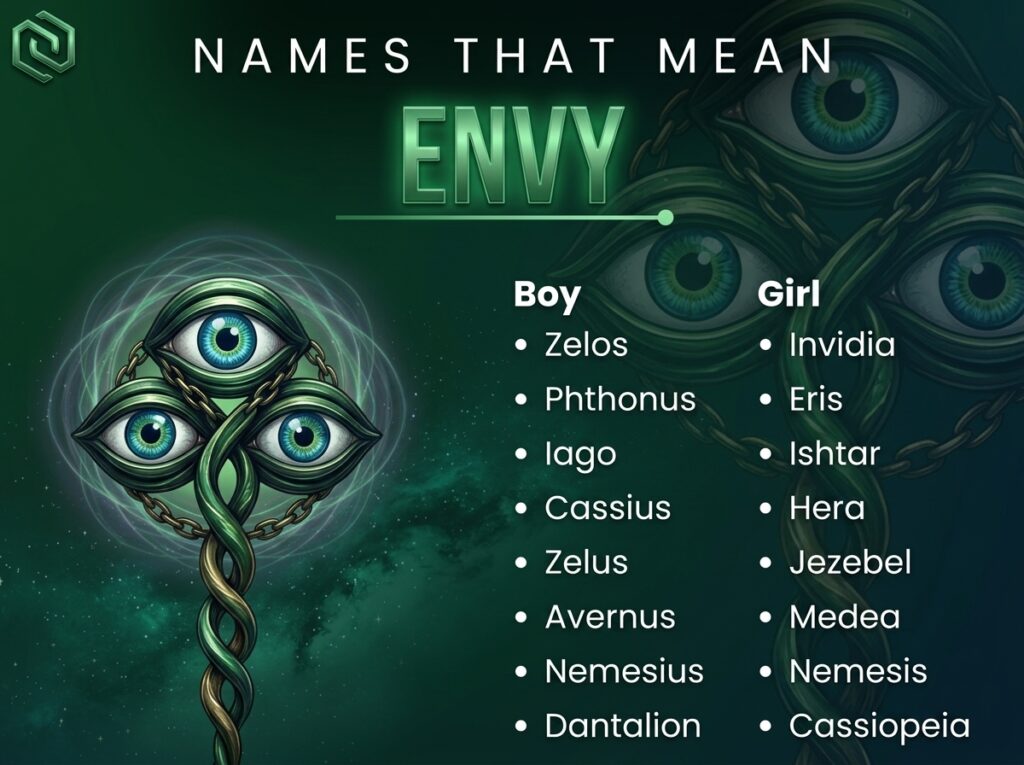
Envy sits uncomfortably in most cultures. It’s one of the seven deadly sins, a destructive force tied to longing, comparison, and discontent. Yet naming traditions around the world have preserved words and figures connected to this feeling. Some draw from mythology’s jealous gods and goddesses. Others come from ancient languages where envy, desire, and rivalry were given distinct names. These aren’t popular baby name choices, but they carry weight and complexity.
Parents drawn to these names often want something unconventional. They may appreciate mythological depth, philosophical nuance, or simply a name with darker undertones. Most of these choices work best as middle names or creative characters. A few, softened by sound or historical distance, might suit a first name for the right family.
What Are Some Names That Mean Envy?
Names directly meaning envy are rare and mostly drawn from mythology and ancient languages. Phthonos (Greek god of envy), Invidia (Roman personification of envy), Hasad (Arabic for envy), and Ayin (Hebrew evil eye) represent the clearest examples. Some mythological figures like Nemesis and Eris embody envy-adjacent concepts like jealousy, rivalry, and retribution. Most authentic options come from Greek, Latin, Hebrew, and Arabic traditions where envy was named and personified.
Girl Names That Mean Envy
Names tied to envy for girls often sound softer than their meanings suggest. Many come from mythology, where female deities personified jealousy, rivalry, or the destructive side of desire. A few derive from ancient words for covetousness or the evil eye. These names carry intensity, but several have been reclaimed in modern contexts as symbols of strength or complexity rather than pure negativity.
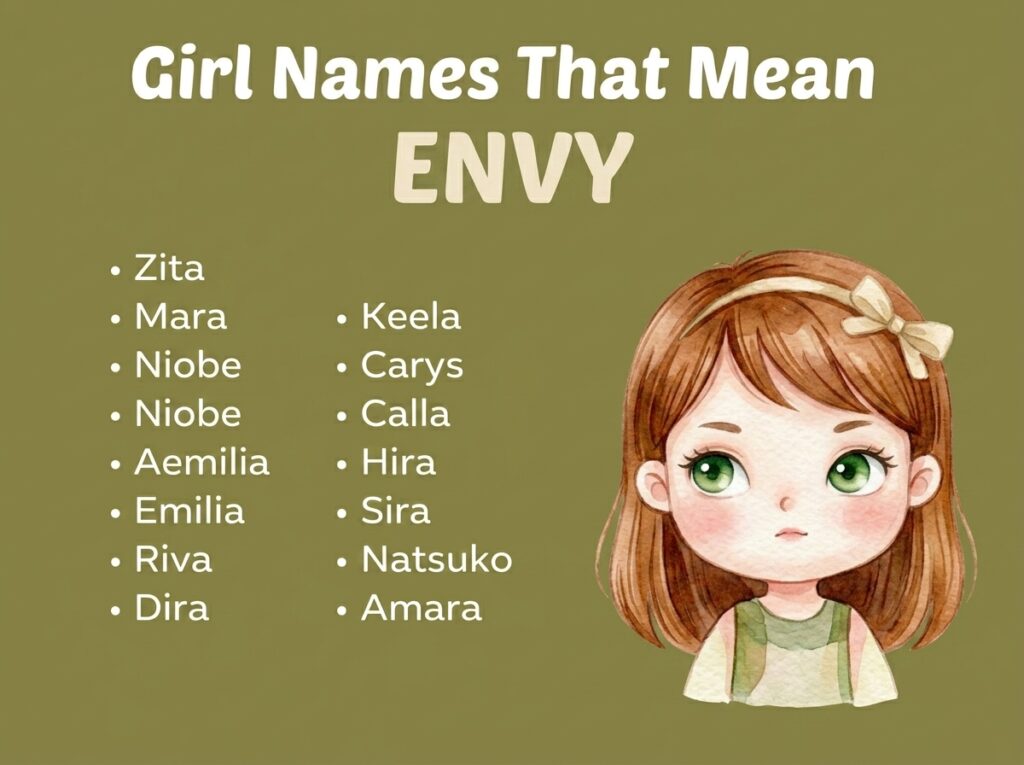
| Name | Origin | Meaning | Pronunciation | Popularity |
|---|---|---|---|---|
| Invidia | Latin | Envy, jealousy | in-VID-ee-ah | Rare |
| Nemesis | Greek | Retribution, envy’s consequence | NEM-uh-sis | Unique |
| Eris | Greek | Strife, discord, rivalry | AIR-iss | Trending |
| Zelia | Greek | Zeal, fervent envy | ZEE-lee-ah | Soft |
| Zelena | Slavic | Envy, green with envy | zeh-LEH-nah | Mystic |
| Ayn | Hebrew | Eye, evil eye (envy) | AYN | Rare |
| Hasada | Arabic | Envious, one who envies | hah-SAH-dah | Unique |
| Phthoné | Greek | Envy, malicious jealousy | THOH-nay | Dark |
| Livor | Latin | Envy, spite, malice | LIH-vor | Rare |
| Keres | Greek | Death spirits born of envy | KEER-eez | Mystic |
| Zelotypia | Latin | Jealousy, zealous envy | zell-oh-TIE-pee-ah | Rare |
| Resentina | Latin-inspired | One who resents | reh-sen-TEE-nah | Unique |
| Zara | Hebrew/Arabic | Envied, coveted | ZAH-rah | Classic |
| Covet | English | To desire enviously | KUH-vit | Dark |
| Avidia | Sanskrit | Ignorance leading to envy | ah-VID-ee-ah | Mystic |
| Grudge | English | Lingering resentment | GRUHJ | Dark |
| Envya | Modern English | Envy | EN-vee-ah | Unique |
| Desira | Latin | Excessive desire | deh-SEER-ah | Soft |
| Longia | Latin-inspired | Longing, yearning | LON-jee-ah | Rare |
| Vye | English | To compete enviously | VY | Powerful |
| Malina | Slavic | Raspberry; also envy in some dialects | mah-LEE-nah | Soft |
| Zelinda | German | Shield of envy | zeh-LIN-dah | Mystic |
| Rivalyn | Latin-inspired | One who rivals | RIV-ah-lin | Unique |
| Invidiana | Latin | Full of envy | in-vid-ee-AH-nah | Rare |
| Grudgina | English-inspired | Bearing grudges | gruhj-EE-nah | Dark |
Also Read: Names That Mean Lust: Bold and Passionate Choices
Boy Names That Mean Envy
Boy names connected to envy often sound bold and weighty. Most come from mythology or ancient languages where male figures represented jealousy, rivalry, or destructive desire. These names tend to carry a sense of power mixed with shadow. They suit characters, creative projects, or families interested in philosophical or mythological depth.
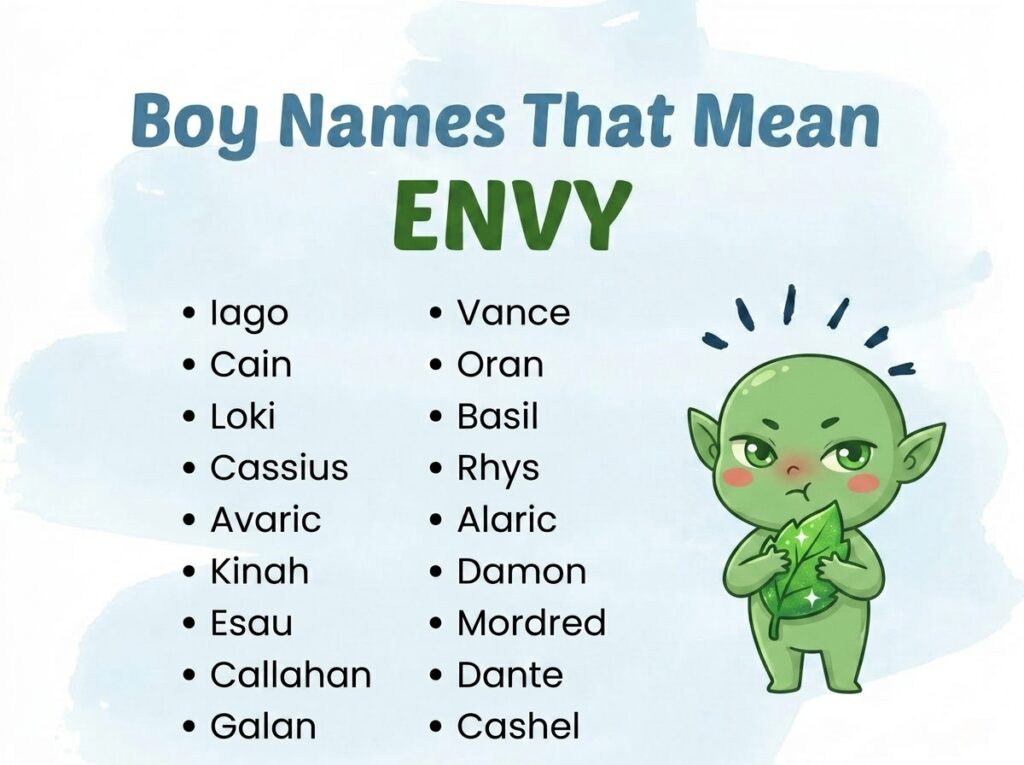
| Name | Origin | Meaning | Pronunciation | Popularity |
|---|---|---|---|---|
| Phthonos | Greek | God of envy and jealousy | THOH-nos | Rare |
| Zelus | Greek | Zeal, rivalry, envy | ZEE-lus | Unique |
| Hasad | Arabic | Envy, jealousy | hah-SAHD | Rare |
| Ayin | Hebrew | Eye, evil eye (envy) | ah-YEEN | Mystic |
| Zelos | Greek | Emulation, envy | ZEH-los | Powerful |
| Livor | Latin | Envy, spite | LIH-vor | Dark |
| Grudgeon | English-inspired | One who holds grudges | GRUHJ-uhn | Rare |
| Rival | English | One who competes enviously | RYE-val | Unique |
| Covetous | English | Full of covetousness | KUV-eh-tus | Dark |
| Invidius | Latin | Envious one | in-VID-ee-us | Rare |
| Envion | Modern invented | Bearer of envy | EN-vee-on | Unique |
| Desiran | Latin-inspired | One who desires excessively | deh-SEER-an | Soft |
| Malice | English | Intent to harm from envy | MAL-iss | Dark |
| Zelion | Greek-inspired | Zealous envier | ZEE-lee-on | Mystic |
| Resentius | Latin-inspired | One who resents | reh-SEN-shus | Rare |
| Spito | Italian-inspired | Spite, envy | SPEE-toh | Unique |
| Jalon | Hebrew | He who envies | jah-LOHN | Rare |
| Vyen | English-inspired | One who competes | VY-en | Powerful |
| Grudge | English | Resentment, envy | GRUHJ | Dark |
| Covetis | Latin-inspired | Desirer, envier | KOH-veh-tis | Rare |
Unisex Names That Mean Envy
Unisex names tied to envy are rare but often carry a modern, edgy sound. Some are drawn from mythology, others from abstract concepts. These names work for any gender and appeal to parents or creators seeking something unconventional and layered.
| Name | Origin | Meaning | Pronunciation | Popularity |
|---|---|---|---|---|
| Envy | English | Jealousy, covetousness | EN-vee | Trending |
| Eris | Greek | Strife, discord, envy | AIR-iss | Unique |
| Rival | English | Competitor driven by envy | RYE-val | Powerful |
| Zeal | English | Fervent desire, envy | ZEEL | Soft |
| Grudge | English | Lingering resentment | GRUHJ | Dark |
| Covet | English | To desire enviously | KUH-vit | Unique |
| Ayin | Hebrew | Eye, evil eye (envy) | ah-YEEN | Mystic |
| Spite | English | Malicious envy | SPYT | Dark |
| Malice | English | Intent to harm from jealousy | MAL-iss | Rare |
| Vyse | English-inspired | One who competes | VYS | Powerful |
| Invy | Modern English | Short for invidia | IN-vee | Unique |
| Zelot | Greek-inspired | Zealous envier | ZEH-lot | Rare |
Also Read: Names That Mean Greed: Bold Choices With Cultural History
Names That Mean Envy Across Cultures
Envy appears in nearly every ancient culture, often personified or given a distinct name. Some societies saw it as a force to ward off. Others honored it through myth. Understanding these cultural roots helps explain why these names carry such gravity.
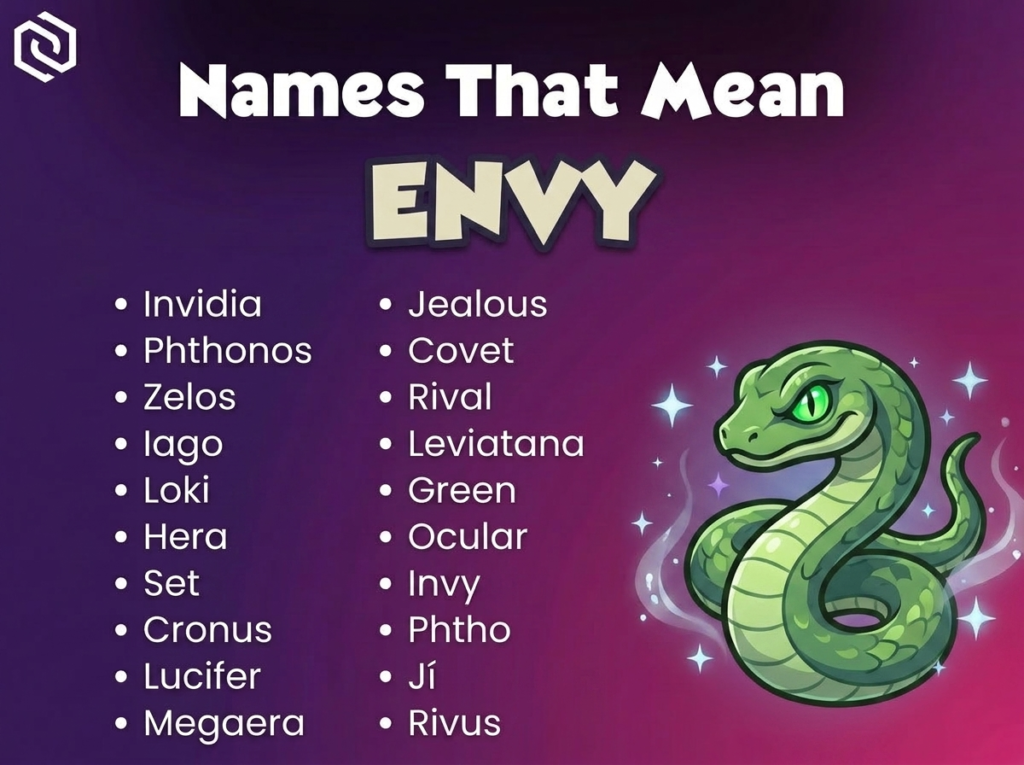
Greek Names That Mean Envy
Greek mythology gave envy a face. Phthonos was the daemon of envy, while Eris stirred jealousy among gods and mortals. These names appear in classical texts and remain recognizable today.
| Name | Meaning | Gender |
|---|---|---|
| Phthonos | God of envy and jealousy | Male |
| Eris | Goddess of strife and discord | Female |
| Nemesis | Retribution born of envy | Female |
| Zelus | Spirit of rivalry and zeal | Male |
| Zelos | Emulation and envy | Male |
| Phthoné | Envy personified | Female |
| Keres | Death spirits tied to jealousy | Female |
| Zelia | Zealous envy | Female |
| Zelion | One driven by zeal | Male |
| Zelena | Green with envy | Female |
Latin Names That Mean Envy
Latin gave us “invidia,” the direct word for envy. Roman culture personified this emotion in literature and art, making it a philosophical and moral concept.
| Name | Meaning | Gender |
|---|---|---|
| Invidia | Envy, jealousy | Female |
| Invidius | Envious one | Male |
| Livor | Envy, spite | Both |
| Zelotypia | Jealousy, zealous envy | Female |
| Covetous | Full of covetousness | Male |
| Desira | Excessive desire | Female |
| Malice | Harmful intent from envy | Both |
| Resentius | One who resents | Male |
| Invidiana | Full of envy | Female |
| Covetis | One who covets | Male |
Arabic Names That Mean Envy
In Arabic tradition, envy (hasad) is taken seriously, often linked to the concept of the evil eye. Names rooted in this word carry spiritual weight.
| Name | Meaning | Gender |
|---|---|---|
| Hasad | Envy, jealousy | Male |
| Hasada | Envious one | Female |
| Ayn | Eye, evil eye (envy) | Both |
| Hasud | One who envies | Male |
| Hasida | She who envies | Female |
| Ghira | Jealousy, protective envy | Female |
| Raghib | Desirous, envious | Male |
| Tamanni | Wishing, coveting | Both |
| Mutahasid | Filled with envy | Male |
| Ayniyah | Related to the evil eye | Female |
Hebrew Names That Mean Envy
Hebrew tradition ties envy to the “evil eye” (ayin hara), a belief that jealousy can bring harm. Names derived from this concept remain rare but meaningful.
| Name | Meaning | Gender |
|---|---|---|
| Ayin | Eye, evil eye (envy) | Both |
| Ayn | Eye associated with envy | Female |
| Kina | Jealousy, zeal | Female |
| Kinna | Zealous one | Female |
| Jalon | He who envies | Male |
| Qanna | Jealous, zealous | Both |
| Kinah | Envy, lament | Female |
| Kinnon | Envious spirit | Male |
| Ayelet | Hind; sometimes tied to longing | Female |
| Qinyan | Possession, envy of ownership | Male |
Also Read: Names That Mean Pride: Powerful Choices Rooted in Strength
Slavic Names That Mean Envy
Slavic languages often link envy to the color green, a cultural symbol of jealousy. Names in this tradition tend to sound lyrical despite their darker meanings.
| Name | Meaning | Gender |
|---|---|---|
| Zelena | Green with envy | Female |
| Zelinda | Shield of envy | Female |
| Zavidia | Envy | Female |
| Zavid | Envious one | Male |
| Malina | Envy in some dialects | Female |
| Grudnik | One who holds grudges | Male |
| Zazdrość | Envy personified | Both |
| Zelenka | Little green one (envy) | Female |
| Zazida | She who envies | Female |
| Grudina | Bearing grudges | Female |
Sanskrit Names That Mean Envy
In Sanskrit and Hindu philosophy, envy (avidya) is often tied to ignorance and desire. These concepts appear in spiritual texts and philosophical writings.
| Name | Meaning | Gender |
|---|---|---|
| Avidia | Ignorance leading to envy | Female |
| Matsarya | Envy, jealousy | Male |
| Kama | Desire, longing | Both |
| Dvesha | Aversion born of envy | Male |
| Irshya | Jealousy | Female |
| Asura | Demon driven by envy | Male |
| Raga | Attachment, envious desire | Male |
| Matsara | Envious one | Male |
| Irsya | She who envies | Female |
| Kamini | One driven by desire | Female |
Names That Mean Jealousy
Jealousy sits close to envy but often carries a possessive edge. These names reflect longing mixed with rivalry or insecurity.
Jealousy names often sound sharper and more intense than pure envy names. They show up in mythology, literature, and ancient languages. Many overlap with envy but emphasize relationship tension or rivalry over abstract covetousness.
- Zelotypia (Latin: jealousy, zealous envy)
- Zelia (Greek: zeal, fervent jealousy)
- Zelus (Greek: rivalry and jealousy)
- Kina (Hebrew: jealousy, zeal)
- Ghira (Arabic: protective jealousy)
- Zelot (Greek-inspired: zealous one)
- Qanna (Hebrew: jealous, zealous)
- Grudge (English: lingering resentment)
- Eris (Greek: strife born of jealousy)
- Irshya (Sanskrit: jealousy)
Names That Mean Covetousness
Covetousness implies desire for what belongs to someone else. These names reflect longing, greed, and the darker side of ambition.
Covetous names tend to sound either elegant or blunt. They draw from English, Latin, and ancient languages where wanting what others had was both sin and human nature.
- Covet (English: to desire enviously)
- Covetous (English: full of covetousness)
- Desira (Latin: excessive desire)
- Raghib (Arabic: desirous, envious)
- Tamanni (Arabic: wishing, coveting)
- Longia (Latin-inspired: longing, yearning)
- Qinyan (Hebrew: possession, envy of ownership)
- Kama (Sanskrit: desire, longing)
- Avidia (Sanskrit: ignorance leading to desire)
- Raga (Sanskrit: attachment, envious desire)
Also Read: Names That Mean Gluttony: Rare and Bold Naming Choices
Names That Mean Rivalry
Rivalry names capture competition driven by envy. They suit characters, athletes, or anyone drawn to names with a competitive edge.
Rivalry names sound bold and active. They come from Greek tradition, English words, and mythological figures who embodied conflict and strife.
- Rival (English: competitor driven by envy)
- Rivalyn (Latin-inspired: one who rivals)
- Eris (Greek: goddess of rivalry and discord)
- Zelus (Greek: spirit of rivalry)
- Zelos (Greek: emulation and envy)
- Vye (English: to compete enviously)
- Vyse (English-inspired: one who competes)
- Nemesis (Greek: retribution from rivalry)
- Vyen (English-inspired: one who competes)
- Agon (Greek: struggle, contest)
How to Choose the Right Name That Means Envy
Sound matters more than meaning when a name is spoken daily. Say each option out loud with your last name. Does it flow naturally, or does it stumble? Short names like Zeal or Ayn pair well with longer surnames. Longer names like Invidiana need simpler last names to avoid overwhelming the ear. Think about nicknames too. Envy could shorten to Vee. Zelus might become Zee.
Cultural fit deserves thought. If you have Greek heritage, Phthonos or Eris might honor that background. If you’re drawn to Arabic or Hebrew tradition, Hasad or Ayin carry spiritual weight. Research pronunciation and meaning fully before committing.
- Say it out loud with your last name
- Check the initials
- Think about natural nicknames
- Research the cultural origin before committing
- Consider how it sounds on a child and an adult
- Check current popularity if you want something less common
Naming Expert’s Note
Eris stands out as one of the few envy-related names that has gained real traction. It helps that the goddess of discord also lent her name to a dwarf planet, giving the name a celestial association that softens its mythological edge. Parents who choose it often emphasize the astronomy connection rather than the strife meaning. It’s a rare case where a “dark” name has been culturally reframed.
Frequently Asked Questions
Q: What is the most popular name meaning envy?
A: The most recognizable name tied to envy is Eris, the Greek goddess of strife and discord. While not common, it has appeared on baby name lists in recent years, partly because of its short, modern sound and connection to the dwarf planet. Most other envy-related names remain extremely rare or are used primarily in creative or literary contexts.
Q: What does envy mean in different languages?
A: Envy appears across languages with distinct words. In Latin, it’s “invidia.” Greek uses “phthonos.” Arabic calls it “hasad,” often tied to the evil eye. Hebrew links it to “ayin hara” (the evil eye) and “kina” (jealousy). Sanskrit uses “matsarya” or “irshya.” Each culture shaped its understanding of envy differently, reflected in how these words were personified or avoided.
Q: What are some rare names that mean envy?
A: Phthonos (Greek god of envy), Invidia (Roman personification of envy), Zelotypia (Latin for jealousy), and Hasad (Arabic for envy) are among the rarest authentic options. These names carry historical and mythological weight but are almost never used as given names today. They work better as middle names or character names.
Q: What is a good middle name to pair with Eris?
A: Since Eris is short and ends with a soft “s,” middle names that start with a vowel or have multiple syllables flow well. Consider Eris Amara, Eris Ophelia, Eris Juliana, or Eris Celeste. Pairing a dark-meaning first name with a softer or more classic middle name creates balance.
Q: Are envy names still used today?
A: Rarely. Most names with direct envy meanings remain unused as first names. Eris is the exception, gaining some modern use. A few names like Zelia or Malina carry envy associations in certain languages but are chosen for their sound or other meanings. Most parents avoid explicit envy names, though they may appear in fiction, gaming, or creative projects.
Q: Can names meaning envy be used positively?
A: Context shapes meaning. In mythology, envy often drove transformation or accountability. Nemesis, for example, represented divine retribution against hubris. Eris sparked the events of the Trojan War, but also revealed truth. Some modern parents or creators reclaim these names as symbols of complexity, ambition, or shadow work rather than pure negativity. It depends on how the name is framed and carried.
Conclusion
Names tied to envy draw from mythology, ancient languages, and philosophical traditions that tried to name human flaws. They carry intensity and cultural history, making them better suited to creative projects, middle names, or symbolic choices than everyday first names. A few, like Eris or Zelia, have softened over time or gained new associations. For parents or creators seeking something with edge and depth, these names offer a path less traveled.
Also Read: Names That Mean Anger: Fierce and Powerful Name Choices