Snakes carry one of the most layered symbolic histories in human naming traditions. Across ancient Egypt, Greece, India, and Mesoamerica, the serpent wasn’t simply a creature to fear. It represented renewal, wisdom, hidden power, and the cycle of life itself. The shedding of a snake’s skin became one of the oldest symbols of transformation and rebirth in human culture. That kind of depth makes snake names genuinely compelling for parents who want something meaningful.
The people drawn to these names tend to appreciate symbolism. They’re not looking for a name that’s simply pretty or popular. They want something that carries a story, a mythology, a pulse. Snake names pull from Sanskrit, Greek, Aztec, Egyptian, and Norse traditions, which means the options feel genuinely global. Some are ancient and rare. Others sound surprisingly modern. All of them carry that quiet, coiled energy that makes a name unforgettable.
What Are Some Names That Mean Snake?
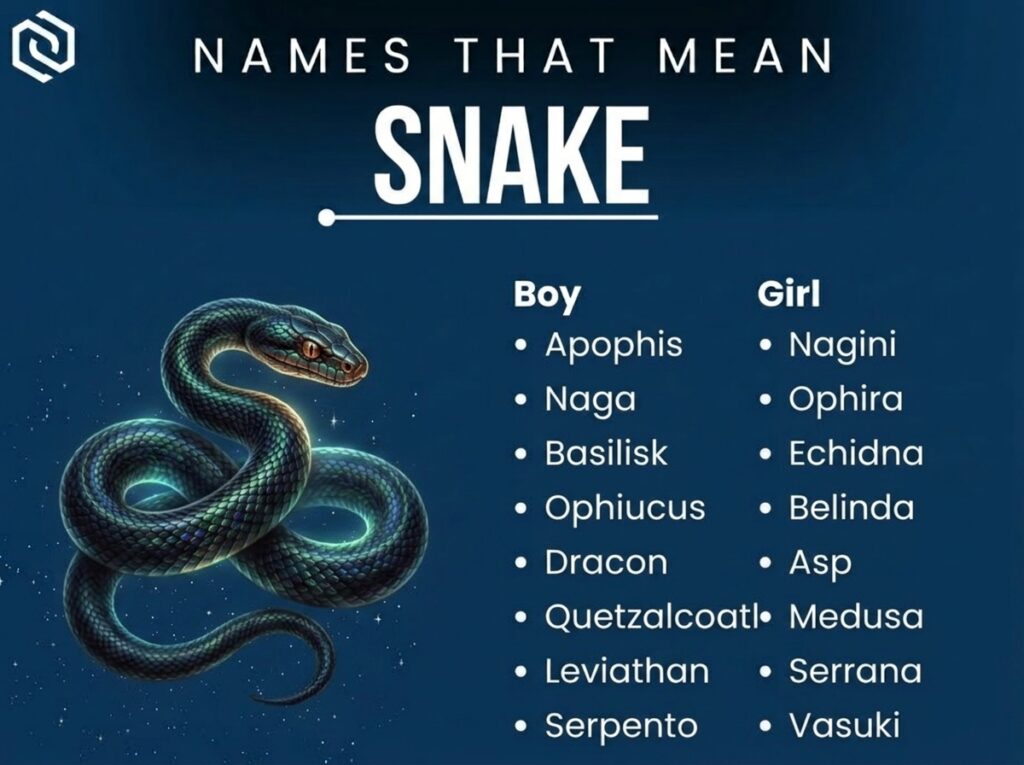
Some strong names that mean snake include Naga (Sanskrit for serpent deity), Hydra (Greek, the multi-headed water serpent), Apophis (Egyptian serpent of chaos), Vasuki (Hindu mythological serpent king), Medusa (Greek Gorgon with serpentine hair), Echidna (Greek mother of monsters, half-serpent), and Coatl (Aztec for serpent). These names come from real mythological and linguistic traditions where the snake symbolized power, wisdom, and transformation.
Girl Names That Mean Snake
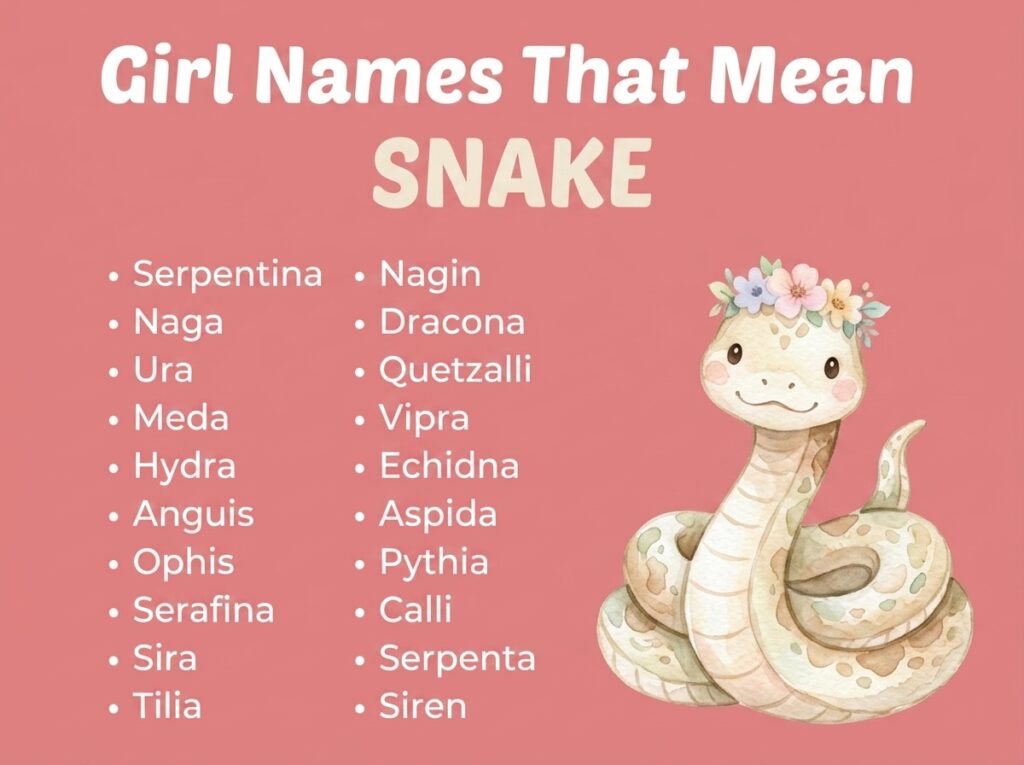
Serpent names for girls carry a magnetic quality that’s hard to pin down. They’re dark without being grim. Powerful without being aggressive. Many of them come from goddess traditions where female serpent figures ruled wisdom, healing, and the underworld. If you want a name with genuine mythological weight and a sound that lingers, this is a rich category.
| Name | Origin | Meaning | Pronunciation | Popularity |
|---|---|---|---|---|
| Medusa | Greek | “Guardian” — the Gorgon whose hair became serpents | meh-DOO-sah | Dark |
| Echidna | Greek | “She-viper,” mother of monsters, half-woman half-serpent | eh-KID-nah | Mystic |
| Naga | Sanskrit/Hindu | “Serpent” or “serpent deity,” a divine snake being | NAH-gah | Rare |
| Hydra | Greek | Multi-headed water serpent of Greek mythology | HY-drah | Dark |
| Apophis | Egyptian | The great serpent of chaos and darkness | ah-POH-fis | Unique |
| Vasanta | Sanskrit | Related to the serpent goddess tradition in Vedic lore | vah-SAHN-tah | Rare |
| Renenutet | Egyptian | Egyptian cobra goddess of fertility and harvest | reh-neh-NOO-tet | Mystic |
| Wadjet | Egyptian | The green cobra goddess, protector of Lower Egypt | WAD-jet | Mystic |
| Coatlicue | Aztec | “Serpent skirt” — the Aztec earth and death goddess | kwat-lee-KWAY | Dark |
| Serpentina | Latin | Feminine form of serpentinus, meaning “of the serpent” | ser-pen-TEE-nah | Unique |
| Lamia | Greek | A serpent-woman figure from Greek mythology | LAY-mee-ah | Dark |
| Aido | Fon/West African | From Aido-Hwedo, the rainbow serpent goddess | EYE-doh | Rare |
| Melusine | French/Medieval | A water spirit depicted as part serpent, part woman | meh-loo-ZEEN | Mystic |
| Nagi | Japanese/Sanskrit | Female form of Naga; serpent spirit | NAH-gee | Soft |
| Cessair | Irish Celtic | Associated with the serpent in early Irish mythological lore | KES-ir | Rare |
| Ananta | Sanskrit | “Infinite” — the name of the cosmic serpent Shesha who is also called Ananta | ah-NAN-tah | Mystic |
| Dracaena | Greek/Latin | “Female dragon or serpent” from drakaina | drah-KEE-nah | Unique |
| Coatl | Nahuatl/Aztec | “Serpent” — the raw Aztec word for snake | KOH-atl | Rare |
| Elaphe | Greek | From the genus of snakes; directly meaning “serpent kind” | EL-ah-fee | Unique |
| Naagin | Sanskrit/Hindi | “Female serpent” — used in South Asian folklore traditions | NAH-gin | Rare |
| Vipera | Latin | “Viper,” the Latin word for a venomous female serpent | vih-PEH-rah | Dark |
| Sesheta | Egyptian | Feminine variant related to Shesha, the cosmic serpent | seh-SHEH-tah | Mystic |
Boy Names That Mean Snake
Male serpent names tend to pull from warrior traditions and cosmic mythology. In Hindu texts, serpent kings ruled the underworld. In Norse mythology, the great serpent Jormungandr encircled the entire world. In Aztec tradition, Quetzalcoatl was the feathered serpent god of creation. These aren’t just creature names. They’re names built on ancient power.
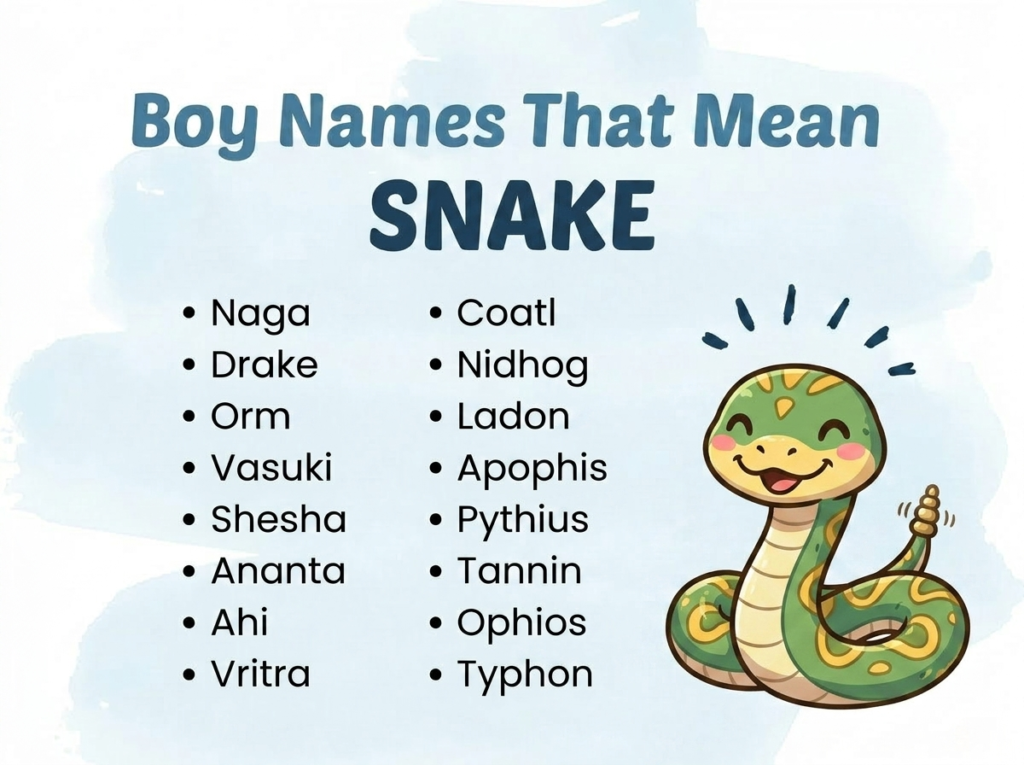
| Name | Origin | Meaning | Pronunciation | Popularity |
|---|---|---|---|---|
| Vasuki | Sanskrit/Hindu | King of the Nagas, the divine serpent in Hindu mythology | VAH-soo-kee | Mystic |
| Jormungandr | Norse | The world serpent of Norse mythology, son of Loki | YOR-mun-gahn-der | Dark |
| Quetzalcoatl | Aztec/Nahuatl | “Feathered serpent” — the great Mesoamerican creator god | ket-sal-koh-AHT-l | Mystic |
| Ophion | Greek | “Serpent” — the primordial snake-god of Greek orphic tradition | OH-fee-on | Rare |
| Naga | Sanskrit | “Serpent deity” — used as a masculine name in Hindu tradition | NAH-gah | Rare |
| Shesha | Sanskrit/Hindu | “Remainder” — the cosmic serpent who bears the universe on his hood | SHEH-shah | Mystic |
| Apophis | Egyptian | The great serpent of chaos who battles Ra each night | ah-POH-fis | Dark |
| Glycon | Greek | A serpent deity worshipped in the ancient Roman Empire | GLY-kon | Unique |
| Ophiuchus | Greek | “Serpent bearer” — the constellation associated with snake handling | oh-FEE-yoo-kus | Rare |
| Nahuatl | Aztec | Refers directly to the Nahuatl people whose name connects to serpent symbolism | nah-WAH-tl | Unique |
| Coluber | Latin | “Snake” or “serpent” — the classical Latin genus name for serpents | KOL-yoo-ber | Rare |
| Sarpanit | Akkadian | From Sarpa (serpent) tradition in Mesopotamian naming | sar-PAH-nit | Unique |
| Takshaka | Sanskrit | One of the nine Naga kings in Hindu epic the Mahabharata | tak-SHAH-kah | Mystic |
| Ketu | Sanskrit/Hindu | Associated with the serpent’s tail in Vedic astrology; the descending lunar node | KAY-too | Rare |
| Nahualli | Nahuatl | “Serpent spirit” or shapeshifter linked to snake forms | nah-WAHL-ee | Dark |
| Draco | Latin/Greek | “Dragon or serpent” — used in both senses in ancient texts | DRAY-koh | Trending |
| Orochi | Japanese | The eight-headed serpent of Japanese mythology (Yamata no Orochi) | oh-ROH-chee | Dark |
| Zahhak | Persian | A mythological king with serpents growing from his shoulders | ZAH-hak | Mystic |
| Sarpedon | Greek | Possibly derived from “serpent” roots in pre-Greek naming | sar-PEE-don | Unique |
| Ningizzida | Sumerian | “Lord of the good tree” — a Sumerian god depicted as a horned serpent | nin-giz-EE-dah | Rare |
| Ahi | Sanskrit/Vedic | “Serpent” — one of the oldest Vedic words for snake, used as a name | AH-hee | Rare |
| Glycas | Byzantine Greek | Linked to the serpent deity tradition of the Hellenistic period | GLY-kas | Unique |
Also Read: Names That Mean Dark for Girls and Boys Across Cultures
Unisex Names That Mean Snake
These names feel grounded in something old. Many gender-neutral serpent names come from places where the snake wasn’t gendered at all — it was simply a force. They tend to sound strong without leaning hard toward masculine or feminine. That balance is part of their appeal.
| Name | Origin | Meaning | Pronunciation | Popularity |
|---|---|---|---|---|
| Coatl | Nahuatl/Aztec | “Serpent” — the direct Aztec word for snake, used for all genders | KOH-atl | Unique |
| Naga | Sanskrit | “Serpent being” — used across genders in Hindu and Buddhist traditions | NAH-gah | Rare |
| Ophid | Greek | Derived from ophis, the Greek word for serpent | OH-fid | Unique |
| Sarpa | Sanskrit | “Serpent” — the Sanskrit root word for snake, used as a gender-neutral name | SAR-pah | Rare |
| Draco | Latin | “Dragon/serpent” — works across genders in modern naming culture | DRAY-koh | Trending |
| Nagin | Hindi/Sanskrit | “Serpent spirit” — used for both male and female figures in South Asian tradition | NAH-gin | Rare |
| Aido | Fon/West African | Rooted in Aido-Hwedo, the cosmic serpent in Fon mythology | EYE-doh | Mystic |
| Ahi | Vedic/Sanskrit | The ancient Vedic word for serpent, short and gender-neutral | AH-hee | Rare |
| Ophite | Greek | “Of the serpent” — a term used in early religious traditions | OH-fyt | Dark |
| Hydra | Greek | The multi-headed water serpent — used occasionally as a gender-neutral mythological name | HY-drah | Mystic |
Snake Names Across Cultures
The serpent appears in almost every ancient naming tradition on earth. That says something important. Whether it was a symbol of chaos in Egypt, divine wisdom in India, cosmic power in Norse mythology, or transformation in Mesoamerica, cultures couldn’t agree on much — but they all kept naming things after snakes. That level of cross-cultural presence makes this one of the most symbolically rich areas in name research.
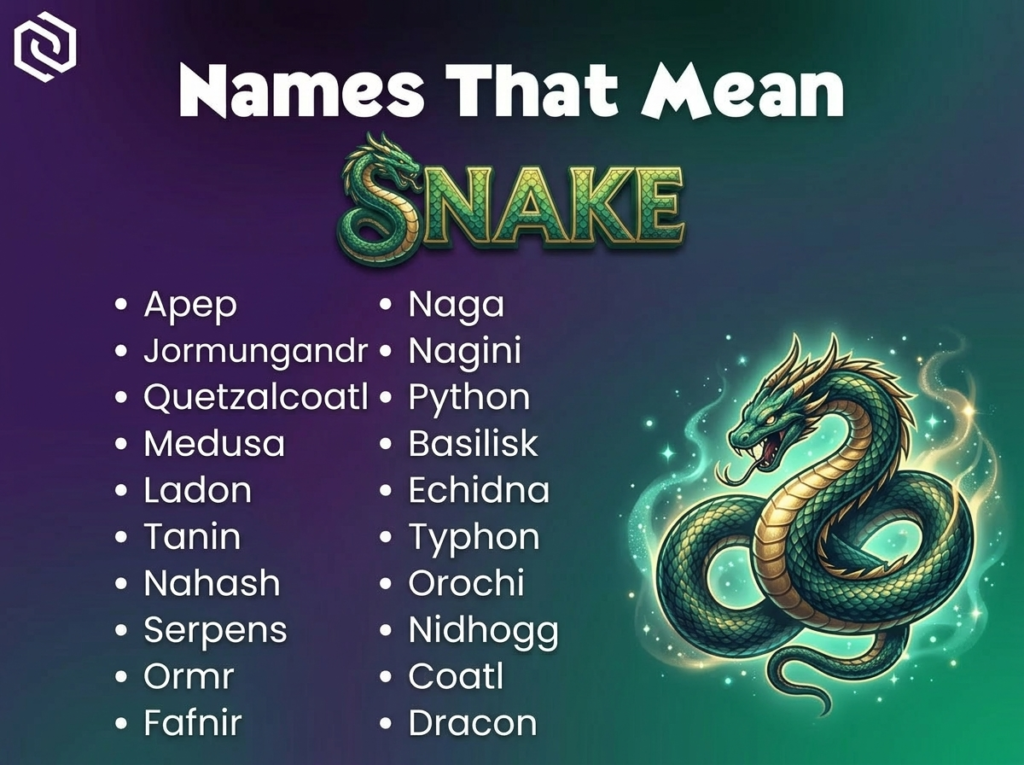
Greek Names That Mean Snake
Greek mythology gave us some of the most vivid serpent figures in Western tradition. The Gorgons, the Hydra, Ophion — all of them shaped how Europeans understood snake symbolism for centuries.
| Name | Meaning | Gender |
|---|---|---|
| Medusa | Gorgon with serpentine hair | Girl |
| Echidna | She-viper, mother of monsters | Girl |
| Hydra | Multi-headed water serpent | Unisex |
| Ophion | Primordial serpent god | Boy |
| Dracaena | Female serpent or dragon | Girl |
| Lamia | Serpent-woman of Greek myth | Girl |
| Ophiuchus | Serpent-bearer | Boy |
| Glycon | Serpent deity of the Hellenistic world | Boy |
Sanskrit & Hindu Names That Mean Snake
The Hindu tradition has more serpent names than almost any other culture. The Nagas are divine serpent beings. The cosmic serpent Shesha holds up the universe. Snake names in this tradition carry profound spiritual weight, not danger.
| Name | Meaning | Gender |
|---|---|---|
| Vasuki | King of the Nagas | Boy |
| Shesha | Cosmic serpent bearing the universe | Boy |
| Ananta | The infinite cosmic serpent | Girl |
| Naga | Serpent deity | Unisex |
| Takshaka | Naga king from the Mahabharata | Boy |
| Ahi | Ancient Vedic word for serpent | Unisex |
| Naagin | Female serpent spirit | Girl |
| Sarpa | Serpent | Unisex |
| Ketu | The serpent’s tail in Vedic astrology | Boy |
Egyptian Names That Mean Snake
In ancient Egypt, snakes were royal. The cobra appeared on the pharaoh’s crown. The goddess Wadjet was the patron of kings. Apophis was the chaos serpent who threatened the sun itself. Egyptian serpent names carry the weight of thousands of years of sacred tradition.
| Name | Meaning | Gender |
|---|---|---|
| Wadjet | Green cobra goddess, protector of Egypt | Girl |
| Apophis | Chaos serpent who battles Ra | Boy |
| Renenutet | Cobra goddess of fertility | Girl |
| Sesheta | Feminine form of the cosmic serpent | Girl |
| Mehen | The coiled serpent who protects Ra’s solar boat | Boy |
Aztec & Mesoamerican Names That Mean Snake
Nowhere in the ancient world was the serpent more central to divine tradition than in Mesoamerica. Snakes appear in creation myths, deity names, and royal titles throughout Aztec and Maya culture.
| Name | Meaning | Gender |
|---|---|---|
| Quetzalcoatl | Feathered serpent, creator god | Boy |
| Coatl | Serpent | Unisex |
| Coatlicue | Serpent skirt, earth/death goddess | Girl |
| Nahualli | Serpent spirit / shapeshifter | Boy |
| Mixcoatl | Cloud serpent, Aztec hunting god | Boy |
Norse & Germanic Names That Mean Snake
The Norse relationship with serpents was intense and cosmic. Jormungandr was literally the world-encircling serpent whose death triggers Ragnarok. These names feel heavy in the best way.
| Name | Meaning | Gender |
|---|---|---|
| Jormungandr | The world serpent | Boy |
| Fafnir | A dragon-serpent in Norse legend | Boy |
| Nidhogg | The serpent gnawing the world tree Yggdrasil | Boy |
Also Read: Names That Mean Demon From Every Culture and Mythology
Names That Mean Serpent Goddess
There’s a specific category of names that goes beyond just “snake” — these are names tied directly to divine feminine serpent figures. These names feel powerful in a way that’s specific and grounded. They’re not vaguely edgy. They carry real goddess energy from real historical traditions.
The difference between a name that means snake and a name that means serpent goddess is depth. These names come attached to stories of protection, fertility, cosmic power, and sacred wisdom.
- Wadjet — Egyptian cobra goddess, one of the oldest deities in Egyptian religion
- Renenutet — Egyptian cobra goddess of the harvest and nursing mothers
- Coatlicue — Aztec mother goddess clothed in a skirt of serpents
- Melusine — Medieval French serpent-woman, patron of the Lusignan dynasty
- Dracaena — Greek female serpent figure
- Lamia — Serpent queen of Greek mythology
- Echidna — The mother of all monsters, half-serpent half-woman
- Ananta — The infinite cosmic serpent in Hindu tradition, also called Shesha
- Naagin — South Asian folkloric female serpent spirit
- Aido — West African rainbow serpent goddess figure
Names That Mean Feathered Serpent
The feathered serpent is one of the most fascinating and specific archetypes in world mythology. It appears in Aztec, Maya, and other Mesoamerican traditions as a symbol of sky, earth, wisdom, and wind combined. These names lean into that elevated, dual-natured symbolism.
The feathered serpent represents the union of opposites. The serpent crawls the earth. The feather belongs to the sky. Together they create something transcendent, which is why these names feel different from other snake names.
- Quetzalcoatl — The Aztec feathered serpent god, meaning “quetzal feather snake”
- Kukulkan — The Maya equivalent of Quetzalcoatl, the feathered serpent deity
- Gucumatz — Another Maya feathered serpent name from the Popol Vuh
- Coatl — The serpent component of Quetzalcoatl’s name
- Ehecatl — The wind aspect of Quetzalcoatl; sometimes used as a name
- Quetzal — Refers to the sacred bird in the feathered serpent tradition
- Xiuhcoatl — “Turquoise serpent” in Nahuatl, a fire serpent weapon of the gods
Names That Mean World Serpent
Cosmic serpent names occupy their own category entirely. These are the serpents of myth who don’t just exist in the world — they define its edges. These names carry immense symbolic weight and a slightly forbidding power that some parents find deeply appealing.
If you’re drawn to the idea of a name that references something foundational and ancient, world serpent names deliver that in a way few others can.
- Jormungandr — Norse world serpent who encircles Midgard
- Shesha — The Hindu serpent who bears the world on his hoods
- Apophis — Egyptian chaos serpent who battles the sun
- Mehen — The coiling serpent that protects Ra’s solar boat
- Glycon — Ancient serpent deity of prophetic tradition
- Nidhogg — The serpent chewing the roots of Yggdrasil in Norse myth
- Leviathan — The biblical sea serpent of chaos and the deep
- Ananta — “Infinite” — the name of Shesha as the endless cosmic serpent
Also Read: Names That Mean Chaos From Ancient Mythology and Beyond
Naming Expert’s Note
Ophion deserves more attention than it gets. It’s a genuine Greek name meaning “serpent,” rooted in the Orphic tradition where Ophion was the original serpent-god who ruled the world before the Olympians. It’s short, sounds completely wearable today, and carries no cultural baggage. Unlike Medusa or Apophis, which read as heavy mythological statements, Ophion is subtle. Most people won’t immediately recognize its serpentine origin — which gives it that rare quality of being meaningful to the parents without being a conversation piece at every school pickup.
How to Choose the Right Snake Name
Sound matters first. A name like Vasuki or Jormungandr hits very differently than a name like Naga or Coatl. Think about your last name and whether the combination flows naturally. Short serpent names tend to pair well with longer last names, and vice versa.
Cultural origin matters too. Many of these names come from living religious and cultural traditions — Hindu, Aztec, Egyptian, Norse. If the name doesn’t connect to your family background, that’s not automatically a problem, but it’s worth understanding the full story before committing.
- Say it out loud with your last name at least ten times
- Check the initials spell nothing unintended
- Look into the full mythology behind the name, not just the surface meaning
- Consider what the name sounds like on a grown adult, not just a child
- Think about natural nicknames — does the name shorten to something you like?
- If rarity matters to you, check current birth data before choosing
Frequently Asked Questions
Q: What is the most popular name that means snake?
A: Draco is arguably the most widely recognized name with serpent roots in Western culture, derived from the Latin and Greek word for dragon or serpent. Naga is widely known across South and Southeast Asia. In mythological circles, Medusa and Quetzalcoatl are the most culturally prominent serpent names globally.
Q: What does snake mean in different languages?
A: The word for snake varies fascinatingly across languages. In Sanskrit it’s sarpa or naga. In Greek it’s ophis. In Latin it’s serpens or coluber. In Nahuatl (Aztec) it’s coatl. In Japanese, the word hebi refers to snakes, while orochi specifically means a great serpent. These roots directly inform the names in this article.
Q: What are some rare names that mean snake?
A: Some genuinely rare options include Ophion (Greek primordial serpent-god), Ahi (ancient Vedic word for serpent), Glycon (Hellenistic serpent deity), Nahualli (Aztec serpent spirit), and Renenutet (Egyptian cobra goddess). These are historically grounded names that almost no one is currently using, which makes them distinctive without being invented.
Q: What is a good middle name to pair with Naga?
A: Naga works well with one or two-syllable middle names that have a different energy. Naga Elise, Naga Ren, Naga James, or Naga Soleil all create interesting contrast. Because Naga is short and strong, it benefits from a middle name with some movement or softness to balance it.
Q: Are snake names still popular for babies?
A: Traditional snake names like Draco have seen real use, particularly after cultural touchstones like Harry Potter brought the name into mainstream awareness. Mythological serpent names more broadly — Medusa, Lamia, Echidna — are seeing renewed interest as parents look for names with genuine mythological depth. The trend toward meaningful, unusual names makes serpent names increasingly appealing.
Q: Is it okay to name a child after a serpent deity from another culture?
A: This is worth thinking about carefully. Names like Vasuki, Shesha, and Wadjet belong to living religious traditions — Hinduism and ancient Egyptian religion still influence people’s spiritual lives today. If you’re drawn to these names, spend time learning the full context. Many families from outside those traditions do use such names respectfully and with genuine appreciation for the culture. The key is intention and understanding, not just aesthetics.
Conclusion
Serpent names span nearly every ancient civilization that ever left records behind. From the coiling cosmic Shesha in Hindu tradition to the chaos-serpent Apophis in Egyptian myth, from the feathered Quetzalcoatl of the Aztecs to the world-encircling Jormungandr of Norse legend — the snake meant something profound everywhere it appeared. Names rooted in serpent symbolism carry that accumulated meaning. They signal transformation, wisdom, power, and the kind of ancient energy that most modern names simply can’t manufacture.
If you’re drawn to names with elemental mythological depth, you might also love exploring names that mean dragon across world mythology — another tradition where creature and cosmos intertwine in unforgettable ways.