Dragon surnames carry a weight that few family names can match. They trace back to medieval legends, ancient Chinese dynasties, and Eastern European folklore where the dragon symbolized raw power and protection. In many cultures, being linked to a dragon was a badge of honor.
These last names survived centuries of migration, war, and language shifts. Some families earned them as nicknames for fierce warriors or local leaders. Others inherited them from ancestors who lived near castles or mountains named after dragons. A dragon surname tells a story that stretches back generations.
Quick answer: names that mean dragon
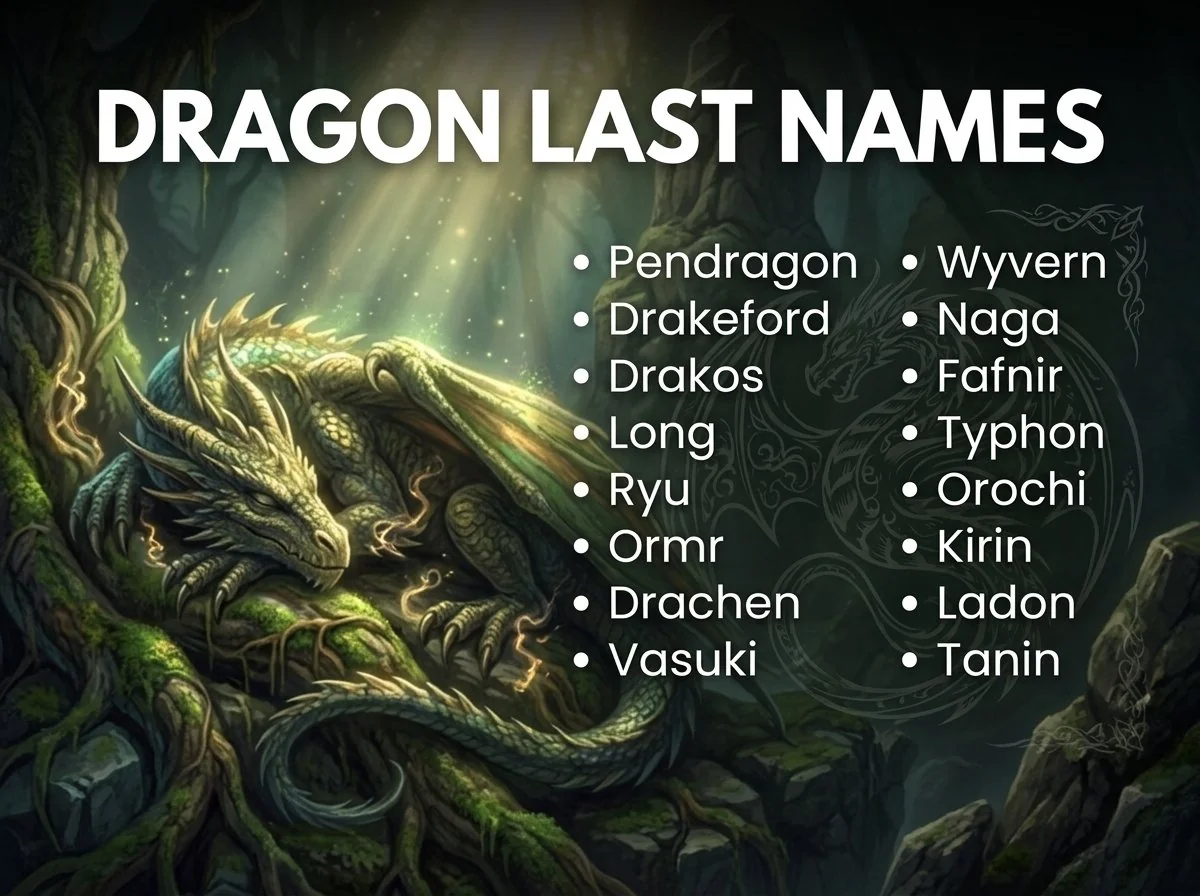
This guide lists 35+ names that mean dragon. Here are the top picks; tap any name to jump to its full entry with meaning and origin.
Most common origins: German. Also inside: names from Germanic and Greek traditions.
Also explore: Baby names that mean dragon · Japanese names that mean dragon. Part of our Mythology & Magic Names collection.
What Are Some Last Names That Mean Dragon?
Some of the most recognized last names that mean dragon include Drake (Old English), Drago (Italian), Long (Chinese), Ryu (Japanese), Dracul (Romanian), and Pendragon (Welsh). These surnames appear across European and Asian naming traditions, often originating as nicknames for brave warriors or families connected to dragon mythology and local legends.
Last Names That Mean Dragon
Surnames tied to dragons tend to sound bold and carry a certain gravity when spoken aloud. Many started as nicknames for people who fought with unusual ferocity or lived near landmarks associated with dragon legends. Others come directly from the word for dragon in languages like Chinese, Japanese, Romanian, and Greek. If you are exploring first names that mean dragon alongside family names, you will notice the same mythological roots running through both.
| Surname | Origin | Meaning | Notable Bearers | Popularity |
|---|---|---|---|---|
| Drake | English | Dragon (from Old English "draca") | Sir Francis Drake, English explorer | Classic |
| Dragon | French | Dragon (from Latin "draco") | French noble families | Rare |
| Drago | Italian | Dragon (from Latin "draco") | Billy Drago, American actor | Unique |
| Drache | German | Dragon (from Middle High German "drache") | German noble families | Rare |
| Drach | German / Ashkenazi | Dragon | Michael Drach, Danish mathematician | Dark |
| Drachman | German / Jewish | Dragon man | Ashkenazi Jewish families | Powerful |
| Drachmann | Danish / German | Dragon man | Holger Drachmann, Danish poet | Rare |
| Dracul | Romanian | The dragon (from Latin "draco") | Vlad II Dracul, Wallachian ruler | Dark |
| Drăculea | Romanian | Son of the dragon | Vlad III Drăculea (Vlad the Impaler) | Mystic |
| Pendragon | Welsh | Chief dragon, head dragon | Uther Pendragon, Arthurian legend | Powerful |
| Long | Chinese | Dragon (龙 / Lóng) | Long Yun, Chinese general | Classic |
| Lung | Chinese (Cantonese) | Dragon (龍) | Cantonese diaspora families | Rare |
| Ryu | Japanese | Dragon (龍 / 竜) | Ryu Murakami, Japanese author | Trending |
| Drakos | Greek | Dragon, serpent (from "drakon") | Greek families | Unique |
| Dracopoulos | Greek | Son of the dragon | Greek families | Rare |
| Sárkány | Hungarian | Dragon | Hungarian noble families | Rare |
| Drachenfels | German | Dragon rock | Siegfried von Drachenfels, legendary knight | Mystic |
| Drachenberg | German | Dragon mountain | German noble families | Rare |
| Drakes | English | Dragon (variant of Drake) | English landed families | Classic |
| Drăculești | Romanian | Of the dragon house | House of Drăculești, Wallachian dynasty | Dark |
Dragon Surnames Across Cultures
The dragon appears in nearly every major mythology on Earth, which explains why dragon surnames show up from Wales to southern China. Each culture shaped the dragon differently. European dragons were often fearsome beasts to be conquered, while East Asian dragons represented wisdom, rainfall, and imperial authority. That contrast shows up clearly in how these surnames were formed and who carried them.
Germanic Surnames That Mean Dragon
Germanic languages gave us some of the most literal dragon surnames. The Middle High German word "drache" produced a whole family of compound names tied to geography and folklore.
| Surname | Meaning | Region |
|---|---|---|
| Drache | Dragon | Germany |
| Drach | Dragon | Germany, Austria |
| Drachman | Dragon man | Germany, Jewish communities |
| Drachmann | Dragon man | Denmark, Germany |
| Drachenfels | Dragon rock | Rhineland, Germany |
| Drachenberg | Dragon mountain | Germany |
Romanian Surnames That Mean Dragon
Romania has perhaps the most famous dragon surname lineage in the world, thanks to the House of Drăculești and the legend of Vlad the Impaler. The Latin root "draco" evolved into distinctly Romanian forms.
| Surname | Meaning | Region |
|---|---|---|
| Dracul | The dragon | Wallachia |
| Drăculea | Son of the dragon | Wallachia, Transylvania |
| Drăculești | Of the dragon house | Wallachia |
| Dragon | Dragon (borrowed form) | Transylvania |
East Asian Surnames That Mean Dragon
In Chinese and Japanese naming traditions, the dragon is a deeply auspicious symbol. The Chinese surname Long (龙) is one of the most common surnames in the world, carried by millions of families. For more on given names from this tradition, explore Japanese names that mean dragon.
| Surname | Meaning | Region |
|---|---|---|
| Long | Dragon | China (Mandarin) |
| Lung | Dragon | China (Cantonese) |
| Ryu | Dragon | Japan |
| Ryū | Dragon (alternate romanization) | Japan |
Greek Surnames That Mean Dragon
The Greek word "drakon" originally meant serpent or large snake before it evolved into the broader dragon concept. Greek surnames carrying this root often use the patronymic "-poulos" ending.
| Surname | Meaning | Region |
|---|---|---|
| Drakos | Dragon, serpent | Greece |
| Dracopoulos | Son of the dragon | Greece, Peloponnese |
| Drakon | Dragon | Ancient Greece |
Dragon mythology is rich with subtypes and related creatures. Some surnames reference specific kinds of dragons or the serpentine beings that inspired dragon legends in the first place. These names tend to be rarer but carry equally strong mythological weight.
Surnames That Mean Serpent
The original Greek "drakon" meant serpent before it came to mean dragon. Several surnames preserve this older, snakelike meaning. In many ancient traditions, the line between serpent and dragon was thin.
- Drakos (Greek)
- Drakon (Greek)
- Dracopoulos (Greek)
- Serpente (Italian, meaning serpent)
- Serpent (French)
- Wurm (German, meaning serpent or wyrm)
- Wurms (German variant)
- Orm (Old Norse, meaning serpent)
- Orme (English, from Old Norse)
- Lindworm (German, a wingless dragon type)
Surnames Connected to Dragon Places
Many dragon surnames originated not from the creature itself but from places named after dragons. A family living near Drachenfels castle in Germany, for instance, might eventually take that name.
- Drachenfels (German, dragon rock)
- Drachenberg (German, dragon mountain)
- Drachenhausen (German, dragon houses)
- Drakenburg (German/Dutch, dragon fortress)
- Drakenstein (Dutch/Afrikaans, dragon stone)
- Pendragon (Welsh, chief dragon, also a place reference)
- Dragonara (Italian, from place names)
- Dragoș (Romanian, from place names)
- Drakelow (English, dragon hill)
- Draycott (English, possibly dragon cottage)
Surnames That Mean Wyrm or Wyvern
The wyrm and wyvern are specific dragon types from Germanic and English folklore. The wyrm is a legless serpent-dragon, while the wyvern has two legs and wings. Surnames from these roots are extremely rare.
- Wyrm (Old English)
- Wurm (German)
- Wurms (German)
- Wyvern (English, very rare)
- Lindworm (German/Scandinavian)
- Orm (Old Norse)
- Orme (English)
- Guivre (French, a heraldic wyvern)
- Vouivre (French, regional variant)
- Tatzelwurm (German, Alpine dragon creature)
How to Choose the Right Dragon Surname
Sound matters more with surnames than most people realize. A name like Drake flows easily with almost any first name, while something like Drachenfels demands a shorter given name to avoid sounding overwhelming. Say the full name out loud several times before settling on it.
Cultural connection is equally important. If your family has Romanian roots, Dracul carries genuine heritage. If you are drawn to East Asian traditions, Long or Ryu may feel more authentic. Matching the surname to your actual background gives it meaning beyond the surface.
- Say the full name out loud with your chosen first name
- Check how the initials look written down
- Research the specific cultural origin before committing
- Consider how the name sounds in professional and casual settings
- Look into whether the surname has alternate meanings in other languages
- Check current rarity if you want something that stands out or blends in
Frequently Asked Questions
What is the most common last name that means dragon?
The Chinese surname Long (龙) is by far the most common dragon surname in the world, carried by millions of families across China and the Chinese diaspora. In English-speaking countries, Drake is the most widely recognized surname with dragon origins.
What does the surname Drake actually mean?
Drake comes from the Old English word "draca," meaning dragon. However, it also developed independently from a word meaning male duck. The dragon meaning is the older and more mythologically significant of the two. Sir Francis Drake is the most famous historical bearer.
Are there any Japanese last names that mean dragon?
Yes. Ryu (龍 or 竜) is a Japanese surname that directly means dragon. It appears in both historical and modern Japanese families. The kanji character used can vary, which slightly shifts the visual meaning while keeping the dragon connection intact.
What is the origin of the surname Dracul?
Dracul comes from the Romanian word for dragon, derived from the Latin "draco." The most famous bearer was Vlad II Dracul, a 15th-century ruler of Wallachia. His son Vlad III became known as Drăculea, meaning "son of the dragon," which later inspired the name Dracula.
Are dragon surnames still used today?
Absolutely. Drake, Long, and Ryu are all active surnames used by living families worldwide. Rarer names like Drachenfels and Sárkány still exist but are far less common. Dragon surnames have proven remarkably durable across centuries of cultural change.
What is a good first name to pair with a dragon surname?
Short, strong first names tend to pair best with bold dragon surnames. For example, "Leo Drake" or "Mia Long" sound balanced and natural. If the surname is longer, like Drachenfels, a one-syllable first name like "Kai" or "Eve" keeps the full name from feeling heavy.
The final word
Dragon surnames span more cultures and centuries than most people expect. From the battlefields of medieval Wallachia to the imperial courts of ancient China, families have carried the dragon in their names as a mark of strength, protection, and legacy. These names endure because the dragon itself endures in human imagination. If you want to explore more mythological family names, consider reading about last names that mean fire for a similarly powerful naming tradition.
Sources & further reading
Name meanings can differ between languages, spellings and sources. These independent references are worth checking alongside this guide, and our research approach explains how we work.
- Behind the Name: SurnamesMeaning, origin and history of surnames, with usage statistics.
- Behind the Name: Surnames by meaningA reverse dictionary that lists family names by what they mean.
- Behind the Name: Most common surnamesLists of the most common surnames in different countries.
Reference links last checked September 2026.
Names that mean dragon in other styles:
More in Last Names Meaning:
- 45+ Surnames Meaning Freedom (With Meanings)
- 55+ Surnames Meaning Angel (With Meanings)
- 40+ Surnames Meaning Night (With Meanings)
- 35+ Surnames Meaning Death (With Meanings)
- 45+ Surnames Meaning Ocean (With Meanings)
- 40+ Surnames Meaning Wolf (With Meanings)
- 50+ Surnames Meaning Love (With Meanings)
- 55+ Surnames Meaning Royalty (With Meanings)
Browse everything in Mythology & Magic Names.