In Japanese naming tradition, the sun carries deep spiritual weight. The sun goddess Amaterasu sits at the center of Shinto belief, and her presence echoes through centuries of art, literature, and daily life. This reverence naturally flows into how parents name their children. Kanji like 日 (hi) and 陽 (yō) appear in names that connect a child to warmth, clarity, and the promise of each new morning. Japanese names that mean sun range from the quietly traditional to the distinctly modern, and every one holds a brightness that feels both grounded and full of life.
Quick answer: names that mean sun
This guide lists 60+ names that mean sun. Here are the top picks; tap any name to jump to its full entry with meaning and origin.
Girl names
Boy names
Most common origins: Japanese.
Also explore: Baby names that mean sun · Last names that mean sun. Part of our Celestial & Time Names collection.
What are some Japanese names that mean sun?
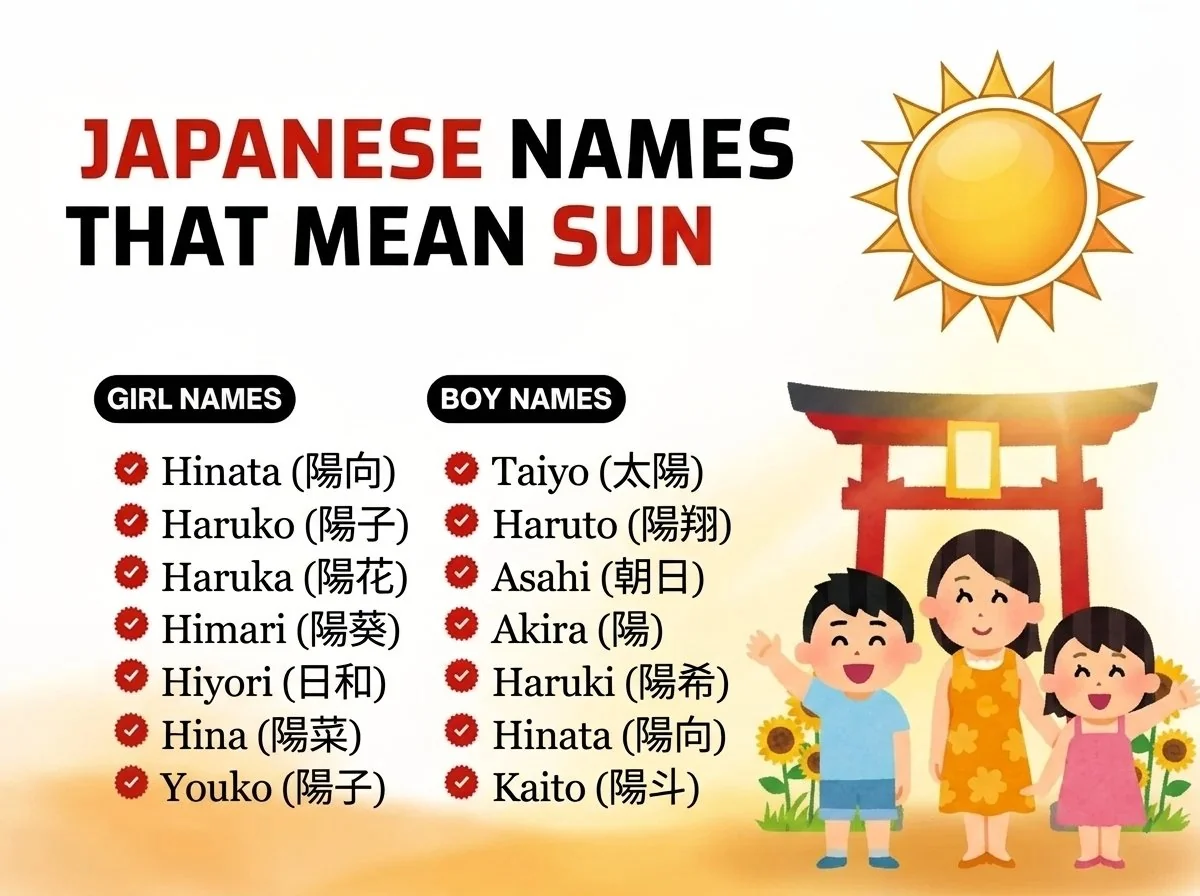
Popular Japanese names that mean sun include Hinata (sunny place), Asahi (morning sun), Haruki (sun and radiance), and Yōko (sun child). These names typically use the kanji 日 or 陽, both of which directly translate to sun. The sun holds special significance in Japanese culture through the Shinto goddess Amaterasu, making these names both meaningful and deeply rooted in tradition.
Japanese Girl Names That Mean Sun
Sun names for girls in Japan tend to feel warm and gentle without being overly delicate. Many pair the sun kanji with nature elements like flowers, seasons, or greenery, creating names that feel alive and grounded. These names have grown steadily more popular in recent decades as modern Japanese parents move toward brighter, more optimistic meanings.
| Name | Origin | Meaning | Pronunciation | Popularity |
|---|---|---|---|---|
| Himari | Japanese | Sun, hollyhock | HEE-mah-ree | Trending |
| Hina | Japanese | Sun, greens | HEE-nah | Classic |
| Hinata | Japanese | Sunny place | HEE-nah-tah | Trending |
| Hiyori | Japanese | Fine sunny weather | HEE-yoh-ree | Soft |
| Yōko | Japanese | Sun child | YOH-koh | Classic |
| Asahi | Japanese | Morning sun | AH-sah-hee | Powerful |
| Haruhi | Japanese | Spring sun | HAH-roo-hee | Unique |
| Nichika | Japanese | Sun, flower | NEE-chee-kah | Rare |
| Haruna | Japanese | Sun, greens | HAH-roo-nah | Trending |
| Yōka | Japanese | Sun, flower | YOH-kah | Soft |
| Himawari | Japanese | Sunflower | HEE-mah-wah-ree | Unique |
| Haru | Japanese | Sun, spring | HAH-roo | Classic |
| Kohinata | Japanese | Little sunny place | koh-HEE-nah-tah | Rare |
| Nichiyo | Japanese | Sun, sunshine | NEE-chee-yoh | Rare |
| Yōna | Japanese | Sun, apple tree | YOH-nah | Unique |
Japanese Boy Names That Mean Sun
Boy names with sun meanings in Japanese often pair 陽 or 日 with kanji suggesting strength, flight, or clarity. The result is names that feel open and confident. Many of these have surged in popularity over the last twenty years, especially Haruto and Haruki, which now rank among the most chosen boy names in Japan.
| Name | Origin | Meaning | Pronunciation | Popularity |
|---|---|---|---|---|
| Haruki | Japanese | Sun, radiance | HAH-roo-kee | Trending |
| Haruto | Japanese | Sun, soar | HAH-roo-toh | Trending |
| Asahi | Japanese | Morning sun | AH-sah-hee | Powerful |
| Yōhei | Japanese | Sun, peace | YOH-hey | Classic |
| Yōsuke | Japanese | Sun, assist | YOH-soo-keh | Classic |
| Yōta | Japanese | Sun, great | YOH-tah | Trending |
| Haruhiko | Japanese | Sun, prince | HAH-roo-hee-koh | Rare |
| Hinata | Japanese | Sun-facing | HEE-nah-tah | Soft |
| Taiyō | Japanese | The sun | TAH-ee-yoh | Powerful |
| Yōichi | Japanese | Sun, first | YOH-ee-chee | Classic |
| Haru | Japanese | Sun | HAH-roo | Classic |
| Nichirō | Japanese | Sun, clear | NEE-chee-roh | Rare |
| Haruma | Japanese | Sun, truth | HAH-roo-mah | Unique |
| Yōji | Japanese | Sun, second | YOH-jee | Classic |
| Hiaki | Japanese | Sun, bright | HEE-ah-kee | Rare |
Japanese Unisex Names That Mean Sun
Some of the most versatile sun names in Japanese work beautifully across genders. These tend to be shorter, often just two syllables, and rely on a single strong kanji. Their simplicity gives them a clean, modern feel that suits any child. Names like Hinata and Asahi have become genuinely unisex in contemporary Japan, appearing on birth certificates for boys and girls alike.
| Name | Origin | Meaning | Pronunciation | Popularity |
|---|---|---|---|---|
| Hinata | Japanese | Sunny place | HEE-nah-tah | Trending |
| Asahi | Japanese | Morning sun | AH-sah-hee | Powerful |
| Haru | Japanese | Sun, spring | HAH-roo | Classic |
| Hiyori | Japanese | Sunny weather | HEE-yoh-ree | Soft |
| Yō | Japanese | Sun, positive | YOH | Rare |
| Harumi | Japanese | Sun, beauty | HAH-roo-mee | Classic |
| Akira | Japanese | Bright sun | AH-kee-rah | Classic |
| Hikaru | Japanese | Sunlight | HEE-kah-roo | Trending |
| Haruka | Japanese | Sun, distant | HAH-roo-kah | Soft |
| Nichi | Japanese | Sun, day | NEE-chee | Rare |
The Cultural Roots of Japanese Sun Names
The sun is not just a celestial body in Japanese culture. It is a deity, a national symbol, and a daily presence in the language itself. Japan's very name, 日本 (Nihon), translates to "origin of the sun." This deep connection explains why sun-related kanji appear so frequently in personal names, family names, and place names throughout the country. Understanding the layers behind these names helps you choose one with real meaning.
Names Using the 日 (Hi/Nichi) Kanji
The kanji 日 is the most direct representation of the sun in Japanese. It also means "day," which gives names a double layer of warmth and time. Names built on this kanji tend to feel traditional and grounded.
| Name | Meaning | Gender |
|---|---|---|
| Asahi | Morning sun | Unisex |
| Haruhi | Spring sun | Girl |
| Nichika | Sun flower | Girl |
| Nichirō | Sun, clear | Boy |
| Hiyori | Sunny weather | Unisex |
| Nichiyo | Sunshine | Girl |
| Hiaki | Sun, bright | Boy |
| Nichi | Sun, day | Unisex |
| Kohinata | Little sunny place | Girl |
| Himawari | Sunflower | Girl |
Names Using the 陽 (Yō/Haru) Kanji
The kanji 陽 carries a softer, more expansive meaning. It refers to sunlight, warmth, and positive energy. Names using this character often feel modern and optimistic. This is the kanji behind many of the most popular contemporary Japanese sun names.
| Name | Meaning | Gender |
|---|---|---|
| Haruki | Sun, radiance | Boy |
| Haruto | Sun, soar | Boy |
| Yōko | Sun child | Girl |
| Yōta | Sun, great | Boy |
| Himari | Sun, hollyhock | Girl |
| Haruna | Sun, greens | Girl |
| Yōhei | Sun, peace | Boy |
| Haruma | Sun, truth | Boy |
| Yōna | Sun, apple tree | Girl |
| Harumi | Sun, beauty | Unisex |
Shinto Mythology and Sun Names
The Shinto sun goddess Amaterasu Ōmikami is the most important deity in the Japanese pantheon. According to mythology, she was born from the left eye of the creator god Izanagi and went on to illuminate the world. Her name itself contains the root "ama" (heaven) and "terasu" (to shine). While Amaterasu is not used as a personal name, her legacy shapes the reverence behind every sun name in Japan. The imperial family traces its lineage directly to her, which gives sun-related names a quiet sense of nobility and continuity.
Names That Mean Morning Sun
Morning sun names carry a specific kind of hope. They suggest beginnings, fresh starts, and the quiet power of a new day. In Japanese, the combination of 朝 (asa, morning) with 日 (hi, sun) creates this meaning directly.
- Asahi (朝日)
- Asahiko (朝日彦)
- Asahina (朝日菜)
- Asahiyo (朝日陽)
- Chōyō (朝陽)
- Reiji (黎明)
- Akatsuki (暁)
- Shinonome (東雲)
- Asaka (朝香)
- Asato (朝陽)
Names That Mean Sunshine and Warmth
Sunshine names go beyond the literal sun to capture the feeling of warmth and clear skies. These names often use 陽 (yō) or 和 (wa, harmony) to evoke gentle, radiant weather rather than the sun as an object.
- Hiyori (日和)
- Yōka (陽花)
- Haruka (陽香)
- Yōsei (陽晴)
- Haruno (陽野)
- Yōko (陽子)
- Harue (陽恵)
- Yōta (陽太)
- Harumi (陽実)
- Yōhei (陽平)
Names That Mean Sunlight and Radiance
Sunlight names focus on the glow and brightness the sun produces rather than the sun itself. These names often blend sun kanji with characters meaning light, shine, or brilliance, creating a layered solar meaning.
- Hikaru (陽)
- Haruki (陽輝)
- Akira (陽)
- Kōyō (光陽)
- Teru (照)
- Teruko (照子)
- Haruaki (陽明)
- Yōki (陽輝)
- Nichika (日花)
- Haruhiko (陽彦)
How to Choose the Right Japanese Sun Name
Sound matters more than most parents expect. A name like Haruki flows easily in English and Japanese alike, while Nichirō may require more explanation. Think about how the name pairs with your family's last name and whether it feels natural to say out loud in your daily life.
Cultural connection is equally important. If your family has Japanese heritage, a traditional name like Yōko or Yōhei may feel right. If you are drawn to Japanese culture from the outside, choosing a well-known name with clear meaning shows respect and intention.
- Say the full name out loud several times before deciding
- Check how the initials look written down
- Think about natural nicknames your child might adopt
- Research the specific kanji behind the name you love
- Consider how the name sounds on both a child and an adult
- Look up current popularity in Japan if you want something less common
Frequently Asked Questions
What is the most popular Japanese name that means sun?
Haruto (陽翔) and Himari (陽葵) consistently rank among the most popular baby names in Japan, and both carry direct sun meanings through the 陽 kanji. For unisex options, Hinata (日向) has seen a major surge in recent years.
What does sun mean in Japanese naming tradition?
The sun in Japanese names is represented primarily by two kanji: 日 (hi/nichi), meaning "sun" or "day," and 陽 (yō/haru), meaning "sunlight" or "positive energy." Both connect to the Shinto sun goddess Amaterasu and carry associations with warmth, clarity, and new beginnings.
What are some rare Japanese sun names?
Nichirō (日朗, sun and clear), Nichika (日花, sun flower), and Kohinata (小日向, little sunny place) are all genuinely rare choices. They use authentic sun kanji but appear infrequently on modern birth registrations, making them distinctive without being invented.
What is a good middle name to pair with Hinata?
Hinata pairs well with short, soft middle names. Hinata Ren, Hinata Sora, or Hinata Yuki all flow naturally. If you want a non-Japanese middle name, Hinata James or Hinata Rose work surprisingly well because the three-syllable first name balances a single-syllable middle.
Are Japanese sun names still popular?
Yes. Sun-related names remain extremely popular in Japan. The 陽 kanji has been one of the top choices for baby names over the last decade. Names like Haruto, Haruki, and Himari regularly appear in Japan's annual top ten baby name rankings.
Are there Japanese last names that mean sun?
Yes. Several Japanese surnames contain sun kanji. Hinata (日向), Asahi (朝日), and Hioka (日岡) are all real family names with direct sun meanings. These surnames often originated from place names describing sunny geographic features. You can explore more last names that mean sun across different cultures.
The final word
Japanese sun names offer a remarkable range, from the gentle warmth of Hiyori to the bold clarity of Taiyō. Whether you choose a name built on the traditional 日 kanji or the modern brightness of 陽, you are connecting your child to one of the oldest and most respected symbols in Japanese culture. The sun has meant hope and renewal across every era of Japanese history, and these names carry that same quiet confidence into the future. If you are exploring other celestial meanings, you might also enjoy Japanese names that mean star.
Sources & further reading
Name meanings can differ between languages, spellings and sources. These independent references are worth checking alongside this guide, and our research approach explains how we work.
- Behind the Name: names with the meaning “sun”Given names from many languages that share this meaning.
- Behind the Name: Japanese given namesA browsable list of Japanese given names with their meanings.
- Wikipedia: NanoriWhy the same kanji can be read several ways in names.
Reference links last checked September 2026.
Names that mean sun in other styles:
More in Japanese Names Meaning:
- 60+ Japanese Names Meaning Star (With Meanings)
- 40+ Japanese Names Meaning Space (With Meanings)
- 65+ Japanese Names Meaning Red (With Meanings)
- 50+ Japanese Names Meaning Hope (With Meanings)
- 65+ Japanese Names Meaning Beauty (With Meanings)
- 55+ Japanese Names Meaning Dark (With Meanings)
- 60+ Japanese Names Meaning Earth (With Meanings)
- 50+ Japanese Names Meaning Water (With Meanings)
Browse everything in Celestial & Time Names.