Red holds a special place in Japanese culture. It shows up on torii gates, in festival decorations, and woven into centuries of art and poetry. The color symbolizes energy, protection, and life force. So it makes sense that Japanese parents have long chosen names carrying shades of red, from soft madder tones to bold vermilion.
The beauty of Japanese naming is that meaning lives in the kanji. Two names can sound identical but carry completely different meanings depending on the characters chosen. When it comes to red, four main kanji open up a surprisingly rich set of options.
Quick answer: names that mean red
This guide lists 65+ names that mean red. Here are the top picks; tap any name to jump to its full entry with meaning and origin.
Girl names
Boy names
Most common origins: Japanese.
Also explore: Baby names that mean red. Part of our Color & Gem Names collection.
What Japanese names mean red?
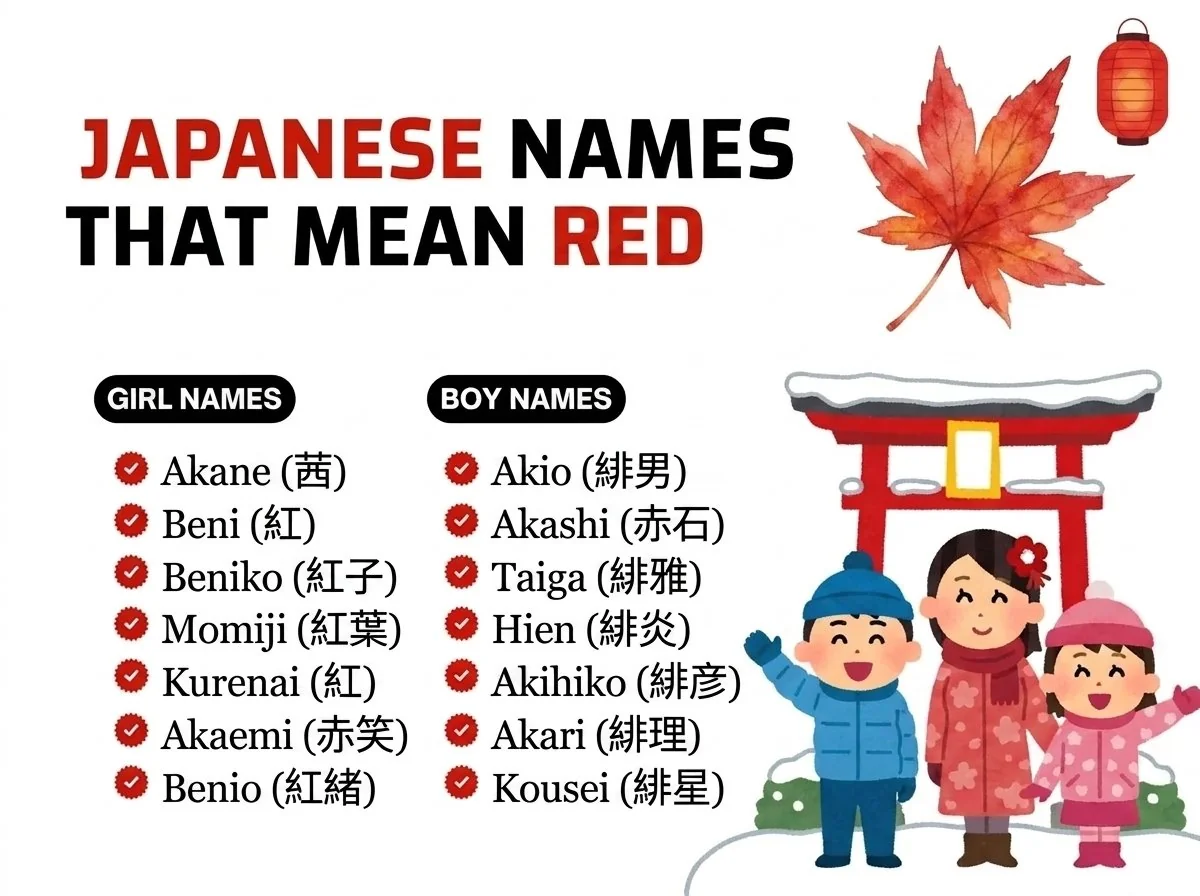
Some of the most authentic Japanese names meaning red include Akane (madder red), Kurenai (crimson), Beni (crimson), Akemi (vermilion beauty), Shu (vermilion), Akito (vermilion person), and Tan (cinnabar red). These names draw from four traditional kanji for red, each carrying a slightly different shade and cultural association rooted in Japanese dyeing traditions, nature, and folklore.
Japanese Girl Names That Mean Red
Red-toned names for girls in Japan tend to feel warm and grounded rather than flashy. Many trace back to the natural dyes and pigments used in traditional textile work, giving them a quiet, artisan quality. Names built with the kanji 茜 (akane) or 紅 (beni) are especially beloved because they connect to specific plants and colors found in the Japanese landscape.
| Name | Origin | Meaning | Pronunciation | Popularity |
|---|---|---|---|---|
| Akane | Japanese | Madder red | ah-KAH-neh | Trending |
| Kurenai | Japanese | Crimson | koo-reh-NAI | Classic |
| Beni | Japanese | Crimson | BEH-nee | Classic |
| Akemi | Japanese | Vermilion beauty | ah-KEH-mee | Classic |
| Beniko | Japanese | Crimson child | BEH-nee-koh | Rare |
| Shuko | Japanese | Vermilion child | SHOO-koh | Rare |
| Akako | Japanese | Red child | ah-KAH-koh | Rare |
| Shuka | Japanese | Vermilion flower | SHOO-kah | Unique |
| Akano | Japanese | Vermilion field | ah-KAH-noh | Rare |
| Shuna | Japanese | Vermilion grace | SHOO-nah | Soft |
| Akina | Japanese | Vermilion greens | ah-KEE-nah | Trending |
| Kōko | Japanese | Crimson child | KOH-koh | Unique |
| Akaho | Japanese | Red grain | ah-KAH-hoh | Rare |
| Shuri | Japanese | Vermilion village | SHOO-ree | Soft |
| Akitsu | Japanese | Vermilion harbor | ah-KEE-tsoo | Rare |
Japanese Boy Names That Mean Red
Red names for boys in Japanese are less common than their feminine counterparts, which makes them feel distinctive and bold. Most rely on the kanji 朱 (shu), meaning vermilion, a bright orange-red pigment historically associated with shrine gates and imperial lacquerware. These names carry a sense of strength and visibility without being aggressive.
| Name | Origin | Meaning | Pronunciation | Popularity |
|---|---|---|---|---|
| Shu | Japanese | Vermilion | SHOO | Powerful |
| Akito | Japanese | Vermilion person | ah-KEE-toh | Trending |
| Akihiko | Japanese | Vermilion boy | ah-kee-HEE-koh | Classic |
| Akio | Japanese | Vermilion man | ah-KEE-oh | Classic |
| Shuji | Japanese | Vermilion administrator | SHOO-jee | Rare |
| Shuhei | Japanese | Vermilion peace | SHOO-hey | Soft |
| Shuta | Japanese | Vermilion, big | SHOO-tah | Unique |
| Tan | Japanese | Cinnabar red | TAHN | Rare |
| Akamaru | Japanese | Red circle | ah-KAH-mah-roo | Rare |
| Akira | Japanese | Vermilion (with 朱 kanji) | ah-KEE-rah | Classic |
| Shun | Japanese | Vermilion (with 朱 kanji) | SHOON | Trending |
| Kō | Japanese | Crimson | KOH | Powerful |
| Aka | Japanese | Red | AH-kah | Rare |
| Shō | Japanese | Vermilion | SHOH | Unique |
| Akimasa | Japanese | Vermilion righteousness | ah-kee-MAH-sah | Rare |
Japanese Unisex Names That Mean Red
Gender-neutral red names in Japanese tend to be short, often just one or two syllables. This brevity gives them a modern, clean feel that works well in any context. Many of these names use the kanji 紅 (crimson) or 朱 (vermilion) on their own, without the gendered suffixes like -ko (child) or -hiko (boy) that signal a specific gender.
| Name | Origin | Meaning | Pronunciation | Popularity |
|---|---|---|---|---|
| Kurenai | Japanese | Crimson | koo-reh-NAI | Classic |
| Beni | Japanese | Crimson | BEH-nee | Classic |
| Shu | Japanese | Vermilion | SHOO | Powerful |
| Tan | Japanese | Cinnabar red | TAHN | Rare |
| Aka | Japanese | Red | AH-kah | Rare |
| Kō | Japanese | Crimson | KOH | Unique |
| Akira | Japanese | Vermilion (with 朱 kanji) | ah-KEE-rah | Classic |
| Ren | Japanese | Crimson lotus | REHN | Trending |
| Shun | Japanese | Vermilion (with 朱 kanji) | SHOON | Trending |
| Akane | Japanese | Madder red | ah-KAH-neh | Trending |
The Four Kanji Behind Japanese Red Names
Japanese does not have just one word for red. The language distinguishes between several shades, and each shade carries its own cultural weight. Understanding these four kanji will help you pick a name with the exact tone you want.
赤 (Aka) Names: The Purest Red
This is the most basic and direct kanji for red. It appears in everyday language and is the first red a Japanese child learns. Names using 赤 tend to be old-fashioned and straightforward. They feel honest and unadorned.
| Name | Meaning | Gender |
|---|---|---|
| Aka | Red | Unisex |
| Akako | Red child | Girl |
| Akamaru | Red circle | Boy |
| Akaho | Red grain | Girl |
| Akaha | Red feather | Unisex |
紅 (Beni/Kurenai) Names: Deep Crimson
The kanji 紅 refers to a rich, deep crimson. It originally described the color extracted from safflower petals, a dye so valuable it was once reserved for the nobility. Names with this kanji feel luxurious and layered.
| Name | Meaning | Gender |
|---|---|---|
| Kurenai | Crimson | Unisex |
| Beni | Crimson | Unisex |
| Beniko | Crimson child | Girl |
| Kōko | Crimson child | Girl |
| Kō | Crimson | Unisex |
| Ren | Crimson lotus | Unisex |
朱 (Shu) Names: Bright Vermilion
Vermilion is the vivid orange-red you see on torii gates at Shinto shrines. The kanji 朱 carries spiritual and protective associations in Japanese culture. Names built with this character feel bright, confident, and slightly sacred.
| Name | Meaning | Gender |
|---|---|---|
| Shu | Vermilion | Unisex |
| Shuko | Vermilion child | Girl |
| Shuka | Vermilion flower | Girl |
| Shuna | Vermilion grace | Girl |
| Shuri | Vermilion village | Girl |
| Shuhei | Vermilion peace | Boy |
| Shuta | Vermilion, big | Boy |
| Akemi | Vermilion beauty | Girl |
| Akito | Vermilion person | Boy |
| Akihiko | Vermilion boy | Boy |
| Akimasa | Vermilion righteousness | Boy |
丹 (Tan) Names: Cinnabar Red
The kanji 丹 refers to cinnabar, the mineral pigment used in ancient East Asian painting and medicine. It is the rarest of the four red kanji in modern naming. Names with 丹 feel earthy, historical, and uncommon.
| Name | Meaning | Gender |
|---|---|---|
| Tan | Cinnabar red | Unisex |
| Tani | Cinnabar red | Girl |
| Tanji | Cinnabar second son | Boy |
Names That Mean Crimson and Vermilion
Crimson and vermilion are the two most common shades of red in Japanese naming, and each carries a distinct personality. Crimson names feel deep and romantic, often tied to flowers and textiles. Vermilion names feel brighter and more energetic, connected to shrines and spiritual protection.
Crimson names (紅):
- Kurenai
- Beni
- Beniko
- Kō
- Kōko
- Ren
- Beniha
- Kuren
- Kōki
- Benika
Vermilion names (朱):
- Shu
- Shuka
- Shuna
- Shuri
- Shuhei
- Shuta
- Akemi
- Akito
- Shun
- Akira
How to Choose the Right Japanese Red Name
Sound matters more than you might think. A name like Akane flows easily in English and Japanese alike, while something like Akitsu may require more explanation. Say your top choices out loud with your last name and listen for rhythm.
Cultural connection is worth considering too. If your family has Japanese heritage, a name with deep kanji roots like Kurenai may feel especially meaningful. If you are drawn to the culture from outside, choosing a well-documented name shows respect and care.
- Say it out loud with your last name
- Check the initials for unintended combinations
- Think about natural nicknames your child might prefer
- Research the specific kanji before committing to a meaning
- Consider how the name sounds on both a child and an adult
- Check current popularity if you want something less common
Frequently Asked Questions
What is the most popular Japanese name meaning red?
Akane is the most popular Japanese name meaning red, especially for girls. It consistently ranks among the top names in Japan and uses the kanji 茜, which refers to the madder plant used for traditional red dye.
What does red mean in Japanese naming culture?
Red in Japanese culture symbolizes vitality, protection, and celebration. The color appears on Shinto shrine gates and in festivals marking life events. In naming, red kanji convey energy, warmth, and a connection to nature.
What are some rare Japanese names that mean red?
Rare options include Akitsu (vermilion harbor), Akaho (red grain), Akamaru (red circle), and Tan (cinnabar red). These names use uncommon kanji combinations and are rarely seen in modern Japan.
What is a good middle name to pair with Akane?
Akane pairs well with short, soft middle names like Rose, Mae, or June. Since Akane has three syllables, a one-syllable middle name creates a clean rhythm. You can also explore names that mean flower for a nature-themed pairing.
Are Japanese red names still popular?
Yes, particularly Akane and Akemi for girls and Akito for boys. Red remains a culturally significant color in Japan, and names carrying red kanji continue to appear in birth registries every year.
Can Kurenai be used as a boy's name?
Kurenai is primarily a feminine name in Japan, but it does appear occasionally for boys, especially in modern naming where gender boundaries are more flexible. The meaning (crimson) is not inherently gendered.
The final word
Japanese names meaning red span a wide range of shades, from the soft madder tones of Akane to the bold vermilion of Shu and the deep crimson of Kurenai. Each kanji tells a different story about Japanese history, from ancient dyeing traditions to the painted gates of Shinto shrines. Red names endure because the color itself endures in Japanese life, tied to celebration, protection, and the natural world. If you are exploring color-inspired names beyond red, names that mean fire offer a similarly warm and energetic feel.
Sources & further reading
Name meanings can differ between languages, spellings and sources. These independent references are worth checking alongside this guide, and our research approach explains how we work.
- Behind the Name: names with the meaning “red”Given names from many languages that share this meaning.
- Behind the Name: Japanese given namesA browsable list of Japanese given names with their meanings.
- Wikipedia: NanoriWhy the same kanji can be read several ways in names.
Reference links last checked September 2026.
Names that mean red in other styles:
More in Japanese Names Meaning:
- 65+ Japanese Names Meaning Blue (With Meanings)
- 55+ Japanese Names Meaning Dragon (With Meanings)
- 45+ Japanese Names Meaning Anger (With Meanings)
- 30+ Japanese Names Meaning Death (With Meanings)
- 21 Japanese Names Meaning Fox (With Meanings)
- 80+ Japanese Names Meaning Mountain (With Meanings)
- 55+ Japanese Names Meaning Shadow (With Meanings)
- 55+ Japanese Names Meaning Angel (With Meanings)
Browse everything in Color & Gem Names.