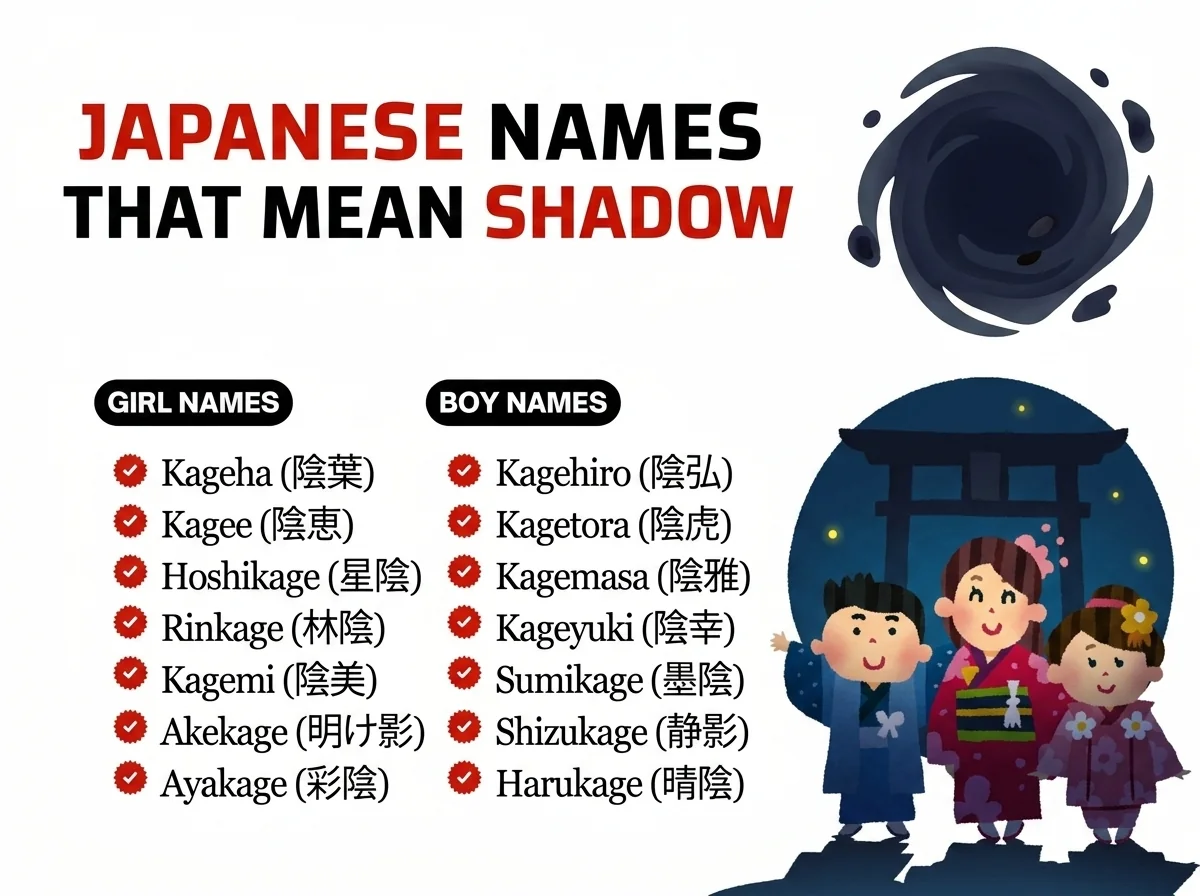
Shadow holds a complicated place in Japanese culture. It is not something to fear. In traditional aesthetics, shadow creates depth, subtlety, and quiet beauty. The kanji 影 (kage) carries this layered meaning into Japanese naming, though it appears far less often than elements like "light" or "flower." That rarity is exactly what makes these names compelling. A child named with the shadow kanji carries something understated and deeply intentional.
Quick answer: names that mean shadow
This guide lists 55+ names that mean shadow. Here are the top picks; tap any name to jump to its full entry with meaning and origin.
Girl names
Boy names
Most common origins: Japanese.
Also explore: Baby names that mean shadow. Part of our Dark & Shadow Names collection.
What Are the Best Japanese Names That Mean Shadow?
The most authentic Japanese shadow names center on the kanji 影 (kage). Strong choices include Kageko and Kagemi for girls, Kagemasa and Kageki for boys, and Kage as a unisex pick. These names are genuinely rare in Japan, which gives them a quiet, distinctive edge for parents seeking something uncommon and culturally grounded.
Japanese Girl Names That Mean Shadow
Girl names built around 影 (kage) have a soft, almost literary quality. They feel like names pulled from a Tanizaki novel rather than a modern baby name forum. The shadow element gives them a contemplative depth that pairs beautifully with lighter second kanji like "flower," "beauty," or "love." These names suit families who appreciate subtlety over spectacle.
| Name | Origin | Meaning | Pronunciation | Popularity |
|---|---|---|---|---|
| Kageko | Japanese | Shadow child | kah-geh-koh | Classic |
| Kagemi | Japanese | Shadow beauty | kah-geh-mee | Soft |
| Kageyo | Japanese | Shadow generation | kah-geh-yoh | Rare |
| Kageha | Japanese | Shadow leaf | kah-geh-hah | Unique |
| Kageri | Japanese | Shadow village | kah-geh-ree | Rare |
| Kageka | Japanese | Shadow flower | kah-geh-kah | Soft |
| Kageno | Japanese | Shadow field | kah-geh-noh | Unique |
| Kageshi | Japanese | Shadow poem | kah-geh-shee | Mystic |
| Kagerin | Japanese | Shadow dignified | kah-geh-reen | Powerful |
| Kagesumi | Japanese | Shadow clarity | kah-geh-soo-mee | Rare |
| Kagea | Japanese | Shadow love | kah-geh-ah | Soft |
| Kagesa | Japanese | Shadow gauze | kah-geh-sah | Unique |
| Tsukikage | Japanese | Moon shadow | tsoo-kee-kah-geh | Mystic |
| Kagee | Japanese | Shadow blessing | kah-geh-eh | Rare |
| Kagemu | Japanese | Shadow dream | kah-geh-moo | Mystic |
Japanese Boy Names That Mean Shadow
Boy names with the shadow kanji carry a grounded, serious weight. Many trace back to samurai naming traditions, where 影 appeared in the names of warriors and clan leaders. These names feel strong without being aggressive. They suggest someone who moves quietly and acts with purpose. The combination of shadow with kanji like "righteous," "victory," or "steadfast" creates a name with real backbone.
| Name | Origin | Meaning | Pronunciation | Popularity |
|---|---|---|---|---|
| Kagemasa | Japanese | Shadow righteous | kah-geh-mah-sah | Classic |
| Kageki | Japanese | Shadow radiance | kah-geh-kee | Powerful |
| Kagehira | Japanese | Shadow peaceful | kah-geh-hee-rah | Rare |
| Kageyuki | Japanese | Shadow fortune | kah-geh-yoo-kee | Unique |
| Kageaki | Japanese | Shadow bright | kah-geh-ah-kee | Rare |
| Kageharu | Japanese | Shadow clear sky | kah-geh-hah-roo | Soft |
| Kagemaru | Japanese | Shadow circle | kah-geh-mah-roo | Classic |
| Kagechika | Japanese | Shadow closeness | kah-geh-chee-kah | Rare |
| Kagesada | Japanese | Shadow steadfast | kah-geh-sah-dah | Powerful |
| Kagenori | Japanese | Shadow model | kah-geh-noh-ree | Unique |
| Kageyoshi | Japanese | Shadow justice | kah-geh-yoh-shee | Powerful |
| Kagesuke | Japanese | Shadow helper | kah-geh-soo-keh | Rare |
| Kagefumi | Japanese | Shadow literature | kah-geh-foo-mee | Unique |
| Kageshige | Japanese | Shadow dignity | kah-geh-shee-geh | Dark |
| Kagehisa | Japanese | Shadow longevity | kah-geh-hee-sah | Rare |
Unisex Japanese Names That Mean Shadow
The shortest and most direct shadow names in Japanese work beautifully across genders. Single-kanji and two-syllable options feel modern and clean. They strip away the gendered suffixes (like "ko" for girls or "ro" for boys) and let the shadow meaning speak for itself. These names suit parents who want something minimal, meaningful, and free from rigid gender expectations.
| Name | Origin | Meaning | Pronunciation | Popularity |
|---|---|---|---|---|
| Kage | Japanese | Shadow | kah-geh | Dark |
| Kagemi | Japanese | Shadow sight | kah-geh-mee | Mystic |
| Kageno | Japanese | Shadow of | kah-geh-noh | Soft |
| Kagen | Japanese | Shadow grace | kah-gehn | Rare |
| Kageyo | Japanese | Shadow sunlight | kah-geh-yoh | Unique |
| Kageshi | Japanese | Shadow thought | kah-geh-shee | Mystic |
| Kageka | Japanese | Shadow fragrance | kah-geh-kah | Soft |
| Kageri | Japanese | Shadow reason | kah-geh-ree | Rare |
| Kagemu | Japanese | Shadow dream | kah-geh-moo | Dark |
| Kagei | Japanese | Shadow reliance | kah-geh-ee | Unique |
The Cultural Roots of Japanese Shadow Names
Shadow in Japanese culture is not the absence of light. It is the presence of depth. The celebrated author Jun'ichirō Tanizaki wrote an entire essay called In Praise of Shadows, arguing that Japanese aesthetics depend on dimness, subtlety, and the beauty of what is partially hidden. This philosophical tradition shapes how the kanji 影 functions in names. It is not a dark omen. It is a nod to quiet complexity.
Shadow in Classical Japanese Literature
In Heian-era poetry and later literary traditions, shadow (kage) often described the reflection of the moon on water or the silhouette of mountains at dusk. Names from this tradition feel poetic and layered.
| Name | Meaning | Gender |
|---|---|---|
| Tsukikage | Moon shadow | Girl |
| Kageha | Shadow leaf | Girl |
| Kageshi | Shadow poem | Girl |
| Kagefumi | Shadow literature | Boy |
| Kagemu | Shadow dream | Unisex |
The Kanji 影 in Samurai-Era Names
During the Sengoku and Edo periods, samurai families occasionally used 影 in male given names. The shadow element suggested stealth, strategy, and the ability to act without being seen. These names carry historical weight.
| Name | Meaning | Gender |
|---|---|---|
| Kagemasa | Shadow righteous | Boy |
| Kagemaru | Shadow circle | Boy |
| Kagesada | Shadow steadfast | Boy |
| Kagechika | Shadow closeness | Boy |
| Kageshige | Shadow dignity | Boy |
Shadow and Shade in Modern Japanese Naming
Contemporary Japanese parents use 影 sparingly. When they do, it often appears alongside a bright or hopeful second kanji, creating a balance between shadow and light. This yin-yang approach gives the name emotional range.
| Name | Meaning | Gender |
|---|---|---|
| Kageki | Shadow radiance | Boy |
| Kageaki | Shadow bright | Boy |
| Kagea | Shadow love | Girl |
| Kageyo | Shadow sunlight | Unisex |
| Kagerin | Shadow dignified | Girl |
Names That Mean Moon Shadow
The combination of moon and shadow produces some of the most evocative names in the Japanese language. Tsukikage (月影) literally translates to "moon shadow," but in classical poetry it refers to moonlight itself. The moon casts a shadow that is actually light. This paradox gives these names a lyrical, almost philosophical quality.
- Tsukikage
- Kageko
- Kagemi
- Kageri
- Kageno
- Kagesumi
- Kageyo
- Kageha
- Kagemu
- Kagea
Names That Mean Shade and Darkness
Shade and darkness overlap with shadow but carry their own distinct kanji and cultural associations. Names using 暗 (an, dark) or 陰 (in, shade) lean heavier and more atmospheric than those using 影. They suit parents who want a name with genuine depth and a touch of the mysterious. For more options in this space, explore Japanese names that mean dark for a broader selection.
- Kageki
- Kageshige
- Kagemu
- Kagesada
- Kagehisa
- Kagen
- Kagei
- Kagerin
- Kagesuke
- Kagechika
Names That Mean Twilight Silhouette
Twilight names sit at the intersection of shadow and fading light. While Japanese does not have a single common kanji for "twilight silhouette," combinations of 影 with evening-related elements create names that evoke that liminal moment between day and night. These are among the rarest and most distinctive options available.
- Kageharu
- Kageyo
- Kageaki
- Kagehira
- Kageno
- Kageshi
- Kageka
- Kagee
- Kagesa
- Kageri
How to Choose the Right Japanese Shadow Name
Sound matters more than most parents realize. A name like Kagemasa has four syllables and a strong rhythm, while Kage is just two syllables and feels almost whispered. Say your top choices out loud with your last name before deciding.
Cultural context matters too. If your family has Japanese heritage, the specific kanji combination will carry meaning for relatives. If not, understanding the cultural weight of 影 helps you choose with respect and intention.
- Say it out loud with your last name
- Check the initials
- Think about natural nicknames
- Research the cultural origin before committing
- Consider how it sounds on a child and an adult
- Check current popularity if you want something less common
Frequently Asked Questions
What is the most popular Japanese name meaning shadow?
Kageko is the most recognized Japanese girl name meaning shadow, largely because the "ko" suffix is a traditional feminine ending. For boys, Kagemasa has the longest historical usage. That said, shadow names remain genuinely rare across all genders in Japan.
What does shadow mean in Japanese naming culture?
The kanji 影 (kage) represents shadow, silhouette, and reflection. In Japanese aesthetics, shadow is associated with depth, subtlety, and quiet beauty rather than fear or negativity. The writer Tanizaki famously celebrated shadows as essential to Japanese art and architecture.
What are some rare Japanese shadow names?
Kagesumi (shadow clarity), Kagerin (shadow dignified), and Kagefumi (shadow literature) are among the rarest. These combinations are uncommon even in Japan, making them distinctive choices for parents who want a name that few others will share.
What is a good middle name to pair with Kageko?
Kageko pairs well with short, bright middle names that balance its heavier meaning. Options like Mei, Hana, or Sora create a nice contrast. The goal is to let the shadow meaning add depth without overwhelming the full name.
Are Japanese shadow names still used today?
They are used, but sparingly. Modern Japanese parents more commonly choose kanji associated with light, nature, or happiness. Shadow names appear more often in literary contexts, historical fiction, and among families who value traditional or unconventional naming.
Can Kage be used as a standalone first name?
Yes. Kage (影) works as a single-kanji given name and is gender-neutral. It is direct, minimal, and carries the full weight of the shadow meaning without any修饰. It is uncommon but entirely legitimate in Japanese naming.
The final word
Japanese names that mean shadow occupy a small but fascinating corner of the naming world. The kanji 影 brings quiet depth, literary resonance, and a kind of beauty that rewards a second look. Whether you choose a traditional option like Kagemasa or a modern unisex pick like Kage, you are giving your child a name rooted in one of Japan's most enduring aesthetic traditions. If you are drawn to names with atmospheric meaning, you might also enjoy exploring names that mean moonlight for a complementary sense of wonder.
Sources & further reading
Name meanings can differ between languages, spellings and sources. These independent references are worth checking alongside this guide, and our research approach explains how we work.
- Behind the Name: Japanese given namesA browsable list of Japanese given names with their meanings.
- Wikipedia: NanoriWhy the same kanji can be read several ways in names.
Reference links last checked September 2026.
Names that mean shadow in other styles:
More in Japanese Names Meaning:
- 40+ Japanese Names Meaning Sorrow (With Meanings)
- 65+ Japanese Names Meaning Red (With Meanings)
- 60+ Japanese Names Meaning Wind (With Meanings)
- 40+ Japanese Names Meaning Space (With Meanings)
- 60+ Japanese Names Meaning Sun (With Meanings)
- 40+ Japanese Names Meaning Warrior (With Meanings)
- 55+ Japanese Names Meaning Dark (With Meanings)
- 45+ Japanese Names Meaning Anger (With Meanings)
Browse everything in Dark & Shadow Names.