The moon holds a special place in Japanese culture. From the autumn tradition of tsukimi (moon viewing) to the Shinto moon god Tsukuyomi, lunar imagery runs deep in Japan's history and language. The kanji 月 (tsuki) appears in countless given names, carrying meanings tied to beauty, calm, and the quiet passage of time.
Japanese naming is uniquely flexible. The same spoken name can shift in meaning depending on which kanji a parent chooses. A name like Mitsuki might mean "beautiful moon" or "light moon" based on the characters used. That flexibility gives families extraordinary creative freedom when choosing a name.
Quick answer: names that mean moon
This guide lists 50+ names that mean moon. Here are the top picks; tap any name to jump to its full entry with meaning and origin.
Girl names
Boy names
Most common origins: Japanese.
Also explore: Baby names that mean moon · Last names that mean moon. Part of our Celestial & Time Names collection.
What Are Some Japanese Names That Mean Moon?
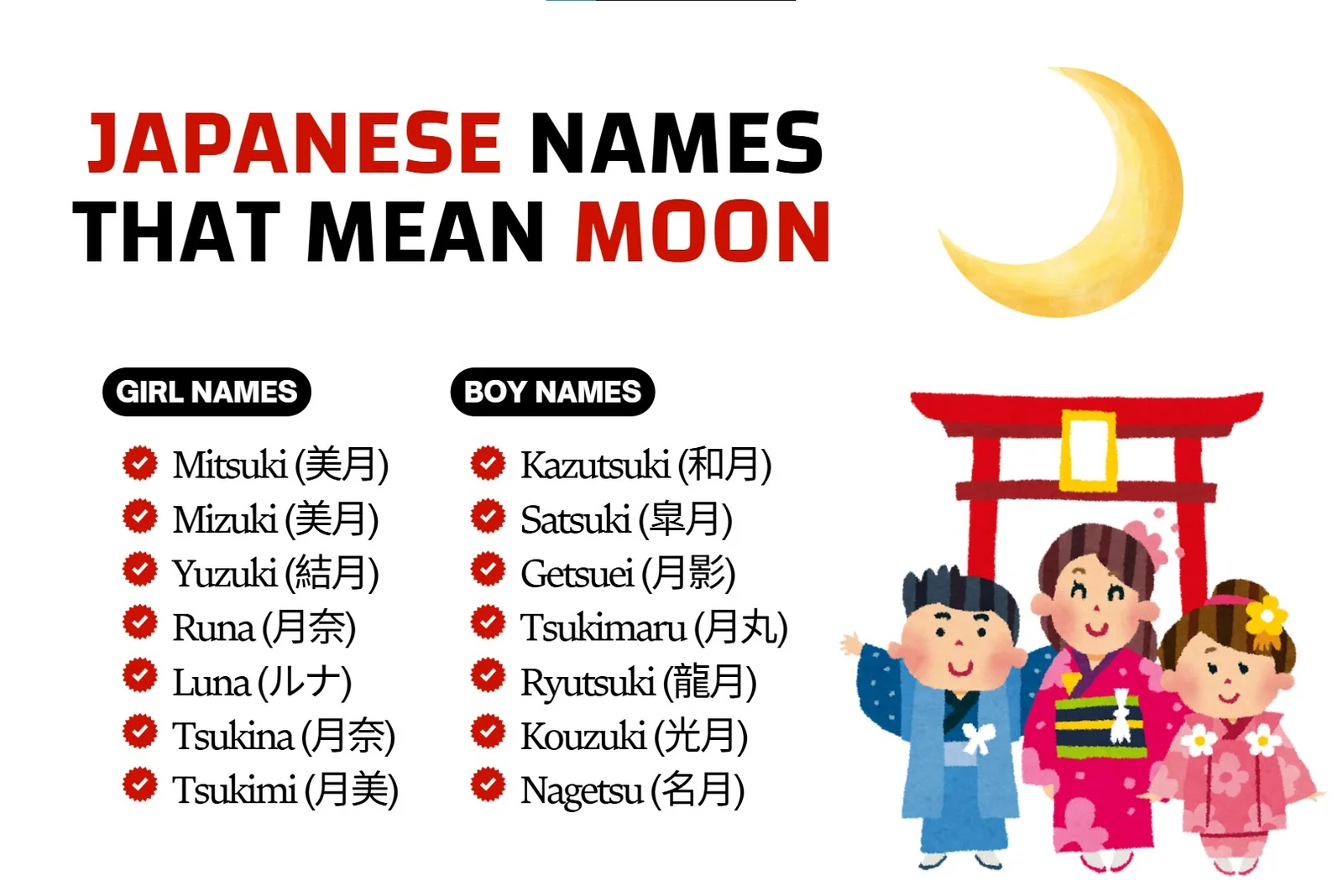
Popular Japanese names that mean moon include Tsuki (月), Mitsuki (美月), Tsukiko (月子), and Hazuki (葉月) for girls, and Tsukihiko (月彦) and Tsukio (月男) for boys. These names use the kanji 月, which directly translates to "moon." Many also draw from Japan's traditional lunar calendar, where each month carries a poetic moon-related name.
Japanese Girl Names That Mean Moon
Lunar names for girls in Japanese tend to feel gentle and poetic. The kanji 月 pairs naturally with characters for beauty, flowers, and sound, creating names that feel both grounded and lyrical. Many of these names have been used in Japan for generations, while others feel fresh and modern.
| Name | Origin | Meaning | Pronunciation | Popularity |
|---|---|---|---|---|
| Tsuki | Japanese | Moon | TSOO-kee | Classic |
| Mitsuki | Japanese | Beautiful moon | mee-TSOO-kee | Trending |
| Tsukiko | Japanese | Moon child | tsoo-KEE-koh | Classic |
| Hazuki | Japanese | Leaf moon | hah-TSOO-kee | Trending |
| Tsukimi | Japanese | Moon beauty | tsoo-KEE-mee | Soft |
| Tsukino | Japanese | Moon field | tsoo-KEE-noh | Rare |
| Tsukine | Japanese | Moon sound | tsoo-KEE-neh | Unique |
| Tsukika | Japanese | Moon flower | tsoo-KEE-kah | Rare |
| Tsukie | Japanese | Moon picture | tsoo-KEE-eh | Rare |
| Tsukina | Japanese | Moon name | tsoo-KEE-nah | Unique |
| Tsukuyo | Japanese | Moon world | tsoo-KOO-yoh | Mystic |
| Mutsuki | Japanese | Harmonious moon | MOO-tsoo-kee | Classic |
| Fumizuki | Japanese | Letter moon | foo-MEE-tsoo-kee | Rare |
| Nagatsuki | Japanese | Long moon | nah-GAH-tsoo-kee | Rare |
| Tsukasa | Japanese | Moon | tsoo-KAH-sah | Classic |
Japanese Boy Names That Mean Moon
Moon names for boys in Japanese carry a quieter strength than many Western lunar names. They often pair 月 with kanji suggesting character, virtue, or nature. These names feel contemplative and steady, suited to parents who want something meaningful without being overly bold.
| Name | Origin | Meaning | Pronunciation | Popularity |
|---|---|---|---|---|
| Tsukihiko | Japanese | Moon prince | tsoo-kee-HEE-koh | Classic |
| Tsukio | Japanese | Moon man | TSOO-kee-oh | Rare |
| Tsukito | Japanese | Moon person | tsoo-KEE-toh | Unique |
| Tsukimaru | Japanese | Moon circle | tsoo-kee-MAH-roo | Classic |
| Tsukihito | Japanese | Moon benevolence | tsoo-kee-HEE-toh | Rare |
| Tsukiyomi | Japanese | Moon reading | tsoo-kee-YOH-mee | Mystic |
| Tsukitaro | Japanese | Moon first son | tsoo-kee-TAH-roh | Classic |
| Tsukimasa | Japanese | Moon righteousness | tsoo-kee-MAH-sah | Powerful |
| Tsukiharu | Japanese | Moon clear sky | tsoo-kee-HAH-roo | Soft |
| Tsukizane | Japanese | Moon truth | tsoo-kee-ZAH-neh | Rare |
| Tsukinosuke | Japanese | Moon helper | tsoo-kee-noh-SOO-keh | Rare |
| Tsukimichi | Japanese | Moon path | tsoo-kee-MEE-chee | Unique |
| Mitsuki | Japanese | Light moon | mee-TSOO-kee | Trending |
| Tsukine | Japanese | Moon root | tsoo-KEE-neh | Rare |
| Tsukasa | Japanese | Moon | tsoo-KAH-sah | Classic |
Unisex Japanese Names That Mean Moon
Japanese is one of the most gender-flexible naming languages in the world. Many moon names work beautifully for any child, especially shorter options like Tsuki or Mitsuki. The meaning stays tied to the kanji, so the name's identity holds regardless of who carries it.
| Name | Origin | Meaning | Pronunciation | Popularity |
|---|---|---|---|---|
| Tsuki | Japanese | Moon | TSOO-kee | Classic |
| Mitsuki | Japanese | Beautiful moon | mee-TSOO-kee | Trending |
| Tsukimi | Japanese | Moon viewing | tsoo-KEE-mee | Soft |
| Hazuki | Japanese | Leaf moon | hah-TSOO-kee | Trending |
| Mutsuki | Japanese | Harmonious moon | MOO-tsoo-kee | Classic |
| Tsukino | Japanese | Moon field | tsoo-KEE-noh | Unique |
| Tsukine | Japanese | Moon sound | tsoo-KEE-neh | Rare |
| Nagatsuki | Japanese | Long moon | nah-GAH-tsoo-kee | Rare |
| Tsukuyo | Japanese | Moon generation | tsoo-KOO-yoh | Mystic |
| Tsukasa | Japanese | Moon | tsoo-KAH-sah | Classic |
The Cultural Roots of Japanese Moon Names
The moon appears in Japanese names more than almost any other celestial body. This is not a coincidence. Japan's old lunar calendar named every single month with the kanji 月, and Shinto mythology places the moon god among the most important deities. The result is a deep well of lunar naming traditions that still influence parents today.
Old Calendar Month Names
Japan's traditional calendar assigned poetic names to each month, and every one of them ends with 月 (tsuki or zuki). These names described seasonal events and are still used as given names today. Hazuki (葉月, "leaf moon") refers to the eighth month when leaves begin to turn. Mutsuki (睦月, "harmonious moon") marks the first month of the new year. Nagatsuki (長月, "long moon") describes the ninth month when nights grow longer. Using these names connects a child to centuries of Japanese seasonal tradition.
| Name | Meaning | Gender |
|---|---|---|
| Mutsuki | Harmonious moon (1st month) | Unisex |
| Kisaragi | Month of changing clothes (2nd month, poetic) | Unisex |
| Yayoi | Increasing life (3rd month) | Girl |
| Uzuki | Rabbit moon (4th month) | Girl |
| Satsuki | Early moon (5th month) | Girl |
| Minazuki | Water moon (6th month) | Unisex |
| Fumizuki | Letter moon (7th month) | Girl |
| Hazuki | Leaf moon (8th month) | Unisex |
| Nagatsuki | Long moon (9th month) | Unisex |
| Kannazuki | Month without gods (10th month) | Rare/Unisex |
| Shimotsuki | Frost moon (11th month) | Unisex |
| Shiwasu | Month of running priests (12th month) | Rare |
Shinto Mythology and the Moon God
In Shinto belief, Tsukuyomi-no-Mikoto is the moon god, born from the right eye of the creator deity Izanagi. He rules the night sky and stands alongside his sister Amaterasu, the sun goddess. The name Tsukuyomi itself breaks down to 月 (moon) and 読 (reading), often interpreted as "reading the moon" or "counting the months." While Tsukuyomi is rarely used as a given name in modern Japan due to its heavy mythological weight, it appears frequently in literature, anime, and popular culture. Names inspired by this tradition tend to feel mystical and powerful.
Modern Poetic Moon Combinations
Contemporary Japanese parents often create moon names by pairing 月 with kanji that evoke emotion or nature. Tsukine (月音, "moon sound") suggests the quiet of a moonlit night. Tsukika (月花, "moon flower") blends lunar and botanical imagery. These combinations follow traditional Japanese naming grammar but feel distinctly modern. They reflect a naming culture that values personal meaning over rigid convention.
Names That Mean Moonlight in Japanese
Moonlight carries a softer, more ethereal quality than the moon itself. In Japanese, moonlight is often expressed through the kanji combination 月光 (gekkō) or through names that suggest illumination and glow. These names feel delicate and atmospheric, perfect for parents drawn to the quieter side of lunar imagery.
- Gekko (月光)
- Terutsuki (照月)
- Akari (明かり, often paired with 月)
- Hikaru (光, used in compounds like 光月)
- Tsukiakari (月明かり)
- Kaguya (輝夜, "shining night," from the famous moon princess tale)
- Tsukiteru (月照)
- Meigetsu (明月)
- Seigetsu (清月)
- Reigetsu (玲月)
Names That Mean Full Moon in Japanese
The full moon holds particular significance in Japanese culture. The harvest moon festival, known as Jugoya, celebrates the fullest moon of autumn. Names referencing the full moon often use the kanji 望 (mochi), meaning "full" or "gazing," combined with 月. These names carry a sense of completeness and celebration.
- Mochizuki (望月)
- Mangetsu (満月)
- Mochika (望月花)
- Mochiko (望月子)
- Mochio (望月男)
- Engetsu (円月)
- Mochimi (望月美)
- Mochito (望月人)
- Mochiyo (望月世)
- Mochina (望月菜)
Names Connected to the Moon God Tsukuyomi
Names inspired by Tsukuyomi, the Shinto moon deity, tend to feel bold and mythological. They work best for parents who want a name with deep cultural roots and a strong narrative behind it. These names are less common in everyday Japanese life but appear regularly in fiction and creative naming.
- Tsukuyomi (月読)
- Tsukiyomi (月夜見)
- Yomitsuki (夜読月)
- Tsukimikoto (月命)
- Tsukikami (月神)
- Yotsuki (夜月)
- Tsukishiro (月白)
- Tsukikage (月影)
- Tsukihana (月華)
- Tsukishima (月島)
How to Choose the Right Japanese Moon Name
Sound matters more than you might think. A name like Tsuki is short and clean, while Tsukiyomi is long and dramatic. Say the full name out loud with your surname to hear how the syllables flow together.
Cultural context matters too. If your family has Japanese heritage, a traditional calendar name like Hazuki may feel especially meaningful. If you are drawn to Japanese culture from outside, take time to understand the kanji behind the name you choose.
- Say the full name out loud with your last name
- Check the initials to avoid unintended combinations
- Think about natural nicknames (Mitsuki easily shortens to Mitsu)
- Research the specific kanji before committing to a meaning
- Consider how the name sounds on both a child and an adult
- Check current popularity if you want something less common
Frequently Asked Questions
What is the most popular Japanese name meaning moon?
Mitsuki (美月) is currently one of the most popular Japanese names meaning moon, especially for girls. It ranks well in modern Japanese baby name surveys and has gained recognition internationally. Tsuki (月) remains the most direct and widely recognized option.
What does the moon mean in Japanese naming tradition?
In Japanese naming, the moon kanji 月 (tsuki) symbolizes beauty, tranquility, and the passage of time. It also connects to Japan's old lunar calendar, where every month name includes 月. The moon is seen as a calming, feminine presence in contrast to the sun's bold energy.
What are some rare Japanese moon names?
Rarer options include Tsukine (月音, "moon sound"), Tsukizane (月実, "moon truth"), and Tsukimichi (月道, "moon path"). These names use less common kanji pairings and are unlikely to be shared with classmates.
What is a good middle name to pair with Mitsuki?
Mitsuki pairs well with short, soft middle names. Options like Ren, Hana, or Sora complement its three-syllable rhythm without competing for attention. If you want a Western middle name, Rose or Grace creates a gentle contrast.
Are Japanese moon names still popular in Japan?
Yes. Names containing 月 remain consistently popular in Japan, especially Mitsuki and Hazuki for girls. The traditional calendar month names see periodic revivals as parents look for names with cultural depth. Lunar names also benefit from their frequent appearance in anime and manga.
Can non-Japanese families use Japanese moon names?
Many families outside Japan choose Japanese names for their beauty and meaning. If you do, take time to learn the correct pronunciation and understand the kanji behind the name. Names like Mitsuki and Tsuki are relatively easy for English speakers to pronounce, making them practical choices.
The final word
Japanese moon names offer a remarkable range, from the simple clarity of Tsuki to the mythological depth of Tsukuyomi. The flexibility of kanji means you can shape the meaning to match exactly what you want your child's name to carry. Lunar names endure across cultures because the moon itself never changes, and the best of these Japanese names capture that same quiet permanence. If you are exploring other celestial options, browse our guide to Japanese names that mean light for more ideas rooted in the same beautiful naming tradition.
Sources & further reading
Name meanings can differ between languages, spellings and sources. These independent references are worth checking alongside this guide, and our research approach explains how we work.
- Behind the Name: names with the meaning “moon”Given names from many languages that share this meaning.
- Behind the Name: Japanese given namesA browsable list of Japanese given names with their meanings.
- Wikipedia: NanoriWhy the same kanji can be read several ways in names.
Reference links last checked September 2026.
Names that mean moon in other styles:
More in Japanese Names Meaning:
- 60+ Japanese Names Meaning Star (With Meanings)
- 55+ Japanese Names Meaning Flower (With Meanings)
- 55+ Japanese Names Meaning Evil (With Meanings)
- 65+ Japanese Names Meaning Blue (With Meanings)
- 50+ Japanese Names Meaning Ice (With Meanings)
- 60+ Japanese Names Meaning Snow (With Meanings)
- 45+ Japanese Names Meaning Anger (With Meanings)
- 30+ Japanese Names Meaning Death (With Meanings)
Browse everything in Celestial & Time Names.