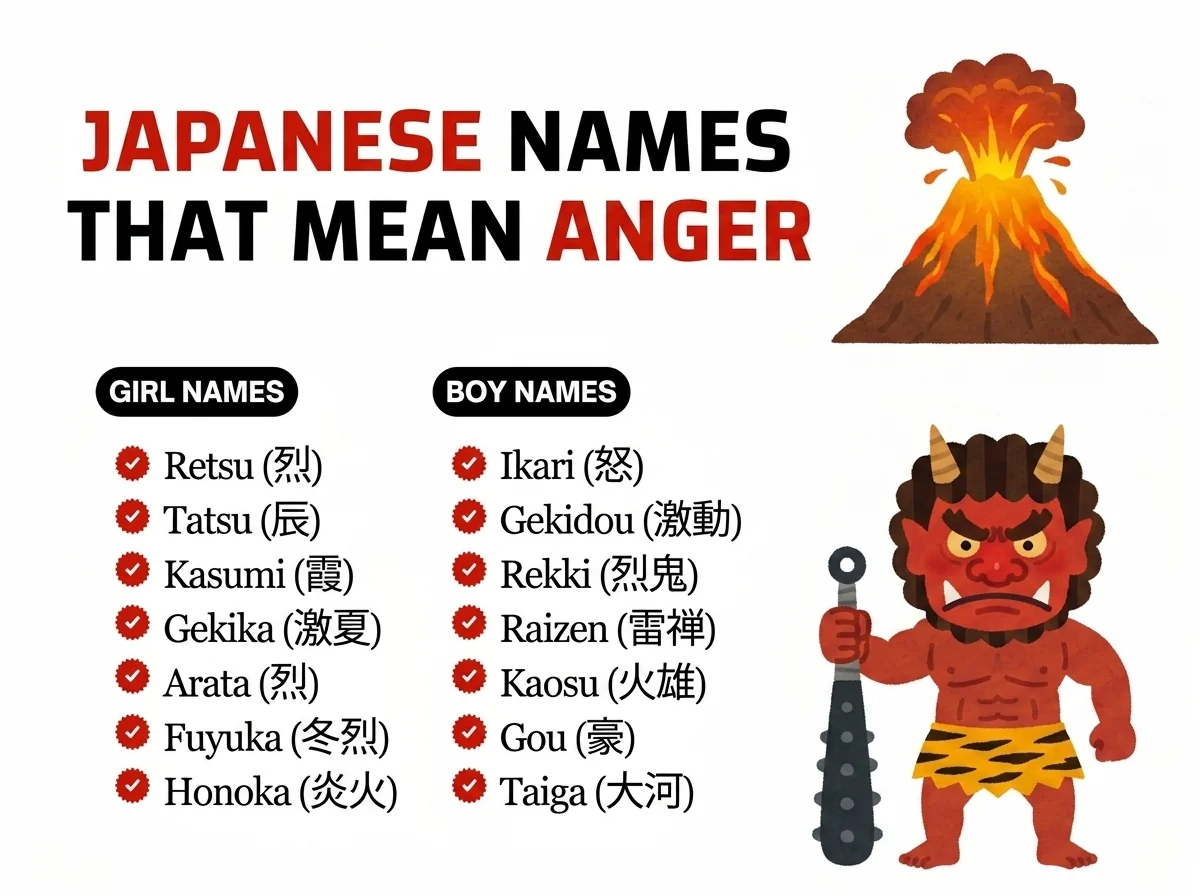
Anger is a raw, primal emotion, and very few cultures encode it directly into baby names. Japan is no exception. The literal kanji for anger, 怒 (do), is almost never given to a child. Japanese naming tradition leans heavily toward auspicious, hopeful meanings.
But fierce energy does live in Japanese naming. Through kanji tied to storms, thunder, flame, and untamed intensity, a small collection of Japanese names that mean anger in its broader, more elemental sense have endured. These names carry the heat of wrath without the weight of the word itself.
Quick answer: names that mean anger
This guide lists 45+ names that mean anger. Here are the top picks; tap any name to jump to its full entry with meaning and origin.
Girl names
Boy names
Most common origins: Japanese.
Also explore: Baby names that mean anger. Part of our Dark & Shadow Names collection.
What Japanese names mean anger?
Authentic Japanese names that mean anger are rare because the direct kanji for anger (怒) is almost never used in given names. Instead, names convey fierce, wrathful energy through kanji for storm, thunder, and flame. Strong examples include Arashi (storm), Takeshi (fierce), Homura (blaze), Rai (thunder), Retsu (intense), and Ibuki (fierce wind).
Japanese Boy Names That Mean Anger
Boys' names in Japan have historically carried more aggressive kanji than girls' names. Samurai families in particular favored characters like 猛 (take, fierce) and 烈 (retsu, intense) to project strength and combat readiness. These names do not mean "anger" in the emotional sense. They channel the outward force of fury through nature and physical power. Many remain in use today, especially in families with martial or military heritage.
| Name | Origin | Meaning | Pronunciation | Popularity |
|---|---|---|---|---|
| Takeshi | Japanese | Fierce, violent | tah-KEH-shee | Classic |
| Takeo | Japanese | Fierce man | tah-KEH-oh | Classic |
| Taketora | Japanese | Fierce tiger | tah-keh-TOH-rah | Rare |
| Takehiko | Japanese | Fierce boy | tah-keh-HEE-koh | Rare |
| Retsu | Japanese | Fierce, intense | REH-tsoo | Rare |
| Arashi | Japanese | Storm, tempest | ah-RAH-shee | Trending |
| Rai | Japanese | Thunder | RYE | Unique |
| Homura | Japanese | Flame, blaze | hoh-MOO-rah | Mystic |
| Mou | Japanese | Fierce, raging | MOH | Rare |
| Ara | Japanese | Wild, rough | AH-rah | Dark |
| Ikazuchi | Japanese | Thunder, lightning | ee-kah-ZOO-chee | Mystic |
| Takemaru | Japanese | Fierce one | tah-keh-MAH-roo | Rare |
| Gen | Japanese | Stern, severe | GEHN | Powerful |
| Takeaki | Japanese | Fierce brightness | tah-keh-AH-kee | Unique |
| Takemichi | Japanese | Fierce path | tah-keh-MEE-chee | Rare |
Japanese Girl Names That Mean Anger
Finding girl names tied to anger in Japanese is genuinely difficult, and it is important to be upfront about that. Japanese naming culture steers girls' names toward beauty, grace, flowers, and gentleness. Kanji associated with wrath or violence are almost never assigned to daughters. The names below represent the very edge of what exists. They lean on storm imagery, flame, and fierce wind rather than direct anger. Some are more commonly seen in fiction than on birth certificates.
| Name | Origin | Meaning | Pronunciation | Popularity |
|---|---|---|---|---|
| Homura | Japanese | Flame, blaze | hoh-MOO-rah | Mystic |
| Ran | Japanese | Storm | RAHN | Classic |
| Arashi | Japanese | Storm, tempest | ah-RAH-shee | Rare |
| En | Japanese | Flame, blaze | EHN | Rare |
| Retsu | Japanese | Fierce, intense | REH-tsoo | Rare |
| Ibuki | Japanese | Fierce breath, wind | ee-BOO-kee | Trending |
| Rai | Japanese | Thunder | RYE | Unique |
| Fubuki | Japanese | Blizzard, snowstorm | foo-BOO-kee | Dark |
Japanese Unisex Names That Mean Anger
The most versatile anger-adjacent names in Japanese tend to be nature words. Storms, thunder, and sudden winds do not belong to one gender. These names work across the spectrum because they describe forces rather than personalities. A name like Arashi evokes the same image whether it belongs to a boy or a girl. This nature-based flexibility is one of the more interesting features of Japanese naming.
| Name | Origin | Meaning | Pronunciation | Popularity |
|---|---|---|---|---|
| Arashi | Japanese | Storm, tempest | ah-RAH-shee | Trending |
| Homura | Japanese | Flame, blaze | hoh-MOO-rah | Mystic |
| Rai | Japanese | Thunder | RYE | Unique |
| Retsu | Japanese | Fierce, intense | REH-tsoo | Rare |
| Ran | Japanese | Storm | RAHN | Classic |
| En | Japanese | Flame, blaze | EHN | Rare |
| Ibuki | Japanese | Fierce breath, wind | ee-BOO-kee | Trending |
| Hayate | Japanese | Sudden fierce wind | hah-YAH-teh | Powerful |
The Cultural Roots of Japanese Anger Names
Anger-related naming in Japan is inseparable from Shinto mythology and samurai history. The storm god Raijin, who beats his drums to create thunder, embodies divine wrath. Samurai warriors chose fierce kanji for their sons to signal battlefield readiness. Modern parents rarely name children after anger directly, but the cultural memory of these traditions keeps a handful of storm and flame names alive.
Shinto and Mythological Names
Shinto tradition personifies natural disasters as expressions of divine emotion. Thunder is the anger of Raijin. Storms are the fury of Susanoo, the storm god who was banished from heaven for his violent temper. Names drawn from these myths carry mythological weight.
| Name | Meaning | Gender |
|---|---|---|
| Rai | Thunder | Boy |
| Ikazuchi | Thunder, lightning | Boy |
| Raijin | Thunder god | Boy |
| Susanoo | Storm god of wrath | Boy |
| Arashi | Storm | Unisex |
Samurai-Era Fierce Names
During the feudal period, samurai families favored kanji like 猛 (take) and 剛 (gou) to project martial strength. These names were declarations of intent. A boy named Takeshi was expected to embody ferocity in battle.
| Name | Meaning | Gender |
|---|---|---|
| Takeshi | Fierce, violent | Boy |
| Takeo | Fierce man | Boy |
| Taketora | Fierce tiger | Boy |
| Retsu | Fierce, intense | Boy |
| Gen | Stern, severe | Boy |
Modern Anime and Pop Culture Influence
Characters like Homura Akemi from Puella Magi Madoka Magica and Arashi from various manga series have kept these rare names visible. While most Japanese parents still avoid anger-related kanji, the popularity of these characters has made names like Homura and Arashi more recognizable to younger generations.
| Name | Meaning | Gender |
|---|---|---|
| Homura | Flame, blaze | Girl |
| Arashi | Storm | Unisex |
| Fubuki | Blizzard | Girl |
| Hayate | Fierce wind | Unisex |
| Ibuki | Fierce breath | Unisex |
Names That Mean Fury and Fierce Intensity
Fury names go a step beyond general anger. They suggest an uncontrolled, explosive force. In Japanese, this energy lives in kanji like 烈 (retsu) and 猛 (mou), which describe violence of action rather than emotion. These names feel urgent and commanding.
- Retsu
- Mou
- Gekko (fierce light)
- Ara
- Takeo
- Taketora
- Gen
- Ikazuchi
- Arashi
- Homura
Names That Mean Storm and Tempest
Storm names capture the external expression of anger. A tempest is nature's fury made visible. Japanese storm names tend to be gender-neutral because weather belongs to no one. They feel wild and untamed.
- Arashi
- Ran
- Hayate
- Fubuki
- Rai
- Ibuki
- Kazahaya (swift wind)
- Tatsumaki (tornado)
- Shigure (cold rain shower)
- Kamaitachi (wind demon)
Names That Mean Wrath and Divine Anger
Wrath implies judgment and power. In Japanese mythology, wrath belongs to the gods. Names in this category carry a heavier, more solemn tone than simple fierceness. They suit families drawn to mythological depth.
- Raijin
- Susanoo
- Ikazuchi
- Rai
- En
- Homura
- Gen
- Retsu
- Ara
- Mou
How to Choose the Right Anger Name
Sound matters more than you might think with intense names. A name like Takeshi flows easily in English and Japanese alike, while Ikazuchi may trip up non-Japanese speakers. Pair the name with your last name and listen to the rhythm.
Cultural context is equally important. If your family has Japanese heritage, a name like Arashi or Homura will carry authentic resonance. If not, take time to understand the kanji and the cultural weight behind the name before committing.
- Say the full name out loud several times in different settings
- Check how the initials look on paper
- Consider whether the name has natural nicknames (Takeshi becomes Take, for example)
- Research the specific kanji, since the same pronunciation can carry very different meanings
- Think about how the name will sound on a resume as well as a playground
- Look up current popularity in Japan if you want something truly uncommon
Frequently Asked Questions
What is the most popular Japanese name meaning anger?
Takeshi is the most widely recognized Japanese name associated with fierce, angry energy. It uses the kanji 猛 (fierce, violent) and has been a staple boys' name in Japan for generations. Arashi has also gained modern popularity, partly due to the famous Japanese boy band of the same name.
Why are Japanese names that mean anger so rare?
Japanese naming culture strongly favors positive, auspicious meanings like beauty, health, wisdom, and prosperity. The literal kanji for anger, 怒 (do), is considered inauspicious and is almost never used in given names. Parents who want to convey strength choose adjacent kanji like 猛 (fierce) or 烈 (intense) instead.
What are some rare Japanese anger names?
Ikazuchi (thunder, lightning), Mou (fierce, raging), and En (flame, blaze) are among the rarest. These names are barely used in modern Japan and are more likely to appear in historical records or fiction than on current birth registrations.
What is a good middle name to pair with Takeshi?
Takeshi pairs well with short, soft middle names that balance its strong sound. Options like Ren, Kai, or Sora work nicely. The contrast between the fierce first name and a gentler middle name creates a pleasing rhythm.
Can girls have Japanese names that mean anger?
It is very uncommon but not impossible. Names like Homura (flame) and Ran (storm) are occasionally given to girls. However, most Japanese families avoid anger-related kanji for daughters, preferring meanings tied to beauty, flowers, or light.
Do Japanese anger names have negative connotations in Japan?
Names using 猛 (fierce) or 嵐 (storm) are generally seen as strong rather than negative. They project power and resilience. However, a name that literally used 怒 (anger) would likely be viewed as unusual and potentially unlucky by most Japanese people.
The final word
Japanese names that mean anger occupy a small, fascinating corner of the naming world. They survive not through the literal word for wrath but through the language of storms, thunder, flame, and fierce wind. These names carry elemental power that transcends the emotion itself. If you are drawn to names with this kind of raw intensity, you might also enjoy exploring Japanese names that mean dark and mysterious energy. The fiercest names often tell the deepest stories.
Sources & further reading
Name meanings can differ between languages, spellings and sources. These independent references are worth checking alongside this guide, and our research approach explains how we work.
- Behind the Name: Japanese given namesA browsable list of Japanese given names with their meanings.
- Wikipedia: NanoriWhy the same kanji can be read several ways in names.
Reference links last checked September 2026.
Names that mean anger in other styles:
More in Japanese Names Meaning:
- 55+ Japanese Names Meaning Angel (With Meanings)
- 50+ Japanese Names Meaning Hope (With Meanings)
- 55+ Japanese Names Meaning Evil (With Meanings)
- 40+ Japanese Names Meaning Sorrow (With Meanings)
- 40+ Japanese Names Meaning Blood (With Meanings)
- 55+ Japanese Names Meaning Flower (With Meanings)
- 40+ Japanese Names Meaning Space (With Meanings)
- 50+ Japanese Names Meaning Ice (With Meanings)
Browse everything in Dark & Shadow Names.