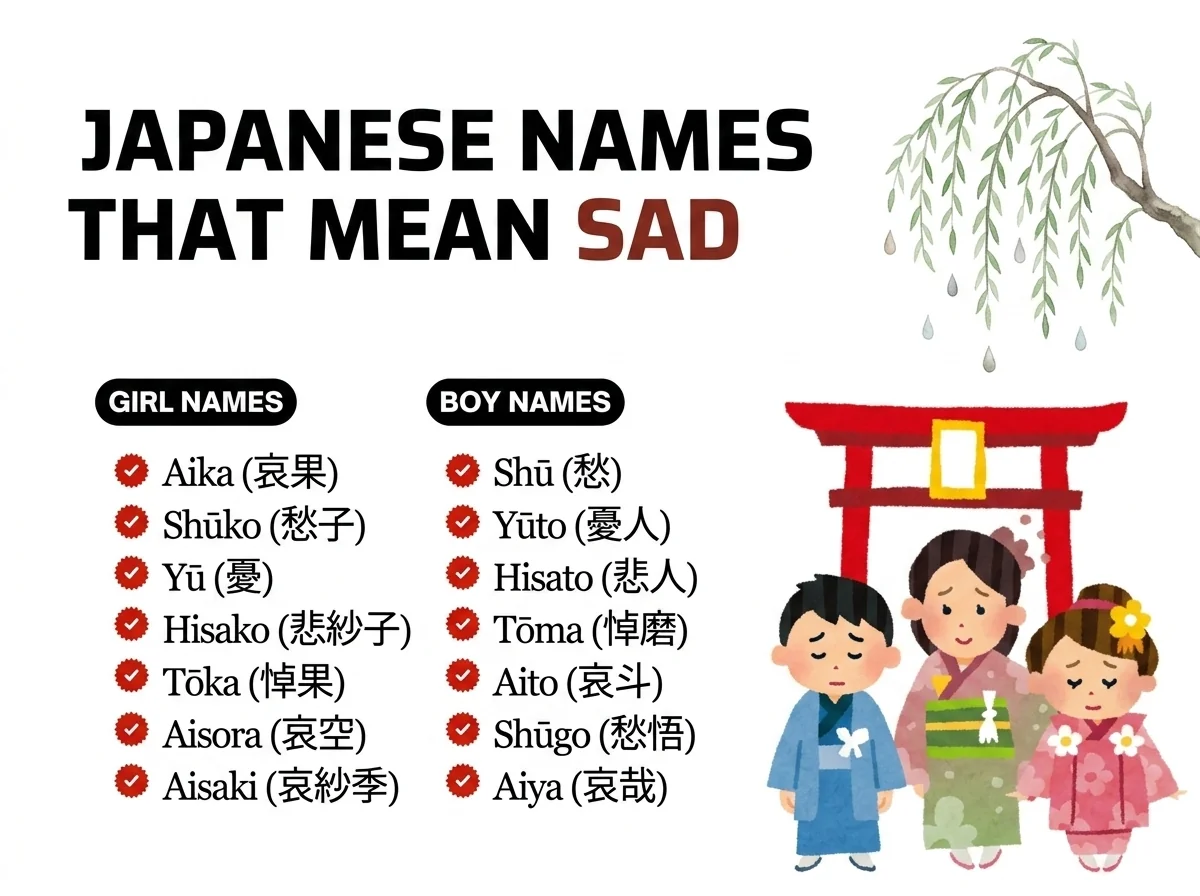
Sadness is not a meaning most parents actively seek in a baby name. Yet in Japanese naming tradition, sorrow carries a weight that goes beyond simple grief. The concept of mono no aware, a deep awareness of impermanence, runs through centuries of Japanese poetry and art. Names tied to sadness often connect to this quieter, more reflective side of beauty.
Finding authentic Japanese names that mean sad or sorrow requires real honesty. These names are genuinely rare because Japanese parents traditionally avoid negative meanings in given names. The few options that do exist are layered, poetic, and deeply rooted in literary culture.
Quick answer: names that mean sad
This guide lists 40+ names that mean sad. Here are the top picks; tap any name to jump to its full entry with meaning and origin.
Girl names
Boy names
Most common origins: Japanese.
Also explore: Baby names that mean sad. Part of our Dark & Shadow Names collection.
What are some Japanese names that mean sad or sorrow?
Japanese names meaning sad or sorrow are uncommon because traditional naming culture favors positive meanings. Authentic options include Ai (哀, sorrow), Rui (涙, tears), Yū (憂, melancholy), Shū (愁, grief), Kana (悲, sadness), and Yūko (憂子, child of melancholy). Most of these names connect to mono no aware, the Japanese literary concept of bittersweet impermanence, giving them a poetic depth rather than a purely negative tone.
Japanese Girl Names That Mean Sad
Sorrow in Japanese girls' names tends to sound soft and lyrical, even when the meaning carries weight. The kanji used for sadness in feminine names often overlap with concepts of beauty, flowers, and song. This creates a bittersweet quality that feels more literary than heavy. Many of these names draw from classical waka poetry, where grief and grace lived side by side.
| Name | Origin | Meaning | Pronunciation | Popularity |
|---|---|---|---|---|
| Ai | Japanese | Sorrow, pathos (哀) | AH-ee | Rare |
| Aiko | Japanese | Child of sorrow (哀子) | AH-ee-koh | Rare |
| Aimi | Japanese | Sorrowful beauty (哀美) | AH-ee-mee | Unique |
| Aika | Japanese | Sorrowful song (哀歌) | AH-ee-kah | Mystic |
| Rui | Japanese | Tears (涙) | ROO-ee | Soft |
| Ruiko | Japanese | Child of tears (涙子) | ROO-ee-koh | Rare |
| Yūna | Japanese | Melancholy grace (憂奈) | YOO-nah | Soft |
| Yūko | Japanese | Child of melancholy (憂子) | YOO-koh | Rare |
| Yūka | Japanese | Flower of sorrow (憂花) | YOO-kah | Unique |
| Yūri | Japanese | Melancholy village (憂里) | YOO-ree | Mystic |
| Yūmi | Japanese | Melancholy beauty (憂美) | YOO-mee | Soft |
| Kana | Japanese | Sadness (悲) | KAH-nah | Rare |
| Kanami | Japanese | Beautiful sadness (悲美) | KAH-nah-mee | Unique |
| Shūko | Japanese | Child of grief (愁子) | SHOO-koh | Dark |
| Shion | Japanese | Sound of melancholy (愁音) | SHEE-ohn | Mystic |
Japanese Boy Names That Mean Sad
Boy names carrying sorrow in Japanese tend to feel more restrained and serious. The kanji for melancholy (憂) and grief (愁) give these names a contemplative, almost scholarly quality. In classical Japanese literature, male poets and monks often embraced these characters to express the weight of the world. These names suit families drawn to understated depth rather than bold statements.
| Name | Origin | Meaning | Pronunciation | Popularity |
|---|---|---|---|---|
| Yū | Japanese | Melancholy, sorrow (憂) | YOO | Rare |
| Shū | Japanese | Grief, distress (愁) | SHOO | Dark |
| Yūto | Japanese | Melancholy, Big Dipper (憂斗) | YOO-toh | Unique |
| Yūta | Japanese | Melancholy, great (憂太) | YOO-tah | Rare |
| Yūji | Japanese | Melancholy, director (憂司) | YOO-jee | Rare |
| Yūsei | Japanese | Sorrowful star (憂星) | YOO-say | Mystic |
| Yūma | Japanese | Melancholy, truth (憂真) | YOO-mah | Unique |
| Yūgo | Japanese | Melancholy, enlightenment (憂悟) | YOO-goh | Dark |
| Yūki | Japanese | Melancholy, radiance (憂輝) | YOO-kee | Soft |
| Yūya | Japanese | Melancholy night (憂夜) | YOO-yah | Mystic |
| Shūta | Japanese | Grief, greatness (愁太) | SHOO-tah | Rare |
| Shūhei | Japanese | Grief, peace (愁平) | SHOO-hay | Unique |
| Shūichi | Japanese | Grief, first (愁一) | SHOO-ee-chee | Rare |
| Shūya | Japanese | Grief, to be (愁也) | SHOO-yah | Dark |
| Aiji | Japanese | Sorrow, director (哀司) | AH-ee-jee | Rare |
Japanese Unisex Names That Mean Sad
Gender-neutral sorrow names in Japanese are some of the most poetic options available. Because many of these names are single-kanji or two-syllable, they carry a simplicity that works across genders. The brevity gives them a quiet confidence. They feel like names from a haiku, where every syllable has to earn its place.
| Name | Origin | Meaning | Pronunciation | Popularity |
|---|---|---|---|---|
| Ai | Japanese | Sorrow, pathos (哀) | AH-ee | Rare |
| Rui | Japanese | Tears (涙) | ROO-ee | Soft |
| Yū | Japanese | Melancholy (憂) | YOO | Rare |
| Shū | Japanese | Grief (愁) | SHOO | Dark |
| Kana | Japanese | Sadness (悲) | KAH-nah | Unique |
| Yūki | Japanese | Melancholy hope (憂希) | YOO-kee | Mystic |
| Aki | Japanese | Sorrow, autumn (哀) | AH-kee | Soft |
| Setsuna | Japanese | Fleeting moment (刹那) | SET-soo-nah | Mystic |
| Kanami | Japanese | Sad beauty (悲美) | KAH-nah-mee | Unique |
| Yūmi | Japanese | Melancholy beauty (憂美) | YOO-mee | Soft |
The Cultural Roots of Japanese Sorrow Names
Sorrow names in Japanese do not exist in a vacuum. They grow out of a literary and philosophical tradition that treats sadness as a form of awareness, not a flaw. Understanding where these names come from helps you choose one with real intention rather than surface appeal.
Japanese Literary Tradition and Sorrow Names
The single biggest influence on Japanese sorrow names is mono no aware. This phrase, popularized by the 18th-century scholar Motoori Norinaga, describes the gentle sadness of watching things pass. Cherry blossoms fall. Seasons change. People leave. The kanji 哀 (ai) sits at the heart of this concept. Names using this character carry that philosophical weight, connecting a child to one of the oldest ideas in Japanese aesthetics.
Chinese Kanji Origins of Sorrow Characters
Japanese kanji originated in China, and the sorrow-related characters used in Japanese names have deep Chinese roots. The character 憂 (yū) appears in classical Chinese poetry dating back to the Tang Dynasty. The character 愁 (shū) shows up in the works of poets like Li Bai and Du Fu, who wrote extensively about exile and longing. When Japanese parents use these kanji in names, they are drawing on over a thousand years of East Asian literary tradition.
Korean Hanja and Shared Sorrow Meanings
Korean names using hanja (Chinese characters shared with Japanese kanji) sometimes overlap with Japanese sorrow names. The character 哀 (ae in Korean) and 憂 (u in Korean) appear in historical Korean given names, though like in Japan, they are uncommon in modern use. The shared character system means that a name like Yū in Japanese and U in Korean can trace back to the exact same written symbol.
Sanskrit and Buddhist Influences
Buddhist philosophy, which traveled from India through China to Japan, shaped how Japanese culture understands suffering. The Sanskrit concept of dukkha (suffering, unsatisfactoriness) influenced the way sorrow is framed in Japanese thought. The name Setsuna (刹那) comes directly from the Sanskrit word "ksana," meaning an instant or moment. In Buddhist teaching, each moment is fleeting, and that impermanence is the root of sorrow.
Names That Mean Tears, Melancholy, and Grief
Sorrow is a broad emotional landscape. In Japanese, different kanji capture different shades of sadness. Exploring these variations helps you find a name that matches the specific feeling you want to carry.
Names That Mean Tears
Tears represent the physical expression of sadness. In Japanese, the kanji 涙 (namida/rui) is the most direct symbol. Names using this character feel raw and honest. They suggest someone who feels deeply and is not afraid to show it.
- Rui (涙)
- Ruiko (涙子)
- Ruito (涙斗)
- Ruina (涙奈)
- Namida (涙)
- Ruiya (涙也)
- Ruika (涙花)
- Ruisei (涙星)
- Ruiko (涙光)
- Ruima (涙真)
Names That Mean Melancholy
Melancholy is quieter than grief. The kanji 憂 (yū) captures a lingering, thoughtful sadness. It is the feeling of watching rain through a window. Names built on this character tend to sound gentle and introspective. They suit families who value emotional depth.
- Yū (憂)
- Yūka (憂花)
- Yūto (憂斗)
- Yūna (憂奈)
- Yūsei (憂星)
- Yūmi (憂美)
- Yūgo (憂悟)
- Yūya (憂夜)
- Yūki (憂輝)
- Yūma (憂真)
Names That Mean Grief
Grief is the heaviest shade of sorrow. The kanji 愁 (shū) and 悲 (hi/kana) carry this weight more directly than the softer 憂. Names using these characters are the rarest of all, and they demand a family that understands the gravity of the meaning. They are not casual choices.
- Shū (愁)
- Shūta (愁太)
- Shūko (愁子)
- Shūhei (愁平)
- Shion (愁音)
- Kana (悲)
- Kanami (悲美)
- Kanade (悲奏)
- Shūya (愁也)
- Shūichi (愁一)
How to Choose the Right Japanese Sorrow Name
Sound matters more than you might think with Japanese names. A name like Shū sounds sharp and abrupt in English, while Rui flows more easily across languages. Say the full name out loud with your surname before you commit.
Cultural context is equally important. A name that reads as poetic in Japanese may confuse speakers of other languages. Make sure you understand the kanji and the cultural weight behind your choice.
- Say the full name out loud with your last name
- Check how the initials look written down
- Think about natural nicknames your child might use
- Research the specific kanji before committing to a reading
- Consider how the name sounds to both Japanese and non-Japanese speakers
- Check whether the kanji you want is approved for Japanese given names (jinmeiyō kanji)
Frequently Asked Questions
What is the most popular Japanese name meaning sad?
Ai (哀) is the most recognizable Japanese name connected to sorrow, though it remains rare in its sorrow-kanji form. The far more common Ai (愛) means "love." Among the melancholy names, Yū (憂) and Rui (涙) see slightly more use in modern Japan, though all sorrow names remain uncommon by design.
What does sadness mean in Japanese naming culture?
In Japanese naming culture, sadness is tied to mono no aware, the bittersweet awareness that all things are temporary. Sadness is not seen as purely negative. It is a sign of emotional depth and sensitivity. However, most Japanese parents still prefer positive meanings for their children's given names, which is why sorrow names are genuinely rare.
What are some rare Japanese names that mean sorrow?
Some of the rarest authentic options include Shūko (愁子, child of grief), Aika (哀歌, sorrowful song), Yūya (憂夜, melancholy night), and Shion (愁音, sound of melancholy). These names use genuine sorrow-related kanji but are almost never encountered in everyday Japanese life.
What is a good middle name to pair with Ai?
Ai pairs well with longer middle names that balance its brevity. Options like Ai Sakura, Ai Haruki, or Ai Celeste create a nice rhythm. Since Ai is only two letters, a middle name with three or more syllables gives the full name more presence.
Are Japanese sorrow names still used today?
They are used, but very sparingly. Modern Japanese naming trends strongly favor bright, positive meanings like light, hope, and beauty. Sorrow names appear more often in fiction, anime, and manga than in real birth registries. A family choosing one today is making a deliberate and unusual statement.
Can the same Japanese name mean both love and sorrow?
Yes. The name Ai is the clearest example. Written as 愛, it means love. Written as 哀, it means sorrow. The pronunciation is identical. The meaning depends entirely on which kanji the parents register on the birth certificate. This duality is one of the most striking features of Japanese naming.
The final word
Japanese names that mean sad and sorrow occupy a small, quiet corner of the naming world. They are not trendy. They are not easy to find. But for families drawn to the literary depth of mono no aware and the honest beauty of impermanence, they carry a resonance that brighter names simply cannot match. The rarity is the point.
If this meaning resonates with you but you want to explore a broader emotional range, you might also enjoy browsing names that mean lost and the stories behind them.
Sources & further reading
Name meanings can differ between languages, spellings and sources. These independent references are worth checking alongside this guide, and our research approach explains how we work.
- Behind the Name: Japanese given namesA browsable list of Japanese given names with their meanings.
- Wikipedia: NanoriWhy the same kanji can be read several ways in names.
Reference links last checked September 2026.
Names that mean sad in other styles:
More in Japanese Names Meaning:
- 55+ Japanese Names Meaning Evil (With Meanings)
- 40+ Japanese Names Meaning Blood (With Meanings)
- 55+ Japanese Names Meaning Dark (With Meanings)
- 60+ Japanese Names Meaning Love (With Meanings)
- 50+ Japanese Names Meaning Hope (With Meanings)
- 40+ Japanese Names Meaning Mischievous (With Meanings)
- 60+ Japanese Names Meaning Star (With Meanings)
- 40+ Japanese Names Meaning Strong (With Meanings)
Browse everything in Dark & Shadow Names.